



If you’ve spent any time in SEO, you already know that keyword research is the foundation of everything. But when it comes to B2B keyword research, the game changes entirely.
You’re no longer targeting casual browsers or impulse buyers. Instead, you’re speaking to decision-makers, stakeholders, and professionals who take time to research, compare, and evaluate before making a move.
That means your keyword strategy can’t just chase traffic—it needs to attract intent, relevance, and conversions.
In this guide, we’ll break down exactly how to master B2B keyword research in a way so your content performs across search engines, AI tools, and voice platforms.
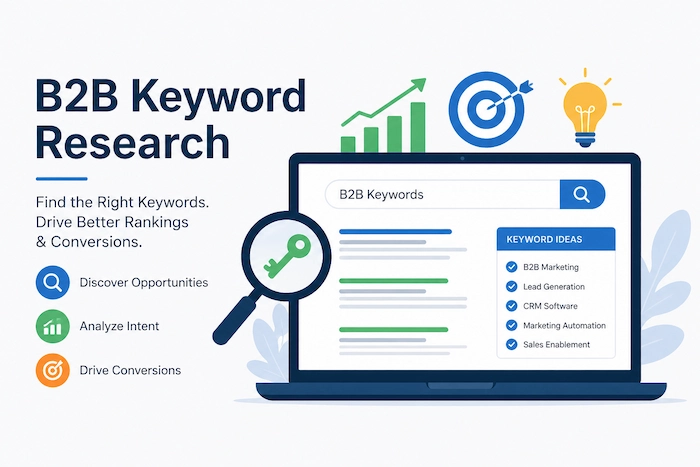
What is B2B Keyword Research?
B2B keyword research is the process of identifying search terms that businesses use when looking for products, services, or solutions online. These keywords typically reflect professional needs, industry challenges, and decision-making processes rather than casual browsing behavior.
Unlike B2C keywords, B2B queries are often more specific and intent-driven. For example, instead of searching “best tools,” a B2B user might search “best CRM software for SaaS startups.” This level of specificity signals a higher likelihood of conversion.
Why B2B Keyword Research Matters for SEO and Conversions
B2B keyword research plays a critical role in connecting your business with the right audience. When done correctly, it helps you attract decision-makers who are actively searching for solutions.
It also improves your ability to rank for meaningful queries, not just high-volume ones. In B2B, even a keyword with low search volume can generate significant revenue if it brings in qualified leads.
Additionally, optimizing for AEO and GEO ensures your content appears in featured snippets, voice search results, and AI-generated responses expanding your visibility beyond traditional search.
What Makes B2B Keyword Research Different?
Before diving into strategies, let’s clear something up: B2B keyword research is not just B2C with bigger words.
Here’s what makes it unique:
1. Longer Decision Cycles
B2B buyers don’t convert instantly. They research over days, weeks, or even months.
2. Multiple Decision-Makers
Your content must appeal to different roles—marketers, managers, CEOs, and procurement teams.
3. High-Intent Searches
Search queries are often specific and problem-focused:
- “best CRM for small SaaS teams”
- “enterprise email automation software comparison”
4. Lower Volume, Higher Value
A keyword with 200 monthly searches could be more valuable than one with 10,000—because it brings qualified leads.
Lets recall the steps to strategize for B2B keyword reseach
Step-1 Understand Search Intent Before Choosing Keywords
Search intent is the foundation of successful keyword research. Without understanding why someone is searching, even the best keywords won’t convert.
In B2B SEO, intent typically falls into three categories: informational, commercial, and transactional. Informational searches focus on learning, such as “what is marketing automation.” Commercial intent involves comparing solutions, while transactional intent signals readiness to take action.
By aligning your keywords with these intent stages, you can create content that meets users exactly where they are in the buyer journey.
Step-2 Build a Strong Seed Keyword List
Every effective keyword strategy begins with a solid list of seed keywords. These are basic terms related to your product, service, or industry.
You can generate seed keywords by analyzing your offerings, reviewing competitor websites, and gathering insights from your sales or customer support teams. Real customer questions are especially valuable because they reflect actual search behavior.
For example, if you offer CRM software, your seed keywords might include “CRM tools,” “sales automation software,” or “customer management system.” These foundational terms will later expand into more targeted keyword opportunities.
Step-3 Expand Keywords Using Research Tools
Once you have your seed list, the next step is expanding it using keyword research tools. These tools help you discover variations, related queries, and long-tail opportunities.
Instead of focusing only on search volume, pay attention to keyword difficulty, cost-per-click (CPC), and user intent. High CPC keywords often indicate strong commercial value, making them ideal for B2B targeting.
You should also prioritize question-based queries, as they are more likely to appear in featured snippets and AI-generated answers. These keywords are essential for AEO and GEO strategies.
Step-4 Focus on Long-Tail Keywords for Better Conversions
Long-tail keywords are one of the most powerful assets in B2B keyword research. These are longer, more specific phrases that typically have lower competition but higher intent.
For example, a broad keyword like “CRM software” may attract a wide audience, while a long-tail keyword like “best CRM for small SaaS companies” targets users who are closer to making a decision.
Because B2B buyers conduct detailed research, they often use long-tail queries. Targeting these keywords increases your chances of attracting qualified leads and improving conversion rates.
Step-5 Analyze Competitor Keywords to Find Opportunities
Competitor analysis is a smart way to uncover keyword opportunities that you might have missed. By studying what your competitors rank for, you can identify gaps in your own strategy.
Look at their top-performing pages, the keywords driving traffic, and the structure of their content. This will give you insights into what works in your industry.
However, don’t just copy competitors—improve upon their content by adding more depth, better structure, and updated information. This approach increases your chances of outranking them.
Step-6 Use Keyword Clustering to Build Topical Authority
Keyword clustering involves grouping related keywords into a single topic or content piece. Instead of creating separate pages for each keyword, you create comprehensive content that covers multiple variations.
This approach helps search engines understand your expertise in a particular subject, improving your chances of ranking for multiple keywords.
It also enhances user experience by providing complete information in one place, which aligns well with both SEO and GEO best practices.
Step-7 Optimize for SEO, AEO, and GEO
Modern keyword research goes beyond traditional SEO. To stay competitive, your content must also be optimized for answer engines and AI-driven platforms.
For SEO, ensure your primary keyword appears naturally in your title, headings, and meta description. Maintain proper internal linking and optimize page performance.
For AEO, structure your content with clear headings and direct answers. Use concise paragraphs and include question-based sections.
For GEO, focus on natural language, context, and clarity. AI tools prefer content that is easy to understand, well-structured, and informative.
Step-8 Map Keywords to the Buyer Journey
Not all keywords serve the same purpose. Mapping them to the buyer journey ensures that your content addresses users at every stage.
At the awareness stage, users seek information. During consideration, they compare solutions. At the decision stage, they are ready to take action.
By creating content for each stage, you build trust and guide potential customers toward conversion.
Step-9 Create Content That Converts, Not Just Ranks
Ranking on search engines is only part of the equation. Your content must also persuade users to take action.
This means clearly communicating your value, providing actionable insights, and including strong calls to action. Adding case studies, data points, and real-world examples can further increase credibility.
Ultimately, successful B2B content balances SEO performance with user engagement and conversion optimization.
Step-10 Track Performance and Continuously Improve
Keyword research is an ongoing process. Search trends change, competitors evolve, and user behavior shifts over time.
Regularly monitor your keyword rankings, traffic, and conversion metrics using different tools like Google Analytics and Search Console. Identify what’s working and refine your strategy accordingly.
Updating existing content can often deliver better results than creating new content from scratch.
Common Mistakes to Avoid
Let’s save you some pain.
1. Targeting Only High-Volume Keywords
These are often too competitive and low-converting.
2. Ignoring Search Intent
Ranking for the wrong intent = zero conversions.
3. Keyword Stuffing
This hurts both SEO and user experience.
4. Not Updating Content
SEO is dynamic—your content should be too.
Future of B2B Keyword Research (2026 and Beyond)
Search is evolving fast.
Here’s what’s shaping the future:
AI-Driven Search
Search engines are becoming answer engines.
Voice Search Growth
More conversational queries:
- “What’s the best CRM for small businesses?”
Zero-Click Searches
Users get answers without clicking—your content must still be visible.
Semantic Search
Google understands context, not just keywords.
Conclusion
Mastering B2B keyword research requires a strategic and human-centered approach. It’s not about chasing traffic it’s about attracting the right audience with the right intent.
By focusing on long-tail keywords, understanding search intent, and optimizing for SEO, AEO, and GEO, you can create content that not only ranks but also converts.
In the end, the goal is simple: connect with decision-makers, provide value, and turn search visibility into real business growth.
FAQs on B2B Keyword Research
A. What is the difference between B2B and B2C keyword research?
B2B keyword research focuses on professional audiences and decision-makers, while B2C targets general consumers. B2B keywords are usually more specific and have higher intent.
B. How do I find high-intent B2B keywords?
You can identify high-intent keywords by analyzing search queries that include terms like “best,” “pricing,” “software,” or “solutions.” These indicate that users are closer to making a decision.
C. Are long-tail keywords important in B2B SEO?
Yes, long-tail keywords are essential because they target specific user needs and often lead to higher conversion rates.
D. Which tools are best for B2B keyword research?
Popular tools include Google Keyword Planner, Ahrefs, SEMrush, and Ubersuggest. These tools help you discover keyword ideas, analyze competition, and track performance.
E. How often should I update my keyword strategy?
You should review and update your keyword strategy regularly, ideally every few months, to stay aligned with changing trends and search behavior.
F. What is AEO and GEO in keyword research?
AEO (Answer Engine Optimization) focuses on optimizing content for direct answers in search results, while GEO (Generative Engine Optimization) ensures your content is suitable for AI-generated responses.