

Most small business marketing advice makes the same mistake: it hands you a list of 20 tactics and expects you to figure out which ones actually matter for your business.
Here’s the truth. Effective small business marketing in 2026 isn’t about being everywhere. It’s about choosing the right two or three channels based on your business type, your target customer, your budget, and where your customers actually spend their attention then executing those channels well before adding anything new.
This guide gives you that decision-making framework. You’ll find 15 proven strategies, a way to match them to your business and budget, a 90-day plan to implement them, and the KPIs that tell you whether any of it is working.
What Are the Most Effective Marketing Strategies for Small Businesses in 2026?
The most effective marketing strategies for small businesses in 2026 combine organic visibility (local SEO, content, social media), direct relationship-building (email, referrals, reviews), targeted paid acquisition (Google Ads), and AI-assisted efficiency chosen deliberately based on the business’s budget, customer type, and growth goal, rather than adopted all at once.
The 15 strategies at a glance
- Local SEO
- SEO and helpful content marketing
- Social media marketing (1–3 platforms)
- Short-form video
- Email marketing
- Google Ads
- Referral marketing
- Customer review marketing
- User-generated content (UGC)
- Partnership marketing
- Micro-influencer marketing
- AI-powered marketing (used carefully)
- Answer Engine Optimization (AEO)
- Website and landing page optimization
- Retention and loyalty marketing
Each is covered in depth below. But before you pick any of them, you need a way to decide which ones deserve your time first.
How to Choose the Right Marketing Strategy for Your Small Business
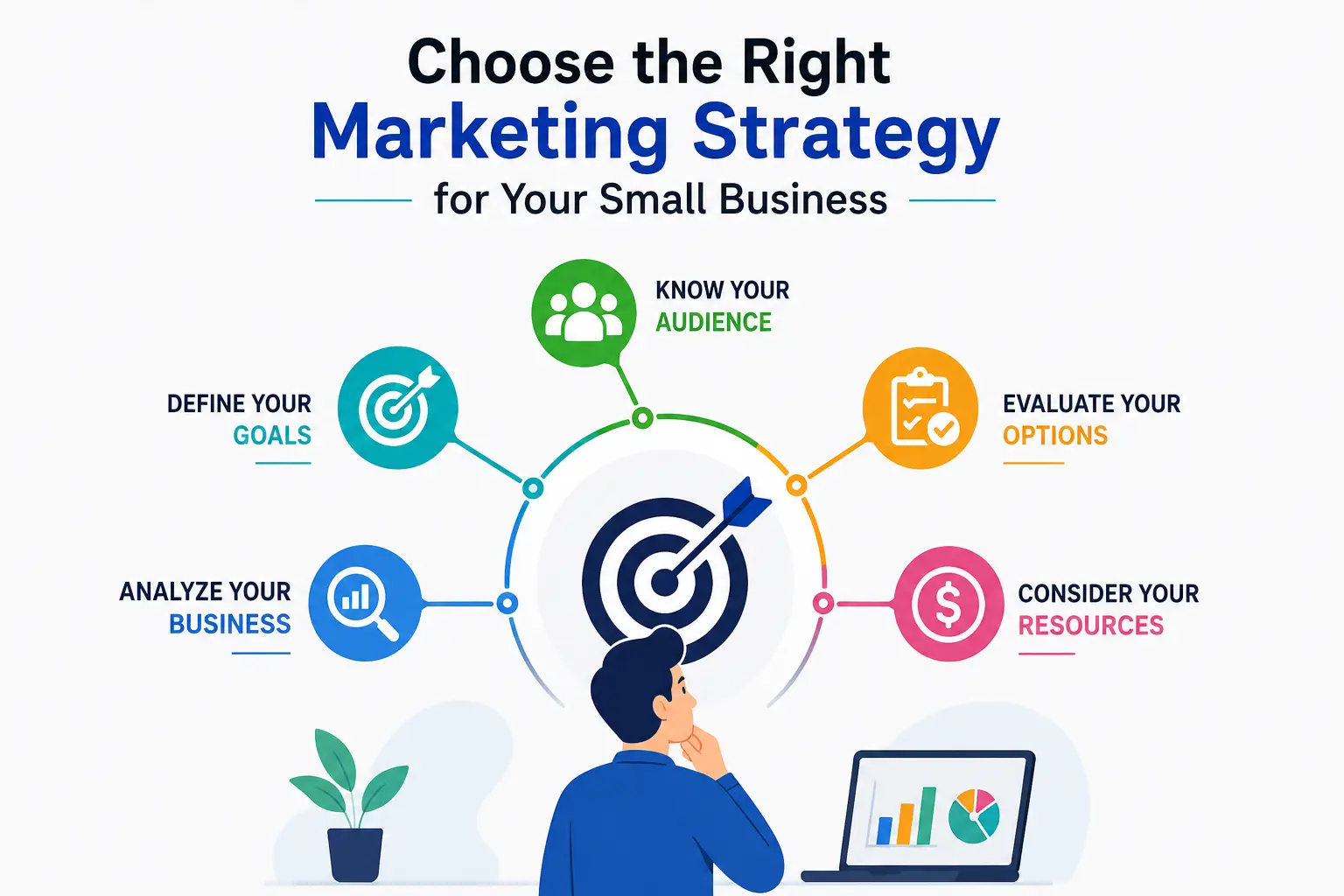
Start with your business goal
Every channel decision should trace back to one clear goal. Common goals for small businesses include:
- Brand awareness in a new market
- Lead generation
- Direct sales
- Appointment bookings
- Repeat purchases
- Customer retention
A plumber trying to fill this week’s schedule needs leads and bookings, not brand awareness. A new e-commerce brand needs both awareness and sales. Naming the goal first keeps you from chasing tactics that don’t move the number you actually care about.
Identify your ideal customer
Before choosing channels, get specific about who you’re marketing to:
- Demographics (age, location, income, business size if B2B)
- Their core needs and pain points
- How they search for solutions like yours
- What triggers them to actually buy
A restaurant’s customer searches “restaurants near me” on a Friday afternoon. A B2B software buyer researches for weeks and reads case studies. These are different journeys that call for different channels.
Analyze your competitors
A short competitive audit tells you where the opportunity is:
- Which channels are they active on?
- What content are they publishing?
- What offers are they running?
- How many reviews do they have, and how do they respond?
- Where do they rank in search?
- Are they running ads?
If every competitor in your area has thin Google Business Profiles and few reviews, that’s a fast, affordable way to stand out. If they’re all fighting over the same paid keywords, organic content may be the better long-term play.
Choose channels based on customer behavior, not trends
This is where most small businesses go wrong. They pick TikTok because it’s trending, not because their customers are on it. Choose a channel because your ideal customer already spends time there and because it matches your budget and goal not because a competitor is using it.
The Small Business Marketing Funnel
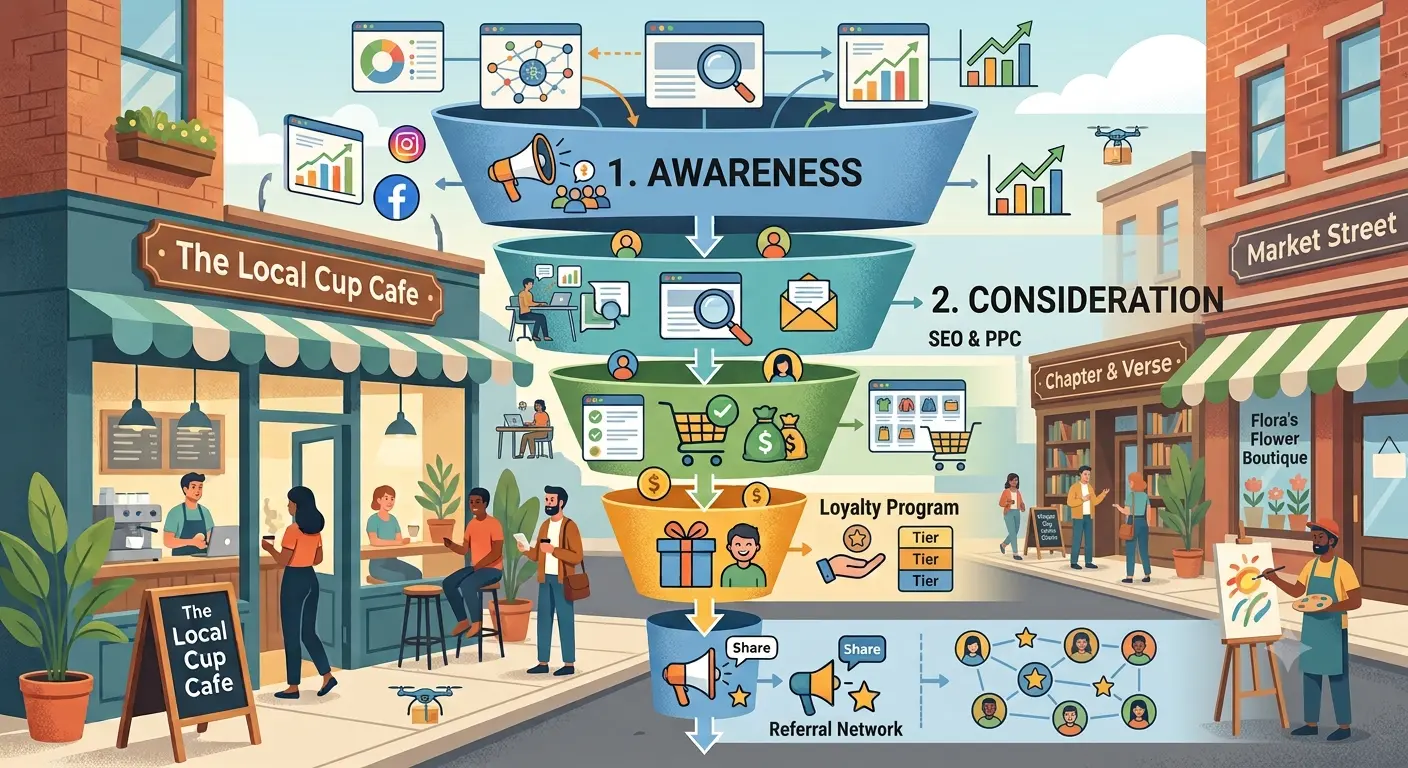
Individual channels work best when you understand where each one fits in the customer journey. Here’s how the funnel breaks down:
Awareness – SEO, social media, short-form video, partnerships. This is how new customers first discover you.
Consideration – Content marketing, email, reviews, case studies. This is where prospects evaluate whether you’re the right choice.
Conversion – Google Ads, landing pages, offers, retargeting. This is where a prospect becomes a paying customer.
Retention – Email, loyalty programs, customer service. This is what keeps a customer coming back.
Referral – Reviews, referral programs, UGC. This is what turns a happy customer into a source of new customers.
A funnel example
Here’s what this looks like end-to-end for a local service business:
Someone searches Google for emergency plumber near me → finds your Google Business Profile and website → calls or submits a lead form → you follow up by email or text → they become a customer → you request a review → they leave a five-star review and refer a neighbor.
That single sequence touches local SEO, your website, lead follow-up, email, and review marketing. None of those channels work in isolation – they work because they’re connected.
15 Effective Marketing Strategies for Small Businesses in 2026
1. Invest in Local SEO
Local SEO is how small businesses show up when nearby customers search for what they offer. For any business with a physical location or service area, it’s usually the highest-ROI channel available.
Optimize your Google Business Profile. Fill out every field categories, services, hours, photos, and a description with your primary keyword used naturally. An incomplete profile is the single biggest local SEO mistake small businesses make.
Maintain consistent NAP information. Your business Name, Address, and Phone number should match exactly across your website, Google Business Profile, and every directory listing. Inconsistent NAP data confuses search engines and can quietly hurt your rankings.
Build local citations. Get listed in relevant local and industry directories (Yelp, Chamber of Commerce sites, trade associations).
Create location-specific pages. If you serve multiple towns or neighborhoods, a dedicated page for each helps you rank for “[service] in [location]” searches.
Generate and manage reviews. Review volume and recency are ranking factors, and they influence buying decisions directly (more on this in strategy 8).
Publish locally relevant content. Blog posts about local events, seasonal service tips, or community involvement reinforce your local relevance to both search engines and readers.
2. Build an SEO and Content Marketing Strategy
Content marketing and SEO work together: content gives search engines something to rank, and SEO makes sure the right people find it.
Find the questions your customers actually ask. Use Google’s “People also ask” boxes, customer emails, and sales conversations as your topic source not guesswork.
Build topic clusters. Group related content around a core “pillar” page with supporting articles that link back to it. This signals topical authority to search engines.
Create genuinely helpful content. Answer the question completely before promoting your product. Thin, promotional content underperforms both in rankings and in reader trust.
Add internal links. Connect related pages so both readers and search engines can navigate your site’s topic coverage.
Demonstrate first-hand expertise. Real examples, original photos, and specific numbers outperform generic advice and they’re increasingly what separates content that ranks from content that doesn’t.
Optimize for both traditional search and AI answers. Structure content with clear headings, direct answers near the top, and well-organized lists this helps you show up in classic search results and AI-generated answers (more in strategy 13).
3. Use Social Media Strategically
Choose 1–3 platforms, not all of them. Spreading a small team across five platforms usually produces mediocre content everywhere instead of strong content anywhere.
Match platforms to your audience. A B2B consultancy likely belongs on LinkedIn; a restaurant or retail shop likely belongs on Instagram and TikTok.
Use educational content. Tips, how-tos, and behind-the-scenes insight into your work build trust faster than pure promotion.
Show behind-the-scenes content. People connect with the humans behind a small business this is a genuine advantage over larger competitors.
Use customer stories. Testimonials and real transformations are some of the highest-performing organic content types.
Build a realistic posting schedule. Consistency at a sustainable pace (for example, three posts a week done well) beats a daily commitment you abandon after a month.
4. Create Short-Form Video Content
Short-form video is one of the fastest-growing discovery channels for small businesses, and it doesn’t require a big production budget.
Key platforms: Instagram Reels, TikTok, YouTube Shorts.
Video ideas that work well for small businesses:
- Quick tutorials related to your product or service
- Before/after transformations
- Answers to frequently asked questions
- Customer stories and testimonials
- Behind-the-scenes footage of your team or process
- Simple product demonstrations
A phone camera and good lighting are enough to start. Polish matters less than usefulness and authenticity.
5. Build an Email Marketing Engine
Email remains one of the highest-ROI channels available to small businesses because you own the list no algorithm controls whether your message gets seen.
Build your email list through website sign-ups, checkout flows, and in-person collection.
Use lead magnets – a discount, guide, or checklist to give people a reason to subscribe.
Create welcome sequences that introduce new subscribers to your business and set expectations.
Segment subscribers by behavior or interest so messages stay relevant.
Send promotional campaigns for offers, launches, and seasonal moments.
Create re-engagement campaigns for subscribers who’ve gone quiet.
Automate follow-ups so leads don’t go cold while you’re busy running the business.
Treat email as the connective tissue of your funnel: it nurtures leads from strategy 1–4, and it drives the retention and referral activity in strategies 8 and 15.
6. Use Google Ads for High-Intent Customers
Google Ads works best for capturing people who are already searching for what you offer it’s a conversion-stage channel, not primarily an awareness one.
When Google Ads makes sense: you have a clear offer, a landing page ready to convert traffic, and enough margin per sale to justify the cost per click.
Target high-intent keywords – searches that signal someone is ready to buy or book, not just browsing.
Use geographic targeting to avoid paying for clicks outside your service area.
Build dedicated landing pages for each campaign instead of sending traffic to your homepage.
Track calls, forms, and purchases, not just clicks, so you know what your spend is actually producing.
Start with controlled testing a small daily budget on a narrow set of keywords before scaling up.
7. Build a Referral Marketing Program
Referral marketing turns your existing customers into a sales channel.
Ask at the right moment – right after a positive experience, not months later.
Create simple incentives (a discount, credit, or small gift) for both the referrer and the new customer.
Automate referral requests through email or text so they happen consistently, not sporadically.
Track referred customers so you know which relationships are generating new business.
8. Turn Customer Reviews Into a Marketing Asset
Reviews influence both search rankings and buying decisions, making them one of the most cost-effective assets a small business can build.
How to request reviews: ask directly after a completed purchase or service, and make the process as short as one click.
Where reviews matter most: Google Business Profile first, then industry-specific platforms (Yelp, Trustpilot, G2, etc.) relevant to your category.
Responding to reviews: thank positive reviewers by name where appropriate, and respond to negative reviews calmly and professionally a good response to criticism often builds more trust than the review itself.
Repurposing reviews into content: turn strong reviews into social posts, website testimonials, and ad creative. (Note: if you ever incentivize reviews or work with influencers, follow FTC disclosure guidance to stay compliant.)
9. Use User-Generated Content
User-generated content (UGC) photos, videos, and posts created by your actual customers carries more credibility than brand-created content because it comes from an independent source.
Encourage customers to create content by asking directly or offering a small incentive.
Build a branded hashtag so UGC is easy to find and collect.
Always ask for permission before reposting someone else’s content.
Repurpose UGC across your website, email, and social channels to extend its value beyond the original post.
10. Partner With Complementary Businesses
Partnership marketing lets you reach a new audience without paying for ads.
Find businesses with overlapping audiences but non-competing offers a wedding photographer and a florist, for example.
Run cross-promotions where each business promotes the other to its list or following.
Host joint events that bring both customer bases together in person or online.
Set up referral partnerships with a simple, informal incentive structure.
Co-create content like a joint guide, video, or webinar.
This is one of the most attractive strategies for resource-constrained businesses because it expands reach without requiring equivalent ad spend.
11. Use Micro-Influencer Marketing
Micro-influencers (typically creators with roughly 1,000–50,000 engaged followers) often deliver stronger ROI for small businesses than large influencers, because their audiences are smaller but more trusting and locally relevant.
When micro-influencers make sense: when you have a visual product or local service and a modest budget for product exchange or a small fee.
How to find local creators: search relevant hashtags, location tags, and platform discovery tools.
How to structure collaborations: be clear about deliverables, timeline, and compensation up front.
Track influencer ROI using unique discount codes or trackable links so results are measurable, not anecdotal.
12. Use AI to Scale Marketing Without Losing the Human Element
AI has become a genuine productivity multiplier for small business marketing in 2026, but it works best as an assistant, not a replacement for judgment.
Where AI is currently the most useful for small businesses:
- Content research – summarizing customer questions and competitor gaps
- Content creation – first drafts of social captions, emails, and blog outlines
- Email personalization – tailoring subject lines and offers by segment
- Customer support – chatbots handling common questions
- Lead qualification – scoring or routing inbound leads
- Marketing analytics – summarizing performance data into plain language
- Ad testing – generating and testing multiple ad variations quickly
What should not be automated: final review of anything public-facing, responses to negative reviews or sensitive customer issues, pricing decisions, and any content making factual claims about your product or industry.
AI can draft; a human should always approve before it goes out. This balance speed from AI, judgment from a person is what separates efficient small business marketing from generic, error-prone content.
13. Optimize for AI Search and Answer Engines
What is AEO? Answer Engine Optimization (AEO) is the practice of structuring content so it can be directly cited or summarized by AI systems like ChatGPT, Perplexity, and Google’s AI-powered search features not just ranked in a traditional list of blue links.
SEO vs. AEO vs. traditional search: Traditional SEO focuses on ranking a page in search results. AEO focuses on getting your content quoted or referenced inside an AI-generated answer, sometimes without the user ever clicking through to your site.
The two overlap heavily but aren’t identical AEO places extra weight on clear, direct, well-structured answers.
How AI search is changing discovery: more customers now ask AI tools direct questions instead of typing search terms and browsing results.
If your content doesn’t answer questions clearly, it’s harder for AI systems to surface it regardless of how well it ranks traditionally.
How to create answer-focused content: open sections with a direct, concise answer (40–60 words is a useful target) before expanding with detail.
How to build topical authority: cover a subject thoroughly across multiple connected pages rather than one shallow article.
How to demonstrate expertise and experience: use specific numbers, named examples, and original insight — generic advice is the easiest content for AI systems to skip in favor of a more substantive source.
Structure content for AI retrieval: clear headings, short paragraphs, numbered steps, and comparison tables all make it easier for both readers and AI systems to extract your content’s core answer.
14. Improve Your Website and Landing Pages
Every channel above sends traffic somewhere.
If that destination doesn’t convert, the marketing spend behind it is wasted a common failure point even for businesses running otherwise strong campaigns.
Focus on:
- A clear value proposition above the fold
- A smooth mobile experience (most small business traffic is mobile)
- Fast page load speed
- Strong, specific calls to action
- Visible trust signals (certifications, guarantees, years in business)
- Reviews and testimonials placed near key decision points
- Dedicated, conversion-focused landing pages for paid campaigns
15. Build a Retention and Customer Loyalty Strategy
Acquiring a new customer typically costs far more than keeping an existing one, which makes retention one of the most overlooked opportunities in small business marketing.
Email follow-ups after purchase keep your business top of mind.
Loyalty programs reward repeat behavior with tangible value.
Personalized offers based on past purchases increase relevance.
Repeat-purchase campaigns proactively remind customers when it’s time to reorder or rebook.
Customer feedback loops catch problems before they turn into lost customers.
Referral loops turn retained customers into your next acquisition channel (connecting back to strategy 7).
Best Marketing Strategies by Business Type
Different businesses should prioritize different channels from the list above. Use this table as a starting point, then adjust based on your specific customer research.
| Business Type | Best Strategies |
|---|---|
| Local service (plumber, HVAC, cleaning) | Local SEO, Google Ads, reviews, referrals |
| Restaurant | Local SEO, social media, email, UGC |
| E-commerce | SEO, email, paid social, UGC |
| B2B | SEO, LinkedIn, email, case studies |
| Professional services (legal, accounting, consulting) | SEO, thought-leadership content, referrals |
| SaaS/startup | SEO, content marketing, email, paid search |
| Retail | Local SEO, social media, email, partnerships |
Example: A local plumber with a $500 monthly budget should prioritize Google Business Profile optimization, local SEO, review generation, and Google Ads before spending anything on TikTok. Their customers search with urgent, local intent a channel like TikTok, however popular, doesn’t match that behavior.
Best Marketing Strategies by Budget
Your monthly budget should determine not just how much you spend, but which strategies are realistic to execute well.
| Monthly Budget | Recommended Focus |
|---|---|
| Under $250 | Google Business Profile, local SEO, organic social, email, reviews, referrals, partnerships |
| $250–$500 | Add basic paid search, original content creation, micro-influencer collaborations |
| $500–$1,000 | Add paid search at scale, retargeting, marketing automation, professional content |
| $1,000–$2,500+ | Add multi-channel paid campaigns, advanced SEO, video production, influencer partnerships, CRM automation, conversion rate optimization |
Every tier still relies on the free and low-cost foundation (Google Business Profile, local SEO, email, reviews) — paid spend should extend that foundation, not replace it.
How Much Should a Small Business Spend on Marketing in 2026?
Marketing budget factors
Your ideal marketing spend depends on several factors specific to your business, not a fixed formula:
- Current revenue
- Growth target for the year
- Industry norms (competitive industries typically require higher spend)
- Customer acquisition cost (CAC)
- Average order value
- Customer lifetime value (LTV)
How to divide a limited budget
Start by funding the channels with the shortest, most measurable path to revenue local SEO, email, and reviews for most small businesses before layering in paid advertising or influencer partnerships.
Why you shouldn’t copy another company’s percentage
General benchmarks (like “spend 7–8% of revenue on marketing”) are useful as a sanity check, but they ignore your specific CAC, margins, and growth stage. A newer business fighting for initial visibility often needs to spend a higher percentage than an established one with strong repeat business and referrals already in motion.
How to Measure Marketing Performance
The most important small business marketing KPIs
| KPI | What It Tells You |
|---|---|
| Leads | Volume of potential customers generated |
| Qualified leads | Leads that fit your ideal customer profile |
| Conversion rate | Percentage of leads or visitors who become customers |
| Customer acquisition cost (CAC) | What it costs to win one new customer |
| Cost per lead (CPL) | What it costs to generate one lead |
| Return on ad spend (ROAS) | Revenue generated per dollar of ad spend |
| Customer lifetime value (LTV) | Total revenue expected from a customer over time |
| Repeat purchase rate | Percentage of customers who buy again |
| Marketing-sourced revenue | Revenue directly traceable to marketing activity |
Vanity metrics vs. business metrics
Followers, likes, and impressions feel good but rarely pay the bills on their own. Prioritize metrics that connect to leads, sales, and revenue the vanity metrics are only useful as early signals, not as proof that marketing is working.
How to set up conversion tracking
At minimum, connect Google Analytics (GA4) to your website, set up goal or event tracking for form submissions and purchases, and use call tracking if phone leads matter to your business.
Monthly marketing dashboard
Review your core KPIs monthly: leads generated, conversion rate, CAC, revenue from marketing, and channel-by-channel performance. This is what lets you cut what isn’t working and invest more in what is a habit, not a one-time setup.
How to Build a 90-Day Small Business Marketing Plan for 2026
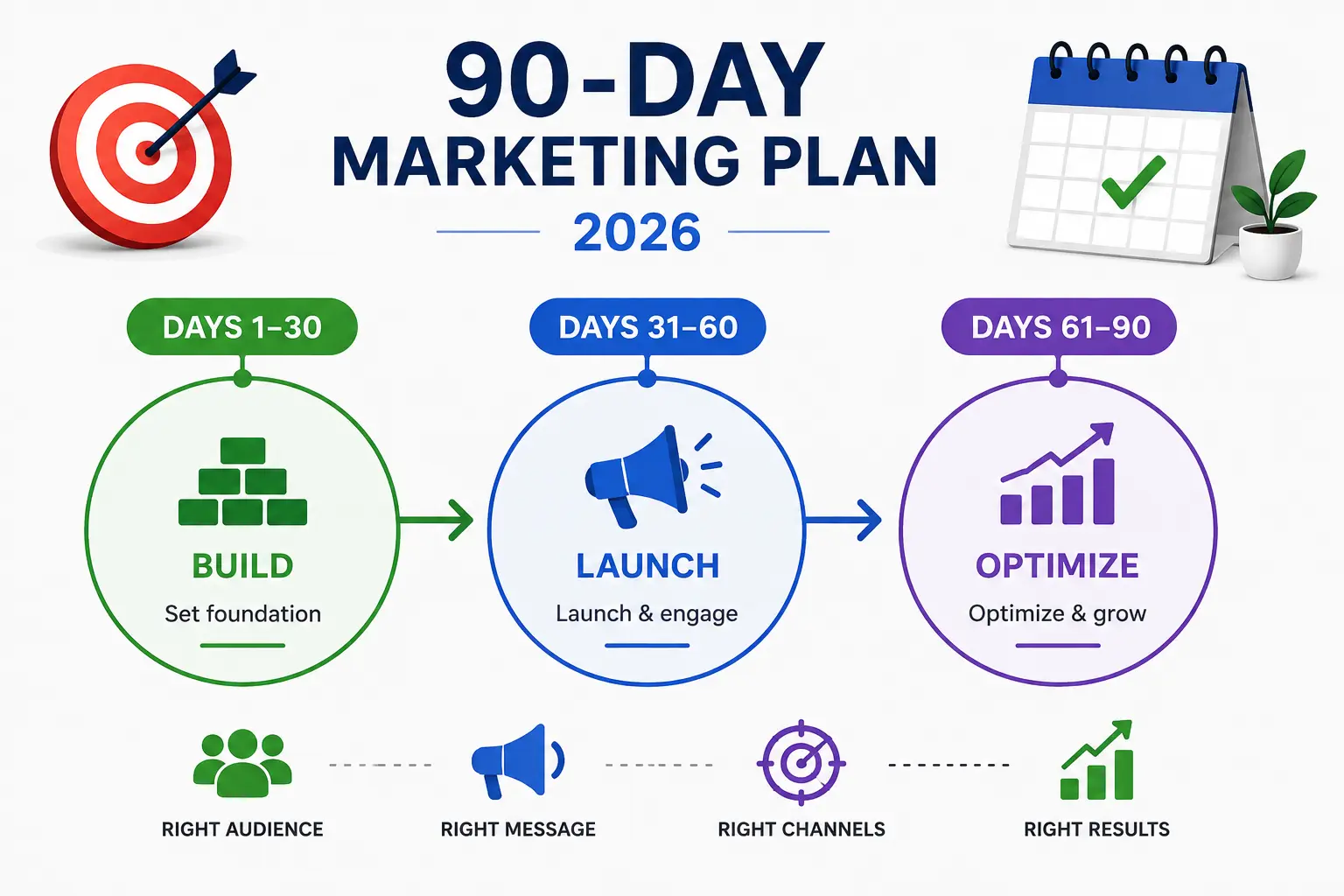
Days 1–30: Build the foundation
- Define your ideal customer profile
- Audit your current website
- Set up analytics and conversion tracking
- Optimize your Google Business Profile
- Fix obvious conversion issues on your site
- Research the keywords your customers actually search
- Establish baseline KPIs to measure progress against
Days 31–60: Launch priority channels
- Publish SEO-focused content
- Launch your first email campaigns
- Start a consistent social content cadence
- Begin actively requesting reviews
- Test a small paid advertising budget
Days 61–90: Optimize and scale
- Analyze conversion data from the first 60 days
- Cut or pause the weakest-performing channels
- Increase investment in what’s clearly working
- Test new offers or messaging
- Improve landing pages based on real user behavior
- Build a formal referral system
2026 Marketing Strategy Mistakes Small Businesses Should Avoid
- Trying to be everywhere. Being mediocre on five channels underperforms being excellent on two.
- Chasing followers instead of customers. Vanity metrics don’t pay invoices.
- Spending on ads before fixing the website. Paid traffic to a weak landing page wastes money that better belongs in the fix itself.
- Creating content without search intent. Content that doesn’t answer a real question rarely ranks or converts.
- Using AI without human review. Unreviewed AI content risks factual errors and a generic tone that undermines trust.
- Ignoring local SEO. For any business with a physical footprint, this is often the highest-ROI channel left unclaimed.
- Not tracking conversions. Without tracking, you’re guessing which channels actually produce revenue.
- Changing strategies too quickly. Most channels need 60–90 days of consistent effort before results are visible.
- Focusing only on customer acquisition. Retention and referrals are cheaper and often faster paths to growth.
Free and Affordable Marketing Tools for Small Businesses
| Tool | Purpose | Best For | Cost Category |
|---|---|---|---|
| Google Business Profile | Local search visibility | All local businesses | Free |
| Google Analytics (GA4) | Website and conversion tracking | All businesses | Free |
| Google Search Console | SEO performance monitoring | All businesses | Free |
| Google Keyword Planner | Keyword research | SEO and Google Ads | Free |
| Canva | Graphic and social content design | Social media, ads | Free / low-cost |
| Mailchimp | Email marketing and automation | Small email lists | Free / low-cost |
| HubSpot | CRM and marketing automation | Growing businesses | Free / tiered |
| ChatGPT | Content drafting and research | All strategies | Free / low-cost |
| Semrush or Ahrefs | SEO and competitor research | Content-heavy strategies | Paid |
Keep your toolset focused on what supports the strategies you’ve actually chosen a long list of unused tools is its own kind of wasted budget.
Frequently Asked Questions
What are the most effective marketing strategies for small businesses in 2026?
The most effective strategies combine local SEO, content marketing, social media, email, reviews, and targeted paid advertising, chosen based on your business type and budget plus AI-assisted efficiency and answer engine optimization to keep pace with how customers now search.
What is the best marketing strategy for a small business?
There’s no single best strategy for every business. The right starting point depends on your business type, budget, and customer behavior most local businesses should start with local SEO and reviews, while e-commerce and B2B businesses often lean more heavily on SEO, content, and email.
How can I market my small business with little money?
Focus on free or low-cost channels first: an optimized Google Business Profile, organic social media, email marketing, review generation, and partnerships with complementary local businesses. These build a foundation before any paid spend is needed.
How much should a small business spend on marketing in 2026?
Spend depends on your revenue, growth goals, industry, and customer acquisition cost there’s no universal percentage. Many small businesses start with a modest monthly budget under $500 and increase it as specific channels prove their ROI.
Is SEO still worth it for small businesses in 2026?
Yes. SEO remains one of the highest-ROI channels because it compounds over time and captures customers actively searching for what you offer and it now also feeds into how AI search tools discover and cite your content.
How can small businesses use AI for marketing?
Small businesses can use AI for content research and drafting, email personalization, customer support chatbots, lead qualification, and ad testing while keeping a human involved in final review of anything public-facing.
What marketing channels have the best ROI?
For most small businesses, local SEO, email marketing, and referral marketing offer the strongest ROI because they’re low-cost and target people who already know or are actively searching for your business.
How do small businesses measure marketing ROI?
Track KPIs tied directly to revenue customer acquisition cost, conversion rate, marketing-sourced revenue, and customer lifetime value rather than relying on vanity metrics like followers or impressions.
What is AEO and why does it matter for small businesses?
Answer Engine Optimization (AEO) is the practice of structuring content so AI tools like ChatGPT and Perplexity can directly cite it in their answers. It matters because a growing share of customers now ask AI tools questions directly instead of browsing traditional search results.
Final 2026 Small Business Marketing Checklist
- [ ] Define your target customer
- [ ] Set a clear revenue or lead goal
- [ ] Choose 2–3 priority channels based on business type and budget
- [ ] Optimize your website for conversions
- [ ] Optimize your Google Business Profile
- [ ] Build a content strategy around real customer questions
- [ ] Start and grow your email list
- [ ] Create a consistent review-generation system
- [ ] Test paid advertising with a small, controlled budget
- [ ] Implement AI where it genuinely saves time
- [ ] Optimize content for AI search and answer engines
- [ ] Set up conversion tracking
- [ ] Review performance monthly
- [ ] Reallocate budget quarterly based on results
conclusion
Effective small business marketing in 2026 isn’t about doing more it’s about doing the right things, in the right order, for your specific business. Start with the foundation: a strong local presence, a website that converts, and a way to track what’s actually working. Add paid advertising and AI-assisted tools only once that foundation is in place, and keep a human reviewing anything that reaches a customer.
The businesses that grow fastest this year won’t be the ones running every tactic on this list. They’ll be the ones that picked two or three strategies matched to their customer and budget, executed them consistently for 90 days, and used real data not guesswork to decide what to do next.