


Most people research money decisions long before they speak to anyone. They look up pension rules, compare mortgage options or check whether an adviser is credible, and they usually start with a search engine.
That is why SEO for financial services in the United Kingdom matters. But it is not the same as promoting a plumber or a pizza shop. Financial pages touch people’s savings, homes and futures, so Google expects more proof, and UK regulation expects more care.
This guide shows how to build organic visibility the sensible way. You will learn how to protect trust, handle compliance, target the right keywords, measure real leads and avoid common traps. Nothing here guarantees rankings or growth. SEO is a long-term channel, and results depend on your market, site and competitors.

What Is SEO for Financial Services?
SEO for financial services is the work of making a finance-related website easier to find, easier to trust and easier to act on in search results. In plain English: you help the right people discover your firm when they search, then give them clear, accurate information so they feel safe getting in touch.
It follows the same foundations as general search engine optimisation, but with tighter standards on accuracy, authorship and claims.
How financial services SEO works
There are five working parts, and they depend on each other:
- On-page SEO and content: Pages that answer real questions in clear language, with sensible titles, headings and internal links.
- Technical SEO: A site that search engines can crawl, index and load quickly, especially on mobile.
- Off-page SEO and digital PR: Relevant mentions and links from credible sources.
- Local SEO and reputation: Accurate business listings and genuine reviews, which matter for advisers, brokers and accountants serving a local area.
- Conversion and measurement: Forms, calls to action and reporting that show whether visitors turn into enquiries.
If one part is weak, the others struggle. A beautifully written pension page will not help if it is blocked from indexing, or if the enquiry form is broken on phones.
Which financial businesses can benefit from SEO?
Most firms that win clients through online research can benefit, including:
- Independent financial advisers and financial planners
- Wealth management and investment firms
- Mortgage and insurance brokers
- Banks, lenders and business finance providers
- Accountancy and tax advisory practices
- Fintech companies and financial platforms
The approach differs by model. A local adviser leans on local SEO and trust. A fintech platform leans on product pages, comparison content and technical performance.
Financial services SEO vs general SEO
The basics are shared. The risk profile is not.
| Area | General SEO | Financial services SEO |
| Content risk | Errors are usually minor | Errors can mislead people about money and create regulatory exposure |
| Trust signals | Helpful but flexible | Named experts, credentials, regulatory details and review dates carry more weight |
| Compliance review | Rarely needed | Often needed before publishing, especially for promotional content |
| Search intent | Mixed | Sharp split between learning queries and “appoint someone” queries |
| Conversion goal | Sales or sign-ups | Qualified consultations, where fit and suitability matter |
Why SEO Matters for UK Financial Services Businesses
Reach people actively researching financial services
Someone searching “how does a workplace pension work” is learning. Someone searching “pension adviser near me” is much closer to choosing a provider.
SEO lets you show up at both moments, with different pages for each. Educational content builds familiarity. Service pages catch readiness to contact.
Build visibility beyond referrals and paid advertising
Referrals are valuable, but they are hard to scale and out of your control. Paid ads stop delivering the moment the budget stops.
SEO can add a steadier source of enquiries over time. It will not replace referrals, partnerships or paid channels. It works best alongside them.
Attract more relevant enquiries
Traffic is not the goal. Clients who fit your services are.
A firm that advises business owners on exit planning gains little from thousands of visits about basic budgeting. Clear service pages that state who you help, and how, tend to attract better-fitting enquiries and fewer wasted calls.
Build familiarity and trust before the first consultation
By the time a prospect books a call, they have often read several pages. If those pages are transparent about services, process and fees, the first conversation starts from a stronger place.
Consistent messaging across your site, listings and profiles also helps. People notice when details don’t match.
Understand UK Financial SEO, YMYL and Compliance Requirements
Why financial content needs stronger trust signals
Google treats topics that could affect someone’s health, finances or safety with extra care. The shorthand is YMYL, “Your Money or Your Life“. Finance sits squarely inside it.
Google’s quality guidance talks about E-E-A-T: experience, expertise, authoritativeness and trustworthiness. It is not a single ranking switch, but it describes what good content looks like. In practice, that means:
- Accurate, up-to-date information
- Named authors with relevant qualifications
- Clear sourcing
- Transparent business details
Google’s own guidance on creating helpful, people-first content is a useful checklist.
Understand when FCA financial promotion rules may apply
The Financial Conduct Authority (FCA) regulates financial promotions in the UK. Web pages can count as promotions if they invite or encourage someone to take up a financial product or service.
A few principles to keep in mind:
- Education vs promotion: A neutral explainer on how ISAs work is different from a page urging readers to open a particular product. The line is not always obvious.
- Fair, clear and not misleading: Applicable promotions must meet this standard. The FCA explains its approach on its financial promotions page.
- Disclaimers are not a cure: Adding “this is not advice” at the bottom does not automatically make a page compliant.
- Get specialist review: Who may approve or communicate promotions, and what applies to your firm, depends on your permissions. Your compliance team or consultant should make that call.
This article is general information, not legal or regulatory advice.
Build a financial content approval workflow
A simple, repeatable process protects both rankings and the firm. Here is a workable version:
- Brief: Define the user intent, audience and business goal.
- Draft and fact-check: Use credible sources, such as GOV.UK, HMRC, the FCA and product documentation.
- Review: Get subject-matter and compliance sign-off.
- Verify claims: Check figures, disclosures and any supporting evidence.
- Record approval: Log who approved it and the publication date.
- Set a review date: Diarise a recheck for anything that may change.
For example, a mortgage broker might assign every new page an owner, a compliance reviewer and a six-month review date in a shared tracker. It takes minutes to set up and saves painful clean-ups later.
Keep content accurate as products and rules change
Outdated financial content is a trust problem as well as an SEO one. Build a habit of checking pages after:
- Budgets, tax-year changes (the UK tax year starts on 6 April) or allowance updates
- Regulatory or rule changes
- Product, fee or eligibility changes
- Corrections or reader feedback
A simple spreadsheet listing each page, its owner and its “depends on” topic makes it easy to see what needs to be reviewed when something changes.
Make credentials and business information easy to verify
Users and search engines both look for proof that you are real and qualified. Make it easy by showing:
- Relevant qualifications and professional memberships
- Regulatory status and your firm reference number where applicable, so visitors can check the FCA Register
- A registered company name and address
- Clear contact details
Build a Financial Services Keyword Strategy
Identify commercial, informational and local search intent
Intent is why someone searches. Getting it right matters more than chasing volume.
- Informational: “Can I take my pension at 55?” The person is learning.
- Commercial: “Pension adviser fees” or “best pension advice firms.” They are comparing.
- Local/transactional: “Pension adviser in Leeds.” They are ready to appoint someone.
The first query suits a guide. The last suits a local service page. Mixing them on one page often serves neither well.
Research high-intent financial keywords
Start with the words clients actually use. Useful sources include:
- Your own enquiry emails, call notes and CRM records
- Google Search Console queries
- Google’s autocomplete and “People also ask” suggestions
- Public conversations in places like UKPersonalFinance, where people describe money problems in their own words
Group what you find into service terms, product-related queries, problem-based searches, comparison terms and local modifiers. Treat forum posts as a way to understand language and concerns, not as a source of facts to repeat.
Map keywords to the right landing pages
Give each important query one best page.
| Financial business | Example search query | Suggested page |
| Financial adviser | financial adviser in Leeds | Local adviser service page |
| Mortgage broker | mortgage broker for first-time buyers | Mortgage service page |
| Wealth manager | wealth management for business owners | Specialist service page |
| Accountant | small business accountant in Bristol | Local accountancy page |
| Fintech provider | business expense management software | Product landing page |
These are illustrative queries, not claims about search volume or ranking difficulty.
Prioritise keywords by business value
Score each opportunity on five points:
- Relevance: Does it match what you actually offer?
- Intent: Is the searcher close to contacting a provider?
- Feasibility: Can your site realistically compete?
- Commercial value: What is a client in this area worth to you?
- Lead quality: Do these searchers tend to become suitable clients?
A smaller, specific query that brings suitable clients often beats a broad term that brings browsers.
Avoid keyword cannibalisation and overlapping pages
Cannibalisation happens when several pages compete for the same query and confuse search engines about which to show.
Consolidate pages when they answer the same question. Keep them separate when they serve genuinely different audiences, such as “inheritance tax planning” for families and “inheritance tax planning for business owners.”
Create Financial Service Pages That Earn Trust and Enquiries
Give each core service a clear, useful page
A strong service page answers what a prospect needs before they call. Cover:
- What the service is and who it is for
- Eligibility or typical client situations
- How the process works, step by step
- Costs or how fees are structured, where relevant
- What happens next
If a visitor has to phone just to learn the basics, many won’t.
Demonstrate expertise with named authors and reviewers
Anonymous finance content is hard to trust. Add an author name, a short bio with relevant qualifications, and a “reviewed by” line with a date where appropriate.
Make sure claims about qualifications are true and match the professional register.
Explain complex financial topics in plain English
Define jargon the first time you use it. Add a worked example, a simple diagram or a short comparison.
For instance, rather than only saying “capital at risk,” add a sentence explaining that the value of an investment can fall as well as rise, and you may get back less than you put in. Be equally clear about limits and risks as about benefits.
Add useful evidence without making exaggerated claims
Evidence builds confidence when it is real and checkable. Good options include:
- Case studies that state the situation, the work done and the timeframe, with client consent and no identifying details
- Genuine testimonials that follow the relevant rules
- A transparent explanation of how you work
- Citations to official sources
Avoid promises like “maximise returns” or “guaranteed savings.” They are risky for compliance and weak for trust.
Improve calls to action and enquiry forms
Make the next step obvious: “Book a free introductory call” beats “Submit.” Then reduce friction:
- Ask only for what you need
- Make forms work well on mobile and for assistive technology
- Show a short privacy note near the form
- Confirm clearly what happens after submission
Test the form yourself monthly. Broken forms quietly waste good rankings.
Build Topical Authority With Financial Content Clusters
Create a content hub for each core financial service
A content hub is a main service page supported by related articles, all linked together. It shows search engines and readers that you cover a topic in depth.
For pension planning, the hub might link the main service page to supporting guides on pension options, retirement planning and eligibility considerations. Each supporting page should answer one distinct question.
Cover the questions clients ask at each stage
Think of the client journey in four stages:
- Early research: Financial education and “what is” questions
- Comparing: How services and providers differ
- Understanding: Eligibility, fees and risks
- Preparing: What to bring and expect at a first consultation
Your front-line staff already hear these questions. Ask them for the top ten and write from there.
Use internal links to connect related pages
Internal links help readers move to the next useful page and help search engines understand how pages relate.
- Use descriptive anchor text such as “pension transfer process,” not “click here”
- Link from guides to the relevant service page where it genuinely helps
- Keep a logical hierarchy, so key pages are only a few clicks from the homepage
Keep financial articles current and useful
Update pages when something meaningful changes: a figure, a rule, a process. Then show the updated date.
Changing a date without improving the content does not help readers, and it can damage trust.
Prevent thin, repetitive and unsupported content
Publishing dozens of near-identical pages feels productive but rarely is. Instead:
- Merge overlapping articles into one stronger page
- Add expert review and original insight
- Remove or redirect pages that serve no purpose
Fewer, better pages usually outperform sheer volume.
Improve Technical SEO for Financial Websites
Fix crawling and indexing problems
If search engines cannot reach a page, it cannot rank. Start with these checks:
- Review robots.txt and your XML sitemap
- Check which pages are indexed and which canonical URL each uses
- Fix important broken URLs and redirect chains
- Confirm your priority pages can be crawled and indexed
Google Search Console’s page indexing report is the best free starting point.
Improve mobile usability and Core Web Vitals
Core Web Vitals measure real user experience. Google’s web.dev guide to Web Vitals explains them. They cover:
- Loading: How quickly the main content appears (Largest Contentful Paint)
- Interaction: How quickly the page responds to taps and clicks (Interaction to Next Paint)
- Visual stability: Whether things jump around as the page loads (Cumulative Layout Shift)
Good performance helps users first. Fast, stable pages on a phone also make enquiries easier.
Secure forms and protect personal information
Financial enquiries often include sensitive details. Use HTTPS across the whole site, collect only necessary data and explain how you use it in a clear privacy notice.
For your obligations under UK data protection law, the Information Commissioner’s Office is the authority to check.
Use structured data appropriately
Structured data (often using Schema.org vocabulary) labels page information so machines understand it. Relevant types may include Organization, LocalBusiness where eligible and BreadcrumbList.
Two rules apply. The markup must match what visitors can see on the page. And it does not guarantee enhanced results. Google explains the basics in its structured data introduction.
Audit technical SEO after website changes
Redesigns, domain moves, URL changes and tracking updates are where rankings are most often lost by accident. Before launch, map old URLs to new ones. After launch, monitor redirects, indexing and analytics for several weeks.
Improve Local SEO for Financial Advisers, Brokers and Accountants
Local SEO helps you appear when people search for a provider in their area.
Optimise your Google Business Profile where eligible
Not every financial business qualifies for a profile, so check Google’s guidelines first. If you do:
- Choose accurate categories
- Write a plain-English service description
- Keep your address, phone number and opening hours correct
- Add real photos of your office or team where appropriate
Create genuinely useful local service pages
A local page should include real local value: the areas you serve, how consultations work (in person, video or phone), and any location-relevant context that is true and useful.
Avoid copying one page 50 times and swapping the town name. That creates thin “doorway” pages that add little for users.
Manage reviews and reputation responsibly
Ask satisfied clients for honest feedback after a good outcome, and respond professionally to all reviews, including negative ones. Never buy reviews, write your own or selectively filter who you ask. Follow platform policies and any rules that apply to your sector.
Build consistent local business information
Your firm’s name, address and phone number should match everywhere: your site, Google profile, relevant directories and professional listings. Small inconsistencies, such as an old office address, can confuse both customers and search engines.
Measure local search performance
Track calls, direction requests, website visits from your profile and, most importantly, qualified local enquiries. Ask new clients how they found you, and record the answer in your CRM.
Build Authority With Digital PR and Relevant Backlinks
A backlink is a link from another website to yours. Links from credible, relevant sites can act as signals of trust, but how you earn them matters.
Create information worth citing
People link to things that help them. Good examples include original research (even a small client survey), expert commentary on a rule change, plain-English explainers and well-supported industry insights.
A wealth manager who explains a new tax change clearly and accurately may get cited by local business media. That is a far better asset than a generic blog post.
Earn relevant coverage and industry mentions
Look for genuine opportunities: financial publications, trade bodies, local business press and professional networks. Offer journalists and editors something useful, such as a qualified comment or data.
Professional visibility on LinkedIn can also support recognition for your named experts, even though it is not a direct ranking tool.
Evaluate backlink quality, not just quantity
One link from a respected, relevant publication can be worth more than dozens from unrelated sites. Judge links by relevance, editorial context, source credibility and whether they were earned naturally.
Avoid risky link-building tactics
Steer clear of link schemes, paid links intended to manipulate rankings and bulk link packages from irrelevant sites. Google’s spam policies treat these as violations, and cleaning up a penalty is far harder than avoiding one.
Improve Visibility in Google AI Overviews and Other AI Search Tools
AI search tools summarise answers and often cite sources. Nobody can guarantee inclusion. The practical approach is to strengthen the same fundamentals that help people.
Make key financial questions easy to answer
Use a clear heading that matches the question, then give a direct answer in the first one or two sentences. Follow with supporting detail, examples and caveats.
This helps featured snippets, AI summaries and human readers alike.
Strengthen the credibility of source content
AI systems favour content that appears reliable. Show who wrote it, who reviewed it, when it was updated and what sources it relies on. Accuracy matters most.
Keep technical accessibility and content structure sound
Pages need to be crawlable and indexable. Use clear headings, short paragraphs, descriptive internal links and valid structured data where relevant.
Measure AI search visibility realistically
Measurement is still limited. You can look at referral traffic from AI tools in analytics, track brand mentions and manually check whether key questions cite your pages.
Treat these as directional signals. Be wary of any provider that claims guaranteed AI citations.
Measure Financial Services SEO Performance and ROI
Track rankings, impressions and organic traffic
Use Google Search Console for impressions, clicks and queries, and an analytics tool for on-site behaviour. Watch trends over months rather than days. Rankings fluctuate.
Measure qualified leads and consultations
Track form submissions, phone calls and consultation bookings. Then go one step further and tag each lead as qualified or not. Do this lawfully, in line with privacy rules and consent requirements.
Connect organic acquisition to commercial outcomes
Connect your website data to your CRM so you can see which enquiries became clients. Be honest about limits: financial decisions often involve several touchpoints, such as a referral, a search and a phone call. SEO rarely deserves, or loses, all the credit for a single client.
Build a practical SEO KPI dashboard
| KPI | What it tells you |
| Search impressions | How often pages appear in search |
| Organic clicks | How much traffic search generates |
| Non-brand visibility | Whether the firm is discovered beyond its name |
| Qualified enquiry rate | Whether visitors match the target audience |
| Consultation bookings | Whether SEO contributes to meaningful next steps |
| Lead-to-client rate | How effectively enquiries become clients |
| Cost per qualified lead | How acquisition efficiency changes over time |
Review progress and prioritise the next actions
Review results monthly. Run a technical audit at least once or twice a year and a content review on a schedule. Then rank next actions by expected impact against effort, and do the high-impact, low-effort items first.
How Much Does Financial Services SEO Cost in the UK?
There is no standard price, and be cautious of anyone who quotes one without looking at your site. Costs vary widely with scope and provider.
What influences financial SEO pricing?
- Level of competition in your niche
- Website size and technical complexity
- Amount of content needed
- Compliance review steps
- Number of locations
- Scope of link-building and digital PR
Compare different engagement models
- In-house SEO: Deep knowledge of your firm and close access to compliance, but you carry salary and tool costs and rely on one skill set.
- Freelance specialist: Flexible and often cost-effective, with limited capacity.
- Specialist SEO agency: Broader skills and process, which suits larger or more competitive projects.
- Full-service digital agency: Joins SEO with design, paid media and development, though SEO depth can vary.
Understand what a proposal should include
A good proposal lists specific deliverables, who is responsible for what, how often you will get reports, how implementation will happen, how content approvals work and the contract terms, including notice periods.
Evaluate value rather than choosing on price alone
The cheapest quote can be the costliest if it delivers little or creates risk. Judge value by relevance to your sector, quality of execution and evidence of past work. Nobody should promise a particular return.
How to Choose a Financial Services SEO Agency
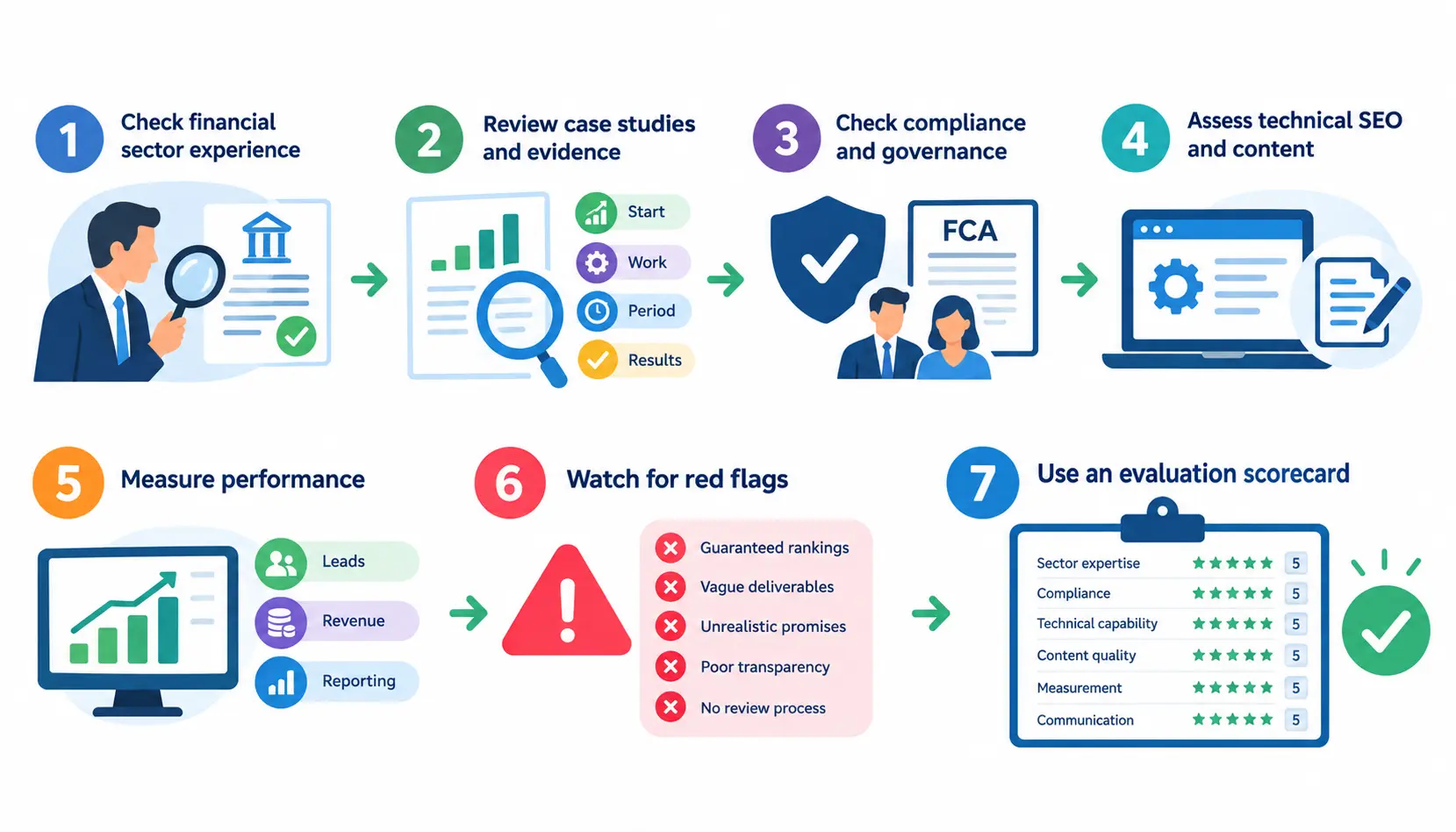
Check relevant financial-sector experience
Ask for examples close to your business model and market. Experience with regulated content is a real advantage.
Review case studies and the evidence behind them
Look beyond headline numbers. Ask what the starting position was, what work was done, over what period and how results were measured.
Assess its approach to compliance and content governance
Ask who reviews content, who approves claims and how updates are handled. A good agency will have a clear answer and will work with your compliance team, not around it.
Compare technical SEO and content capabilities
Check whether they can diagnose technical problems and either fix them or coordinate fixes with your developers. Strong writing cannot rescue a site that search engines can’t read.
Ask how performance will be measured
Prioritise qualified leads, commercial outcomes and transparent reporting over rankings alone. You should own your analytics and Search Console accounts.
Recognise warning signs
- Guaranteed rankings or guaranteed AI citations
- Unclear deliverables
- Unsupported traffic or revenue promises
- Irrelevant or manipulative link-building methods
- No transparent reporting or account ownership
- No clear content review process
Use a consistent agency evaluation scorecard
Score every candidate against the same criteria: sector expertise, compliance workflow, technical capability, content quality, measurement and communication. A simple 1 to 5 scale per criterion keeps decisions fair and less swayed by a polished pitch.
A Practical 90-Day Financial SEO Action Plan
Use this as a planning framework. It does not promise results within 90 days, as SEO often takes longer to show clear effects.
Days 1–30: Audit and prioritise
- Establish a baseline for traffic, enquiries and key rankings
- Audit technical issues and indexing
- Review existing service pages
- Map priority keywords to pages
- Agree governance and measurement
Days 31–60: Improve core pages
- Fix priority technical issues
- Update important service pages
- Improve internal linking
- Complete compliance review for planned content
- Improve local business information
Days 61–90: Expand and evaluate
- Publish useful supporting content
- Start relevant digital PR activity
- Review early visibility and conversion signals
- Identify new content opportunities
- Refine priorities based on evidence
Frequently Asked Questions About SEO for Financial Services
1. What is SEO for financial services?
SEO for financial services is the process of improving a finance-related website so it appears in search results for relevant queries. It combines accurate content, technical health, trust signals and measurement, while following UK compliance expectations.
2. How does financial services SEO differ from general SEO?
Financial SEO covers topics that affect people’s money, so accuracy, authorship, credentials and compliance review matter more. Content often needs expert and regulatory sign-off before publication, and success is measured by qualified leads rather than traffic alone.
3. Does financial SEO need to comply with FCA rules?
Often, yes. Web content that promotes financial products or services may count as a financial promotion and must be fair, clear and not misleading. Educational content may sit outside this, but the line varies, so ask your compliance specialist.
4. How much does financial services SEO cost in the UK?
Costs depend on competition, site size, content needs, compliance steps and the provider type. Freelancers, specialist agencies and in-house hires are priced differently. Request a scoped proposal rather than relying on a generic figure.
5. How long does financial services SEO take to work?
It varies. Technical fixes can show effects sooner, while rankings and enquiries for competitive terms often take several months or longer. No one can guarantee a timeframe. Track leading signals like impressions and indexing as you go.
6. How can financial advisers improve local SEO?
Claim and complete your Google Business Profile if eligible, keep business details consistent, create genuinely useful local pages and request honest reviews. Then track calls and qualified enquiries from your area.
7. How do you measure ROI from financial SEO?
Connect Search Console and analytics data to your CRM. Track qualified leads, consultations, conversion to clients and cost per qualified lead. Recognise that several channels usually contribute to one client decision.
8. How do you choose a financial services SEO agency?
Check sector experience, ask for evidence behind case studies, and review their compliance process and reporting. Use the same scorecard for each candidate and walk away from anyone promising guaranteed rankings.
Conclusion
SEO for financial services in the United Kingdom rewards firms that are patient, accurate and genuinely helpful. Trust sits at the centre. If your pages are clear, reviewed by real experts and honest about limits, you are building something both search engines and clients can rely on.
Start small. Audit your site, fix what blocks indexing, improve your most important service pages and put an approval workflow in place. Then measure by qualified enquiries, not vanity metrics.
If you do one thing this week, choose your most important service page and ask: would a nervous first-time client find everything they need here to feel confident getting in touch? Fix the gaps, and you have started.