Keyword research is the backbone of any successful SEO strategy. Whether you’re running a blog, affiliate website, SaaS platform, or eCommerce store, your rankings depend heavily on choosing the right keywords. The ability to identify what your audience is searching for can directly impact your traffic, conversions, and overall online growth.
But the challenge is:
You don’t get exact keyword data from Google, which makes it difficult to rely on a single source of truth. No SEO tool is 100% accurate, not even Google Keyword Planner because search behavior is dynamic and constantly changing.
That’s where tools like Ahrefs come in.
Ahrefs is widely used for:
- Keyword research
- Backlink analysis
- Competitor research
- Site audits
It provides detailed insights, estimates, and trends that help marketers make smarter SEO decisions without relying solely on guesswork.
However, many users still ask: “How accurate is Ahrefs keyword research?”
The honest answer:
✔ It’s highly reliable for SEO decisions
❌ But it’s not 100% accurate
In this guide, we’ll break everything down in detail so you can understand the strengths, limitations, and best ways to use Ahrefs data effectively for better SEO results.
What Is Ahrefs Keyword Research?

Ahrefs keyword research is a feature within the Ahrefs platform that helps you discover and analyze keywords people search for on search engines. It allows users to identify valuable keyword opportunities based on real search data and trends.
With Ahrefs, you can explore keyword ideas, understand search intent, and evaluate how difficult it is to rank for specific terms. It also provides insights into search volume, keyword difficulty, and potential traffic, helping you make data-driven SEO decisions.
Additionally, Ahrefs enables you to analyze competitor keywords, uncover content gaps, and find long-tail opportunities that can drive targeted traffic to your website.
Key Metrics Provided by Ahrefs
- Search Volume: This metric shows the estimated number of monthly searches a keyword receives, helping you understand its popularity and demand.
- Keyword Difficulty (KD): Ahrefs assigns a score from 0 to 100 that indicates how hard it is to rank for a keyword, mainly based on backlink competition.
- Traffic Potential: This estimates the total traffic you could gain if your page ranks at the top position, considering multiple related keywords—not just one.
- Clicks Data: It reveals how many users actually click on search results, which is useful because not all searches result in clicks.
- Global vs Local Data: Ahrefs allows you to view keyword data by specific countries or globally, helping you target the right audience based on location.
How Ahrefs Collects Keyword Data
Understanding how Ahrefs gathers keyword data is essential if you want to evaluate how accurate its metrics really are. Since Ahrefs does not have direct access to Google’s internal search database, it relies on multiple data sources and advanced algorithms to estimate keyword metrics.
By combining different datasets and technologies, Ahrefs creates a reliable approximation of real search behavior, which helps marketers make informed SEO decisions.
Data Sources Used by Ahrefs
1. Google Keyword Planner (GKP)
One of the primary data sources Ahrefs uses is Google Keyword Planner, a tool provided by Google Ads. This tool offers keyword ideas and approximate search volume data based on actual Google searches.
Ahrefs collects and processes this aggregated data to build its own keyword database. However, Google Keyword Planner does not provide exact numbers. Instead, it often groups similar keywords together and shows search volume in ranges (for example, 1K–10K searches).
Limitation:
Because of this grouping and rounding, Ahrefs must refine and adjust the data using its own models, which means the final numbers are still estimates rather than exact values.
2. Clickstream Data
Clickstream data is another crucial component of Ahrefs’ keyword research system. This data is collected anonymously from millions of users through various sources such as mobile apps, browser extensions, and third-party data providers.
This dataset helps Ahrefs understand how users actually behave when they search online.
This helps Ahrefs estimate:
- How many searches result in clicks
- Which results users click on
- How users interact with search engine results pages (SERPs)
For example, some keywords may have high search volume but low clicks because users get answers directly from Google (like featured snippets). Clickstream data helps Ahrefs account for this behavior.
3. SERP Analysis
Ahrefs also performs detailed analysis of search engine results pages (SERPs) to better understand keyword performance and ranking difficulty.
It studies the top-ranking pages for each keyword and evaluates multiple factors, including:
- Number and quality of backlinks
- Content depth and relevance
- Domain authority of ranking sites
- Estimated traffic to top pages
By analyzing these elements, Ahrefs can estimate how competitive a keyword is and how much traffic a page might receive if it ranks well.
This approach makes its keyword difficulty and traffic potential metrics more practical and SEO-focused.
4. Machine Learning Models
To refine all the collected data, Ahrefs uses advanced machine learning algorithms. These models process large amounts of data from different sources and identify patterns in search behavior.
Ahrefs uses machine learning to:
- Predict search volume more accurately
- Estimate organic traffic potential
- Calculate keyword difficulty scores
- Adjust data inconsistencies from different sources
These algorithms continuously improve as more data is collected, making Ahrefs’ estimates more reliable
How Accurate Is Ahrefs Keyword Research?
Now let’s understand the accuracy of Ahrefs in detail, along with real-world examples so you can apply it in SEO.
Accuracy Benchmarks (Explained with Examples)
1. Search Volume Accuracy (60–70%)
Ahrefs estimates how many times a keyword is searched per month. However, since it doesn’t have direct access to Google’s exact data, the numbers are approximate.
Example:
Keyword: “best SEO tools”
- Ahrefs shows → 10,000 searches/month
- Actual (Google Search Console) → 8,500–11,500
Insight: The number may vary, but it still gives a strong idea of keyword popularity.
2. Traffic Estimates (85–90% Directional Accuracy)
Ahrefs estimates how much traffic a page can get if it ranks for a keyword. This is usually more reliable because it considers multiple ranking keywords.
Example:
A page targeting “email marketing software”
- Ahrefs estimate → 5,000 visits/month
- Actual traffic → 4,500–5,500
Insight: Traffic estimates are often close enough to plan your SEO strategy confidently.
3. Keyword Trends (Highly Reliable)
Ahrefs is very good at showing whether a keyword is growing, stable, or declining over time.
Example:
Keyword: “AI tools for business”
- Ahrefs shows rising trend
- Real-world data also shows increasing searches
Insight: Trend direction is usually accurate even if numbers fluctuate.
What “Accurate” Really Means
When we talk about accuracy in Ahrefs, it doesn’t mean the numbers are exact. Instead, it means the data is reliable enough to guide your SEO decisions.
Ahrefs Is:
- Directionally correct: It accurately shows which keywords have higher or lower demand, helping you understand overall search trends.
- Reliable for comparisons: You can confidently compare multiple keywords and choose the better one based on relative data.
- Consistent across keywords: The data follows logical patterns, so similar keywords will have proportionate values.
What “Accurate” Really Means
Ahrefs is:
- Directionally correct
- Reliable for comparisons
- Consistent across keywords
Ahrefs Is Not:
- 100% precise or exact
- A source of real-time Google data
- Perfect for measuring exact search numbers
Accuracy by Keyword Type
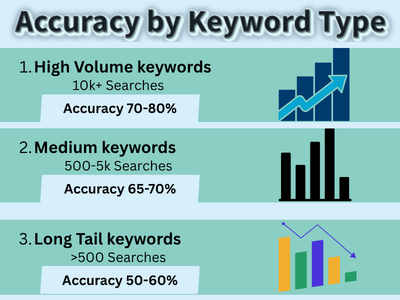
The accuracy of keyword data in Ahrefs is not the same for every keyword. It varies depending on how often a keyword is searched and how much data is available.
In simple terms: The more search data a keyword has, the more accurate the estimate will be.
1. High-Volume Keywords (10K+)
Accuracy: ~70–80%
High-volume keywords are searched thousands of times every month, which means there is a large amount of data available from multiple sources like clickstream data and historical trends.
Why They Are More Accurate
- Stable data: High-volume keywords are searched by a large number of users every day, which creates a consistent and predictable pattern. Because thousands of people are searching the same term regularly, small daily changes don’t significantly impact the overall monthly data.
In simple terms:
If 1–2% of users stop searching for a keyword, it won’t drastically change the total volume.
- More historical data: High-volume keywords generate a lot of data over months and years. Ahrefs stores this data and uses it to identify patterns, trends, and seasonal changes.
What Ahrefs can analyze with this data:
- Whether a keyword is growing or declining
- Seasonal spikes (e.g., courses, festivals, sales)
- Long-term user interest
- Easier to estimate: High-volume keywords produce large datasets from multiple sources like clickstream data and SERP analysis. In data analysis, larger datasets always lead to more accurate predictions.
Why this matters:
- More data points = lower chance of error
- Patterns become clearer
- Estimates become more precise
Example: Keyword: “digital marketing”
- Ahrefs → 50,000 searches
- Actual → 45,000–55,000
Even if slightly off, the estimate is close enough to trust.
2. Medium Keywords (500–5K Searches)
Accuracy: ~65–70%
Medium-volume keywords sit in the middle—they are not too broad like high-volume keywords and not too specific like long-tail keywords. Because of this, Ahrefs can estimate them with fairly good accuracy, making them highly useful for SEO planning.
Why They Are Balanced
1. Enough Data for Estimation: These keywords are searched regularly, so there is enough data available from sources like clickstream and historical trends.
What this means: Ahrefs has sufficient information to make a reasonable estimate, though not as precise as high-volume keywords.
2. Moderate Fluctuations: Search behavior for these keywords is relatively stable but can still change due to trends, seasonality, or user interest.
Example: Keyword: “best email marketing tools”
- Searches may increase during product launches or marketing campaigns
- Drop slightly during slower periods
Result: Some variation exists, but it’s manageable.
3. Good Mix of Competition and Opportunity: These keywords are not extremely competitive, yet they still offer decent traffic potential.
What this means:
- Easier to rank than high-volume keywords
- More traffic than long-tail keywords
Result: Ideal for most websites, especially growing blogs and businesses.
Example Keyword: “best email marketing tools”
- Ahrefs → 2,000 searches
- Actual → 1,600–2,400
Slight variation, but still reliable.
3. Long-Tail Keywords (<500)
Accuracy: ~50–60%
Long-tail keywords are highly specific search queries that usually contain more words and target a narrow audience. Because these keywords have low search volume, there is less data available for tools like Ahrefs to analyze.
As a result, their search volume estimates are less accurate compared to medium and high-volume keywords.
Why Accuracy Is Lower
1. Limited Data (Fewer Searches = Less Reliable Estimates)
Long-tail keywords are searched by a small number of users each month. This means Ahrefs has fewer data points from clickstream sources and historical records.
What this means:
- Smaller dataset
- Higher uncertainty in estimates
Example: If only 100 people search for a keyword, missing even 20–30 searches creates a large percentage error.
Result: Lower confidence in exact numbers.
2. Higher Fluctuation (Numbers Change Quickly)
With low-volume keywords, even small changes in user behavior can significantly impact the data.
Example: Keyword gets:
- Month 1 → 80 searches
- Month 2 → 150 searches
- Month 3 → 220 searches
This looks like a huge change, but it’s only a difference of 100–150 searches.
Result: Data appears unstable even though the change is small in absolute terms.
3. Irregular Search Patterns (Unpredictable Behavior)
Many long-tail keywords do not follow a consistent search pattern. They can be:
- Seasonal: (e.g., “best winter jackets for trekking”)
- Trend-based: (e.g., “latest AI SEO tools 2026”)
- Rare queries: searched occasionally by niche users
What this means: Search demand may spike suddenly and then disappear.
Result: Harder for Ahrefs to predict accurate monthly averages.
Why Long-Tail Keywords Are Still Valuable
Even though their accuracy is lower, long-tail keywords are extremely powerful for SEO.
1. Lower Competition: Fewer websites target these specific queries, making it easier to rank.
Example:
“SEO tools” → Highly competitive
“best SEO tools for small business in India” → Much easier to rank
2. Higher Conversion Rates: Users searching long-tail keywords usually know exactly what they want.
Example:
- “SEO tools” → general research
- “best free SEO tools for beginners” → ready to take action
Result: Higher chances of clicks, sign-ups, or purchases.
3. Easier to Rank (Best for New Websites): Because competition is low, even new or low-authority websites can rank for long-tail keywords.
Strategy: Target multiple long-tail keywords instead of one big keyword.
Ahrefs vs Other SEO Tools
When it comes to keyword research accuracy, different SEO tools use different data sources and methods. Below is a detailed comparison to help you understand how each tool performs.
| Tool | Accuracy Level | Data Source | Strengths | Weaknesses | Best For |
| Ahrefs | ~67% | Clickstream + GKP + SERP analysis | Balanced accuracy, strong backlink data, reliable traffic estimates | Not 100% exact, expensive | All-in-one SEO, keyword + competitor analysis |
| SEMrush | ~64% | Clickstream + third-party data | Great for competitor research, PPC insights, keyword gap analysis | Slightly less accurate traffic estimates | Competitive analysis, ads & SEO strategy |
| Moz | ~61% | Limited clickstream + modeled data | Beginner-friendly interface, simple metrics | Smaller database, less frequent updates | Beginners, basic SEO tasks |
| Google Keyword Planner | ~52% | Direct Google Ads data | Direct Google source, useful for PPC | Shows ranges, groups keywords, lacks SEO insights | Paid ads (PPC), basic keyword ideas |
Keyword Difficulty (KD) Accuracy
Ahrefs calculates Keyword Difficulty (KD) mainly based on the number and quality of backlinks pointing to top-ranking pages.
KD Score Breakdown
- 0–10 → Very Easy (Low competition, easy to rank)
- 11–30 → Easy (Moderate effort required)
- 31–60 → Medium (Strong competition)
- 61+ → Hard (Difficult, requires high authority)
Accuracy Insights
- Accurate for backlink competition: KD is reliable when measuring how many backlinks you need to compete
- Doesn’t consider important factors like:
- Content quality
- Search intent
- Brand authority
Example :A keyword may show low KD, but top results could be from strong websites with high-quality content.
This means the keyword may actually be harder to rank than Ahrefs suggests.
Traffic Potential Accuracy
Traffic Potential is one of the most powerful features in Ahrefs because it goes beyond single keyword data.
What It Measures
- Estimates the Total Traffic a Page Can Get:
Traffic Potential measures the overall traffic a page can generate instead of focusing on a single keyword. It gives a broader view of how much visibility and traffic a page can achieve in search results. - Includes Traffic from Multiple Related Keywords, Not Just One:
It considers traffic from all related keywords a page can rank for, including variations and similar search queries. This reflects real SEO behavior where one page ranks for multiple terms. - Helps You Understand the Real Ranking Potential of a Topic:
Traffic Potential helps you evaluate the true value of a topic by showing its full traffic potential. It allows you to focus on topics that can bring higher and more sustainable traffic over time.
Accuracy Level
- Highly reliable (~70–80%)
Traffic Potential in Ahrefs is considered highly reliable because it is based on real ranking data from top-performing pages. Since it evaluates multiple keywords and actual SERP performance, it gives a more realistic estimate compared to single keyword metrics. - More useful than search volume alone
Unlike search volume, which only measures how often a keyword is searched, Traffic Potential looks at the bigger picture. It shows how much traffic you can gain from an entire topic, making it far more useful for planning content and SEO strategies. - Reflects actual SEO performance better
Traffic Potential closely matches how pages perform in real search results because it considers multiple ranking keywords. This makes it a better indicator of real-world SEO success, helping you understand the true traffic opportunity of a page.
Example: Keyword: “SEO tools”
- Search volume → 10K
- Traffic potential → 50K
This happens because a page ranking for this keyword also ranks for many related keywords, bringing in more total traffic.
Real Case Studies
Case Study 1:
For the keyword “best email marketing tools”, Ahrefs estimated 12,000 searches, while the actual traffic was around 10,500.
This reflects high accuracy, with only a small difference of about 10–15%. Such variation is normal because Ahrefs uses modeled data rather than exact Google numbers.
The important takeaway is that the keyword still falls in the same traffic range, making it reliable for planning content, estimating potential visitors, and prioritizing SEO efforts.
Case Study 2:
For “cheap SEO services near me”, Ahrefs reported 800 searches, but the actual traffic was closer to 1,200.
This shows a slight underestimation, which commonly happens with local-intent keywords or phrases with lower search volume. These keywords often have fluctuating demand depending on location, time, and user behavior.
Despite the difference, Ahrefs still correctly identifies the keyword as a moderate opportunity, helping users make informed decisions.
Example (Simple Understanding)
If Ahrefs shows a keyword has 1,000 searches, the actual traffic may range between 800 and 1,300 due to estimation methods and data sampling.
This variation occurs because search behavior changes frequently, and tools rely on averages and trends rather than real-time exact numbers.
However, the keyword still represents strong demand, and the estimate is accurate enough to guide content creation and SEO strategy
Limitations of Ahrefs
- Estimated Data Only: Ahrefs uses modeled and third-party data, not direct Google search data, so numbers are always estimates—not exact figures.
- Long-Tail Inaccuracy: Low-volume or rare keywords have limited data, making estimates less reliable and more prone to fluctuation.
- Delayed Updates: Keyword data and traffic estimates are not real-time and may take weeks or months to update.
- Intent Misinterpretation: Ahrefs cannot fully understand user intent (informational, transactional, etc.), which can affect keyword targeting decisions.
- SERP Changes: Search results change frequently due to algorithm updates, competition, and trends, which Ahrefs may not reflect instantly.
- Click Data Variations: Not all searches result in clicks (due to featured snippets, ads, etc.), which can impact accuracy.
- Over/Underestimation: Some keywords may be slightly overestimated or underestimated depending on available data.
- Local Search Gaps: Accuracy may drop for location-based keywords like “near me” searches.
- No Direct Google Integration: Unlike Google Keyword Planner, Ahrefs does not use first-party Google search data.
- Content Quality Not Considered: Metrics like Keyword Difficulty don’t factor in how strong or optimized the actual content is.
How to Use Ahrefs Correctly
1. Focus on Trends
Instead of relying on exact search volume numbers, use Ahrefs to compare keywords and identify trends. Look at which keywords are growing, stable, or declining over time.
SEO success depends on choosing the right direction, not perfect numbers. If one keyword consistently shows higher volume than another, it’s usually the better opportunity—even if the exact figures are slightly off.
2. Analyze SERP
Always review the Search Engine Results Page (SERP) before targeting a keyword. Ahrefs allows you to see:
- Competitors → Who is ranking (big brands or small sites)
- Content type → Blog posts, product pages, videos, etc.
- Search intent → Informational, transactional, or navigational
This helps you understand what kind of content Google prefers and whether you can realistically compete.
3. Combine Tools
Do not rely only on Ahrefs. Combine it with other tools like:
- Google Search Console → For real performance data
- Google Keyword Planner → For direct Google keyword insights
Using multiple tools helps you cross-check data, reduce errors, and get a more complete SEO picture.
4. Validate with Real Data
After publishing content, track how it performs using real data. Monitor:
- Rankings: Track where your page appears in search results for your target keywords. If your rankings improve over time, it means your SEO strategy is working. If not, you may need better content, backlinks, or optimization.
- Clicks: Clicks show how many users actually visit your page from search results. Even if your rankings are good, low clicks may indicate poor titles or meta descriptions.
- Impressions: Impressions tell you how often your page appears in search results. High impressions but low clicks suggest you need to improve your CTR (Click-Through Rate).
- Traffic: Traffic shows the total number of visitors coming to your page. This is the most important metric because it reflects the real outcome of your SEO efforts.
This allows you to confirm whether Ahrefs estimates were accurate and helps you optimize your strategy over time.
Common Mistakes in Keyword Research
1. Trusting Exact Numbers
Many beginners treat keyword metrics (like search volume or traffic) in Ahrefs as exact values. In reality, these are estimates based on models and data sampling.
Focusing too much on exact numbers can lead to poor decisions. Instead, you should compare keywords and look at relative differences and trends, which are far more reliable.
2. Ignoring Search Intent
Search intent refers to why a user is searching for a keyword (informational, transactional, navigational). Ignoring this can result in content that doesn’t match what users expect.
Even if a keyword has high volume, your content won’t rank well unless it aligns with the intent behind the search query.
3. Targeting High KD Too Early
Going after keywords with high Keyword Difficulty (KD) without having strong authority or backlinks is a common mistake.
These keywords are usually dominated by established websites. Beginners should start with low to medium KD keywords and gradually move to more competitive ones.
4. Skipping SERP Analysis
Not analyzing the Search Engine Results Page (SERP) means you’re missing critical insights about competition and content type.
You should always check:
- Who is ranking
- What type of content ranks (blogs, videos, product pages)
- Content quality and depth
This helps you understand if you can realistically compete.
5.Not Updating Content
SEO is not a one-time task. Many people publish content and never update it again.Search trends, competitors, and algorithms change over time. Regular updates help you:
- Maintain rankings
- Improve accuracy
- Increase traffic
- Here’s your section expanded into clear, detailed explanations:
Future of Keyword Research
Keyword research is rapidly evolving as search behavior and technology continue to change. Traditional keyword targeting is shifting toward intent, topics, and user experience.
How Keyword Research Is Evolving
1. AI-Powered Search: Search engines are increasingly using AI to understand context, meaning, and user intent rather than just matching keywords.
This means SEO is moving from exact keywords → topic-based content. Content needs to be more comprehensive, relevant, and helpful to rank well.
2. Voice Queries: With the rise of voice assistants, users now search using natural language and conversational phrases.
Keywords are becoming longer and more question-based (long-tail queries). This requires optimizing for how people speak, not just how they type.
3. Zero-Click Searches: Many searches now end without a click because users get answers directly on the search results page (featured snippets, knowledge panels, etc.).
This reduces organic clicks but increases the importance of ranking in featured positions and providing concise, high-quality answers.
How Ahrefs Is Improving
1. Better Clickstream Data: Ahrefs is continuously improving its data sources to provide more accurate insights into real user behavior and clicks.
This helps in estimating traffic more realistically.
2. Larger Databases: Ahrefs is expanding its keyword and backlink databases to cover more queries across different regions and languages.
This improves keyword discovery, especially for long-tail and international SEO.
3. Advanced Algorithms: With better machine learning models, Ahrefs is enhancing its ability to predict search volume, traffic potential, and keyword difficulty.
This leads to more reliable and actionable SEO data.
Conclusion
Ahrefs is one of the most reliable SEO tools available for keyword research, offering a strong balance between data accuracy, usability, and actionable insights. While it does not provide exact Google search data, it delivers directionally accurate estimates that are highly effective for making informed SEO decisions.
Its strengths lie in trend analysis, traffic potential, and competitor insights, making it far more valuable than relying on raw search volume alone. However, like any SEO tool, it has limitations especially with long-tail keywords, local searches, and real-time data updates.
The key to success is not expecting perfect numbers but using Ahrefs as a strategic guide. When combined with tools like Google Search Console and Google Keyword Planner, it becomes even more powerful.
FAQs (Frequently Asked Questions)
1. How accurate is Ahrefs keyword research?
Ahrefs keyword data is about 60–70% accurate for search volume and up to 85–90% accurate for traffic estimates, making it reliable for SEO planning.
2. Is Ahrefs better than Google Keyword Planner?
Yes, Ahrefs provides more detailed SEO insights, while Google Keyword Planner is better suited for PPC and shows limited SEO data.
3. Why is Ahrefs not 100% accurate?
Because it uses clickstream data, third-party sources, and machine learning models, not direct Google search data.
4. Can I rely on Ahrefs for keyword research?
Yes, you can rely on it for trend analysis, keyword comparison, and SEO strategy, but not for exact numbers.
5. Which metric in Ahrefs is most accurate?
Traffic Potential and keyword trends are generally more accurate than search volume because they consider multiple data points.
6. Why do Ahrefs numbers differ from Google Search Console?
Google Search Console shows real data from your website, while Ahrefs provides estimated data based on global trends.
7. Is Keyword Difficulty (KD) accurate in Ahrefs?
KD is accurate for backlink competition, but it doesn’t consider content quality or search intent.
8. Are long-tail keywords accurate in Ahrefs?
They are less accurate (50–60%) due to limited data, but still useful for finding low-competition opportunities.
9. Should I use Ahrefs alone for SEO?
No, it’s best to combine it with tools like Google Search Console and other SEO tools for better accuracy.
10. What is the best way to use Ahrefs effectively?
Focus on trends, SERP analysis, and traffic potential, and always validate your strategy with real performance data.