

Ranking on Google is difficult when you start keyword research from zero.
A faster way is to find the keywords your competitors already rank for and target the ones you can realistically beat them on.
This process is called competitor keyword research.
It helps you discover:
- Keywords already bringing traffic in your niche
- Content ideas that are proven to work
- Low-competition opportunities
- Gaps your website is missing
Instead of guessing what people search for, you use real search data from websites already getting traffic.
For example, if a competing website ranks for “technical seo checklist” and their content is outdated or weak, you can create a better page and try to outrank them.
This approach works faster because:
- The keyword is already validated
- You know Google ranks content on that topic
- You can study what currently works in the SERP
- You avoid wasting time on keywords with no traffic potential
In this guide, you’ll learn:
- How to find competitor keywords
- Which keywords are actually worth targeting
- How to discover keyword gaps
- Ways to outrank competitors
- Common mistakes that stop pages from ranking
By the end, you’ll have a practical system for finding keyword opportunities your competitors are already benefiting from, and using them to grow your own traffic.
The Fastest Way to Find Competitor Keywords
The easiest way to steal competitor keywords is to first identify the websites that already rank for the topics you want traffic from.
Many people make the mistake of analyzing the wrong competitors.
A company can be your business competitor but not your SEO competitor.
That distinction matters a lot.
Step 1: Identify Your Real SEO Competitors
Your business competitors are companies selling similar products or services.
Your SEO competitors are websites competing with you in Google search results.
These are not always the same.
For example, if you run a small SEO agency, your business competitors may be other local agencies.
But in Google search, you may actually compete with:
- Large blogs
- SaaS companies
- Affiliate websites
- Industry publications
- YouTube pages
- Forums like Reddit or Quora
That’s why SEO competitor research should focus on who ranks for your target keywords — not just who sells similar services.
Business Competitors vs SEO Competitors
| Type | Meaning |
|---|---|
| Business competitors | Companies selling similar services or products |
| SEO competitors | Websites ranking for the keywords you want |
A website can rank above you in Google without offering the same service as you.
For example:
| Keyword | Ranking Website |
|---|---|
| seo audit checklist | Blog website |
| best seo tools | Affiliate site |
| technical seo guide | SaaS company |
| link building strategies | Marketing publication |
All of these become SEO competitors if they compete for your traffic.
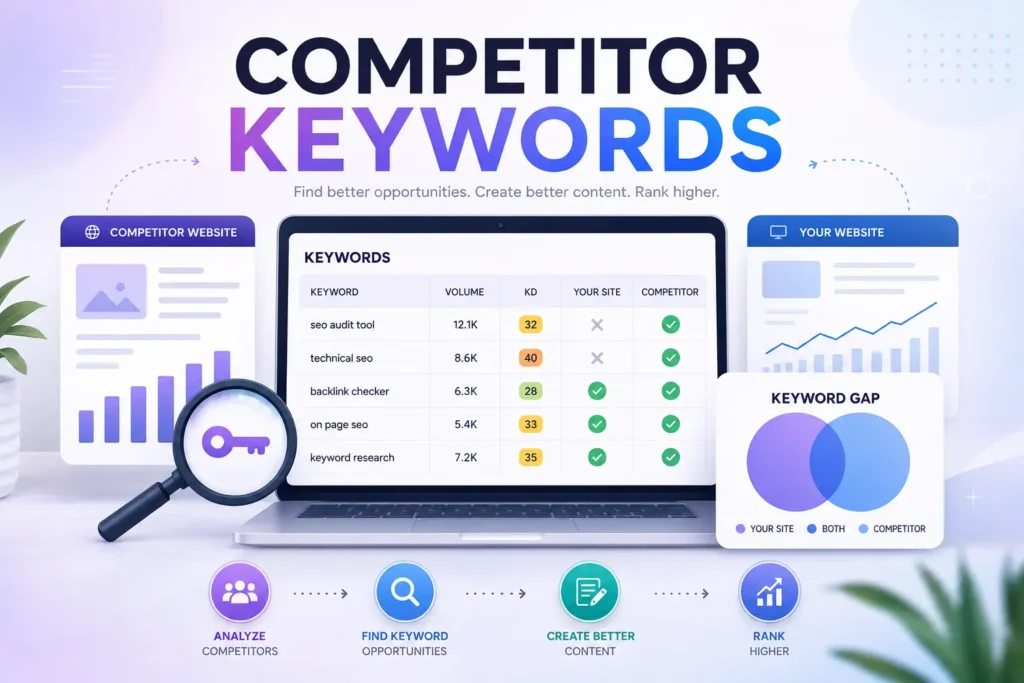
Method 1: Find SEO Competitors Using Google Search
This is the fastest free method.
Start by searching your main keywords in Google.
For example:
- technical seo checklist
- seo audit guide
- keyword research tools
- local seo tips
Now look for websites that repeatedly appear in the top results.
If the same domains keep showing up, they are likely your real SEO competitors.
What to Look For
- Websites ranking for multiple keywords in your niche
- Competitors consistently appearing on page one
- Sites publishing similar types of content
Example
If you repeatedly see:
then these are your SEO competitors for SEO-related content.
Method 2: Use Ahrefs or Semrush to Find Competitors Automatically
SEO tools make this process much faster.
In Ahrefs:
- Enter your domain into Site Explorer
- Open the “Organic Competitors” report
- View websites ranking for similar keywords
In Semrush:
- Enter your domain
- Open “Organic Research”
- Go to the “Competitors” tab
The tool will show:
- Shared keywords
- Competition level
- Estimated traffic
- Keyword overlap
This helps you quickly identify domains competing for the same search visibility.
How to Find Overlapping Domains
Overlapping domains are websites ranking for many of the same keywords as you.
These are usually your strongest SEO competitors.
The more keyword overlap a site has with yours, the more useful it becomes for competitor keyword research.
Signs of Strong Keyword Overlap
- Similar blog topics
- Ranking for the same search intent
- Competing on multiple pages
- Similar audience targeting
Simple Rule
If a domain ranks for dozens or hundreds of the keywords you want, add it to your competitor research list.
Aim to collect at least:
- 3–5 direct competitors
- 5–10 broader content competitors
This gives you enough keyword data to find real opportunities.
Quick Tip: Your SEO competitors are websites ranking for the same keywords, not always companies selling the same service.
Step 2: Put Competitor Domains Into a Keyword Tool
Once you’ve identified your SEO competitors, the next step is to extract the keywords they already rank for.
This is where competitor keyword research becomes powerful.
Instead of brainstorming random ideas, you’re pulling real keyword data from websites already getting traffic from Google.
The goal here is simple:
- Find the keywords driving traffic to competitors
- Identify weak spots you can beat
- Discover content opportunities faster
Several SEO tools can help with this process.
Best Tools for Competitor Keyword Research
| Tool | Best Use |
|---|---|
| Ahrefs | Organic keyword research |
| Semrush | Keyword gap analysis |
| Google Search Console | Existing keyword rankings |
| Ubersuggest | Beginner-friendly research |
| Moz | SERP and ranking analysis |
Using Ahrefs to Find Competitor Keywords
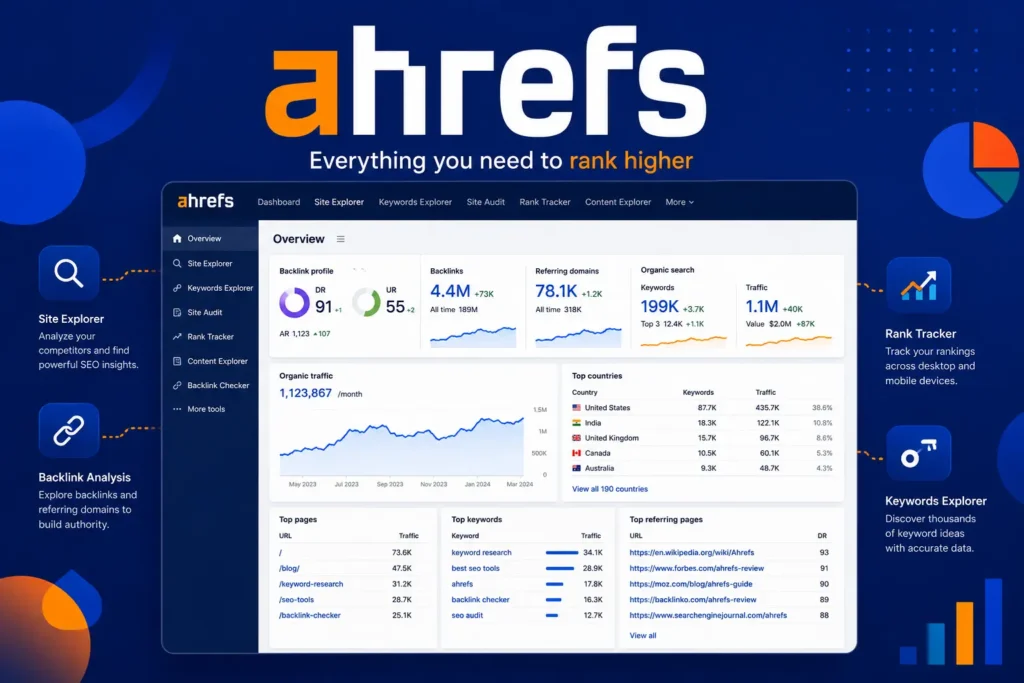
Ahrefs is one of the fastest tools for uncovering organic keywords.
Here’s the process:
- Open Site Explorer
- Enter a competitor domain
- Open the “Organic Keywords” report
You’ll now see:
- Keywords they rank for
- Ranking positions
- Traffic estimates
- Keyword difficulty
- Ranking pages
This instantly gives you hundreds or thousands of keyword ideas.
What to Focus On
Do not blindly copy every keyword.
Instead, prioritize:
- Low to medium keyword difficulty
- Keywords with clear search intent
- Topics relevant to your website
- Keywords where competitors rank outside the top 3
These are usually easier opportunities.
Using Semrush for Keyword Gap Analysis
Semrush is especially useful for finding keyword gaps.
A keyword gap is simply:
Keywords your competitors rank for that your website does not.
To find them:
- Open Keyword Gap Tool
- Add your domain
- Add competitor domains
- Compare keyword profiles
Semrush will show:
- Missing keywords
- Weak rankings
- Shared keywords
- Untapped opportunities
This is one of the fastest ways to build a content plan.
Using Google Search Console
Google Search Console works differently.
It doesn’t show competitor keywords directly.
Instead, it helps you find:
- Keywords you already rank for
- Pages almost ranking on page one
- Existing opportunities to improve
This is useful because sometimes you don’t need new keywords.
You just need to improve rankings for keywords you already appear for.
Quick Win Strategy
Look for keywords ranking between positions 8–20.
Improving those pages is often easier than creating entirely new content.
Using Ubersuggest for Beginner Research
If you are new to SEO or working with a smaller budget, Ubersuggest is a simpler option.
You can:
- Enter competitor domains
- View organic keywords
- Analyze top pages
- Find content ideas
The data is less detailed than Ahrefs or Semrush, but it’s enough for basic competitor research.
Using Moz for SERP Analysis
Moz is useful for understanding search competition.
It helps analyze:
- Domain authority
- Page authority
- SERP difficulty
- Ranking competitors
This can help you decide whether a keyword is realistically worth targeting.
What You Should Export From These Tools
Once you analyze competitors, export the following data:
| Data Type | Why It Matters |
|---|---|
| Organic keywords | Find ranking opportunities |
| Top pages | Discover traffic-driving content |
| Ranking positions | Identify weak rankings |
| Keyword difficulty | Measure competition |
| Search volume | Estimate traffic potential |
This keyword list becomes the foundation of your competitor SEO strategy.
Step 3: Export the Keywords They Rank For
After identifying your competitors and analyzing them in an SEO tool, the next step is to export their keyword data.
This is where you build your actual keyword opportunity list.
Most SEO tools allow you to export competitor data into a spreadsheet so you can filter and analyze it properly.
Instead of randomly targeting keywords, you’ll now work with real search data.
Focus on Organic Keywords
Organic keywords are the search terms a website ranks for naturally in Google.
These are not paid ads.
For example, if a competitor ranks for:
- technical seo checklist
- keyword clustering
- local seo tips
those become potential keyword opportunities for you.
Why Organic Keywords Matter
They show:
- What Google already rewards in your niche
- Which topics bring traffic
- Which keywords are achievable
- What content users are searching for
This removes a lot of guesswork from keyword research.
Analyze Their Top Pages
Do not focus only on individual keywords.
Look at the pages bringing the most traffic.
In tools like Ahrefs or Semrush, open the “Top Pages” or “Top Pages by Traffic” report.
This shows:
- Which pages generate the most organic traffic
- Which topics perform best
- What type of content Google prefers
Sometimes one page ranks for hundreds of related keywords.
That’s a strong sign of topical authority.
Check the Ranking URLs
Ranking URLs help you understand exactly what type of page ranks for a keyword.
For example:
| Keyword | Ranking URL Type |
|---|---|
| seo audit checklist | Blog post |
| best seo tools | List article |
| local seo services | Service page |
| technical seo guide | Long-form guide |
This helps you match search intent correctly.
If Google ranks list articles for a keyword, creating a service page may not work well.
Find Traffic-Driving Keywords
Not every keyword is valuable.
Some keywords bring very little traffic even if rankings are high.
Your goal is to identify:
- High-traffic keywords
- Low-competition opportunities
- Commercially valuable topics
- Keywords with ranking potential
Pay close attention to keywords where competitors rank between positions 4–20.
Those are often easier to beat than keywords dominated by powerful websites in position #1.
Example Competitor Keyword Analysis
| Keyword | Competitor Rank | Search Volume | Difficulty | Worth Targeting? |
|---|---|---|---|---|
| seo audit checklist | #2 | 12,000 | Medium | Yes |
| ecommerce seo guide | #4 | 8,000 | High | Maybe |
| technical seo basics | #8 | 3,000 | Low | Strong opportunity |
How to Decide Which Keywords to Target
A keyword becomes a strong opportunity when:
- Search volume is decent
- Competition is manageable
- Search intent matches your content
- Competitor content is weak or outdated
- You can create something better
Good Signs of an Easy Opportunity
- Thin competitor content
- Poor page structure
- Outdated information
- Weak backlinks
- Low-authority ranking pages
These gaps make it easier to outrank competitors with better content and stronger optimization.
Pro Tip
Do not export thousands of keywords and target all of them.
Filter aggressively.
Focus on keywords that are:
- Relevant to your niche
- Realistic for your website authority
- Valuable for traffic or conversions
- Closely related to your core topics
A smaller list of high-quality keyword opportunities is far more useful than a massive spreadsheet filled with irrelevant terms.
Which Competitor Keywords Should You Actually Steal?
Finding competitor keywords is easy.
Choosing the right ones is where most websites fail.
Many beginners export thousands of keywords from tools like Ahrefs or Semrush and try to target everything.
That usually leads to wasted time and poor rankings.
The smarter approach is to focus only on keywords you can realistically rank for.
Prioritize Low-Competition Keywords
Not all competitor keywords are worth targeting.
Some keywords are dominated by massive websites with:
- Strong backlink profiles
- High domain authority
- Established topical authority
- Large content teams
Trying to outrank those pages early on can take years.
Instead, look for low-competition opportunities where smaller websites still have a chance to rank.
These keywords are usually:
- More specific
- Less competitive
- Easier to rank for
- Faster to generate traffic
Why Keyword Difficulty Matters
Keyword difficulty is an estimate of how hard it is to rank for a keyword.
SEO tools calculate this score based on factors like:
- Backlinks
- Authority of ranking pages
- SERP competition
- Content strength
In most cases:
| Difficulty Level | Best For |
|---|---|
| Low | Small or newer websites |
| Medium | Growing websites |
| High | Established authority sites |
If your website is still building authority, targeting high-difficulty keywords can slow your growth.
For example:
| Keyword | Difficulty | Better Choice? |
|---|---|---|
| seo | Very High | No |
| technical seo checklist | Medium | Better |
| ecommerce seo checklist for shopify | Low | Strong opportunity |
Longer and more specific keywords are often easier to rank for.
These are called long-tail keywords.
Easier Wins Matter More Early On
Small websites grow faster by stacking smaller wins.
Ranking for multiple low-competition keywords can generate:
- Consistent traffic
- Faster indexing
- Internal linking opportunities
- Topical authority
- Early backlinks
Over time, this helps your website compete for larger keywords.
Example Strategy
Instead of targeting:
- “SEO tools”
Target:
- “best free seo tools for small businesses”
- “seo tools for ecommerce stores”
- “technical seo audit tools”
These keywords usually have:
- Lower competition
- Clearer search intent
- Better ranking potential
How to Spot Good Low-Competition Keywords
Look for keywords where:
- Smaller websites already rank
- Search results are weak
- Content quality is outdated
- Forums or Reddit pages appear in SERPs
- Search intent is underserved
These are often signs that Google does not have a strong result yet.
That creates an opportunity for better content to rank.
A Simple Filtering Process
After exporting competitor keywords, filter them using these criteria:
| Filter | Good Target |
|---|---|
| Keyword difficulty | Low to medium |
| Search volume | Enough to matter |
| Relevance | Closely related to your niche |
| Search intent | Matches your content type |
| Competition quality | Weak or outdated pages |
This quickly removes keywords that are unrealistic or not worth the effort.
Focus on Realistic Opportunities
A keyword is only valuable if you can realistically compete for it.
Smaller websites usually perform better when they focus on:
- Long-tail keywords
- Topic clusters
- Specific problems
- Lower competition searches
That approach builds momentum faster than chasing extremely competitive keywords too early.
Find Keywords Where Competitors Rank Between Positions 4–20
One of the easiest ways to find ranking opportunities is to target keywords where competitors already rank — but not very strongly.
Keywords sitting between positions 4–20 are often much easier to beat than keywords where competitors dominate the #1 spot.
Why?
Because Google already sees the competitor page as somewhat relevant, but not strong enough to fully own the keyword.
That usually means there is room for improvement.
Why These Rankings Are Easier to Beat
When a page ranks between positions 4–20, it often has weaknesses like:
- Incomplete content
- Weak on-page SEO
- Poor user experience
- Weak backlinks
- Outdated information
- Search intent mismatch
This creates opportunities for better content to move ahead.
Example
If a competitor ranks:
| Keyword | Competitor Position |
|---|---|
| technical seo basics | #8 |
| local seo checklist | #12 |
| ecommerce seo tips | #5 |
you may be able to outrank them with:
- Better formatting
- More complete information
- Improved search intent matching
- Stronger internal linking
- Updated examples
Weak Rankings Often Signal Weak Content
Many pages ranking outside the top 3 are not fully optimized.
Common problems include:
- Short articles
- Missing important sections
- Poor heading structure
- Weak introductions
- No examples or visuals
- Outdated SEO practices
Sometimes the page ranks simply because there are not many strong alternatives.
That’s a good opportunity.
Thin Content Creates Easy Openings
Thin content means the page does not fully answer the search query.
For example, a competitor article about “technical seo checklist” may only contain:
- Basic definitions
- Short explanations
- Few actionable steps
But users often want:
- Real examples
- Tools
- Checklists
- Screenshots
- Common mistakes
- Step-by-step instructions
Creating more complete content can help you outperform weaker pages.
Poor Optimization Is Common
Many ranking pages are not properly optimized for SEO.
Common issues include:
| Weak Optimization | Better Approach |
|---|---|
| Weak title tag | Clear keyword-focused title |
| Poor headings | Structured H2s and H3s |
| No internal links | Strong topic connections |
| Slow page speed | Faster loading experience |
| No schema | Rich result optimization |
| Weak CTR | Better titles and meta descriptions |
Even small improvements can make a difference when competitors already rank weakly.
How to Find These Keywords Quickly
In tools like Ahrefs or Semrush:
- Export competitor keywords
- Filter rankings between positions 4–20
- Sort by:
- Search volume
- Keyword difficulty
- Traffic potential
This quickly reveals keywords with realistic ranking potential.
Best Opportunities Usually Look Like This
| Factor | Ideal Signal |
|---|---|
| Competitor rank | Between 4–20 |
| Content quality | Average or weak |
| Search intent | Poorly matched |
| Keyword difficulty | Low to medium |
| SERP competition | Not dominated by authority sites |
When several of these signals appear together, the keyword becomes a strong opportunity to target.
Focus on “Almost Winning” Keywords
The best competitor keywords are often the ones where pages are already close to ranking well — but not quite there.
Google has already validated the topic.
Your job is simply to create a better result.
Target Keywords With Business Value
Not every keyword is valuable just because it has traffic.
Some keywords bring visitors who never convert into leads, customers, or sales.
That’s why competitor keyword research should focus not only on rankings, but also on business value.
A keyword with lower traffic can sometimes generate far more revenue than a keyword with massive search volume.
Understand Search Intent First
Every keyword has a different type of intent behind it.
Some users want information.
Others want to compare products.
Some are ready to buy immediately.
Understanding this helps you prioritize the right opportunities.
Types of High-Value Keywords
| Keyword Type | Example | Value |
|---|---|---|
| Informational | what is technical seo | Medium |
| Commercial | best seo audit tool | High |
| Transactional | hire seo agency | Very High |
Informational Keywords
Informational keywords target users looking for answers or education.
Examples:
- what is technical seo
- how backlinks work
- seo checklist for beginners
These keywords are excellent for:
- Building topical authority
- Growing traffic
- Earning backlinks
- Bringing users into your funnel
But conversions are usually lower because users are still researching.
Best Use Case
Use informational keywords to attract early-stage visitors and build trust.
Commercial Keywords
Commercial keywords target users comparing products, tools, or services.
Examples:
- best seo audit tool
- top keyword research tools
- best local seo agencies
These users are much closer to making a decision.
That makes commercial keywords extremely valuable.
Why Commercial Keywords Matter
They often lead to:
- Affiliate revenue
- Product signups
- Demo requests
- Qualified leads
These keywords usually have strong buyer intent without being as competitive as direct transactional searches.
Transactional Keywords
Transactional keywords target users ready to take action.
Examples:
- hire seo agency
- buy seo software
- seo consultant near me
These keywords usually have the highest conversion potential.
Users searching these terms are often ready to:
- Purchase a service
- Book a call
- Request a quote
- Start a trial
That’s why they carry very high business value.
Don’t Chase Traffic Alone
A keyword with 1,000 searches and strong buyer intent can be more valuable than a keyword with 50,000 informational searches.
For example:
| Keyword | Traffic Potential | Conversion Potential |
|---|---|---|
| what is seo | Very High | Low |
| best seo tools | High | Medium-High |
| seo agency pricing | Medium | Very High |
This is why smart SEO strategies focus on a mix of:
- Traffic keywords
- Authority-building keywords
- Revenue-driving keywords
How to Find High-Value Competitor Keywords
When analyzing competitor keywords, prioritize terms that:
- Show buying intent
- Include words like:
- best
- top
- pricing
- services
- software
- agency
- consultant
- tools
- compare
- Lead to commercial landing pages
- Drive conversions for competitors
These are often the keywords generating actual business results.
A Smarter Keyword Strategy
The best SEO strategies combine all three keyword types together.
For example:
| Funnel Stage | Keyword Type |
|---|---|
| Awareness | Informational |
| Consideration | Commercial |
| Decision | Transactional |
This helps you capture users at different stages of the buying journey instead of relying only on traffic-based keywords.
Focus on Keywords That Support Real Goals
Before targeting a competitor keyword, ask:
- Can this keyword bring qualified traffic?
- Does the intent match my business?
- Can this topic lead to conversions later?
- Is the competition realistic?
The best competitor keywords are not always the biggest keywords.
They are the ones most likely to grow your business.
Look for Content Gaps
One of the fastest ways to grow organic traffic is to find content gaps between your website and your competitors.
A content gap is simply:
Keywords and topics your competitors rank for that your website does not.
These gaps often reveal missed opportunities that can bring new traffic, rankings, and customers.
What Are Keyword Gaps?
Keyword gaps happen when competitors rank for valuable searches but your website has no visibility for them.
For example:
| Keyword | Competitor Ranking | Your Website |
|---|---|---|
| technical seo checklist | #3 | Not ranking |
| ecommerce seo guide | #5 | Not ranking |
| seo audit template | #8 | Not ranking |
These missing keywords become potential targets for new content.
Why Content Gaps Matter
Content gaps usually indicate one of three problems:
- You have not covered the topic
- Your content is too weak
- Your content does not match search intent
Finding these gaps helps you understand what your website is missing compared to competitors already getting traffic.
Keywords Competitors Rank for But You Do Not
This is the most obvious type of content gap.
Your competitors may already have content covering:
- Beginner guides
- Comparison articles
- Tutorials
- Service pages
- Tool pages
- Industry-specific topics
If your website lacks those pages entirely, Google has fewer reasons to rank you for related searches.
Example
A competitor may rank for:
- local seo checklist
- ecommerce seo for shopify
- technical seo audit process
while your website only targets broad SEO terms.
That creates missed traffic opportunities.
Missing Topics
Sometimes the problem is not just missing keywords.
You may be missing entire topic clusters.
For example, if you run an SEO blog but never cover:
- local SEO
- ecommerce SEO
- technical SEO
- SEO tools
- link building
your topical authority becomes weaker compared to competitors covering those areas deeply.
Google usually prefers websites that cover a topic comprehensively.
Missing Search Intent Coverage
Many websites target keywords but fail to cover the right search intent.
This is a major ranking problem.
For example:
| Search Query | Actual User Intent |
|---|---|
| best seo audit tool | Comparison content |
| technical seo checklist | Step-by-step guide |
| hire seo agency | Service page |
| seo pricing | Commercial information |
If your page format does not match what users expect, rankings become harder.
Common Search Intent Gaps
Competitors may rank because they provide:
- Better tutorials
- Comparison articles
- Tool roundups
- Templates
- Case studies
- Checklists
- Beginner-friendly explanations
If your content only gives general information, Google may prefer competitors with more useful formats.
How to Find Content Gaps Quickly
Tools like Ahrefs and Semrush have dedicated keyword gap features.
These tools compare your domain against competitors and show:
- Missing keywords
- Weak rankings
- Untapped topics
- Shared keyword opportunities
This quickly reveals where competitors are outperforming you.
Signs of a Valuable Content Gap
A content gap becomes a strong opportunity when:
- Competitors get traffic from it
- Search volume exists
- Search intent matches your audience
- Competition is manageable
- Your site lacks quality coverage
These are often the easiest opportunities to prioritize.
Focus on Gaps You Can Improve
Do not copy competitors blindly.
Instead, look for areas where you can create something:
- More detailed
- More updated
- Easier to understand
- Better structured
- More useful for users
The goal is not just to fill gaps.
It is to create stronger content than what already exists in the SERP.
How to Find Competitor Keyword Gaps
Finding keyword gaps becomes much easier when you use dedicated SEO tools.
One of the most effective methods is the Content Gap feature inside Ahrefs.
This tool shows keywords your competitors rank for that your website does not.
Instead of manually comparing websites, Ahrefs does the work automatically.
Using Ahrefs Content Gap Tool
The Content Gap tool helps you uncover missed keyword opportunities in minutes.
You can use it to find:
- Missing keywords
- Weak rankings
- Untapped topics
- Competitor traffic opportunities
This is one of the fastest ways to build an SEO content plan based on real ranking data.
Step 1: Open the Content Gap Tool
Inside Ahrefs:
- Open Site Explorer
- Enter your website domain
- In the left sidebar, open:
- “Content Gap”
You’ll now see fields for competitor comparison.
Step 2: Enter Competitor Domains
Add competitor websites that rank in your niche.
Example
| Your Website | Competitors |
|---|---|
| yourdomain.com | competitor1.com |
| competitor2.com | |
| competitor3.com |
Choose competitors that:
- Rank for similar topics
- Publish similar content
- Target the same audience
- Consistently appear in Google results
Using 3–5 strong competitors usually gives the best results.
Step 3: Configure the Comparison
Ahrefs allows you to compare ranking positions.
A common setup is:
“Show keywords that competitors rank for, but my website does not rank in the top 100 for.”
This reveals true keyword gaps.
You can also find keywords where:
- Competitors rank higher than you
- Your site ranks weakly
- Competitors dominate the SERP
Step 4: Analyze the Results
After running the report, Ahrefs will display:
- Missing keywords
- Search volume
- Keyword difficulty
- Traffic potential
- SERP position data
You may suddenly uncover hundreds or thousands of opportunities.
But not all keywords are worth targeting.
Filtering is the important part.
How to Filter the Results Properly
Without filtering, the report becomes overwhelming.
Focus only on keywords with realistic ranking potential.
Recommended Filters
| Filter | Recommended Use |
|---|---|
| Keyword Difficulty | Low to medium |
| Search Volume | Enough to matter |
| Competitor Position | 1–20 |
| Traffic Potential | High relative value |
| Intent | Matches your business |
These filters help remove irrelevant or unrealistic keywords.
Which Filters Matter Most
Some filters are much more important than others.
1. Keyword Difficulty
This should usually be your first filter.
If your website is newer or smaller, prioritize lower-difficulty keywords first.
Example
| Difficulty | Action |
|---|---|
| 0–10 | Strong opportunity |
| 10–30 | Good target |
| 30–60 | Competitive |
| 60+ | Difficult for smaller sites |
2. Competitor Ranking Position
Pay close attention to keywords where competitors rank between positions 4–20.
These are often easier to outrank because the existing rankings are not fully secure.
This usually signals:
- Weak content
- Poor optimization
- Search intent gaps
3. Search Volume
Do not chase volume blindly.
Instead, look for keywords with:
- Relevant traffic
- Clear intent
- Real business value
Sometimes lower-volume keywords convert much better.
4. Search Intent
This filter is often ignored.
Before targeting a keyword, ask:
- What does the user actually want?
- Does the SERP show guides, tools, or service pages?
- Can my content satisfy that intent better?
Matching search intent is critical for rankings.
Step 5: Export Your Best Opportunities
After filtering the results:
- Export the keyword list
- Group related keywords together
- Prioritize by:
- Difficulty
- Intent
- Business value
- Ranking potential
This becomes your content roadmap.
Pro Tip
Do not target isolated keywords one by one.
Instead, build content around keyword clusters.
For example:
| Main Topic | Related Keywords |
|---|---|
| technical seo checklist | technical seo audit, technical seo basics, seo crawl errors |
| local seo guide | local seo tips, google business profile seo, local ranking factors |
This improves topical authority and helps pages rank for multiple keywords together.
Why the Ahrefs Content Gap Tool Works So Well
Most keyword research starts with guessing.
Content gap analysis starts with proven data.
You already know competitors are getting traffic from these keywords.
Your job is simply to:
- Find realistic opportunities
- Create stronger content
- Optimize better than competitors
- Match search intent more effectively
That makes competitor keyword gaps one of the most practical SEO growth strategies available.
Using Semrush Keyword Gap Tool
The Keyword Gap tool in Semrush helps you compare your website against competitors and uncover keyword opportunities quickly.
Instead of manually checking rankings, the tool automatically shows where competitors are outperforming you.
This makes it easier to find:
- Keywords you are missing
- Keywords where competitors rank higher
- Easy ranking opportunities
- Topics you have not covered properly
For competitor keyword research, this is one of the most useful reports inside Semrush.
How the Keyword Gap Tool Works
The tool compares multiple domains side by side.
You simply:
- Enter your domain
- Add competitor domains
- Run the comparison
Semrush then organizes the keyword data into different categories.
These categories help you quickly understand where your SEO gaps exist.
Shared Keywords
Shared keywords are terms both you and your competitors already rank for.
Example
| Keyword | Your Rank | Competitor Rank |
|---|---|---|
| technical seo guide | #11 | #3 |
| keyword research tools | #9 | #5 |
These keywords matter because Google already considers your website relevant for them.
That means ranking improvements are often achievable.
Why Shared Keywords Are Valuable
Shared keywords help you identify:
- Pages needing optimization
- Keywords close to page one
- Opportunities to improve rankings faster
Instead of creating new content, you may only need to:
- Improve content depth
- Add internal links
- Update outdated sections
- Better match search intent
These are often quick SEO wins.
Missing Keywords
Missing keywords are terms your competitors rank for but your website does not rank for at all.
This is one of the most important reports in the tool.
Example
| Keyword | Competitor Rank | Your Website |
|---|---|---|
| ecommerce seo checklist | #4 | Not ranking |
| local seo pricing | #7 | Not ranking |
These keywords reveal content gaps on your website.
Why Missing Keywords Matter
Missing keywords often indicate:
- Topics you have never covered
- Weak topical authority
- Untapped traffic opportunities
If multiple competitors rank for the same keyword while you do not, that usually means Google expects websites in your niche to cover that topic.
Weak Keywords
Weak keywords are terms where your website ranks lower than competitors.
Example
| Keyword | Your Rank | Competitor Rank |
|---|---|---|
| seo audit template | #15 | #2 |
| local seo checklist | #12 | #5 |
These keywords are important because your website already has some visibility.
That means improving rankings may require less effort than targeting completely new keywords.
Why Weak Keywords Are Great Opportunities
Weak keywords usually signal:
- Existing relevance
- Partial authority
- Ranking potential
In many cases, updating and improving an existing page can move rankings significantly.
This is often faster than publishing entirely new content.
Untapped Opportunities
Untapped keywords are opportunities competitors have discovered that you have not targeted yet.
These keywords are often:
- Long-tail searches
- New trends
- Low-competition topics
- Niche-specific searches
Example
| Keyword | Opportunity Type |
|---|---|
| seo checklist for shopify stores | Niche keyword |
| technical seo for saas websites | Industry-specific keyword |
| local seo for dentists | Long-tail commercial keyword |
These terms are usually easier to rank for because competition is lower.
How to Filter the Results Properly
The Keyword Gap tool can generate thousands of results.
Filtering is critical.
Recommended Filters
| Filter | Best Target |
|---|---|
| Keyword difficulty | Low to medium |
| Search volume | Relevant traffic |
| Competitor rank | Positions 1–20 |
| Intent | Matches your business |
| SERP competition | Weak or moderate |
This helps you focus on realistic opportunities instead of impossible keywords.
Which Opportunities Should You Prioritize First?
The best order is usually:
- Weak keywords
- Shared keywords
- Missing keywords
- Untapped long-tail opportunities
Why?
Because improving existing rankings is usually faster than building authority for completely new topics.
Pro Tip
Do not only compare yourself against one competitor.
Use several competitors together.
This helps you uncover:
- Broader topic coverage
- More keyword gaps
- Better content ideas
- Repeated ranking patterns
If multiple competitors rank for the same keyword and your website does not, that keyword becomes much more important to investigate.
Manual Google Search Method (Free)
You do not always need expensive SEO tools to find competitor keywords.
Google itself provides a huge amount of keyword data for free.
In fact, many low-competition keyword opportunities can be found directly in Google search results before they appear in SEO tools.
This method works especially well for:
- Beginners
- Small websites
- Content ideation
- Long-tail keyword discovery
- Search intent research
The goal is to reverse engineer what Google already shows users.
Use Google Autocomplete
Google autocomplete is one of the easiest free keyword research methods.
Start typing a keyword into Google, and Google automatically suggests related searches.
Example
Type:
technical seo
Google may suggest:
- technical seo checklist
- technical seo audit
- technical seo tools
- technical seo for beginners
- technical seo examples
These suggestions come from real user searches.
That means they often reveal:
- Popular searches
- Long-tail keywords
- Related topics
- Search intent variations
Why Autocomplete Is Useful
Autocomplete helps you discover keywords competitors may already target.
It also reveals:
- Questions users ask
- Topic variations
- Beginner-friendly searches
- Commercial searches
Many of these keywords are easier to rank for than broad terms.
Use People Also Ask (PAA)
The “People Also Ask” section in Google is extremely valuable for competitor research.
These are common questions Google associates with a topic.
Example
Searching:
technical seo checklist
may show questions like:
- What is included in technical SEO?
- How do I audit technical SEO?
- What are technical SEO errors?
- Which technical SEO tools are best?
Each question becomes:
- A keyword opportunity
- A content section idea
- A possible FAQ
- A search intent clue
Why People Also Ask Matters
Google uses these questions to understand user intent.
If competitors answer these questions and your content does not, they may rank higher.
Adding strong answers to these questions can improve:
- Topical coverage
- Search relevance
- Featured snippet opportunities
Check Related Searches
At the bottom of Google search results, you’ll find “Related Searches.”
This section often reveals closely connected keyword ideas.
Example
Searching:
seo audit checklist
might show:
- seo audit template
- technical seo audit
- website seo audit checklist
- local seo audit checklist
These searches help you discover:
- Supporting keywords
- Content clusters
- Long-tail opportunities
- Topic expansion ideas
Analyze Competitor Category Pages
Many competitors organize their content into categories.
These category pages reveal:
- Important topics
- Content priorities
- SEO strategy focus areas
Example Categories
| Category | Possible Keyword Opportunities |
|---|---|
| Technical SEO | technical seo guide, crawl errors |
| Local SEO | local seo checklist, local rankings |
| Link Building | link building outreach, backlink analysis |
| Ecommerce SEO | shopify seo guide, ecommerce seo audit |
This helps you identify entire topic clusters competitors prioritize.
Explore Competitor Blog Archives
Competitor blog archives are excellent for finding hidden keyword opportunities.
Go through:
- Older articles
- Popular posts
- Topic hubs
- Tag pages
You’ll often discover:
- Long-tail keywords
- Seasonal content
- Trending topics
- Niche subtopics
Many competitors unintentionally expose their SEO strategy through their blog structure.
What to Look for in Competitor Blogs
Pay attention to:
- Repeated topic themes
- Titles targeting search intent
- Comparison articles
- Beginner guides
- Commercial content
- FAQ-style posts
These patterns reveal what Google rewards in your niche.
Combine Multiple Free Signals Together
The best manual keyword research usually combines:
| Source | What It Helps Find |
|---|---|
| Google autocomplete | Long-tail keywords |
| People Also Ask | User questions |
| Related searches | Topic variations |
| Competitor categories | Topic clusters |
| Blog archives | Content opportunities |
When several signals point toward the same topic, that keyword usually becomes much more valuable.
Why Manual Research Still Works
Many websites rely completely on SEO tools.
That creates an advantage for people who manually study search results.
Google itself often reveals:
- Fresh search trends
- Real user behavior
- Emerging keyword ideas
- Untapped search intent
Sometimes the best keyword opportunities are hidden directly in the SERP before tools fully detect them.
How to Outrank Competitors for Their Keywords
Finding competitor keywords is only the first half of the process.
The real challenge is outranking the pages already ranking in Google.
Many websites fail because they simply copy competitor content instead of improving it.
Google usually rewards the page that provides the best overall experience for users.
That means your goal is not to create similar content.
Your goal is to create a noticeably better result.
Create Better Content Than They Have
The easiest way to outrank competitors is to improve what already exists in the SERP.
Start by analyzing the top-ranking pages for your target keyword.
Look for weaknesses such as:
- Thin content
- Weak explanations
- Poor formatting
- Outdated information
- Missing visuals
- Weak user experience
Then create a page that solves those problems better.
Add Better Depth
Many competitor articles only cover topics at a surface level.
They may:
- Define the topic briefly
- List a few tips
- Skip important details
- Ignore advanced use cases
A more complete guide usually performs better because it satisfies more search intent.
Example
Instead of briefly mentioning:
- keyword research
- on-page SEO
- backlinks
explain:
- how they work
- when to use them
- common mistakes
- practical examples
- tools involved
This creates stronger topical coverage.
Use Better Examples
Examples make content easier to understand.
Many competitor pages stay too theoretical.
They explain concepts without showing real situations.
Weak Example
“Improve internal linking for better SEO.”
Better Example
“If your ‘technical SEO checklist’ article links to your ‘crawl budget guide,’ Google better understands the relationship between those topics.”
Real examples improve:
- Readability
- User engagement
- Time on page
- Clarity
Add Better Visuals
Visuals make content easier to scan and understand.
Many ranking pages still rely only on text.
Adding useful visuals can immediately improve content quality.
Useful Visuals Include
- Screenshots
- Comparison tables
- Charts
- Checklists
- Step-by-step graphics
- Workflow diagrams
These help users process information faster.
Improve Formatting
Poor formatting is one of the biggest weaknesses in many ranking articles.
Large walls of text reduce readability.
Good formatting improves:
- User experience
- Content scanning
- Engagement
- Mobile readability
Better Formatting Practices
- Short paragraphs
- Clear headings
- Bullet points
- Tables
- Highlighted tips
- Logical section flow
Google prefers content that users can navigate easily.
Improve User Experience (UX)
User experience affects how people interact with your content.
If visitors leave quickly because the page feels difficult to use, rankings may suffer.
Important UX Factors
| UX Factor | Why It Matters |
|---|---|
| Mobile friendliness | Most searches happen on mobile |
| Fast loading speed | Reduces bounce rate |
| Clean layout | Improves readability |
| Easy navigation | Helps users find answers faster |
| Minimal clutter | Keeps focus on content |
Even strong content can struggle if the page experience is poor.
Simple Content Improvement Comparison
| Weak Competitor Content | Better Version You Should Create |
|---|---|
| 800-word article | Detailed guide |
| No examples | Real examples |
| Poor headings | Clear structure |
| No visuals | Charts/screenshots |
| Outdated stats | Fresh data |
Look for Missing Information
Many ranking pages leave important questions unanswered.
Before creating content, ask:
- What information is missing?
- What questions remain unanswered?
- What would make this more useful?
- What would help beginners understand faster?
The more completely you satisfy user intent, the stronger your ranking potential becomes.
Don’t Just Make Content Longer
Longer content does not automatically mean better content.
Some articles are long but repetitive.
Focus on:
- Relevance
- Clarity
- Practical usefulness
- Depth where needed
Every section should add value.
Reverse Engineer Why Competitors Rank
Before writing, study the top-ranking pages carefully.
Look at:
- Page structure
- Heading patterns
- Search intent
- Content depth
- Visual usage
- Internal linking
- User experience
This helps you understand what Google already rewards.
Then improve upon it.
The Goal Is to Become the Best Result
Google already has content for most keywords.
Your job is to create the result users prefer over existing options.
That usually means being:
- More useful
- Easier to understand
- Better organized
- More complete
- More current
The bigger the quality gap between your content and competitor pages, the easier it becomes to outrank them.
H3: Match Search Intent Properly Explain: Informational intent Commercial intent Transactional intent Show examples of mismatched intent.
Match Search Intent Properly
One of the biggest reasons pages fail to rank is search intent mismatch.
Even strong content can struggle if it does not match what users actually want.
Google’s goal is simple:
Show the result that best satisfies the user’s intent.
That means before targeting a competitor keyword, you must understand why people search for it.
What Is Search Intent?
Search intent is the purpose behind a search query.
Different keywords signal different user goals.
Some users want information.
Some want comparisons.
Others are ready to buy or hire.
If your page format does not match that intent, competitors will usually outrank you.
Informational Intent
Informational keywords are searched by users looking to learn something.
These searches are educational.
Examples
- what is technical seo
- how backlinks work
- seo checklist for beginners
Users expect:
- Guides
- Tutorials
- Explanations
- Step-by-step content
Best Content Types
| Intent | Best Content Format |
|---|---|
| Informational | Guides, tutorials, explainers |
Trying to rank a sales page for these searches usually fails.
Commercial Intent
Commercial keywords come from users researching products, tools, or services before making a decision.
Examples
- best seo audit tool
- top keyword research software
- best seo agency for ecommerce
Users want:
- Comparisons
- Reviews
- Pros and cons
- Recommendations
- Pricing details
Best Content Types
| Intent | Best Content Format |
|---|---|
| Commercial | Comparison posts, list articles, reviews |
These keywords often convert well because users are closer to buying.
Transactional Intent
Transactional keywords indicate strong buying intent.
The user is ready to take action.
Examples
- hire seo agency
- buy seo software
- seo consultant near me
Users expect:
- Service pages
- Product pages
- Contact forms
- Pricing information
Best Content Types
| Intent | Best Content Format |
|---|---|
| Transactional | Landing pages, service pages, product pages |
Google usually prioritizes pages built for conversions here.
Why Intent Mismatch Hurts Rankings
Many websites target keywords with the wrong page type.
This creates a poor user experience.
If users quickly leave because the page does not solve their problem, rankings often drop.
Examples of Mismatched Search Intent
| Keyword | Wrong Content Type | Better Content Type |
|---|---|---|
| what is technical seo | Service page | Beginner guide |
| best seo audit tool | Generic homepage | Comparison article |
| hire seo agency | Blog post | Service landing page |
| seo pricing | Long tutorial | Pricing-focused page |
These mismatches happen very often in SEO.
How to Understand Search Intent Quickly
The easiest way is to study the top-ranking pages in Google.
Search your target keyword and look for patterns.
Questions to Ask
- Are top results guides or landing pages?
- Are list articles dominating the SERP?
- Do users expect comparisons?
- Are videos ranking?
- Are ecommerce pages appearing?
Google already shows what type of content users prefer.
SERP Patterns Reveal Intent
| SERP Pattern | Likely Intent |
|---|---|
| Tutorials and guides | Informational |
| “Best” list articles | Commercial |
| Service pages | Transactional |
| Product listings | Purchase intent |
Matching these patterns improves your ranking chances significantly.
Competitors Often Rank Because Their Intent Match Is Better
Sometimes competitor content is not even better overall.
It simply matches user intent more accurately.
For example:
- A short checklist may outrank a long guide
- A comparison article may outrank a tutorial
- A pricing page may outrank a blog post
Intent alignment often matters more than word count.
How to Beat Competitors With Better Intent Matching
Before creating content:
- Study the SERP carefully
- Identify dominant page formats
- Understand what users expect
- Match the intent directly
- Improve usefulness beyond competitors
This gives Google stronger signals that your page deserves rankings.
Search Intent Should Guide the Entire Page
Intent affects:
- Titles
- Headings
- Content format
- CTA placement
- Visuals
- Page structure
The better your page aligns with user expectations, the easier it becomes to compete for rankings.
Improve On-Page SEO
Even strong content can struggle if the page is poorly optimized.
On-page SEO helps Google understand your content and improves the chances of ranking for competitor keywords.
Many competitor pages rank weakly simply because their optimization is incomplete.
Small improvements here can create a major advantage.
Optimize Your Title Properly
The title tag is one of the strongest on-page SEO signals.
It tells both Google and users what the page is about.
A weak title can reduce:
- Rankings
- Click-through rate
- Relevance signals
Good Title Optimization Practices
- Include the primary keyword naturally
- Keep the title clear and readable
- Place important keywords near the beginning
- Avoid keyword stuffing
- Match search intent
Weak vs Better Title Example
| Weak Title | Better Title |
|---|---|
| SEO Guide | Technical SEO Checklist for 2026 |
| Keyword Research | How to Find Competitor Keywords |
| SEO Tools | 15 Best SEO Audit Tools Compared |
Clearer titles improve both rankings and clicks.
Use Smart Keyword Placement
Keywords should appear naturally throughout the page.
Google uses these signals to understand topic relevance.
Important Keyword Placement Areas
| Placement Area | Why It Matters |
|---|---|
| Title tag | Strong ranking signal |
| H1 heading | Defines page topic |
| First paragraph | Early relevance signal |
| H2 and H3 headings | Topic structure |
| URL slug | Helps page understanding |
| Meta description | Improves CTR |
| Image alt text | Additional relevance |
Avoid Keyword Stuffing
Repeating keywords excessively can make content difficult to read.
Instead:
- Use natural variations
- Include related terms
- Write for humans first
Google now understands semantic relationships much better than before.
Strengthen Internal Linking
Internal links help Google discover and understand your content.
They also distribute authority across your website.
Many competitor pages underperform because they are poorly connected internally.
Example
If you publish an article about:
competitor keyword research
you can internally link to related pages like:
- technical SEO guide
- keyword clustering
- on-page SEO checklist
- link building strategies
This strengthens topical relevance.
Benefits of Internal Linking
| Benefit | Impact |
|---|---|
| Better crawling | Helps Google discover pages |
| Topic relationships | Improves topical authority |
| Higher engagement | Users visit more pages |
| Link equity distribution | Strengthens rankings |
Optimize Image Alt Text
Search engines cannot fully understand images without context.
Alt text helps explain what the image contains.
Good Alt Text Example
Instead of:
image1.png
Use:
competitor keyword gap analysis in Ahrefs
This improves:
- Accessibility
- Image SEO
- Topic relevance
Best Practices for Alt Text
- Describe the image clearly
- Include keywords naturally
- Avoid stuffing keywords
- Keep it concise
Every image should support the page topic.
Add Schema Markup
Schema markup helps search engines understand page content more clearly.
It can also improve search appearance through rich results.
Common Schema Types
| Schema Type | Best Use |
|---|---|
| Article schema | Blog posts |
| FAQ schema | Question sections |
| Review schema | Product reviews |
| HowTo schema | Step-by-step tutorials |
Schema can improve visibility in search results and increase clicks.
Optimize for Higher CTR
CTR stands for click-through rate.
Even if your page ranks well, poor CTR can limit traffic.
Google often measures how users interact with search results.
If users consistently choose competitor pages instead of yours, rankings may weaken over time.
Ways to Improve CTR
| Optimization | Example |
|---|---|
| Use numbers | “15 SEO Tips” |
| Add freshness | “2026 Guide” |
| Use emotional triggers | “Common Mistakes” |
| Match intent clearly | “Step-by-Step Tutorial” |
| Improve meta descriptions | Clear value proposition |
Example of Better CTR Optimization
| Weak Title | Better Title |
|---|---|
| SEO Keyword Guide | How to Find Competitor Keywords (Step-by-Step) |
| Technical SEO | Technical SEO Checklist for Beginners |
| SEO Tools | 12 Best SEO Audit Tools Compared |
These titles are clearer and more compelling.
On-Page SEO Creates Competitive Advantages
Many ranking pages already have decent content.
But weak on-page SEO often holds them back.
Improving areas like:
- Titles
- Internal linking
- Keyword placement
- CTR optimization
- Schema markup
can help your content outperform competitors even without significantly more backlinks.
Small Improvements Add Up
On-page SEO is rarely about one major change.
It’s usually a combination of small optimizations working together.
When your content:
- Matches intent
- Uses clear structure
- Is easy to navigate
- Sends strong relevance signals
Google has a much easier time ranking it above weaker competitor pages.
Build Links to the Right Pages
Even with great content and strong on-page SEO, rankings can still struggle without links.
Links remain one of Google’s strongest ranking signals because they help measure:
- Trust
- Authority
- Relevance
- Popularity
When multiple websites link to a page, Google sees that page as more credible.
That is why competitor pages with strong backlinks often rank higher, even if their content is not the best.
Why Links Still Matter
Google originally relied heavily on links to evaluate website authority.
While SEO has evolved, links are still extremely important for competitive keywords.
Strong backlinks can help:
- Improve rankings
- Increase crawl frequency
- Build domain authority
- Strengthen page authority
- Speed up ranking growth
For many keywords, especially competitive ones, content alone is not enough.
What Happens Without Links
A page may:
- Get indexed slowly
- Struggle to rank
- Remain stuck on page two
- Lose to more authoritative competitors
This is common with newer websites.
Even strong content sometimes needs authority signals to compete.
Internal Links vs Backlinks
There are two main types of links that affect SEO.
| Link Type | Source | Purpose |
|---|---|---|
| Internal links | From your own website | Connect related pages |
| Backlinks | From external websites | Build authority and trust |
Both matter, but they work differently.
Internal Links
Internal links connect pages within your website.
Example:
Your “competitor keyword research” guide may link to:
- technical SEO checklist
- keyword clustering guide
- on-page SEO tips
- SEO audit template
These links help Google understand relationships between topics.
Benefits of Internal Linking
| Benefit | Impact |
|---|---|
| Better crawling | Helps Google discover pages |
| Stronger topical authority | Connects related topics |
| Better user navigation | Improves engagement |
| Distributes authority | Strengthens important pages |
Internal links are one of the easiest SEO improvements because you fully control them.
Backlinks
Backlinks come from other websites linking to your content.
These links act like trust signals.
If authoritative websites reference your page, Google usually sees your content as more valuable.
Example Backlink Sources
- Industry blogs
- News websites
- Resource pages
- Forums
- SaaS companies
- Case studies
Not all backlinks are equal.
A few high-quality backlinks are usually better than hundreds of weak links.
Link-Building Methods That Support Rankings
The best link-building strategies support genuinely useful content.
Avoid spammy methods focused only on volume.
Create Linkable Content
Some content naturally attracts backlinks.
Examples include:
- Original research
- Statistics pages
- Industry studies
- Templates
- Free tools
- Detailed guides
These assets are easier to promote and reference.
Guest Posting
Writing articles for relevant websites can help earn backlinks.
Focus on:
- Relevant websites
- Real audiences
- High-quality content
- Natural anchor text
Guest posting still works well when done properly.
Resource Page Outreach
Many websites maintain:
- SEO resource lists
- Tool collections
- Helpful guide pages
If your content adds value, you can request inclusion.
This works especially well for:
- Checklists
- Templates
- Tutorials
- Free tools
Broken Link Building
This strategy involves:
- Finding broken links on websites
- Creating or using similar content
- Suggesting your page as a replacement
This helps website owners fix issues while earning backlinks.
Digital PR and Data Content
Unique data and studies often attract natural links.
Examples:
- SEO industry surveys
- Ranking studies
- AI search trends
- Traffic reports
Journalists and bloggers frequently reference useful statistics.
Link to the Pages That Matter Most
Do not build links randomly.
Focus on pages targeting:
- Important keywords
- High business value
- Competitive search terms
- Core topic clusters
These pages benefit the most from authority signals.
Common Link-Building Mistakes
| Mistake | Problem |
|---|---|
| Buying spammy links | Can hurt rankings |
| Irrelevant backlinks | Weak relevance |
| Over-optimized anchor text | Looks unnatural |
| Building links to weak pages | Poor ROI |
| Ignoring internal links | Wasted authority |
Strong SEO Usually Combines Both Types of Links
The best-performing websites use:
- Smart internal linking
- High-quality backlinks
- Strong topical structure
Together, these signals help Google understand:
- Which pages matter most
- Which topics you specialize in
- Which content deserves stronger rankings
That combination makes it much easier to outrank weaker competitor pages.
Advanced Competitor Keyword Strategies
Basic competitor keyword research helps you find rankings.
Advanced competitor research helps you understand why certain pages generate so much traffic.
Instead of only analyzing individual keywords, you analyze entire pages that already perform well in Google.
This reveals:
- Proven content strategies
- High-performing topic clusters
- Search intent patterns
- Ranking structures competitors use successfully
One of the best methods is studying competitors’ top-performing pages.
Steal Keywords From Competitors’ Top Pages
Top pages are usually the pages bringing the most organic traffic to a competitor website.
These pages often rank for:
- Hundreds of keywords
- Multiple keyword variations
- Entire topic clusters
Instead of targeting single keywords one by one, you can uncover broader ranking opportunities.
Sort Competitor Pages by Traffic
In tools like Ahrefs or Semrush:
- Enter a competitor domain
- Open:
- “Top Pages”
- “Top Pages by Traffic”
- “Pages” report
- Sort pages by estimated organic traffic
This instantly shows which pages drive the most visibility.
What Top Pages Reveal
Top-performing pages often reveal:
| Insight | What It Tells You |
|---|---|
| High-traffic topics | What users search most |
| Strong content formats | What Google prefers |
| Search intent patterns | What users expect |
| Keyword clusters | Related searches ranking together |
These pages become blueprints for your own content strategy.
Example of a High-Performing Page
A competitor page titled:
“Technical SEO Checklist”
may rank for:
- technical seo checklist
- technical seo audit
- crawl errors
- website indexing issues
- seo crawl analysis
That single page may generate thousands of monthly visits.
This is why analyzing top pages matters more than analyzing isolated keywords.
Find Keyword Clusters
Keyword clusters are groups of related keywords ranking on the same page.
Google increasingly rewards pages covering topics comprehensively instead of targeting only one exact keyword.
Example Keyword Cluster
| Main Topic | Related Keywords |
|---|---|
| technical seo checklist | technical seo audit |
| crawlability issues | |
| indexing errors | |
| website crawl analysis |
Instead of creating separate weak pages for every keyword, competitors often rank by covering related searches together.
Why Keyword Clusters Matter
Keyword clustering helps:
- Improve topical authority
- Rank for more keywords
- Avoid keyword cannibalization
- Build stronger pages
One well-optimized page can rank for dozens or hundreds of related searches.
How to Discover Competitor Keyword Clusters
Inside Ahrefs or Semrush:
- Open a competitor’s top-ranking page
- View all keywords ranking for that URL
- Look for recurring themes and variations
You’ll often notice:
- Similar modifiers
- Related problems
- User questions
- Search intent variations
These become subtopics for your own content.
Reverse Engineer Successful Pages
The goal is not to copy competitor pages.
The goal is to understand why they rank.
Study the page carefully.
What to Analyze
| Element | What to Look For |
|---|---|
| Content depth | How detailed is the page? |
| Heading structure | How topics are organized |
| Search intent | What user problem is solved |
| Internal linking | Related pages connected |
| Backlinks | Why the page gained authority |
| Visuals | Screenshots, charts, examples |
| Content freshness | Recently updated information |
This helps identify what Google already rewards for that topic.
Questions to Ask While Analyzing
- Why does this page rank well?
- What information does it include?
- What is missing?
- Can I create a more useful version?
- Is the page outdated?
- Is the UX weak?
- Are examples missing?
These gaps become your opportunity.
Look for Weaknesses in Successful Pages
Even top-ranking pages usually have weaknesses.
Common issues include:
- Outdated statistics
- Weak formatting
- Missing visuals
- Thin explanations
- Poor mobile experience
- Weak examples
- Limited topical coverage
Improving these areas can help you compete effectively.
Build a Better Version, Not a Copy
Your goal should be:
- Better depth
- Better organization
- Better examples
- Better visuals
- Better user experience
- Better intent matching
Google usually rewards pages that solve user problems more effectively.
Top Pages Often Reveal Entire SEO Strategies
Competitor top pages show:
- Which topics generate traffic
- Which keywords convert
- What search intent matters most
- Which formats Google prefers
Studying them carefully gives you a shortcut to understanding what already works in your niche.
Find Keywords Competitors Recently Started Ranking For
One of the smartest competitor SEO strategies is finding keywords competitors have only recently started ranking for.
These keywords are often easier to target because competition has not fully matured yet.
Instead of chasing highly competitive keywords that established websites have dominated for years, you can identify newer opportunities early.
This gives you a chance to rank before the SERP becomes crowded.
Why Recently Ranking Keywords Matter
When competitors suddenly begin ranking for new keywords, it usually signals one of these things:
- A growing search trend
- New user demand
- Emerging industry topics
- Fresh Google search behavior
- New content opportunities
These keywords often have lower competition because fewer websites have optimized for them yet.
Rising Trends Create Early SEO Opportunities
SEO changes constantly.
New searches appear every year because of:
- AI tools
- Google updates
- Industry changes
- New technologies
- Market shifts
For example, keywords related to:
- AI SEO tools
- AI Overviews
- generative search
- ecommerce AI optimization
grew rapidly once AI became mainstream.
Websites that targeted these topics early gained strong traffic advantages.
Easier Competition
Older keywords usually have stronger competition because many websites have targeted them for years.
But newer keywords often have:
- Fewer optimized pages
- Weaker content
- Lower backlink competition
- Less established authority
That creates opportunities for smaller websites to rank faster.
Example Comparison
| Keyword Type | Competition Level |
|---|---|
| seo tools | Extremely high |
| ai seo tools for ecommerce | Lower |
| technical seo | Very competitive |
| ai technical seo audit | Easier opportunity |
Specific emerging searches are often more achievable.
Fresh Content Opportunities
Google frequently rewards fresh content for newer topics.
This is especially true when search behavior changes quickly.
Competitors may rank simply because they published early.
That means you can often compete by creating:
- More complete guides
- Better examples
- Updated information
- Stronger formatting
- Better search intent matching
How to Find Recently Ranking Keywords
Tools like Ahrefs and Semrush can help identify these keywords.
In Ahrefs
You can:
- Open competitor domains
- Check “New Keywords”
- Filter by:
- Recently improved rankings
- Newly ranking pages
- Traffic growth
This helps uncover keywords competitors did not previously rank for.
In Semrush
Look at:
- Position changes
- New ranking keywords
- Recently improved pages
- Traffic trend reports
These reports often reveal growing search topics before they become highly competitive.
What to Look For
The best opportunities usually have:
| Signal | Why It Matters |
|---|---|
| Growing search interest | Rising demand |
| Lower keyword difficulty | Easier rankings |
| Few strong competitors | Better opportunity |
| Fresh SERPs | Google still testing results |
| Weak existing content | Easier to improve upon |
These signals often indicate strong early-stage opportunities.
Analyze Why Competitors Started Ranking
Do not just copy the keyword.
Study what changed.
Ask questions like:
- Did they publish a new article?
- Did they update old content?
- Did search intent change?
- Is the topic trending?
- Is Google prioritizing fresher pages?
Understanding the reason behind ranking growth helps you build stronger content.
Trending Keywords Often Have Short Ranking Windows
Some trends become highly competitive very quickly.
Websites that move early usually gain the biggest advantage.
That’s why monitoring new competitor rankings regularly is valuable.
Combine Trend Research With Search Intent
Not every trending keyword is worth targeting.
Prioritize keywords that:
- Fit your niche
- Match your audience
- Have long-term value
- Support business goals
This helps avoid chasing temporary traffic spikes with no real value.
Early Movers Often Gain the Strongest Rankings
Many successful SEO pages rank because they covered topics before competitors reacted.
Finding recently ranking competitor keywords helps you:
- Spot trends early
- Publish faster
- Build authority sooner
- Capture low-competition traffic
That can create major SEO advantages over time.
H3: Find “Almost Ranking” Keywords Explain: Keywords where competitors rank low on page 1 or page 2 Easier opportunities to beat them
Find “Almost Ranking” Keywords
Some of the best competitor keyword opportunities are keywords where competitors are already close to ranking well, but have not fully secured top positions yet.
These are often called “almost ranking” keywords.
They usually sit:
- At the bottom of page 1
- On page 2
- Between positions 6–20
These rankings are important because Google already considers the page somewhat relevant, but not strong enough to dominate the SERP.
That creates an opening for better content.
Why These Keywords Are Easier to Beat
A competitor ranking at position #2 is usually difficult to outrank.
But pages ranking at:
- #7
- #11
- #15
- #18
often have weaknesses you can improve upon.
These pages may rank because:
- Competition is moderate
- Google lacks stronger alternatives
- The topic is underserved
- The content is only partially optimized
This makes them much more realistic targets.
What “Almost Ranking” Usually Signals
These rankings often indicate:
| Signal | Meaning |
|---|---|
| Position 6–10 | Competitive but beatable |
| Position 11–20 | Relevant but weaker |
| Weak page quality | Opportunity for improvement |
| Few backlinks | Easier authority gap |
| Thin content | Better content can win |
Google has already validated the topic.
You simply need to produce a stronger result.
Common Weaknesses in “Almost Ranking” Pages
Competitor pages ranking low on page 1 or page 2 often suffer from:
- Weak introductions
- Thin content
- Poor formatting
- Outdated information
- Search intent mismatch
- Weak internal linking
- Few backlinks
- Poor user experience
These weaknesses create opportunities to outrank them.
Example
| Keyword | Competitor Position | Opportunity Level |
|---|---|---|
| seo audit template | #14 | Strong |
| local seo checklist | #9 | Good |
| ecommerce seo guide | #18 | Strong |
| technical seo examples | #7 | Moderate |
Keywords like these are often easier to target than heavily dominated top-3 rankings.
How to Find “Almost Ranking” Keywords
In Ahrefs or Semrush:
- Export competitor keyword rankings
- Filter positions:
- 6–20
- Sort by:
- Search volume
- Keyword difficulty
- Traffic potential
This quickly reveals realistic opportunities.
Why Page 2 Keywords Matter
Page 2 rankings are especially interesting because Google already sees the page as relevant.
Small improvements can sometimes push rankings significantly higher.
Examples of improvements include:
- Better content depth
- Stronger internal linking
- Updated information
- Better title optimization
- Improved CTR
- More backlinks
Sometimes moving from position #12 to #5 requires far less effort than trying to rank for a completely new keyword.
Focus on Weak SERPs
“Almost ranking” keywords become even more valuable when the SERP contains:
- Forums
- Reddit threads
- Thin affiliate pages
- Low-authority websites
- Outdated content
These are signs that Google may not have strong content available yet.
That gives you a better chance to compete.
Prioritize Keywords With Realistic Competition
Do not only look at rankings.
Also study:
- Domain authority
- Content quality
- Search intent
- Backlink strength
A keyword may look competitive at first, but the actual ranking pages could be surprisingly weak.
Why This Strategy Works Well for Smaller Websites
Newer websites often struggle to compete for highly established keywords.
But “almost ranking” keywords provide a middle ground.
They offer:
- Faster ranking opportunities
- Lower competition
- Easier traffic gains
- Better chances of early SEO success
This helps build authority gradually over time.
Look for Keywords Competitors Have Not Fully Secured
The best opportunities are usually keywords where competitors are visible, but vulnerable.
If their page is already weak, outdated, or poorly optimized, Google may be looking for a better result.
That creates your opportunity to take the ranking.
H3: Use Reddit and Forums to Find Untapped Keywords Mention: Reddit Quora Industry forums Comment sections Explain how competitors often ignore these topics.
Use Reddit and Forums to Find Untapped Keywords
Many of the best keyword opportunities never appear in traditional SEO tools early on.
They first appear in places where real people discuss problems, ask questions, and share experiences.
That’s why platforms like:
can be powerful sources of untapped keywords.
Most competitors ignore these platforms completely.
That creates opportunities to discover low-competition topics before they become saturated.
Why Reddit Is Valuable for Keyword Research
Reddit contains real conversations from users actively discussing problems and solutions.
Unlike keyword tools, Reddit often reveals:
- Emerging trends
- Frustrations users have
- Beginner questions
- Long-tail keyword ideas
- Search intent variations
Many SEO tools only detect keywords after search volume becomes noticeable.
Reddit discussions often appear much earlier.
How to Find Keyword Ideas on Reddit
Search Reddit using:
- niche keywords
- product names
- industry problems
- beginner questions
Example Searches
- technical seo reddit
- local seo problems reddit
- best seo audit tool reddit
Look for:
- repeated questions
- highly upvoted discussions
- recurring complaints
- detailed user problems
These often become excellent content ideas.
Why Competitors Ignore Reddit Topics
Many competitor websites focus only on high-volume keywords from SEO tools.
As a result, they miss:
- niche questions
- real user language
- practical pain points
- newer search trends
This creates gaps you can target with more useful content.
Quora Reveals Question-Based Keywords
Quora works similarly.
People ask highly specific questions there, which makes it useful for discovering:
- informational keywords
- beginner searches
- long-tail opportunities
Example Questions
- How do I perform a technical SEO audit?
- What is the easiest SEO tool for beginners?
- Why is my website not ranking on Google?
These questions can become:
- blog topics
- FAQ sections
- supporting content
- search intent research
Industry Forums Are Often Overlooked
Many industries still have active forums where users discuss detailed problems.
Examples include:
- SEO forums
- SaaS communities
- developer communities
- ecommerce forums
- marketing discussion boards
These communities often reveal highly targeted keyword opportunities.
What Makes Forum Keywords Valuable
Forum discussions usually contain:
- natural search language
- very specific problems
- underserved topics
- lower competition searches
These keywords are often easier to rank for because larger websites rarely optimize for them properly.
Check Comment Sections for Hidden Topics
Comment sections on blogs, YouTube videos, and industry websites can also reveal keyword ideas.
Users often ask:
- follow-up questions
- clarification requests
- advanced use cases
These questions frequently indicate missing search intent coverage.
Example
An article about “technical SEO” may have comments like:
- How do crawl budgets affect large ecommerce websites?
- What is the best way to fix orphan pages?
- Can JavaScript hurt SEO rankings?
Each question can become a separate content opportunity.
Why These Sources Help You Find Easier Keywords
Traditional SEO tools usually prioritize keywords with existing search demand.
But forums and communities reveal:
- newer searches
- niche interests
- underserved problems
- real user intent
This helps you discover opportunities competitors may not even know about yet.
How to Turn Forum Topics Into SEO Content
When you find recurring questions:
- Group similar discussions together
- Identify common pain points
- Create detailed answers
- Optimize for search intent
- Build supporting content around the topic
This often results in highly useful content that stands out from generic competitor articles.
Signs of a Strong Untapped Keyword
| Signal | Why It Matters |
|---|---|
| Repeated user questions | Real search demand |
| Few strong Google results | Easier competition |
| Detailed discussions | Strong search intent |
| Missing quality content | Ranking opportunity |
| New industry trend | Early SEO advantage |
These opportunities are often easier to rank for than heavily targeted mainstream keywords.
Real Conversations Often Reveal Better Keywords Than SEO Tools
People naturally describe problems differently than SEO software predicts.
That makes Reddit, Quora, forums, and comment sections extremely useful for finding:
- authentic keyword phrasing
- long-tail searches
- fresh content ideas
- underserved search intent
Many competitors ignore these sources entirely, which gives you a chance to target topics before the competition increases.
Common Mistakes When Stealing Competitor Keywords
Competitor keyword research can grow traffic quickly when done correctly.
But many websites fail because they focus only on copying keywords instead of understanding why competitors rank.
These mistakes often lead to:
- Poor rankings
- Wasted content efforts
- Keyword cannibalization
- Weak topical authority
- Low conversion rates
Avoiding these problems gives you a major advantage over competitors creating low-quality SEO content.
Copying Keywords Without Checking Intent
One of the biggest SEO mistakes is targeting a keyword without understanding what users actually want.
Many people see a competitor ranking for a keyword and immediately create content around it.
But if the search intent does not match, the page often struggles to rank.
Example of Intent Mismatch
| Keyword | Wrong Content Type | Better Content Type |
|---|---|---|
| best seo audit tool | Generic homepage | Comparison article |
| hire seo agency | Blog post | Service page |
| what is technical seo | Sales page | Beginner guide |
Google ranks pages that satisfy user intent best.
Even strong content may fail if the format is wrong.
Always Study the SERP First
Before targeting a competitor keyword, check:
- What type of pages rank?
- Are users expecting guides or tools?
- Are list articles dominating?
- Are service pages ranking?
The SERP usually tells you exactly what Google wants for that keyword.
Targeting Keywords That Are Too Competitive
Many websites waste months targeting keywords they realistically cannot rank for yet.
High-competition keywords are often dominated by:
- Large brands
- Authority websites
- Strong backlink profiles
- Established topical authority
Example
| Keyword | Competition Level |
|---|---|
| seo | Extremely high |
| technical seo checklist | Medium |
| ecommerce seo checklist for shopify | Lower |
Smaller websites usually grow faster by targeting:
- Long-tail keywords
- Lower-difficulty searches
- Niche topics
- Specific search intent
Ignoring Topical Authority
Google increasingly rewards websites that cover topics comprehensively.
Publishing isolated articles without building supporting content weakens rankings.
For example, ranking for:
technical seo checklist
becomes easier if your site also covers:
- crawl errors
- indexing issues
- site speed
- XML sitemaps
- internal linking
Together, these pages build topical authority.
Why Topical Authority Matters
Topical coverage helps Google understand:
- Your expertise
- Content depth
- Subject relevance
- Niche specialization
Competitors often rank because they have stronger topic clusters, not just better individual pages.
Publishing Thin Content
Thin content is one of the most common SEO weaknesses.
Many competitor-focused articles simply repeat basic information without adding value.
Thin content usually includes:
- Short explanations
- Generic advice
- Little original insight
- No examples
- Weak formatting
- Minimal practical help
What Better Content Looks Like
| Thin Content | Strong Content |
|---|---|
| Basic tips | Step-by-step guidance |
| No visuals | Charts and screenshots |
| Generic advice | Real examples |
| Short explanations | Deep topic coverage |
| Weak structure | Clear headings and flow |
Google generally rewards pages that solve problems more effectively.
Targeting the Same Keyword Multiple Times
Keyword cannibalization happens when multiple pages on your website target the same keyword.
This confuses Google.
Instead of strengthening rankings, pages compete against each other.
Example of Cannibalization
| Page | Target Keyword |
|---|---|
| SEO Audit Guide | seo audit checklist |
| Technical SEO Checklist | seo audit checklist |
| SEO Audit Template | seo audit checklist |
Google may struggle to determine which page should rank.
How to Avoid It
- Assign one primary keyword per page
- Use keyword clusters strategically
- Build supporting content around main topics
- Internally link related pages together
A clear content structure improves rankings significantly.
Ignoring Internal Linking
Many websites focus heavily on backlinks while neglecting internal links.
This is a major missed opportunity.
Internal linking helps:
- Distribute authority
- Connect related topics
- Improve crawling
- Strengthen topical relevance
Example
A page about:
competitor keyword research
should internally link to related topics like:
- keyword clustering
- on-page SEO
- technical SEO
- link building
This helps Google understand topic relationships more clearly.
Weak Internal Linking Creates Problems
Without strong internal links:
- Pages become isolated
- Crawling becomes harder
- Authority distribution weakens
- Rankings may stagnate
Even strong content can underperform because Google lacks contextual signals.
Most Competitor Keyword Strategies Fail Because of Execution
Finding keywords is not the hard part anymore.
The real difference comes from:
- Better intent matching
- Stronger topical authority
- Better content quality
- Smarter internal linking
- Realistic keyword targeting
Avoiding these common mistakes gives your content a much stronger chance of outranking competitors.
Free vs Paid Tools for Competitor Keyword Research
You do not need expensive software to start competitor keyword research.
Free tools can already help you discover:
- Competitor topics
- Search intent
- Long-tail keywords
- Ranking opportunities
However, paid SEO tools provide deeper data and faster analysis.
The best choice depends on:
- Your budget
- Website size
- SEO goals
- Content volume
- Competition level
Best Tools for Competitor Keyword Research
| Tool | Free Version | Best For |
|---|---|---|
| Google Search | Yes | Manual research |
| Google Search Console | Yes | Existing rankings |
| Ahrefs | Limited | Deep competitor analysis |
| Semrush | Limited | Keyword gap research |
| Ubersuggest | Yes | Beginners |
| Keyword Surfer | Yes | Quick SERP data |
Google Search (Free)
Google itself is one of the most underrated keyword research tools.
You can use it to analyze:
- Autocomplete suggestions
- People Also Ask
- Related searches
- Ranking competitors
- Search intent
Best For
- Manual keyword discovery
- SERP analysis
- Beginner research
- Long-tail keyword ideas
Biggest Advantage
The data comes directly from real Google searches.
Google Search Console (Free)
Google Search Console shows keywords your website already ranks for.
This is extremely useful for finding:
- Weak rankings
- Page-two opportunities
- Existing keyword visibility
- CTR problems
Best For
- Improving existing rankings
- Discovering near-ranking keywords
- Tracking performance
Biggest Advantage
The data comes directly from Google.
Ahrefs (Paid)
Ahrefs is one of the strongest tools for competitor analysis.
It provides:
- Organic keywords
- Backlink data
- Top pages
- Content gap analysis
- Traffic estimates
Best For
- Deep competitor research
- Backlink analysis
- Top-performing page analysis
- Keyword clustering
Biggest Advantage
Very strong keyword and backlink database.
Semrush (Paid)
Semrush is excellent for keyword gap analysis and broader SEO research.
It helps uncover:
- Missing keywords
- Shared rankings
- Weak keyword positions
- Competitor trends
Best For
- Keyword gap research
- Competitive comparisons
- Search visibility tracking
- Content planning
Biggest Advantage
Strong competitor comparison tools.
Ubersuggest (Free + Paid)
Ubersuggest is easier for beginners compared to larger SEO platforms.
It provides:
- Keyword ideas
- Traffic estimates
- Competitor keyword reports
- SEO difficulty data
Best For
- Small websites
- Beginner SEO research
- Simple competitor analysis
Biggest Advantage
Easy to use with lower cost barriers.
Keyword Surfer (Free)
Keyword Surfer is a browser extension that shows keyword data directly inside Google search results.
It displays:
- Search volume
- Related keywords
- SERP overlap
- Traffic estimates
Best For
- Quick SERP analysis
- Fast keyword validation
- Lightweight research
Biggest Advantage
Extremely fast workflow while browsing Google.
Which Tool Should You Choose?
The best tool depends on your SEO stage.
| Situation | Best Choice |
|---|---|
| Beginner SEO | Ubersuggest + Google |
| Existing website growth | Search Console |
| Deep competitor research | Ahrefs |
| Keyword gap analysis | Semrush |
| Fast keyword checks | Keyword Surfer |
Free Tools vs Paid Tools
Free tools are usually enough for:
- Basic keyword research
- Search intent analysis
- Finding content ideas
- Understanding SERPs
Paid tools become valuable when you need:
- Large-scale competitor analysis
- Detailed keyword data
- Backlink analysis
- Traffic estimation
- Advanced filtering
You Can Start Without Paying
Many successful websites began with:
- Google Search
- Google Search Console
- Manual SERP analysis
- Reddit and forum research
The strategy matters more than the tool.
Good SEO comes from:
- Understanding user intent
- Creating useful content
- Finding realistic opportunities
- Executing consistently
Tools simply make the process faster and more scalable.
FAQs
Is it legal to steal competitor keywords?
Yes, competitor keyword research is completely legal.
You are not stealing private data.
SEO tools simply analyze publicly available search rankings and show which keywords websites appear for in Google.
However, you should never copy competitor content directly.
The goal is to:
- Find ranking opportunities
- Understand search intent
- Create better and more useful content
What is a keyword gap?
A keyword gap is a keyword your competitors rank for but your website does not.
For example:
| Keyword | Competitor | Your Website |
|---|---|---|
| technical seo checklist | Ranking | Not ranking |
| ecommerce seo guide | Ranking | Not ranking |
These gaps reveal content opportunities you may be missing.
Keyword gaps can include:
- Missing topics
- Untapped search intent
- Commercial keywords
- Long-tail opportunities
Which tool is best for competitor keyword research?
The best tool depends on your goals and budget.
| Tool | Best For |
|---|---|
| Ahrefs | Deep competitor analysis |
| Semrush | Keyword gap analysis |
| Google Search Console | Existing rankings |
| Ubersuggest | Beginners |
| Google Search | Free manual research |
Many SEO professionals combine several tools together for better insights.
Can small websites outrank large competitors?
Yes, especially when targeting:
- Long-tail keywords
- Low-competition topics
- Untapped search intent
- Emerging trends
Small websites often win by:
- Creating more focused content
- Matching search intent better
- Covering niche topics deeply
- Building topical authority gradually
Trying to compete immediately for highly competitive keywords is usually much harder.
How many competitor keywords should I target?
Focus on quality instead of quantity.
It is usually better to target:
- Smaller groups of highly relevant keywords
- Keyword clusters
- Topics closely related to your niche
Many successful pages rank for dozens of related keywords naturally once the content is strong enough.
Should I copy competitor content?
No.
Copying competitor content can lead to:
- Poor rankings
- Duplicate content issues
- Weak user value
- Low trust signals
Instead, study competitor pages to understand:
- What works
- What is missing
- What users expect
Then create something:
- More useful
- Better structured
- More updated
- Easier to understand
Google rewards better content, not copied content.
How long does it take to rank for competitor keywords?
It depends on factors like:
- Keyword competition
- Website authority
- Content quality
- Backlinks
- Search intent alignment
Lower-competition keywords may rank within weeks, while competitive keywords can take months or longer.
In general:
| Keyword Difficulty | Typical Ranking Time |
|---|---|
| Low | Weeks to a few months |
| Medium | Several months |
| High | Long-term effort |
Consistent publishing and optimization usually improve results over time.
Final Thoughts
Competitor keyword research is one of the fastest ways to discover SEO opportunities that already work in your niche.
Instead of guessing what people search for, you analyze real keywords already bringing traffic to competing websites.
That saves time and helps you focus on topics with proven ranking potential.
But successful competitor keyword research is not about copying everything competitors do.
The real advantage comes from:
- Finding realistic opportunities
- Understanding search intent properly
- Creating stronger content
- Building better topical coverage
- Executing more effectively
Smaller websites usually grow faster when they focus on:
- Low-competition keywords
- Long-tail searches
- Content gaps
- Weak competitor pages
- Underserved search intent
Over time, these smaller wins build authority and make it easier to compete for larger keywords.
Remember that Google rewards pages that solve user problems best.
That means rankings often come from:
- Better organization
- Better examples
- Better user experience
- Better optimization
- Better intent matching
not simply longer content or more keywords.
Consistency also matters more than aggressive targeting.
Publishing useful content regularly, improving existing pages, and building topical authority gradually usually works better than chasing highly competitive keywords too early.
The goal is not just to steal competitor keywords.
The goal is to create content users and search engines prefer over the existing results.