

Have you ever wondered why your website ranks well in one city but struggles in others? Or why do your competitors appear in multiple locations while your business is visible only in one area?
In today’s digital world, simply ranking for general keywords is not enough. If your business serves multiple cities or regions, you need a smarter strategy to reach people in each location. This is where keyword research for multiple locations becomes essential.
Instead of targeting broad keywords, this approach focuses on location-based searches and the exact phrases people use when they are looking for services nearby. For example, someone searching for “SEO services in Chandigarh” or “best dentist in Ludhiana” is not just browsing, they are actively looking for a solution in a specific place.
Search engines like Google now prioritize local intent more than ever. They analyze factors like user location, search behavior, and relevance to show the most accurate results. This means your business needs to be optimized not just for keywords, but also for where those keywords are being searched.
“If you’re not visible where your customers are searching, you’re invisible to your business.”
With the growing use of mobile devices and “near me” searches, local SEO has become a powerful driver of traffic and conversions. People want quick, nearby solutions, and they usually choose businesses that appear at the top.
In this comprehensive guide, you’ll learn:
- Right keywords for multiple locations
- What multi-location keyword research is
- Why it matters for SEO
- Types of local keywords
- Step-by-step process to find keywords
- Advanced strategies for scaling
- Common mistakes to avoid
By the end of this guide, you’ll have a clear, actionable framework to rank your website in multiple locations effectively.
What Is Keyword Research for Multiple Locations?
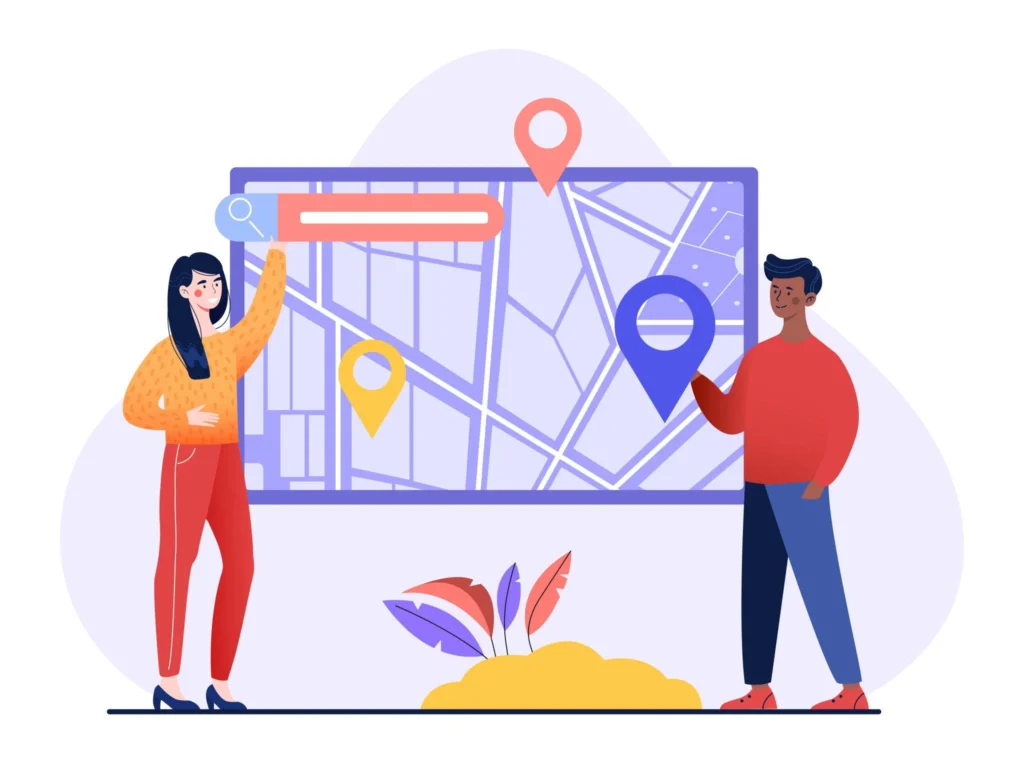
Keyword research for multiple locations is the process of finding, analyzing, and targeting search terms that include geographic intent across different cities, regions, or countries. It helps search engines clearly understand where your business operates and ensures your website appears in front of the right audience in the right location.
In simple terms, instead of targeting one broad keyword like: “digital marketing services”
You create multiple location-specific variations such as:
“digital marketing services in Chandigarh”
“digital marketing services in Mohali”
“digital marketing services in Ludhiana”
This allows your business to rank in multiple locations simultaneously, rather than competing globally for a single keyword.
Why This Concept Is Important
Search engines, especially Google have become highly location-aware. When a user searches for a service, Google tries to show results that are:
- Closest to the user
- Most relevant to the query
- Trusted within that specific area
For example, if someone in Punjab searches for “best gym”, Google will show gyms near their current location, not gyms from another state or country.
This means: If your website is not optimized with location-specific keywords, you may miss out on highly targeted local traffic.
Types of Location Intent
When users search on Google, their queries often carry location intent meaning they are looking for results relevant to a specific place. Understanding this intent is critical in multi-location keyword research because Google uses different logic to rank results based on how the location is expressed.
There are two main types of local search intent:
1. Explicit Local Intent: Explicit local intent occurs when the user clearly includes a location name in their search query. This makes it very easy for Google to understand where the user wants results from.
Examples:
- “SEO services in Amritsar”
- “Best dentist in Chandigarh”
- “Digital marketing agency Mohali”
- “Restaurants in Ludhiana”
In these searches, the location (Amritsar, Chandigarh, etc.) is directly mentioned.
How Google Processes Explicit Intent
When a user includes a location:
- Google prioritizes results within that specific area
- It may ignore the user’s current physical location
- It shows:
- Local business listings
- Google Map pack
- Organic location-specific pages
Example: If someone in Delhi searches “SEO services in Amritsar”, Google will show Amritsar-based results, not Delhi ones.
2. Implicit Local Intent: Implicit local intent occurs when the user does not mention a location, but Google automatically understands it based on their:
- GPS location
- IP address
- Device settings
- Search history
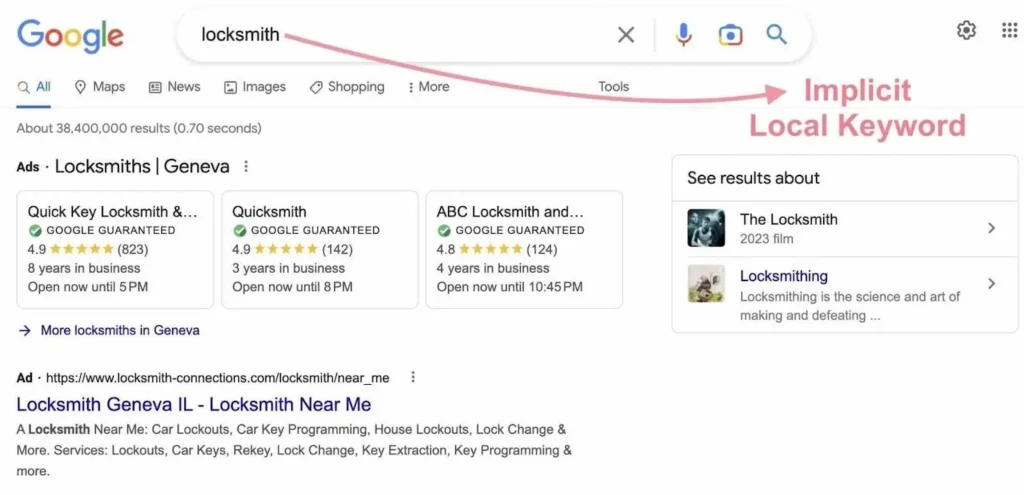
Examples:
- “SEO agency near me”
- “Best gym nearby”
- “Coffee shop open now”
- “Plumber”
Even without a location, Google assumes the user wants nearby results.
How Google Processes Implicit Intent
For implicit searches, Google uses advanced signals:
1. Location Detection: Mobile GPS, Wi-Fi signals, and IP address determine the user’s real-time location.
2. Context Understanding: Google analyzes previous searches, user behavior, and time of day to refine intent.
3. Result Display: Shows Google Map Pack, nearby businesses, reviews & ratings, and directions
Example: If you search “gym” in Chandigarh, Google shows gyms near your current location not gyms in another city.
Understanding both types is critical because Google treats them differently but ranks local businesses for both.
Why Keyword Research for Multiple Locations Matters
Reach More Local Customers
Each city or region has its own unique audience, search behavior, and demand patterns, which means people search differently depending on where they are.
By targeting multiple locations through keyword research, you can expand your visibility beyond a single area and connect with potential customers in different cities.
This approach allows businesses to tap into new markets, increase brand awareness, and attract highly relevant local traffic that is more likely to convert.
Improve Local Rankings
Google’s local search algorithm is primarily based on three key factors: relevance, distance, and prominence. When you optimize your content with location-specific keywords, you make it easier for Google to understand where your business operates and match it with relevant local searches.
This significantly increases your chances of appearing in local search results, including the highly visible Google Map Pack and top organic listings, ultimately improving your rankings across multiple locations.
Increase Conversion Rates
Local searches typically have strong intent, meaning users are often ready to take immediate action. For example, when someone searches for “plumber near me” or “best dentist in Chandigarh,” they are usually looking to hire a service or make a decision quickly.
By targeting these location-based keywords, you attract users who are closer to making a purchase, which leads to higher conversion rates and better return on investment.
Avoid Keyword Cannibalization
Without a clear keyword strategy, multiple pages on your website may end up targeting the same or very similar keywords, causing them to compete against each other in search results. This issue, known as keyword cannibalization, can weaken your overall SEO performance.
By using a structured multi-location keyword research approach, you can assign unique keyword clusters to each page, ensuring that every page serves a specific purpose and ranks effectively without internal competition.
Types of Local Keywords You Must Know
Understanding the different types of local keywords is essential for building a strong multi-location SEO strategy. Each keyword type targets a different kind of user intent, which means you need to use all of them strategically to capture traffic at every stage of the customer journey.
Geo-Modified Keywords (Location-Specific Keywords)
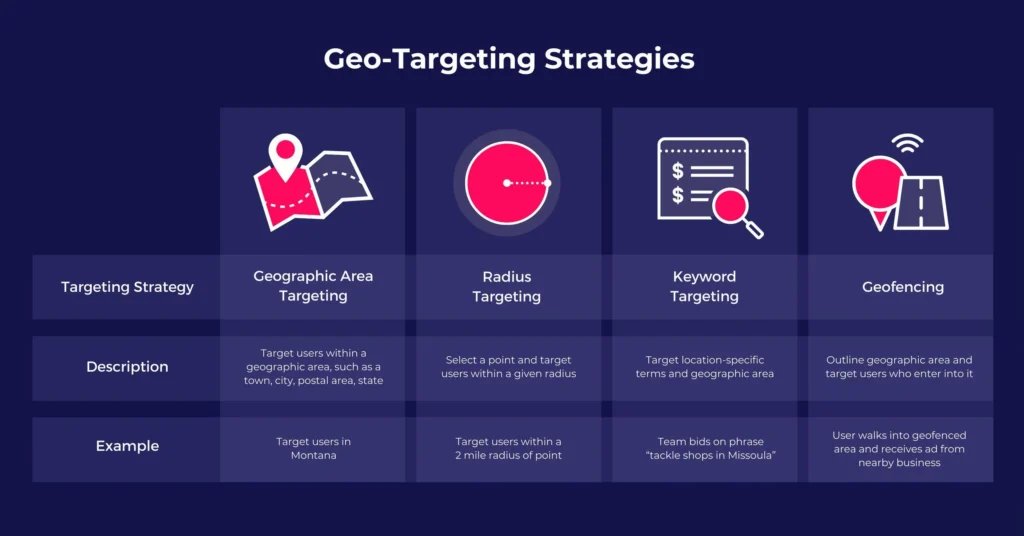
Geo-modified keywords are search queries that include a specific geographic location, such as a city, area, state, or even a neighborhood. These keywords clearly tell search engines where the user wants the service.
Examples
- “SEO company in Chandigarh”
- “Best café in Ludhiana”
- “Digital marketing agency in Mohali”
- “Gym in Sector 17 Chandigarh”
How They Work
When a user includes a location in their search, Google prioritizes results from that exact area. Even if the user is physically located somewhere else, Google will still show results based on the location mentioned in the query.
Example: If someone in Delhi searches “SEO services in Chandigarh”, Google will show Chandigarh-based businesses.
Implicit Local Keywords (“Near Me” & Location-Aware Searches)
Implicit local keywords are search queries that do not include a location, but Google understands the user’s intent based on their current location.
Examples
- “Restaurant near me”
- “Gym nearby”
- “Dentist open now”
- “Coffee shop”
How They Work
Google uses advanced signals to determine location:
- GPS (mobile devices)
- IP address
- Wi-Fi data
- Search history
Based on this, it shows nearby results automatically, even if no location is mentioned.
Example: If you search “gym” in Chandigarh, Google will show gyms near you in Chandigarh.
Service-Based Keywords (Transactional Keywords)
Service-based keywords focus on the specific service or product a user is searching for. These are often combined with location or urgency modifiers.
Examples
- “Emergency plumber Mohali”
- “24-hour electrician Punjab”
- “Affordable SEO services Chandigarh”
- “Best web design company in Amritsar”
How They Work
These keywords reflect strong buying intent, meaning users are actively looking to hire or purchase a service.
They often include:
- Service name
- Location (optional)
- Intent modifiers (best, affordable, emergency)
Informational Local Keywords (Top-of-Funnel Keywords)
Informational local keywords are used by people who are looking for information related to a specific location, rather than immediately buying something.
Examples
- “Best schools in Chandigarh”
- “How to choose a dentist in Amritsar”
- “Top places to visit in Punjab”
- “Cost of SEO services in Mohali”
How They Work
These searches are usually part of the research phase of the customer journey. Users are exploring options, comparing services, or learning before making a decision.
Key Difference Between All Types
| Keyword Type | Purpose | Intent Level | Best Use |
| Geo-Modified | Target specific location | High | Location pages |
| Implicit Local | Target nearby users | Very High | Local SEO (GBP) |
| Service-Based | Focus on service + action | Very High | Service pages |
| Informational | Provide knowledge | Medium | Blog content |
Step-by-Step Guide to Keyword Research for Multiple Locations
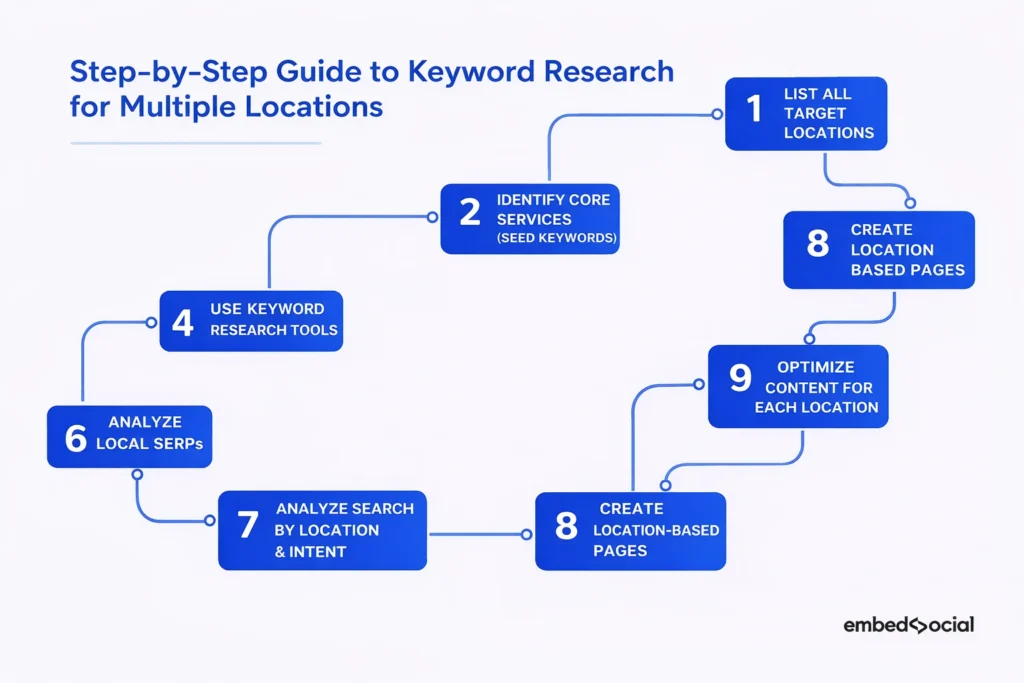
Step 1: List All Target Locations
The first step is to identify every location where you want your business to appear in search results. This includes breaking down your target areas into multiple levels such as countries, states, cities, and even specific neighborhoods.
A well-structured location list helps you create a strong foundation for your SEO strategy and ensures that you don’t miss potential opportunities in smaller or less competitive areas. The more detailed your targeting, the easier it becomes to rank for specific searches and attract highly relevant traffic.
Include:
- Countries (e.g., India)
- States (e.g., Punjab)
- Cities (e.g., Chandigarh, Mohali)
- Neighborhoods (e.g., Sector 17 Chandigarh)
Example:
India → Punjab → Chandigarh → Sector 17
Step 2: Identify Core Services (Seed Keywords)
Once you have your locations, the next step is to define your core services or products. These are known as seed keywords and act as the base for your entire keyword research process.
By clearly identifying what your business offers, you can combine these services with different locations to generate a wide range of keyword ideas.
Examples of Seed Keywords:
- SEO services
- Web design
- PPC advertising
- Content marketing
Why It Matters:
- Forms the foundation of keyword research
- Helps maintain focus on business goals
- Makes scaling easier across multiple locations
Step 3: Create a Keyword Combination Grid
This step involves combining your seed keywords with locations and intent modifiers to create a structured keyword list. Instead of manually searching for keywords, this method allows you to generate hundreds of keyword variations quickly and efficiently.
Formula: Service + Location + Modifier
Examples:
- “SEO services in Chandigarh”
- “Affordable SEO services in Mohali”
- “Best digital marketing agency in Punjab”
Benefits:
- Saves time
- Ensures full keyword coverage
- Creates scalable keyword strategy
Step 4: Use Keyword Research Tools
After generating keyword ideas, you need to validate them using SEO tools. These tools help you understand how often people search for a keyword, how competitive it is, and what related keywords you can target. Always apply location filters to get accurate data for each city or region.
Popular Tools: Like Google Keyword Planner, Ahrefs, SEMrush, Ubersuggest etc
What to Check: Search volume, Keyword difficulty, Related keywords, Trends
Step 5: Analyze Search Volume & Competition
Not all keywords are worth targeting, so it’s important to evaluate each one based on its potential. Look for keywords that have a good balance of search volume and competition, while also matching user intent. This ensures you are targeting keywords that can actually bring traffic and conversions.
Focus On:
- High or moderate search volume
- Low to medium competition
- Strong intent (buying or inquiry)
Example:
- “SEO services Chandigarh” → High competition
- “Affordable SEO services Chandigarh” → Easier to rank
Step 6: Analyze Local SERPs
Before finalizing your keywords, search them on Google and analyze the results page (SERP). This helps you understand what type of content is ranking and what Google prefers for that keyword. You should also study your competitors to identify opportunities and gaps.
Analyze:
- Top-ranking websites
- Google Map Pack results
- Content type (service page, blog, directory)
- Competitor strategies
Goal: Create better and more relevant content than competitors.
Step 7: Cluster Keywords by Location & Intent
Grouping keywords into clusters is essential to avoid confusion and improve SEO performance. Instead of targeting one keyword per page, you group similar keywords together and target them on a single page. This improves relevance and prevents keyword cannibalization.
Example Cluster (Chandigarh):
- SEO services Chandigarh
- Best SEO company Chandigarh
- Affordable SEO Chandigarh
Benefits: Better rankings, Clear content structure, Avoids duplicate targeting
Step 8: Create Location-Based Pages
Now, create dedicated pages for each location based on your keyword clusters. Each page should focus on one location and provide valuable, relevant information for users in that area.
Example URLs:
- /seo-services-chandigarh/
- /seo-services-mohali/
- /seo-services-ludhiana/
Important: Avoid duplicate content→ Keep each page unique and location-specific
Step 9: Optimize Content for Each Location
Once your pages are created, optimize them with local SEO elements to improve rankings. The goal is to clearly signal to Google that your page is relevant to a specific location.
Include:
- Location in title and headings
- Unique, high-quality content
- Local testimonials or case studies
- Google Maps embed
- Local keywords naturally in content
Result: Higher relevance → Better rankings → More local traffic
Step 10: Track Performance by Location
The final step is to monitor how your location-based pages are performing. SEO is an ongoing process, so tracking data helps you understand what’s working and what needs improvement.
Track:
- Keyword rankings (per city)
- Organic traffic
- Conversion rates
- User behavior
Tools: Google Analytics→ Google Search Console
Goal: Optimize continuously and scale successful locations.
Advanced Strategies (Deep Research Insights)
Use Location Taxonomy Structure
A location taxonomy structure organizes your website in a clear hierarchical format such as country → state → city → area, which helps search engines better understand your geographic targeting and improves overall crawlability.
Instead of creating random pages, this structured approach ensures that each page is logically connected, making it easier for both users and search engines to navigate your website.
For example, a structured URL like /india/punjab/chandigarh/sector-17/ clearly signals relevance at multiple location levels. This not only strengthens SEO but also allows you to scale your website efficiently when targeting multiple regions.
Avoid Keyword Cannibalization
Keyword cannibalization occurs when multiple pages on your website target the same keyword, causing them to compete against each other in search results. This confuses search engines and weakens your ranking potential because Google cannot determine which page is most relevant.
To avoid this, each page should be assigned a unique keyword cluster with a clear focus. By mapping keywords properly and ensuring no overlap between pages, you create a more organized SEO strategy that improves visibility and ensures each page performs at its full potential.
Build Strong Internal Linking
Internal linking plays a crucial role in multi-location SEO by connecting related pages across your website and distributing authority effectively. By linking location pages to service pages and also connecting nearby location pages, you help search engines discover your content more easily and understand the relationship between different pages.
For example, a Chandigarh service page can link to Mohali and Ludhiana pages, creating a strong network of relevant content. This not only improves crawlability but also enhances user experience by guiding visitors to related information, increasing engagement and time spent on your site.
Focus on Hyperlocal Keywords
Hyperlocal keywords target very specific areas within a city, such as neighborhoods, sectors, or landmarks, making them highly effective for capturing users with strong intent. These keywords usually have lower competition compared to broader terms, which makes them easier to rank for while delivering higher conversion rates.
For instance, targeting a keyword like “SEO services in Sector 17 Chandigarh” allows you to reach a very specific audience that is more likely to take action. Incorporating hyperlocal terms into your content, headings, and pages can significantly improve your visibility in smaller, high-value search segments.
Optimize for “Near Me” Searches
“Near me” searches are driven by user location and are extremely common on mobile devices. To rank for these queries, you need to optimize your online presence for local signals, especially through your Google Business Profile.
Ensuring that your business information is accurate, complete, and consistent helps Google match your business with nearby searches. Additionally, having a mobile-friendly website, fast loading speed, and positive customer reviews further improves your chances of appearing in local map results. By focusing on these elements, you can capture high-intent users who are actively looking for services nearby and ready to convert.
Common Mistakes to Avoid in Multi-Location Keyword Research
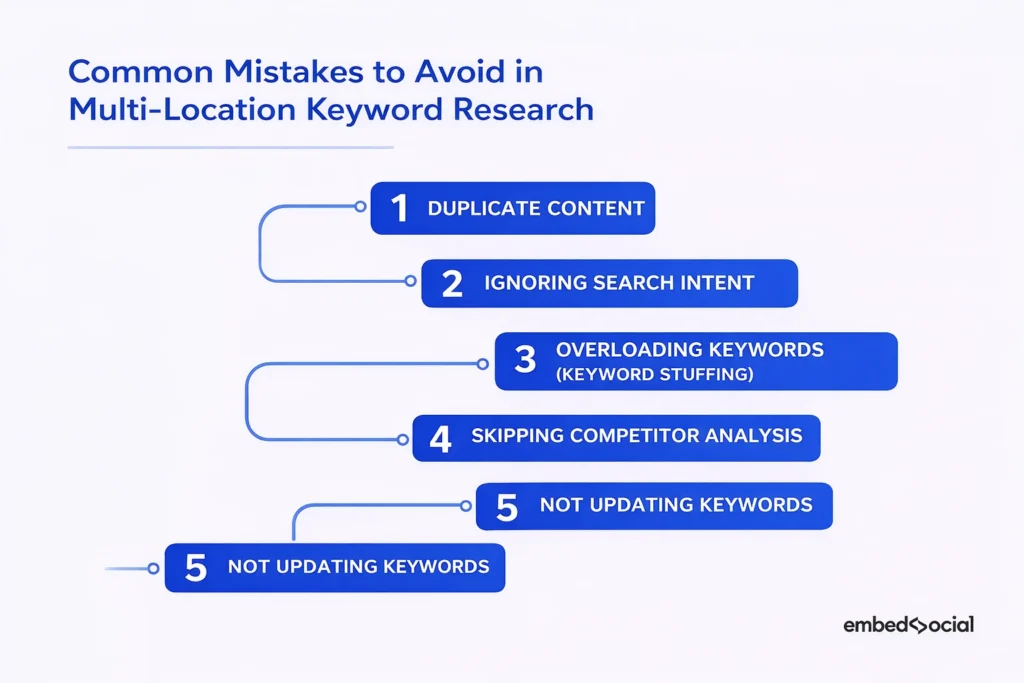
Avoiding common mistakes is just as important as following the right strategy. Many websites fail to rank in multiple locations not because they lack effort, but because they unknowingly make critical SEO errors. Below are the most common mistakes explained in detail, along with actionable points to help you avoid them.
1. Duplicate Content
Creating multiple location pages with the same or slightly modified content is one of the biggest mistakes in multi-location SEO. Many businesses simply replace the city name while keeping the rest of the content identical.
However, search engines like Google can easily detect duplicate or thin content, which can harm your rankings or even prevent your pages from being indexed properly.
Instead, each location page should provide unique, valuable, and location-specific information that genuinely helps users in that area.
Avoid This:
- Copy-pasting the same content for different cities
- Only changing the city name in headings
- Using generic content with no local relevance
Do This Instead:
- Write unique content for each location
- Add local details (landmarks, areas, audience needs)
- Include location-specific testimonials or case studies
2. Ignoring Search Intent
Another common mistake is focusing only on keywords without understanding the intent behind them. Not all keywords are meant for selling; some users are just looking for information, comparisons, or guidance. If your content doesn’t match the user’s intent, it won’t rank well or convert visitors.
For example, someone searching “best SEO company in Chandigarh” is likely ready to hire, while someone searching “how SEO works in Chandigarh” is still in the research phase.
Avoid This:
- Treating all keywords the same
- Targeting informational keywords with sales pages
- Ignoring user needs behind the search
Do This Instead:
- Identify intent (informational, transactional, navigational)
- Create blog content for informational queries
- Use service pages for high-intent keywords
3. Overloading Keywords (Keyword Stuffing)
Using too many keywords on a single page can make your content look unnatural and spammy. In the past, keyword stuffing worked, but modern search engines prioritize content quality and readability. Overusing keywords can lead to poor user experience and may negatively impact your rankings.
Instead, focus on writing natural, helpful content where keywords are used strategically.
Avoid This:
- Repeating the same keyword excessively
- Forcing keywords into every sentence
- Adding irrelevant keyword variations
Do This Instead:
- Use keywords naturally in headings and content
- Focus on readability and user experience
- Include related terms (LSI keywords) instead of repetition
4. Skipping Competitor Analysis
Ignoring competitors means missing out on valuable insights. Your competitors have already done part of the work by ranking for certain keywords, so analyzing them can help you understand what works and what doesn’t.
By studying competitor pages, you can identify gaps and create better, more optimized content.
Avoid This:
- Creating content without research
- Ignoring top-ranking pages
- Not analyzing competitor strategies
Do This Instead:
- Study top 10 Google results for your keywords
- Analyze their content length, structure, and keywords
- Identify gaps and improve your content
5. Not Updating Keywords
SEO is not a one-time process. Search trends, user behavior, and competition change over time. If you don’t update your keywords and content regularly, your rankings may drop and you may lose traffic.
Regular updates ensure your content stays relevant and competitive.
Avoid This:
- Using outdated keyword data
- Ignoring new trends and opportunities
- Not refreshing old content
Do This Instead:
- Re-analyze keywords every few months
- Update content with new data and trends
- Add new keywords and improve existing pages
Example of Multi-Location Keyword Strategy
A multi-location keyword strategy helps businesses target different cities by creating separate keyword clusters and dedicated pages for each location. Instead of using one generic page for all areas, this approach ensures that every city has its own focused content, which improves rankings, relevance, and conversions.
Let’s understand this with a detailed example of a digital marketing agency targeting multiple cities in Punjab.
Business Example: Digital Marketing Agency
Imagine you run a digital marketing agency that offers services like SEO, PPC, and social media marketing across multiple cities. Your goal is to rank in different locations such as Chandigarh, Mohali, and Ludhiana.
Instead of targeting all cities on one page, you create a structured keyword and content strategy for each location.
Step 1: Define Location-Based Keyword Clusters
Each location should have its own set of keywords based on services and user intent. This helps Google clearly understand which page is relevant for which city.
Chandigarh Cluster:
- SEO services Chandigarh
- Digital marketing agency Chandigarh
- Best SEO company Chandigarh
- Affordable digital marketing Chandigarh
These keywords target users specifically searching for services in Chandigarh.
Mohali Cluster:
- SEO agency Mohali
- Digital marketing company Mohali
- PPC services Mohali
- Social media marketing Mohali
Even though Mohali is close to Chandigarh, it still requires separate targeting due to different search behavior.
Ludhiana Cluster:
- PPC services Ludhiana
- SEO company Ludhiana
- Digital marketing services Ludhiana
- Online marketing agency Ludhiana
Each city has different competition levels and keyword demand.
Step 2: Create Dedicated Pages for Each Location
After defining keyword clusters, the next step is to create separate landing pages for each location. Each page should focus only on one city and its related keywords.
Example Website Structure:
- /seo-services-chandigarh/
- /digital-marketing-mohali/
- /ppc-services-ludhiana/
Why This Works:
- Improves local relevance
- Helps rank in city-specific searches
- Avoids keyword cannibalization
Step 3: Optimize Each Page with Local Relevance
Each location page should be optimized with unique content that reflects the local audience, needs, and search behavior.
Include on Each Page:
- City name in title and headings
- Unique service descriptions
- Local keywords naturally in content
- Testimonials from that city (if possible)
- Google Maps embed for that location
Example: A Chandigarh page might mention local business hubs like Sector 17 or IT Park, making it more relevant.
Step 4: Match Keywords with Search Intent
Not all keywords serve the same purpose, so each page should target a mix of intent types.
Types of Keywords to Use:
- Transactional: “SEO services Chandigarh”
- Commercial: “Best SEO company Mohali”
- Informational (for blogs): “How digital marketing helps businesses in Ludhiana”
This ensures you attract users at different stages of the buying journey.
Step 5: Internal Linking Between Location Pages
To strengthen your SEO, link your location pages to each other in a natural way.
Example:
- Chandigarh page links to Mohali and Ludhiana pages
- Blog posts link to relevant location pages
Benefits:
- Improves website structure
- Helps search engines crawl pages better
- Distributes authority across pages
Step 6: Track Performance for Each Location
After implementing the strategy, track how each location page performs. This helps you understand which cities are bringing the most traffic and conversions.
Track Metrics:
- Keyword rankings per city
- Organic traffic by location
- Leads or conversions
- Bounce rate and engagement
Example Insight:
- Chandigarh page may rank faster due to higher demand
- Mohali page may have lower competition and convert better
Conclusion
Keyword research for multiple locations is no longer optional; it’s a necessity for businesses that want to grow beyond a single region. By targeting location-specific keywords, understanding search intent, and creating dedicated pages for each area, you can significantly improve your visibility in local search results.
This approach not only helps you attract more relevant traffic but also connects you with users who are actively searching for services in their area.
In the long run, success in multi-location SEO comes down to consistency, strategy, and continuous optimization. By avoiding common mistakes, leveraging advanced techniques, and regularly updating your keyword strategy, you can build a scalable system that drives traffic, leads, and conversions across multiple cities.
When done correctly, this strategy allows your business to dominate local search results and stay ahead of the competition.
FAQs (Frequently Asked Questions)
1. What is multi-location keyword research?
Multi-location keyword research is the process of finding keywords that target different cities, regions, or areas to rank in multiple locations.
2. Why is location-based keyword research important?
It helps businesses reach local customers, improve rankings in specific areas, and increase conversions from high-intent searches.
3. How do I find keywords for different cities?
You can combine your services with city names and use tools like Google Keyword Planner, Ahrefs, or SEMrush to find data.
4. What are geo-modified keywords?
These are keywords that include a location, such as “SEO services in Chandigarh.”
5. What is the difference between explicit and implicit local keywords?
Explicit keywords include a location (e.g., “dentist in Mohali”), while implicit keywords rely on user location (e.g., “dentist near me”).
6. How many location pages should I create?
Create one page per location, but only if you can provide unique and valuable content for each.
7. What is keyword cannibalization in local SEO?
It happens when multiple pages target the same keyword, causing them to compete and reduce rankings.
8. Can I use the same content for different location pages?
No, duplicate content can harm SEO. Each page should have unique, location-specific content.
9. How do “near me” searches work?
Search engines use GPS, IP address, and user data to show nearby results even if no location is mentioned.
10. Which tools are best for multi-location keyword research?
Popular tools include Google Keyword Planner, Ahrefs, SEMrush, and Ubersuggest.
11. How do I optimize a page for a specific location?
Use the location in titles, headings, content, and include local elements like maps and testimonials.
12. What are hyperlocal keywords?
These target very specific areas like neighborhoods, e.g., “SEO services in Sector 17 Chandigarh.”
13. How long does it take to rank in multiple locations?
It depends on competition, but typically takes 3–6 months with consistent SEO efforts.
14. How do I track performance for different locations?
Use tools like Google Analytics and Search Console to monitor traffic, rankings, and conversions by location.