

Healthcare has become increasingly competitive as more medical practices establish an online presence to attract new patients. Today, most people rely on search engines before choosing a doctor or clinic.
Whether they are looking for a dentist, dermatologist, pediatrician, orthopedic specialist, cardiologist, or general physician, their journey often begins with a simple Google search.
Patients compare clinics based on reviews, location, services, and availability before making an appointment, making online visibility more important than ever.
This is where Google Ads for doctors becomes a valuable digital marketing tool. Instead of waiting months for your website to improve its organic search rankings through SEO, Google Ads allows your practice to appear at the top of Google search results almost immediately.
Your advertisements are shown to people who are actively searching for the healthcare services you offer, helping you connect with patients at the exact moment they need medical care. This targeted approach increases the chances of attracting qualified leads who are more likely to schedule an appointment.
When managed effectively, Google Ads can generate a steady flow of high-quality patient inquiries while giving you complete control over your advertising budget. It helps increase appointment bookings, improve your clinic’s visibility in local search results, strengthen your online presence, and deliver measurable returns on investment through detailed performance tracking.
Whether you run a private clinic, a multi-specialty hospital, or a specialized healthcare practice, Google Ads can support your patient acquisition goals and help your practice grow in a highly competitive market.
In this comprehensive guide, you’ll learn everything you need to know about Google Ads for doctors, including how it works, the different campaign types available, the step-by-step setup process, estimated advertising costs, keyword selection, optimization strategies, best practices for improving campaign performance, and the common mistakes you should avoid to maximize your return on investment.
What Are Google Ads for Doctors?

Google Ads for doctors is a digital advertising solution that enables medical professionals, clinics, hospitals, and healthcare providers to promote their services across Google’s platforms, including Google Search, Google Maps, YouTube, Gmail, and millions of partner websites. It helps healthcare providers reach potential patients who are actively searching online for medical services, consultations, or treatments.
Google Ads operates on a Pay-Per-Click (PPC) model, which means doctors only pay when someone clicks on their advertisement. Instead of spending money on traditional advertising methods that reach a broad audience, PPC focuses on people who have already expressed interest by searching for relevant healthcare services. This makes Google Ads a highly cost-effective marketing channel for medical practices looking to attract qualified patients.
Unlike traditional advertising through newspapers, radio, or billboards, Google Ads targets users based on their search intent. When someone searches for a doctor or a specific medical treatment, your advertisement can appear at the top of Google’s search results before the organic listings. This gives your practice immediate visibility and increases the chances of receiving appointment requests from patients who are ready to seek medical care.
For example, your clinic’s advertisement may appear when potential patients search for terms such as:
- Dentist near me
- Best pediatrician in my city
- Skin specialist consultation
- Orthopedic doctor appointment
- Family physician nearby
- Eye doctor near me
- Cardiologist consultation
- Emergency dental clinic
Google Ads also offers advanced targeting options that allow you to display advertisements only to people within your service area. You can target specific cities, neighborhoods, ZIP codes, or even a defined radius around your clinic, ensuring your marketing budget is spent reaching patients who are most likely to visit your practice.
By connecting your services with people at the exact moment they are searching for medical care, Google Ads helps increase website traffic, generate qualified patient leads, improve appointment bookings, and strengthen your clinic’s online presence in a competitive healthcare market.
Why Doctors Should Use Google Ads
Many medical practices depend on patient referrals, word-of-mouth recommendations, or social media marketing to attract new patients. While these channels remain valuable, they often have limited reach and may not consistently generate new appointments. Google Ads offers a more direct and measurable way to connect with people who are actively searching for medical care. Since these users already have a healthcare need, they are more likely to contact your clinic or book an appointment, making Google Ads one of the most effective digital marketing tools for doctors.
1. Reach Patients with High Intent
One of the biggest advantages of Google Ads is its ability to target people with high purchase intent. Unlike social media users who may simply be browsing, people searching for healthcare services on Google are often looking for immediate medical assistance or planning to schedule a consultation. By displaying your advertisement at the right time, Google Ads helps your clinic connect with potential patients who are ready to take action.
2. Appear Above Organic Search Results
Ranking on the first page of Google through SEO can take several months, especially in competitive healthcare markets. Google Ads allows your practice to appear above the organic search results almost instantly. This increased visibility helps your clinic stand out from competitors and gives patients a better chance of finding your services first. It is especially beneficial for new clinics or practices that are still building their online presence.
3. Target Local Patients
Most healthcare providers serve patients within a specific geographic area, making local targeting essential for successful advertising. Google Ads allows you to show your advertisements only to people located in the areas you serve, helping you reach the right audience while avoiding unnecessary advertising costs.
You can target:
- Specific cities
- ZIP or postal codes
- A custom radius around your clinic
- Selected neighborhoods or service areas
This precise targeting ensures your marketing budget is spent on attracting patients who are most likely to visit your practice.
4. Control Your Advertising Budget
Google Ads gives doctors complete control over their advertising expenses. Whether you run a small private clinic or a large healthcare center, you can create campaigns that fit your marketing budget. There are no long-term contracts, and you can increase, decrease, pause, or stop your campaigns whenever needed.
You can control:
- Daily advertising budget
- Monthly advertising budget
- Maximum cost-per-click bid
- Campaign duration and schedule
This flexibility allows you to invest according to your practice’s goals and financial resources.
5. Track Every Conversion
Unlike traditional advertising methods, Google Ads provides detailed performance reports that help you measure the success of your campaigns. You can see exactly how patients interact with your advertisements and identify which campaigns generate the best results.
Google Ads can track important actions such as:
- Phone calls
- Online appointment bookings
- Website visits
- Contact form submissions
- Clicks for directions through Google Maps
- Cost per patient acquisition
These insights help you optimize your campaigns over time, improve your return on investment, and make informed decisions about your healthcare marketing strategy.
Benefits of Google Ads for Doctors
Google Ads offers numerous advantages for doctors and healthcare providers looking to grow their practice and attract more patients. Unlike many traditional marketing methods, Google Ads targets people who are actively searching for medical services, making it easier to connect with patients who are ready to book an appointment. From increasing online visibility to delivering measurable results, Google Ads provides a flexible and cost-effective way to promote your clinic and achieve your business goals.
1, Increased Appointment Bookings
One of the biggest benefits of Google Ads is its ability to generate more appointment requests. Your advertisements appear when potential patients search for specific medical services, treatments, or specialists, allowing your clinic to reach people with an immediate healthcare need.
Because these users are already looking for a doctor, they are more likely to contact your practice, complete an online booking form, or call your clinic.
This targeted approach helps increase the number of qualified patient inquiries and appointments. This targeted approach helps increase the number of qualified patient inquiries and appointments, while a QR code for location makes it easier for patients to find your clinic.
2. Immediate Online Visibility
Building organic visibility through SEO is a long-term strategy that often takes several months before producing noticeable results. Google Ads, however, provides immediate exposure.
Once your campaign is approved, your advertisements can begin appearing at the top of Google search results for relevant keywords.
This instant visibility is especially valuable for new clinics, recently launched medical practices, or doctors introducing new services, as it helps them reach potential patients without waiting for organic rankings to improve.
3. Better Return on Investment
Google Ads allows you to target highly relevant keywords and specific audiences, ensuring that your advertising budget is spent on users who are genuinely interested in your services.
Since your ads are shown to people actively searching for medical care, the traffic you receive is typically more qualified than traffic from many other advertising channels.
With proper campaign management, keyword optimization, and conversion tracking, doctors can achieve a strong return on investment while minimizing wasted ad spend.
4. Stronger Brand Recognition
Even if users do not click on your advertisement during their first search, seeing your clinic appear consistently in Google search results helps build familiarity and trust. Over time, repeated exposure increases brand recognition and makes your practice more memorable.
When patients are ready to choose a healthcare provider, they are often more likely to select a clinic they have seen multiple times, giving your practice a competitive advantage.
5. Flexible Campaign Management
Google Ads provides complete flexibility, allowing you to manage your campaigns according to your goals and budget. You can start with a small advertising budget, test different keywords, update ad copy, target new locations, or promote additional medical services whenever needed.
Campaigns can be paused, adjusted, or expanded at any time without long-term commitments, making Google Ads an adaptable marketing solution for both small private practices and large healthcare organizations.
Types of Google Ads for Medical Practices
Different campaign types serve different marketing goals.
1. Search Ads
Search ads appear at the top of Google search results.
These work best for:
- Dentists
- Dermatologists
- Gynecologists
- Orthopedic clinics
- Pediatricians
- Eye specialists
- General physicians
Example:
Best Cardiologist Near Me
Your clinic appears above organic listings.
2. Local Search Ads
Local campaigns promote nearby clinics through:
- Google Maps
- Local search
- Mobile searches
These campaigns help increase:
- Walk-in patients
- Direction requests
- Phone calls
3. Display Ads
Display ads appear on millions of websites.
Doctors use them for:
- Brand awareness
- Health awareness campaigns
- Remarketing previous visitors
4. Video Ads
YouTube ads help educate patients while promoting healthcare services.
Popular topics include:
- Cosmetic procedures
- Dental treatments
- Eye surgeries
- Health tips
- Preventive care
5. Performance Max Campaigns
Performance Max campaigns use AI to display ads across:
- Search
- Maps
- Gmail
- Display Network
- Discover
- YouTube
These campaigns simplify advertising while maximizing reach.
How Google Ads Works for Doctors
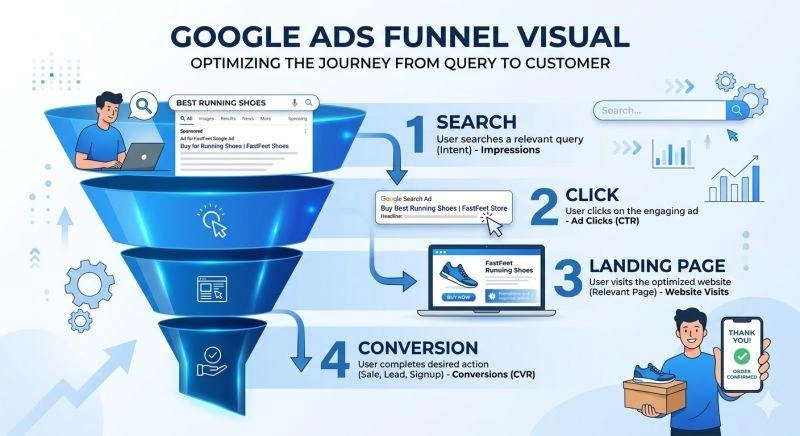
Google Ads follows a straightforward process that helps doctors connect with patients who are actively searching for healthcare services.
A successful campaign involves selecting the right keywords, creating engaging advertisements, directing visitors to relevant landing pages, and tracking patient actions to measure performance.
When each step is planned carefully, Google Ads can generate high-quality leads, increase appointment bookings, and deliver a strong return on investment.
Step 1: Keyword Selection
The first step in creating a successful Google Ads campaign is selecting the keywords that potential patients are most likely to search for.
Choosing the right keywords ensures your advertisements appear in front of people who are actively looking for the medical services you provide.
Focusing on specific, high-intent keywords can improve click-through rates and increase the chances of converting visitors into patients.
Examples of effective keywords include:
- Family doctor near me
- Emergency dentist
- Pediatric clinic
- Skin treatment clinic
- Dentist appointment
- Orthopedic surgeon
- Eye specialist near me
- Cardiologist consultation
You can also include location-based keywords such as “dentist in Mumbai” or “pediatrician in Delhi” to attract nearby patients and improve local visibility.
Step 2: Create Compelling Ads
Once you’ve selected your keywords, the next step is creating advertisements that encourage users to click. Your ad should clearly communicate the services you offer while highlighting what makes your clinic different from competitors.
Including trust-building elements such as years of experience, same-day appointments, or specialized treatments can increase the effectiveness of your ads.
An effective Google Ads campaign typically includes:
- Clinic or hospital name
- Primary medical service
- Clinic location
- Unique selling points
- A strong call to action
Example Ad:
Experienced Pediatrician in Delhi
Same-Day Appointments Available
Book Your Visit Today
Clear, concise, and informative ad copy helps attract qualified patients who are ready to schedule a consultation.
Step 3: Landing Page
After users click your advertisement, they should be directed to a dedicated landing page instead of your website’s homepage.
A well-designed landing page provides detailed information about the specific service mentioned in the ad, making it easier for patients to find the information they need and take action.
A high-converting landing page should include:
- Doctor’s profile and qualifications
- Medical services offered
- Patient reviews and testimonials
- Clinic address and contact information
- Online appointment booking form
- High-quality clinic and doctor images
- Business hours and consultation details
The landing page should also load quickly, be mobile-friendly, and feature clear call-to-action buttons such as “Book an Appointment” or “Call Now” to improve conversion rates.
Step 4: Conversion Tracking
The final step is tracking the actions patients take after interacting with your advertisements. Conversion tracking helps you measure campaign performance and understand which ads, keywords, and landing pages generate the best results.
These insights allow you to optimize your campaigns, improve patient acquisition, and make better use of your advertising budget.
Important conversions to track include:
- Phone calls
- Appointment form submissions
- WhatsApp message clicks
- Online appointment bookings
- Direction requests through Google Maps
- Website contact form submissions
Regularly monitoring these metrics enables doctors to identify successful campaigns, eliminate underperforming keywords, and continuously improve their Google Ads strategy for better long-term results.
Best Keywords for Google Ads for Doctors
Keyword selection determines campaign success.
Examples include:
General Keywords
- doctor near me
- best doctor
- family physician
- clinic near me
- healthcare clinic
Specialty Keywords
- dentist near me
- dermatologist consultation
- orthopedic doctor
- ENT specialist
- eye specialist
- pediatrician appointment
Treatment Keywords
- dental implants
- acne treatment
- physiotherapy
- root canal treatment
- knee replacement consultation
Long-tail keywords often generate better conversion rates because they match specific patient needs.
How Much Does Google Ads Cost for Doctors?
The cost of Google Ads for doctors can vary significantly depending on several factors, including your medical specialty, location, competition, and the keywords you choose to target.
Since Google Ads operates on a Pay-Per-Click (PPC) model, you only pay when someone clicks on your advertisement. This means your overall advertising cost depends on the number of clicks your ads receive and the cost of each click.
Some medical specialties are more competitive than others, resulting in higher advertising costs. For example, specialties such as cosmetic dentistry, plastic surgery, dermatology, orthodontics, and orthopedic care often have higher cost-per-click rates because many clinics compete for the same high-value keywords.
On the other hand, less competitive specialties may have lower advertising costs while still attracting qualified patients.
Several factors influence how much you’ll spend on Google Ads, including:
- Medical specialty: Competitive specialties generally have higher advertising costs.
- Competition: The more advertisers bidding on the same keywords, the higher the cost per click.
- City or location: Advertising in large metropolitan areas usually costs more than in smaller towns due to greater competition.
- Keyword demand: Popular search terms with high patient demand typically have higher bidding prices.
- Quality Score: Google rewards well-optimized ads and relevant landing pages with better Quality Scores, which can reduce your cost per click and improve ad placement.
In addition to these factors, your overall campaign budget is influenced by:
- Daily advertising budget
- Monthly advertising budget
- Bid strategy
- Geographic targeting
- Ad relevance
- Landing page quality
- Conversion rate
One of the biggest advantages of Google Ads is its flexibility. Doctors can set their own spending limits and adjust campaigns based on performance.
Many clinics begin with a moderate monthly budget to test different keywords, advertisements, and targeting options.
After identifying which campaigns generate the highest number of appointment bookings and the best return on investment, they gradually increase their advertising budget to reach more potential patients.
Regularly monitoring campaign performance, improving ad quality, refining keyword targeting, and optimizing landing pages can help reduce advertising costs while maximizing patient acquisition and overall marketing success.
Best Practices for Successful Google Ads Campaigns
Common Mistakes Doctors Should Avoid
Although Google Ads can be highly effective for attracting new patients, many medical practices fail to achieve the desired results because of common and avoidable mistakes. Poor campaign setup, ineffective targeting, and lack of optimization can quickly increase advertising costs without generating enough appointments.
Understanding these mistakes and addressing them early can help doctors improve campaign performance, maximize their return on investment, and make better use of their marketing budget.
Targeting Broad Keywords
Using broad or generic keywords can attract visitors who are not looking for your specific medical services. For example, targeting a keyword like “doctor” may bring irrelevant traffic from users searching for general health information rather than someone looking to book an appointment. Instead, focus on specific, high-intent keywords such as “pediatrician near me,” “orthopedic doctor consultation,” or “family physician in [city]” to reach patients who are more likely to convert.
Sending Traffic to the Homepage
Many clinics direct all ad traffic to their homepage, which may not provide the information patients are looking for. Instead, each advertisement should lead to a dedicated landing page related to the specific service being promoted.
For example, an ad about dental implants should direct users to a dental implant service page rather than the general homepage. A relevant landing page improves the user experience and increases the likelihood of appointment bookings.
Ignoring Mobile Optimization
Most patients search for doctors using smartphones and tablets. If your website loads slowly, is difficult to navigate, or has forms that are hard to complete on mobile devices, visitors may leave before contacting your clinic.
Ensuring that your website is mobile-friendly, fast-loading, and easy to use is essential for improving conversions.
Running Ads Without Conversion Tracking
Without conversion tracking, it is impossible to know whether your advertising campaigns are generating real business results.
Google Ads allows you to track valuable actions such as phone calls, appointment bookings, contact form submissions, and clicks for directions. Monitoring these metrics helps identify which campaigns and keywords deliver the highest return on investment.
Using Weak Call-to-Action Phrases
Your advertisements should encourage potential patients to take immediate action. Generic phrases like “Learn More” may not create enough urgency. Strong calls to action such as “Book Your Appointment Today,” “Schedule a Consultation,” “Call Our Clinic Now,” or “Request Same-Day Appointment” are more likely to increase clicks and conversions.
Not Updating Negative Keywords
Negative keywords prevent your advertisements from appearing for irrelevant searches. If they are not reviewed and updated regularly, your ads may be shown to users who are not interested in your services, leading to unnecessary clicks and wasted advertising spend. Regularly analyzing search terms and adding new negative keywords helps improve campaign efficiency.
Forgetting Local Targeting
Most doctors and healthcare providers serve patients within a specific geographic area. Advertising outside your service region can result in clicks from users who are unlikely to visit your clinic.
Google Ads allows you to target specific cities, neighborhoods, ZIP codes, or a defined radius around your practice, ensuring your budget is focused on attracting local patients who can realistically schedule an appointment.
By avoiding these common mistakes and regularly monitoring campaign performance, doctors can improve ad quality, reduce unnecessary spending, attract more qualified patients, and achieve better long-term results from their Google Ads campaigns.
Google Ads vs SEO for Doctors
| Google Ads | SEO |
| Immediate visibility | Long-term growth |
| Paid traffic | Free organic traffic |
| Quick patient acquisition | Sustainable traffic |
| Budget controlled | Requires ongoing optimization |
| Instant results | Results take months |
The most effective strategy is combining Google Ads with SEO. Ads generate immediate appointments, while SEO builds long-term online authority and reduces dependency on paid advertising.
Future Trends in Google Ads for Doctors
Digital healthcare marketing is evolving rapidly as artificial intelligence, machine learning, and automation continue to reshape how online advertising works.
Google regularly introduces new features that help advertisers reach the right audience more efficiently while improving campaign performance. For doctors and healthcare providers, staying updated with these advancements can lead to better patient acquisition, higher conversion rates, and more effective use of advertising budgets.
Several emerging trends are expected to influence the future of Google Ads for doctors, making campaigns smarter, more personalized, and easier to manage.
AI-Powered Bidding Strategies
Google’s AI-driven bidding strategies automatically adjust bids based on factors such as user behavior, device, location, and the likelihood of conversion. This helps doctors maximize appointment bookings while reducing unnecessary advertising costs.
Smart Audience Targeting
Advanced audience targeting uses machine learning to identify users who are most likely to need medical services. Instead of relying only on keywords, Google can analyze search behavior, interests, and online activity to deliver ads to highly relevant potential patients.
Predictive Patient Behavior Analysis
Artificial intelligence is becoming better at predicting how users are likely to interact with advertisements. These insights help healthcare providers understand patient behavior, optimize campaigns, and allocate budgets toward strategies that generate the best results.
Voice Search Optimization
With the growing popularity of voice assistants and mobile devices, more patients are using conversational searches such as “best pediatrician near me” or “dentist open today.” Optimizing Google Ads campaigns for voice search queries will become increasingly important for attracting local patients.
Performance Max Campaigns
Performance Max campaigns continue to gain popularity because they allow doctors to advertise across Google’s entire network, including Search, Maps, YouTube, Gmail, Discover, and Display, through a single AI-powered campaign. This approach helps increase reach while simplifying campaign management.
Enhanced Conversion Tracking
Future improvements in conversion tracking will provide deeper insights into patient interactions. Doctors will be able to measure valuable actions such as phone calls, appointment bookings, online form submissions, and website engagement more accurately, enabling better campaign optimization.
Improved Local Search Advertising
As more patients search for healthcare providers nearby, local search advertising will become even more important. Google is expected to introduce enhanced location-based targeting and improved integration with Google Business Profile, helping clinics attract more patients from their surrounding areas.
AI-Generated Ad Recommendations

Artificial intelligence is making it easier to create high-performing advertisements by suggesting headlines, descriptions, keywords, and campaign improvements based on performance data. These recommendations can help doctors save time while continuously improving their advertising results.
Medical practices that embrace these innovations early will be better positioned to attract qualified patients, improve campaign performance, increase return on investment, and stay competitive in an increasingly digital healthcare landscape. Combining these advanced Google Ads features with a strong website, effective landing pages, and a well-planned SEO strategy will create a sustainable foundation for long-term practice growth.
Conclusion
Google Ads for doctors is one of the fastest ways to attract new patients and grow a medical practice. By targeting people actively searching for healthcare services, doctors can increase appointments, improve local visibility, and achieve measurable marketing results.
Success depends on choosing the right keywords, creating compelling ads, optimizing landing pages, and continuously monitoring campaign performance. When combined with a strong SEO strategy, Google Ads becomes a powerful tool for sustainable patient acquisition and long-term practice growth.
Frequently Asked Questions (FAQs)
1. Is Google Ads worth it for doctors?
Yes. Google Ads helps doctors reach patients who are actively searching for medical services, leading to more appointments and faster results than many traditional marketing methods.
2. How much should doctors spend on Google Ads?
The ideal budget depends on the medical specialty, competition, and location. Many clinics start with a manageable monthly budget and increase spending as campaigns prove profitable.
3. Which Google Ads campaign works best for doctors?
Search campaigns are generally the most effective because they target patients with immediate healthcare needs. Local campaigns can also be highly successful for clinics serving nearby communities.
4. Can Google Ads help new medical practices?
Absolutely. Google Ads provides immediate online visibility, helping new clinics attract patients even before they achieve strong organic search rankings.
5. Should doctors use both SEO and Google Ads?
Yes. Google Ads delivers quick traffic and patient inquiries, while SEO builds long-term visibility and reduces reliance on paid advertising. Using both together creates a balanced digital marketing strategy.