


Most link building campaigns don’t fail at outreach. They fail before outreach even starts at the prospecting stage, when the wrong pages end up on the list.
SERP analysis for link prospecting is the process of searching your target keywords, pulling the pages that already rank for them, and evaluating those pages before you spend a single minute reaching out to get the quality link you need.
Done properly, it replaces guesswork with a filtered, qualified list of prospects worth your time. Done poorly or skipped entirely it leaves you buying links from pages that look strong on paper but pass little real value.
This guide walks through the exact process, step by step, including the scoring framework that separates a genuinely valuable host page from a weak one.
What Is SERP Analysis for Link Prospecting?
SERP analysis for link prospecting means searching the keywords your target page needs to rank for, recording the pages that currently show up in the results, and treating that list as your raw prospect pool before checking anything else.
This is different from prospecting based purely on Domain Rating or a backlink tool’s “similar sites” feature. Those methods start from authority metrics. SERP analysis starts from actual search visibility: a page earns a spot on your list because Google is currently showing it for a relevant query, not because a tool says it has a high score.
That distinction matters because a page can carry strong historical authority while having quietly dropped out of the rankings it once held. SERP analysis catches that. A metrics-only approach usually doesn’t.
Why Start With SERP Data Instead of Domain Metrics
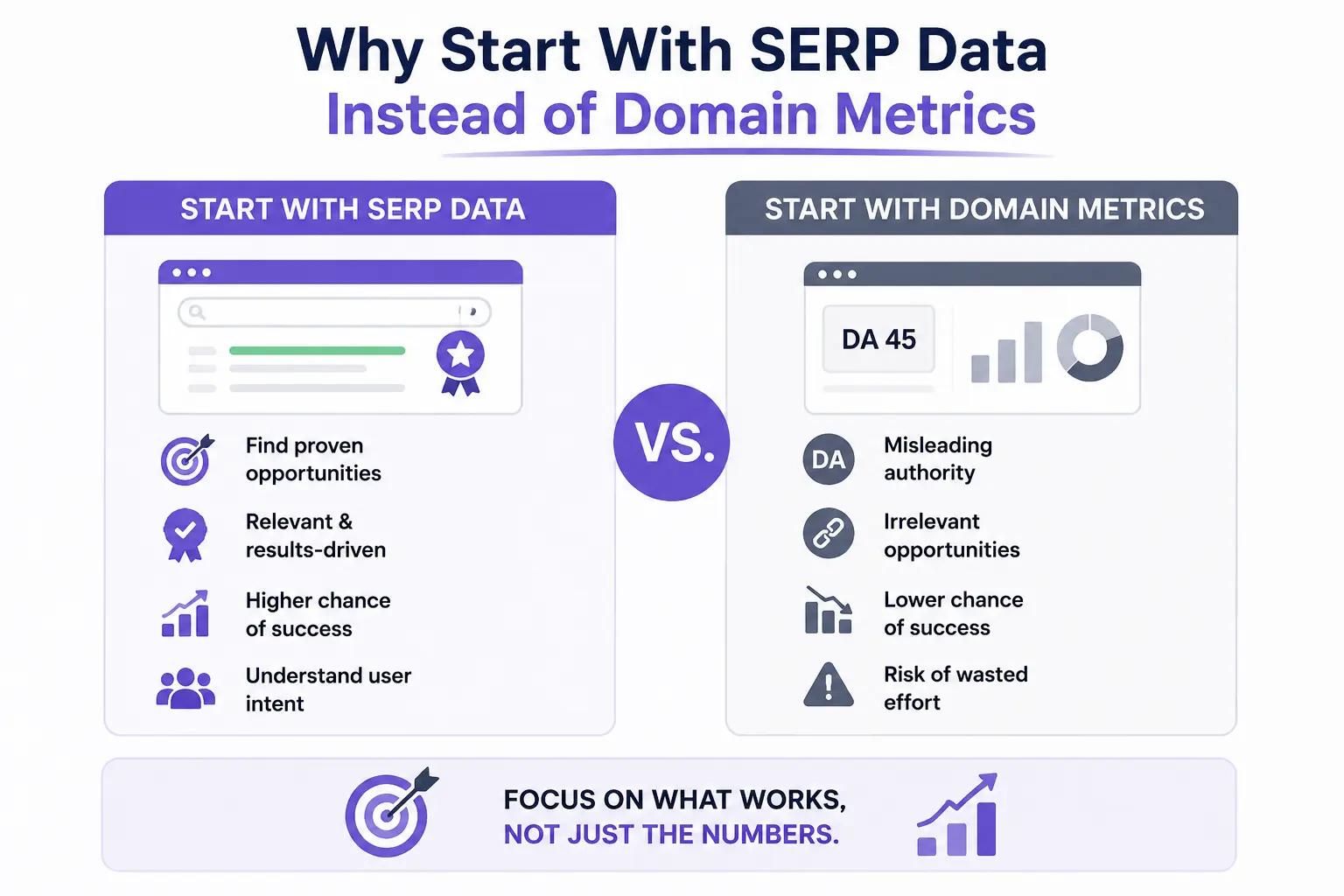
Domain-level metrics like Domain Rating or Domain Authority describe a site’s overall backlink profile. They say very little about whether a specific page is still performing today.
A page can have:
- A high Domain Rating, inherited from the site’s other content
- Zero current rankings for anything relevant to your niche
- Declining or nonexistent organic traffic
- Content that’s technically still live but effectively abandoned
None of that shows up in a domain-level score. It only shows up when you check what the page is actually doing in the search results right now which is exactly what SERP analysis is for.
Step-by-Step: How to Do SERP Analysis for Link Prospecting
Step 1: Build Your Keyword List
Start with the primary keyword your target page is trying to rank for, then add 5–10 closely related terms. Include variations a real searcher might use, not just the exact keyword.
This list becomes your search query set for the next step. Skipping or rushing this step is the most common reason prospecting lists end up full of only loosely relevant pages if your keyword list is too narrow, you miss good prospects; if it’s too broad, you waste time on irrelevant ones.
Practical example: A B2B SaaS company targeting a page about project management software for remote teams would build a keyword list including terms like best remote team software, distributed team collaboration tools, and async project management tools not just the exact primary keyword.
Step 2: Pull the Current SERPs for Each Keyword
Search each keyword and record the top 10–20 ranking URLs. Do this manually or with a rank-tracking tool either works, but manual spot-checks are worth doing even if you’re using software, since SERPs shift and tools can lag behind real-time results.
At this stage, don’t filter anything out yet. You’re casting a wide net across pages Google already considers relevant to your topic space. Filtering happens in the next step.
Step 3: Build the Raw Prospect Pool
Consolidate the URLs from every keyword search into a single list, removing duplicates. This is your raw prospect pool typically anywhere from 40 to 150 URLs depending on how many keywords you searched.
At this point, resist the urge to start outreach. An unfiltered list is not a qualified list, and outreach based on it wastes time on pages that won’t pass meaningful value.
Step 4: Score Each Page Against a Qualification Framework
This is the step that actually separates SERP-based prospecting from a basic keyword search. Run every candidate page through a scoring framework before spending any outreach time on it.
Link Opportunity Score Qualification Checklist
| Criterion | What to Check | Why It Matters |
|---|---|---|
| Organic traffic | Does the page currently receive meaningful search traffic, not just historical peak traffic? | A page with strong past traffic but none today passes little real value |
| Traffic trend | Is traffic stable or growing over the last 6–12 months, or clearly declining? | Declining traffic often signals the page is losing Google’s trust |
| Keyword rankings | Does the page rank in the top 20 for terms relevant to your niche? | Confirms current relevance, not just historical relevance |
| Topical relevance | Is the page’s core topic genuinely close to your target page’s topic? | A link from an off-topic page does less for you, even from a high-authority site |
| Index status | Is the page confirmed indexed in Google right now? | A deindexed page passes no value regardless of its metrics |
| Editorial quality | Is the content well-written and free of link-farm patterns like excessive outbound links or thin content? | Poor editorial quality increases spam-pattern risk |
| Internal linking | Does the site link to this page internally? | Suggests the page is a genuinely maintained part of the site, not an orphaned page kept alive to sell links |
A page that fails three or more of these checks should be dropped from your list, regardless of how attractive its Domain Rating looks.
Step 5: Rank Your Filtered List by Priority
Once you’ve scored every candidate, rank the survivors by a combination of relevance and traffic strength. Prioritize pages that score well on both a page with moderate traffic but excellent topical relevance is usually a better bet than a high-traffic page that’s only loosely related to your subject.
Step 6: Move Qualified Prospects Into Outreach
Only pages that pass the qualification framework should move forward to prospect identification and outreach. This is where SERP analysis pays off: instead of reaching out to 100 pages and hoping a handful respond usefully, you’re reaching out to a smaller, pre-qualified list where each placement has a real chance of passing value.
Manual Research vs. Tool-Based Prospecting
| Method | How It Works | Best For | Limitation |
|---|---|---|---|
| Manual SERP search | Searching keywords directly in Google and recording results | Small campaigns, spot-checking tool output | Time-intensive at scale |
| Rank-tracking tools (Ahrefs, Semrush) | Pulling ranking data and traffic estimates automatically | Medium–large campaigns, faster list-building | Traffic estimates can lag real performance |
| Competitor backlink analysis | Reviewing where competitors already have links, then checking those pages against the same framework | Finding proven, relevant host pages | Limited to pages competitors have already used |
Most experienced link builders combine all three using a tool to build the initial list quickly, then manually spot-checking the top candidates before committing outreach time.
Tools for Each Stage of SERP Analysis
| Stage | Recommended Tools | What It Helps You Do |
|---|---|---|
| Keyword research | Ahrefs, Semrush | Build your query set and find related terms |
| SERP pulling | Ahrefs, Semrush, manual search | Record current ranking URLs for each keyword |
| Traffic and ranking verification | Ahrefs, Semrush | Confirm traffic trend and current keyword positions |
| Index status verification | Google Search Console, manual site: search | Confirm the page is actually indexed right now |
| Internal linking check | Screaming Frog | Confirm the site links to the page internally |
| Editorial quality review | Manual review | Catch thin content or link-farm patterns tools can miss |
Before and After: What Filtering Actually Removes
| Stage | Example Count | What’s Included |
|---|---|---|
| Raw prospect pool (Step 3) | 85 URLs | Every page ranking for any of your target keywords |
| After traffic/index filtering | 52 URLs | Removes deindexed pages and pages with no current organic traffic |
| After relevance filtering | 31 URLs | Removes pages that are topically off-target despite ranking |
| After editorial quality check | 22 URLs | Removes thin, templated, or link-farm-pattern pages |
| Final qualified list | 22 URLs | Ready for prospect identification and outreach |
In a real campaign, it’s common to eliminate 60–75% of the raw prospect pool during qualification. That’s not wasted effort — it’s the step that prevents wasted outreach later.
Common Mistakes in SERP-Based Prospecting
- Skipping the keyword-list step and searching only the exact target keyword. This produces a narrow, incomplete prospect pool.
- Treating the raw prospect pool as ready for outreach. An unfiltered SERP list still needs qualification.
- Relying on a single tool’s traffic estimate without spot-checking. Estimates can be outdated or inaccurate, especially for smaller sites.
- Ignoring the internal linking check. A page with no internal links pointing to it is often an orphaned page kept alive specifically to sell outbound links.
- Prioritizing Domain Rating over the qualification score. A high-DR page that fails the traffic and relevance checks is still a weak prospect.
Scaling SERP Analysis for Larger Campaigns
The process above works well for a single target page. When running SERP analysis across multiple target pages or an entire site, a few adjustments keep the process manageable:
- Batch keyword lists by page, not by campaign. Each target page should have its own keyword set and its own prospect pool combining keyword lists across unrelated pages produces a prospect list that’s relevant to nothing in particular.
- Reuse qualified prospects across similar pages. If two target pages cover closely related topics, a host page that qualifies for one may qualify for the other, saving re-research time.
- Track qualification decisions, not just final lists. Recording why a page was rejected (declining traffic, weak relevance, deindexed) makes it faster to re-evaluate that same page for a future campaign without redoing the full check.
- Set a re-qualification schedule. Pages that qualify today can lose rankings or traffic within months. Campaigns that run over multiple quarters should re-run the qualification checklist on active prospects periodically, not just once at the start.
From Qualified List to Outreach
Once a prospect list has passed the qualification framework, the next steps are prospect identification (finding the right contact for each page) and outreach itself. Those steps depend entirely on having a clean, filtered list to work from which is the actual output of everything covered above.
A qualified list of 20 genuinely relevant, currently-ranking pages will consistently outperform an unfiltered list of 100, both in response rate and in the ranking impact of the links you actually secure.
Advanced SERP Analysis Techniques
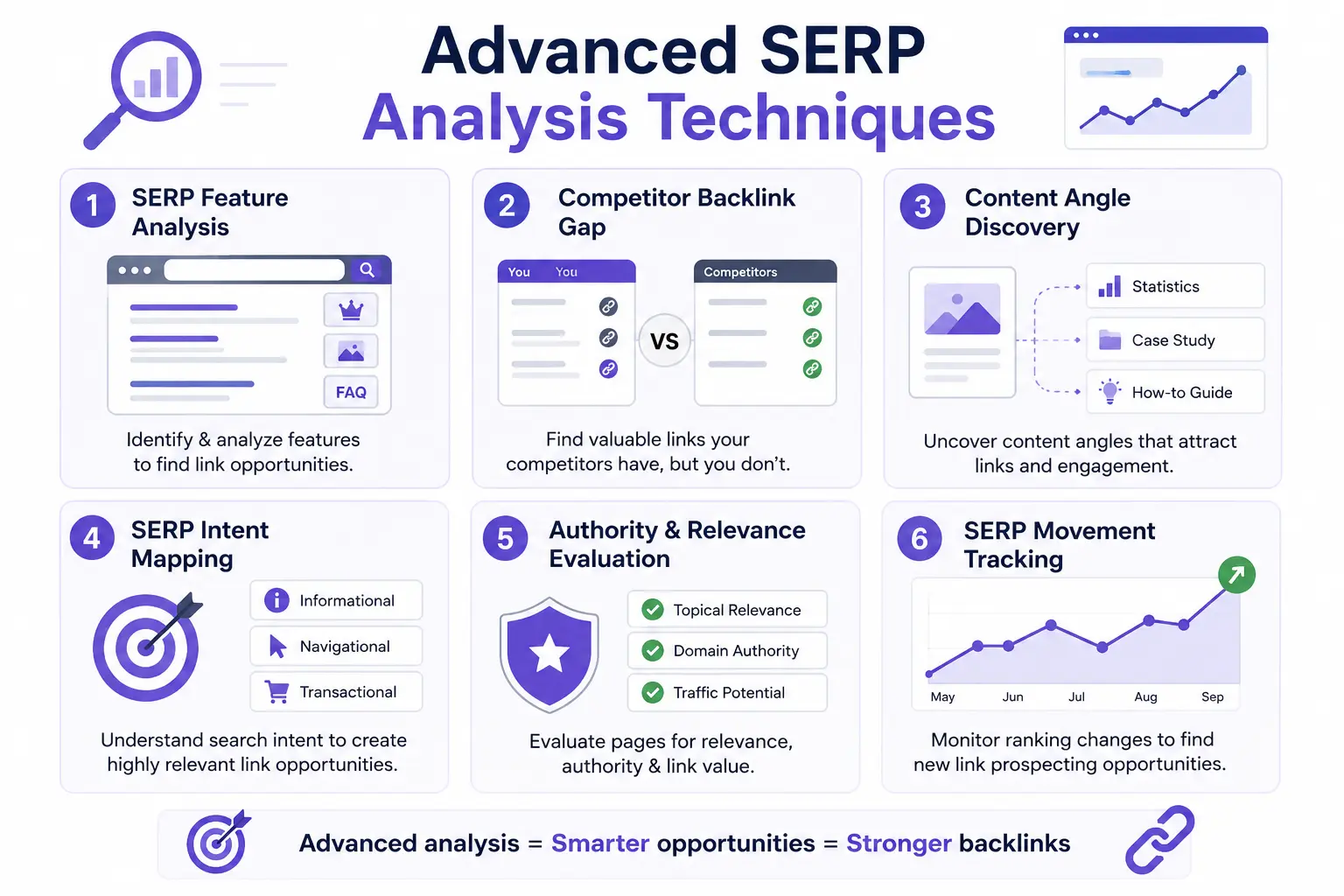
Once the core workflow is in place, a few additional checks help sharpen the quality of your prospect list further, particularly for competitive niches where every placement decision matters more.
Checking SERP Volatility
Some keywords have highly stable top-10 results that barely change month to month. Others shift constantly, with different pages trading positions every few weeks.
A page that ranks well in a volatile SERP is a riskier prospect than one holding a stable position in a SERP that rarely changes the stable page has demonstrated it can hold its ground, while the volatile one might drop out shortly after you secure a placement on it.
Most rank-tracking tools show historical position data for a keyword. Before finalizing a prospect, glance at the page’s ranking history over the past 3–6 months.
A page that’s bounced between position 4 and position 18 repeatedly is a weaker bet than one that’s held steady at position 7 the entire time.
Reviewing SERP Features, Not Just Blue Links
Modern search results include featured snippets, “People Also Ask” boxes, and AI Overviews alongside standard organic listings.
A page that holds a featured snippet or is cited inside an AI Overview for a relevant query is often a stronger prospect than a page that simply ranks in position 6 visibility of that kind tends to correlate with strong topical authority on that specific subject, which is exactly the kind of page you want passing a link to your content.
This isn’t a replacement for the core qualification checklist, but it’s a useful tie-breaker when two candidate pages score similarly.
Competitor Gap Analysis as a Prospecting Supplement
A useful supplementary technique is to pull the backlink profiles of competitors who already rank above your target page, then check which of their linking pages also show up in your own SERP analysis.
A page that both ranks well for your keywords and already links to a competitor is often a strong prospect it demonstrates the page is willing to link out to businesses in your space, which can make outreach easier.
This technique works best as a supplement to keyword-based SERP analysis, not a replacement for it, since competitor backlinks alone don’t confirm the host page is still ranking or indexed today.
A Full Worked Example: SaaS Campaign Walkthrough
To make the process concrete, here’s how a mid-size B2B SaaS company might run through the full workflow for a single target page.
The target page: A comparison page “Best Project Management Software for Remote Teams” currently sitting at position 14 for its primary keyword.
Step 1, keyword list: The team builds a list of 8 keywords: the primary term plus variations like “remote team collaboration software,” “distributed team project tools,” “async project management software,” and five more closely related phrases.
Step 2, SERP pulling: Searching each of the 8 keywords and recording the top 15 results per keyword produces roughly 120 URLs before deduplication.
Step 3, raw prospect pool: After removing duplicate URLs (many pages rank for multiple related keywords), the pool consolidates to 74 unique candidate pages.
Step 4, qualification: Running each of the 74 pages through the scoring framework eliminates:
- 18 pages with declining or negligible current organic traffic
- 11 pages that are technically indexed but show no meaningful rankings for any relevant term
- 14 pages that rank but are topically only loosely related (general business software round-ups with minimal remote-work focus)
- 9 pages with thin content or clear link-farm patterns (excessive outbound links, no internal linking from the rest of the site)
That leaves 22 qualified prospects pages that are currently ranking, currently getting traffic, genuinely relevant, and structurally part of an active site.
Step 5, prioritization: The team ranks the 22 by combining traffic strength with topical closeness, prioritizing the 10 pages that score highest on both.
Step 6, outreach: Of those 10 top-priority prospects, the team secures placements on 4 all inside genuinely relevant paragraphs, with varied anchor text.
Result: Over the following 8 weeks, the target page moves from position 14 to position 9, with continued movement expected as the placements age and Google’s crawlers revisit the linking pages.
The lesson from this kind of walkthrough is consistent across campaigns: the qualification step is where most of the real work happens. Outreach on an already-filtered list converts better and produces links that actually move rankings, compared to outreach on an unfiltered pool of “anything that showed up in search.”
How Often to Re-Run SERP Analysis
SERP analysis isn’t a one-time exercise for an ongoing link building program. Rankings shift, pages get updated or abandoned, and a page that qualified six months ago may no longer meet the same bar today. A few practical guidelines:
- For active campaigns still in outreach: Re-check the top of your qualified list every 4–6 weeks, since pages can lose rankings or get deindexed in that window.
- For a list of prospects you haven’t yet contacted: Re-verify traffic and index status before reaching out if more than 8–10 weeks have passed since the original SERP pull.
- For long-running programs targeting the same page over multiple quarters: Rebuild the keyword list periodically too, not just the prospect list search behavior and related terms shift over time, and a keyword list built a year ago may miss newer, relevant host pages that have since started ranking.
Frequently Asked Questions
What is SERP analysis in link building? SERP analysis for link building is the process of searching your target keywords, recording which pages currently rank for them, and using that list as your prospect pool rather than starting from Domain Rating or generic backlink metrics.
How many keywords should I use for SERP analysis? Most campaigns use 5–10 closely related keywords per target page, in addition to the primary keyword, to build a prospect pool wide enough to find good candidates without becoming unmanageable.
What tools are best for SERP analysis? Ahrefs and Semrush are the most commonly used tools for pulling rankings and traffic estimates, paired with Google Search Console for index verification and manual site: searches for quick spot-checks.
How do I know if a page is a good link prospect? Score it against organic traffic, traffic trend, current keyword rankings, topical relevance, index status, editorial quality, and internal linking. A page that fails three or more of these checks is a weak candidate.
Should I filter prospects before or after outreach? Always before. Filtering after outreach wastes time contacting page owners who were never going to be a good fit, and it’s far more efficient to remove weak candidates during qualification.
How is SERP analysis different from a standard backlink audit? A backlink audit reviews links your site (or a competitor’s) already has. SERP analysis for prospecting looks forward it identifies pages you don’t yet have a link from, based on what’s currently ranking for your target keywords, so you can evaluate them as potential future placements.
Can SERP analysis be automated entirely? Parts of it can pulling rankings and traffic estimates is largely automatable through rank-tracking tools. The qualification step, particularly editorial quality review and topical relevance judgment, still benefits from manual review, since automated scores can miss context a human reviewer would catch quickly.
What’s a reasonable rejection rate during qualification? It’s common to eliminate 60–75% of the raw prospect pool during the qualification step. A rejection rate lower than that often signals the qualification criteria weren’t applied strictly enough.
Does SERP analysis work the same way for local businesses as it does for SaaS or e-commerce? The core process is identical, but the keyword list and relevance bar shift. A local service business should weight geographic relevance heavily in the qualification step, in addition to topical relevance, since a nationally-ranking page with no local angle may pass less contextual value for a location-based target page.
SERP analysis for link prospecting works because it starts from what Google is actually showing right now, not from a static authority score.
The keyword research, SERP pulling, and qualification steps take more time upfront than a domain-metric shortcut but they’re what turns a long list of maybe-relevant pages into a shorter list of pages actually worth pursuing.
That filtering step is also what underpins a properly executed SERP Insight Link Insertion campaign: the research phase is the entire difference between a placement that moves rankings and one that doesn’t.










[…] SERP Analysis – Pull the current search results for those (and closely related) keywords to build a list of candidate host pages. […]