

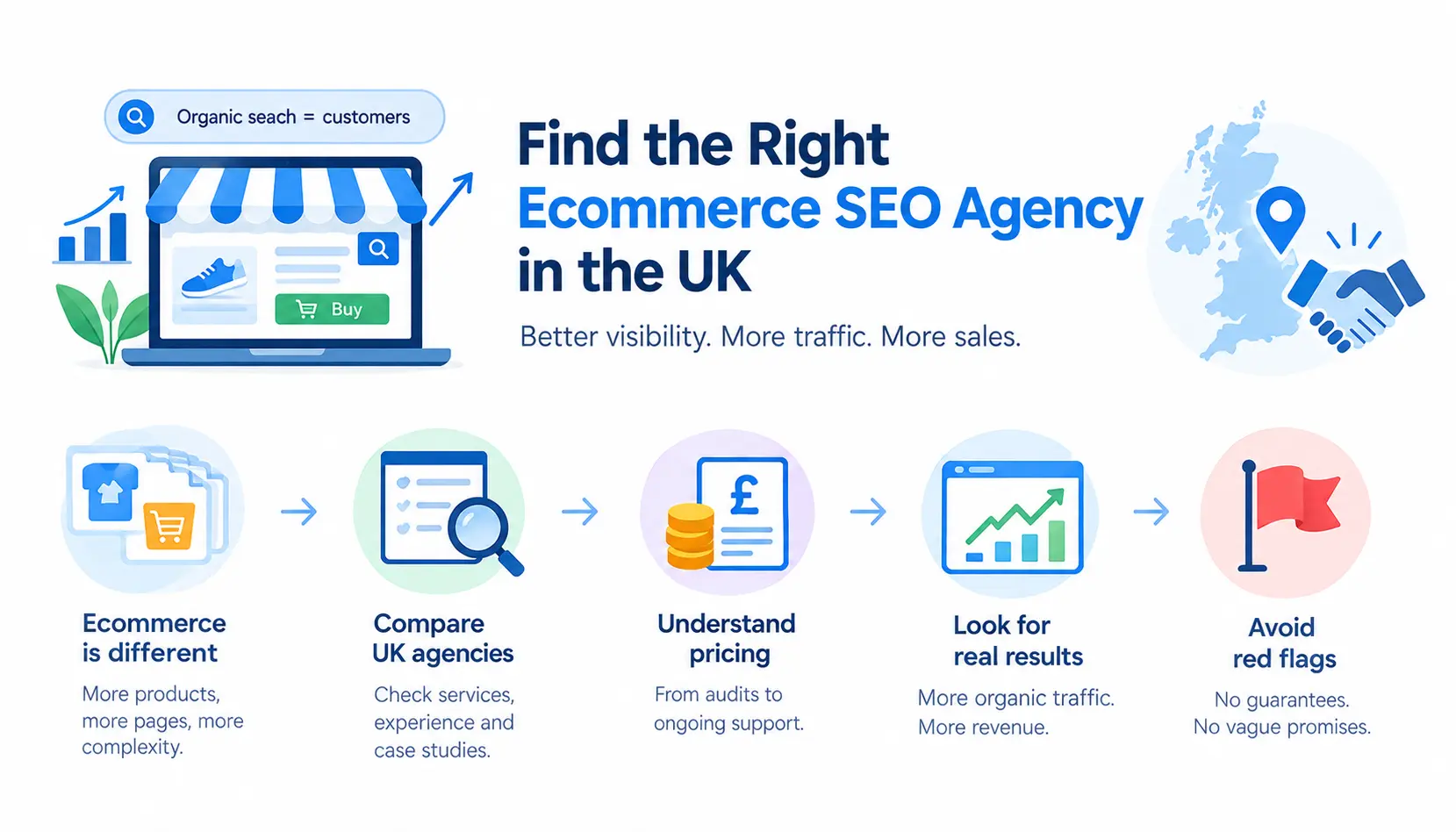
If you run an online store, you already know organic search can be your cheapest source of customers. You also know it is hard to get right. Picking an SEO agency for ecommerce in the United Kingdom is a big decision, because the wrong choice can cost you a year of progress.
Ecommerce SEO is not the same as SEO for a services website. You have thousands of product URLs, filters that create duplicate pages, stock that comes and goes, and revenue you can measure to the penny. A good agency understands all of that.
This guide compares UK agency options, shows you how to judge them, and explains pricing, results, and red flags. Jump straight to the comparison table below if you want a shortlist first.
Best Ecommerce SEO Agencies in the UK
This list is a starting point for your research, not a ranking. Agencies change their services, teams, and pricing often, so treat everything here as something to confirm on a call.
I chose agencies that publish ecommerce-focused services or case studies, plus two directories that help you find more. Details come from each provider’s public website. Where I could not confirm something, I say so rather than guess.
Ecommerce SEO Agency Comparison Table
| Provider | Type | Published ecommerce angle | What to verify |
| Honcho | Ecommerce SEO agency | Ecommerce SEO, technical SEO, product and category optimisation, digital PR | Case-study dates, platforms, pricing model |
| NOVOS | Growth and SEO agency | SEO and digital PR for ecommerce, international growth, migrations | Scope of published case studies, reporting depth |
| StudioHawk UK | SEO agency (UK arm of a larger group) | Ecommerce SEO, technical SEO, product and collection pages | UK team size, platform experience, pricing |
| Marketing Signals | Digital marketing agency | Search strategy, technical SEO, analytics, paid media | Ecommerce depth versus general SEO |
| Clutch UK SEO listings | Directory | Client reviews and project budgets | Whether reviewed projects were ecommerce |
| The Manifest UK SEO listings | Directory | Profiles and service lists | Platform-specific proof |
| PageTraffic, AskGalore, FINN Partners | General SEO or marketing providers | Varies | Current ecommerce services and UK presence |
I have not listed prices or rankings. I could not verify them, and guessing would mislead you. Ask each agency for a written quote based on your own store.
1. Honcho

Honcho positions itself around ecommerce SEO. Its published services point to technical SEO, catalogue management, product and category page optimization, digital PR, and structured data.
That mix suits stores with large catalogues where technical clean-up and page-level work matter most. Before you sign, check which case studies match your platform and size. Ask who does the work and how they handle developer handovers.
2. NOVOS

NOVOS presents ecommerce growth as a core focus, combining SEO with digital PR. It also talks about international expansion and site migrations, which are common pressure points for growing brands.
Look at its published case studies and note the dates, the starting position, and the commercial results reported. Ask how reports tie SEO to revenue, and who will run your account day to day.
3. StudioHawk UK

StudioHawk is a global SEO agency with a UK presence and a stated ecommerce focus. Its services cover technical SEO and work on product and collection pages.
Check the size and experience of the UK team specifically, not just the wider group. Ask for case studies on your platform and a clear explanation of what a monthly fee includes.
4. Marketing Signals
Marketing Signals offers search strategy, technical SEO, analytics, and paid acquisition. That can help if you want one partner across channels.
Disclosure: Marketing Signals also publishes its own agency comparisons while selling agency services. Read any comparison from an agency, including this kind of list, with that in mind. Ask it for ecommerce-specific evidence, not just general SEO results.
5. Clutch-Listed UK SEO Agencies
Clutch is a directory, not an agency. Use it to find options and read client feedback, then verify everything yourself.
- Read reviews closely. Look for reviewers who run stores like yours.
- Compare project budgets. Treat them as rough signals, since scopes differ.
- Filter by service. Narrow the list to SEO and, where possible, ecommerce.
- Verify experience. Ask the agency to confirm any ecommerce work you see on its profile.
6. The Manifest-Listed UK SEO Agencies
The Manifest works in a similar way. It gives you profiles, service lists, and project examples that help you build a longer list.
Profiles are often broad. You still need platform-specific checks, such as whether the agency has fixed Shopify collection issues or Magento filter problems.
7. Other UK SEO Providers Worth Evaluating
PageTraffic, AskGalore, and FINN Partners also appear in UK search results for this topic. Check each one’s current services and ecommerce case studies before shortlisting.
Keep one distinction in mind. An agency with strong general SEO skills is not automatically an ecommerce specialist. Ecommerce needs experience with catalogues, faceted navigation, feeds, and revenue reporting.
How We Evaluated These Ecommerce SEO Agencies
Here is the approach behind this guide, so you can judge it fairly.
- Selection criteria: a visible ecommerce focus, UK relevance, and published services.
- Source verification: public agency websites and directory profiles only.
- Case studies: I looked for dates, baselines, scope, and clear attribution, not headline percentages.
- Pricing: none is listed, because most agencies quote by scope.
- Client reviews: useful, but they can be selective, so I treat them as one signal.
- Limitations: I have no commercial relationship with the agencies named. Information changes, so confirm details directly.
What Does an Ecommerce SEO Agency Do?
An ecommerce SEO agency helps online stores get found by shoppers on search engines like Google. It combines technical fixes, product and category page optimisation, content, link building, and performance tracking. The goal is more qualified visitors who buy.
Technical Ecommerce SEO
Technical SEO makes sure search engines can find, read, and index your pages. For stores, this is often where the biggest wins hide.
Common areas include:
- Crawlability and indexation: Can Google reach your important pages and ignore the junk?
- XML sitemaps: A list of the URLs you want indexed.
- Canonical tags: Tags that tell Google which version of a page is the main one. Google explains how to consolidate duplicate URLs.
- Duplicate URLs: Colour, size, and tracking parameters can create many copies of one product.
- Faceted navigation: Filters that let shoppers narrow results. Left unchecked, they can create thousands of thin pages.
- Pagination and site architecture: How category pages split and how pages link together.
- Core Web Vitals: Google’s page experience measures for speed and stability.
- Redirects and broken URLs: Cleaning up dead pages without losing link value.
Product and Category Page Optimisation
Category pages usually target the high-value searches, like “women’s running shoes”. Product pages capture specific, ready-to-buy searches.
A good agency will review:
- Product titles and descriptions that match how people search.
- Category copy that helps shoppers and answers the search intent.
- Product variants, so colours and sizes do not split your rankings.
- Internal links that point authority to key categories.
- Image optimisation, including file size and descriptive alt text.
- Product availability, so out-of-stock pages are handled sensibly.
- Duplicate manufacturer descriptions, which add little value.
Ecommerce Keyword Research
Keyword research shows what your customers type and which searches lead to sales. It goes beyond volume.
An agency should look at transactional keywords (“buy”), category terms, product-specific queries, and long-tail searches. It should also separate branded searches from non-branded ones, since non-branded traffic shows real new demand. Commercial relevance matters more than big numbers.
Content Marketing and Digital PR
Content supports your category and product pages. Think buying guides, product comparisons, and helpful educational articles.
Digital PR earns links from relevant publications through stories, data, or expert comment. Those links build authority. Ask any agency how it earns links and whether you can see examples.
Structured Data and Product Feeds
Structured data is code that helps search engines understand your page. For products, it can describe price, availability, ratings, and reviews. Google’s product structured data guide shows what is supported.
Product feeds go to Google Merchant Center and help your products appear in shopping results. Your feed and your website must match on price and stock, or products can be disapproved.
Ecommerce Analytics and Reporting
Good reporting shows what SEO did for the business. Expect work in Google Search Console and Google Analytics 4.
Key views include organic revenue, conversion rate, non-branded traffic, and landing-page performance. Be aware of limits too. Attribution is never perfect, and a decent agency will say so.
How to Choose the Right Ecommerce SEO Agency
Use this seven-step framework. It works whether you are comparing three agencies or thirty.
1. Define Your Business Goals
Start with what you actually need. Common goals include:
- Growing non-branded organic traffic.
- Improving category page visibility.
- Increasing organic revenue.
- Reducing reliance on paid ads.
- Entering new markets.
- Recovering from a traffic drop.
A clear goal makes quotes easier to compare.
2. Check Ecommerce Platform Expertise
Platforms behave differently. An agency that knows your platform will spot problems faster.
Shopify SEO Experience
Shopify creates multiple URLs for the same product through collections. Your agency should understand canonical handling, variants, and the limits of editing templates and URLs.
WooCommerce SEO Experience
WooCommerce runs on WordPress, so speed, plugins, and product taxonomies matter. Poor setup can bloat the site and cause indexation problems.
Magento SEO Experience
Magento often powers large catalogues. Look for experience with layered navigation, crawl efficiency, and multi-market setups.
BigCommerce and Headless Commerce
Headless builds separate the front end from the store engine. That raises questions about rendering, routing, and structured data. Ask how the agency has handled these.
3. Review Relevant Case Studies
Case studies show how an agency thinks. Compare:
- The starting performance.
- How long the campaign ran.
- What work was actually done.
- Changes in traffic, revenue, and conversions.
- External factors, like seasonality or a relaunch.
- How the results were measured.
Be wary of big percentages with no baseline.
4. Evaluate Technical SEO Capabilities
An audit report is not a strategy. A strong agency identifies the issues, ranks them by impact, and helps get them fixed.
Ask it to walk you through how it would prioritise problems on your site. If the answer is vague, move on.
5. Understand the Reporting Process
Ask these questions up front:
- What will you report each month?
- How do you measure success?
- Can reports split branded and non-branded results?
- How is revenue attributed?
- How are technical tasks prioritised?
6. Compare Communication and Implementation Support
SEO only works when changes go live. Ask how the agency will work with your developers, merchandisers, content team, and marketing staff.
A realistic plan names who does what and by when. Many campaigns stall because nobody owns implementation.
7. Check Contracts, Deliverables, and Exit Terms
Read the contract carefully. Look for:
- A clear scope of work.
- Reporting commitments.
- Fees and extra costs.
- Contract length.
- Ownership of and access to your accounts.
- Termination terms.
- Data access and handover on exit.
How Much Does an Ecommerce SEO Agency Cost in the UK?
There is no single price. Cost depends on the size of your store, how complex it is, and how much work you need done. Be cautious of anyone who quotes a fixed figure without looking at your site.
Monthly Ecommerce SEO Retainers
A retainer covers ongoing technical work, content, optimisation, reporting, and authority building. It suits stores that need steady progress over time.
One-Off Ecommerce SEO Audits
An audit suits teams with in-house developers who can act on findings. A useful audit ranks issues by impact, explains how to fix them, and gives a clear action plan.
Ecommerce SEO Migration Projects
Migrations carry real risk. Good projects include planning, URL mapping, redirects, technical testing, and monitoring after launch.
Enterprise Ecommerce SEO
Large stores often have huge catalogues, several markets, and complex setups. This work usually needs close collaboration with internal teams and costs more.
What Affects Ecommerce SEO Pricing?
- Catalogue size.
- Technical complexity.
- Competition in your sector.
- Number of markets.
- Content needs.
- Available implementation resources.
- Level of reporting and consultancy.
How to Compare Agency Quotes
Do not simply pick the cheapest quote. Compare scope, the seniority of the people doing the work, deliverables, and how much implementation effort falls on your team.
Two quotes can look similar but cover very different work. Ask each agency to list exactly what you will receive each month.
What Results Should You Expect From an Ecommerce SEO Agency?
Results depend on your starting point, your competition, how fast changes go live, and many outside factors. No honest agency can promise exact outcomes.
How Long Does Ecommerce SEO Take?
SEO is usually a medium to long-term investment. Technical fixes can show effects earlier, while sustained growth in organic revenue tends to take longer. Treat any guaranteed timeframe as a warning sign.
Which Ecommerce SEO Metrics Matter Most?
- Organic revenue.
- Non-branded organic traffic.
- Organic conversion rate.
- Product and category page visibility.
- Revenue per organic session.
- Visibility for commercially relevant searches.
- Contribution margin, where your data is reliable.
Why Rankings and Traffic Are Not Enough
Rankings do not pay the bills. Conversion rate, stock levels, pricing, merchandising, and customer experience all shape sales.
For example, a store can win traffic for a product that is out of stock. Visits rise, revenue does not.
How to Evaluate Agency Performance
Compare results against a documented baseline from before the work began. Then factor in seasonality, paid campaigns, site changes, and attribution limits.
Ecommerce SEO Agency vs In-House SEO Team
| Factor | Agency | In-house team |
| Expertise | Broad, across many sites | Deep knowledge of your products |
| Capacity | Can scale up for projects | Fixed headcount |
| Speed of implementation | Depends on your developers | Often closer to the work |
| Cost structure | Retainer or project fees | Salaries and tools |
| Ownership | Shared | Stays with you |
When Hiring an Agency Makes Sense
An agency fits when you need specialist skills, extra capacity, help with a technical project, or access to experienced people you cannot hire easily.
When an In-House Team Makes Sense
In-house works when you want long-term ownership, deep product knowledge, close coordination, and constant implementation.
When a Hybrid Model Works Best
Many stores split the work. The agency supplies strategy and technical guidance, while the internal team owns priorities and delivers changes.
Common Ecommerce SEO Agency Red Flags
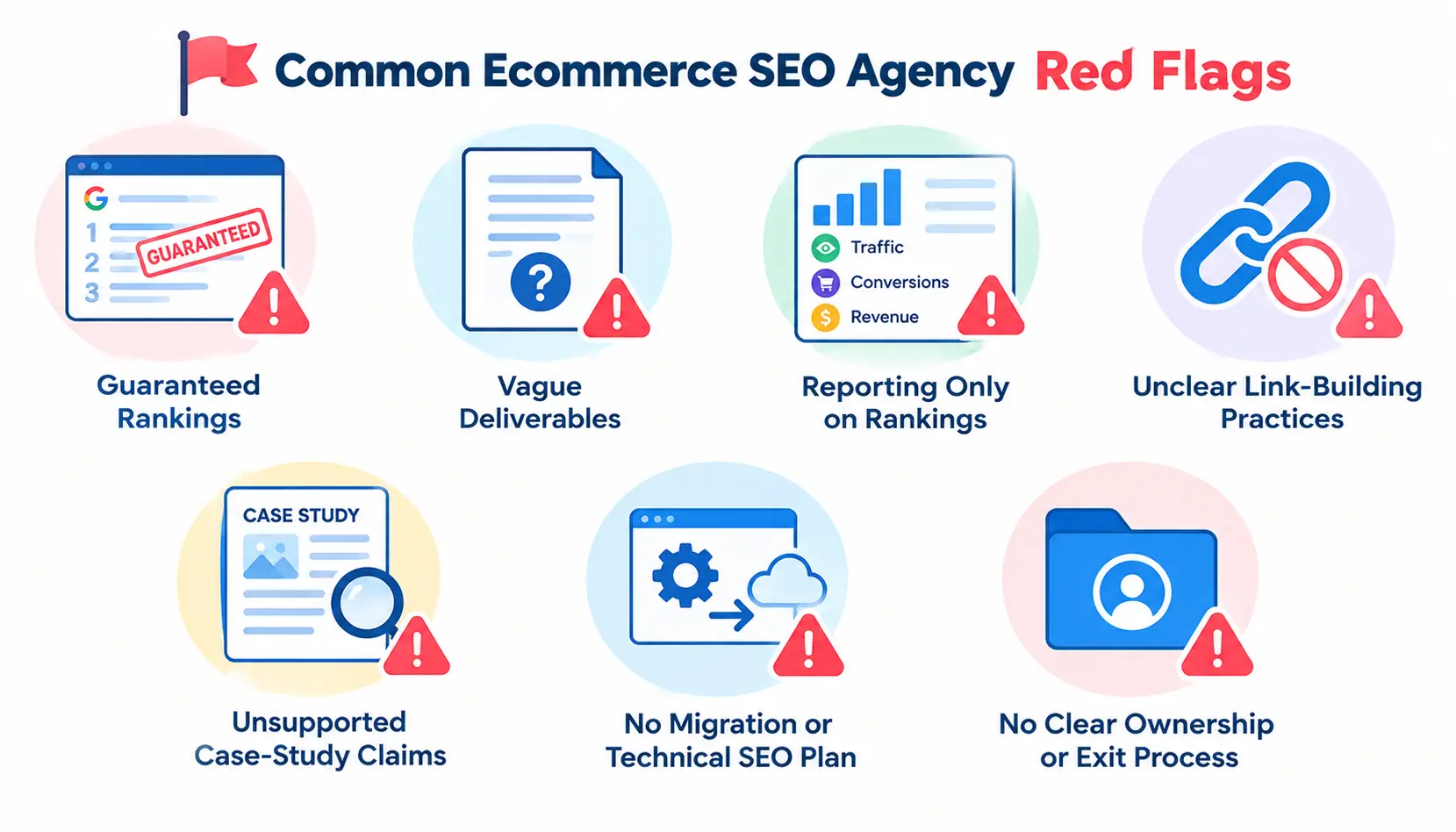
Guaranteed Rankings
Nobody controls Google’s results. An agency that guarantees specific positions is either guessing or not being honest.
Vague Deliverables
Your contract should define scope, responsibilities, and reporting. “Ongoing optimisation” alone tells you nothing.
Reporting Only on Rankings
Rankings are a part of the story. Reports should also show traffic quality, conversions, and revenue.
Unclear Link-Building Practices
Ask how links are earned. If the agency will not explain, you risk low-quality links that could harm your site.
Unsupported Case-Study Claims
Check dates, baselines, methods, and attribution. A claim without context is marketing, not evidence.
No Migration or Technical SEO Plan
A content-only plan rarely works for a complex store. Technical health and migrations need their own plans.
No Clear Ownership or Exit Process
You should keep access to your analytics, accounts, and site assets. Make sure you can leave without losing your data.
Questions to Ask Before Hiring an Ecommerce SEO Agency
- Which ecommerce platforms do you specialise in?
- Have you worked with stores similar to ours?
- Can you show relevant case studies?
- How do you measure organic revenue?
- How do you prioritise technical SEO issues?
- How will you handle product and category page optimisation?
- What is included in your monthly fee?
- Who will manage our account?
- How will you coordinate with our developers?
- How do you approach migrations?
- What reporting will we receive?
- What happens if we end the contract?
SEO professionals regularly discuss real agency experiences on forums such as bigseo and ecommerce. Treat anonymous posts as opinions, not proof, but they can suggest good questions to ask.
Ecommerce SEO Agency Selection Checklist
- The agency understands our ecommerce platform.
- It has relevant experience in our sector.
- It can explain its technical SEO process.
- It can demonstrate relevant case studies.
- Its reporting connects SEO to business objectives.
- Its pricing and deliverables are clear.
- It can work with our internal team.
- It explains risks and limitations honestly.
- Contract and exit terms are acceptable.
- We have verified its claims and references.
Frequently Asked Questions About Ecommerce SEO Agencies in the UK
1. What is the best ecommerce SEO agency in the UK?
There is no single best agency. The right choice depends on your platform, budget, business model, technical complexity, and growth goals. Shortlist a few, then compare them using the checklist above.
2. How much does ecommerce SEO cost in the UK?
Cost depends on catalogue size, technical complexity, competition, markets, and the work involved. See the pricing section above for the main factors and how to compare quotes.
3. How long does ecommerce SEO take to work?
It varies. Technical improvements can help sooner, while sustained organic growth usually takes longer. No one can promise an exact timeline.
4. Do I need a specialist Shopify SEO agency?
If you run on Shopify, platform experience helps, especially with collections, variants, and canonical tags. A broader ecommerce specialist can also work well if they can show relevant Shopify results.
5. Can an ecommerce SEO agency increase online sales?
Yes, it can help shoppers find your products and bring in qualified traffic. Sales also depend on pricing, stock, site experience, and conversion, so SEO is only one part.
6. What should an ecommerce SEO retainer include?
It should list defined deliverables, regular reporting, technical work, and ongoing optimisation. If you cannot tell what you are paying for, ask for a clearer scope.
7. How do I know whether an ecommerce SEO agency is performing well?
Review agreed KPIs, implementation progress, technical health, and commercial results against your starting baseline.
8. Should I hire an ecommerce SEO agency before a website migration?
Yes, ideally. Involving SEO specialists early helps spot risks, plan redirects, and avoid avoidable traffic loss.
Conclusion
Choosing an SEO agency for ecommerce in the United Kingdom comes down to fit. Look for platform experience, honest reporting, clear deliverables, and proof that ties SEO to revenue.
Use the comparison table to build a shortlist, then test each agency with the questions and checklist in this guide. Ask for evidence, check the details, and stay away from guarantees. The right partner will welcome that scrutiny.