

Understand what Google actually prohibits in its link spam policies, how SpamBrain detects paid links, and how to reduce risk in your campaigns.
Most people searching this topic aren’t casually curious they’re mid-campaign, wondering whether a specific tactic they’re already using crosses a line.
The good news: Google’s link spam policies aren’t a vague list of forbidden words. They come down to one consistent test intent and once you understand how that test gets applied, most of the gray areas resolve themselves.
What Is Link Spam, According to Google?
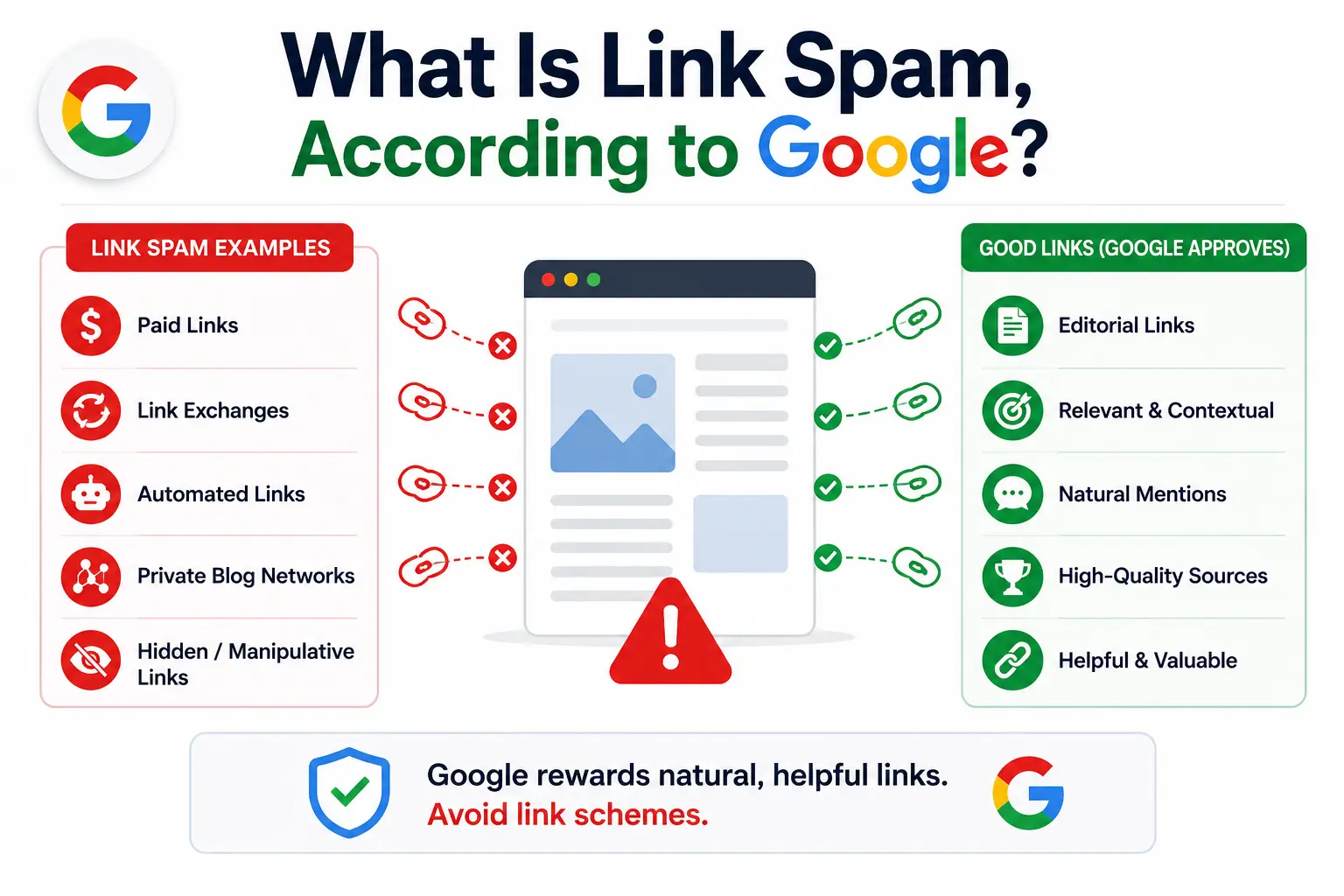
Google defines link spam as any practice that manipulates links to or from a site with the goal of manipulating rankings in Search. That definition covers both incoming links (links pointing to your site) and outgoing links (links your site places elsewhere).
Why intent is the deciding factor, not the link type itself. The same link a guest post byline link, a sponsored mention, a directory listing can be perfectly fine or a policy violation depending on why it exists.
Google’s systems are built to distinguish a link placed because content is genuinely useful from a link placed primarily to pass ranking credit.
This is the single most important thing to understand before diving into specific examples: there’s no universal list of “banned” link types, only banned purposes.
Examples of Link Schemes Google Prohibits
Google’s own documentation lists specific patterns that count as link schemes:
Buying or selling links that pass ranking credit. This includes exchanging money, goods, products, or services for links, or for posts that contain links, when those links aren’t properly tagged to prevent them from passing ranking value.
Excessive link exchanges. Reciprocal “link to me and I’ll link to you” arrangements aren’t automatically a violation, but doing this at scale trading links purely for mutual ranking benefit rather than genuine relevance is.
Automated link placements. Using tools or scripts to generate links programmatically across many sites, rather than earning them individually.
Links required in contracts or Terms of Service. For example, a WordPress theme or plugin that requires a hard-coded backlink to the developer’s site as a condition of use.
Widely distributed footer or template links. Links baked into a template, theme, or widget that gets deployed across many sites at once, rather than links added because of the specific page’s content.
Followed links on advertisements. Ad links must not pass ranking credit they need to be tagged so search engines know they’re paid placements, not editorial endorsements.
Over-optimized, keyword-rich anchor text in guest posts or comments. Stuffing exact-match keyword phrases into anchor text across many guest posts or comment sections is a pattern Google’s systems are specifically trained to catch.
What Google Says Is Safe
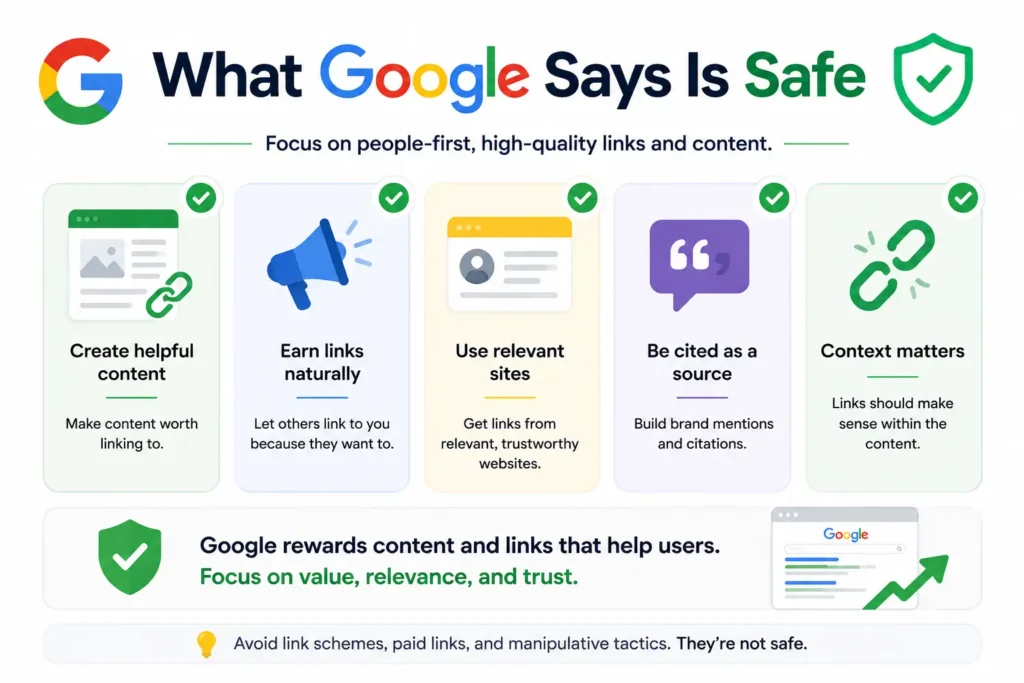
It’s worth being explicit about this, because most link-spam content leans so heavily on warnings that it leaves readers unsure what’s actually permitted.
Paid links with the right attributes. Google explicitly acknowledges that buying and selling links is a normal part of the web’s advertising and sponsorship economy.
It’s not a violation to have paid links, as long as they carry a rel="nofollow" or rel="sponsored" attribute so they don’t pass ranking credit.
Editorially earned links. A link that exists because a journalist, blogger, or site owner genuinely found your content useful and chose to reference it is exactly the kind of link Google’s systems reward.
Legitimate guest posting. Guest posting itself isn’t dead or against policy. High-quality guest content written for real readers, published on genuinely relevant sites, remains an effective and compliant way to build links — the violation only occurs when guest posting becomes a vehicle for scaled, keyword-stuffed anchor text.
The same logic applies to link insertion into existing, already-published content: it’s a compliant tactic as long as the placement is relevant and editorially justified, not inserted purely to pass ranking credit.
Correct attribute implementation. Use rel="sponsored" for paid or sponsored links, rel="ugc" for user-generated content like blog comments or forum posts, and rel="nofollow" as a general-purpose way to indicate a link shouldn’t be treated as an endorsement.
How SpamBrain Detects Link Spam
What SpamBrain is. SpamBrain is Google’s AI-based spam detection system, first deployed internally in 2018 and publicly named in Google’s 2022 Webspam Report. It replaced a largely rule-based approach where specific, known patterns were manually targeted, as with the 2012 Penguin update with a machine-learning model trained on examples of spam rather than fixed rules.
Pattern and behavior-based detection. Rather than judging individual links in isolation, SpamBrain evaluates link behavior at scale: how links appear, how often similar patterns repeat, and how they connect across a site’s broader profile over time.
This is why a single unusual link rarely triggers action on its own, but a repeated pattern the same anchor text, the same link placement style, the same velocity of new links is what draws scrutiny.
Bidirectional detection. Google has described SpamBrain as capable of identifying both the sites buying manipulative links and the sites primarily used to sell or pass them.
That means both the “money site” receiving links and the source site providing them can face algorithmic scrutiny, not just one side of the transaction.
What SpamBrain can’t reliably tell you. Because it’s a machine-learning system rather than a documented rulebook, the exact signals it weighs aren’t fully public and by most accounts, not even fully known inside Google itself.
Treat any claim of “SpamBrain specifically penalizes X” with some skepticism unless it traces back to Google’s own statements. This is also why older, rule-based advice (“never exceed X links per page” or “always vary anchor text by exactly Y%”) tends to age poorly a learning system doesn’t operate on fixed thresholds, and workarounds built around one detection cycle often stop working once the model retrains.
Manual Action vs. Algorithmic Devaluation: What Actually Happens
This distinction is arguably the most practically important part of this entire topic, and it’s the part most guides gloss over.
| Manual Action | Algorithmic Devaluation | |
|---|---|---|
| Who applies it | Human reviewer, after a flagged review | Automated systems (including SpamBrain), continuously |
| Notification | Yes – appears in Search Console | No – happens silently, with no alert |
| Visibility of cause | Explained in Search Console | Not disclosed |
| Recovery path | Fix issues, then file a reconsideration request | Fix issues; Google’s systems reassess over time as it recrawls |
| How common today | Reserved for more serious, clear-cut violations | The more common outcome for most link spam |
Why devaluation is now more common than manual penalties. As detection has become more automated and continuous, Google increasingly handles link spam by simply neutralizing the effect of manipulative links rather than issuing a visible penalty.
,Many sites lose ranking benefit from spammy links without ever seeing a notice in Search Console the links just stop counting.
The critical fact most guides miss: removing bad links after the fact doesn’t restore the ranking value they may have generated. Once Google’s systems identify and discount the effect of spammy links, that lost benefit is gone there’s no retroactive credit for cleanup. This makes prevention meaningfully more valuable than remediation.
How to Check If You’ve Been Hit
Checking Search Console for manual actions. Under Security & Manual Actions in Google Search Console, you’ll see an explicit notice if a manual action has been applied, along with the reason and affected pages.
Diagnosing a traffic drop after a spam update. If there’s no manual action listed but you’ve seen a ranking or traffic decline around the timing of a known spam update, that’s a strong signal you’re dealing with algorithmic devaluation rather than a manual penalty and the fix is different: there’s no reconsideration request to file, only ongoing compliance for Google’s systems to reassess over time.
How to Fix and Recover From Link Spam Issues
Removing or disavowing bad links. Where possible, contact site owners to remove manipulative links pointing to your site. For links you can’t get removed, Google’s disavow tool lets you tell its systems to ignore specific domains or URLs when assessing your link profile.
Filing a reconsideration request. If you’ve received a manual action, address the underlying issue first, document what you changed, and then submit a reconsideration request through Search Console.
This step only applies to manual actions there’s no equivalent request process for algorithmic devaluation.
Realistic recovery timelines. Recovery isn’t instant. Google’s systems need to recrawl and reassess a site over a period of months to recognize sustained compliance, and per the point above any ranking benefit already lost from spammy links generally isn’t recovered even after cleanup.
How to Reduce Risk in Your Link Building Campaigns
Vet link sources before acquiring links. Prioritize sites with genuine relevance to your content and a real audience, rather than sites that exist primarily to sell placements.
Audit anchor text and link velocity. A backlink profile with heavily repeated exact-match anchor text, or a sudden spike in new links, is exactly the kind of pattern automated systems are trained to flag. Aim for natural variation and a steady, organic-looking growth rate.
Build a diversified, compliant link profile. A mix of editorially earned links, properly tagged sponsored or guest post links, and legitimate mentions is far more resilient than a profile built on a single repeated tactic.
If most of your links come from one channel say, a single guest posting vendor or a recurring outreach template that concentration itself can look like a pattern to systems trained to spot exactly that kind of repetition.
Related Spam Policies You Should Know
Link spam doesn’t exist in isolation several newer policies intersect with it and are worth understanding alongside it.
Scaled content abuse targets content including content used as a vehicle for links produced at scale primarily to manipulate rankings rather than help users, regardless of whether it’s written by humans, tools, or AI.
Site reputation abuse covers cases where a site hosts third-party content (including linked content) mainly to exploit the hosting site’s existing ranking signals, rather than because the content fits the site’s own purpose.
Expired domain abuse refers to repurposing an expired domain’s existing authority and backlink profile to manipulate rankings for unrelated content, rather than genuinely continuing the site’s original purpose.
Frequently Asked Questions
What counts as a link scheme? Any practice buying/selling links, excessive exchanges, automated placements, or over-optimized guest post anchors that exists primarily to manipulate rankings rather than help users find useful content.
Is buying backlinks illegal or just against Google’s policy? It’s not illegal it’s a violation of Google’s spam policies. Paid links are fine as long as they’re tagged with rel="sponsored" or rel="nofollow" so they don’t pass ranking credit.
What happens if Google catches you buying links? Depending on severity, either a manual action (visible in Search Console, requiring a reconsideration request) or algorithmic devaluation (silent, with the links simply stopping to count).
Can you recover from a link spam penalty? Yes, for manual actions, by fixing the issue and filing a reconsideration request. Recovery is gradual, not instant.
Does removing bad links undo the damage? Not fully. Any ranking benefit spammy links may have already generated typically can’t be regained once Google’s systems have identified and discounted them.
What is SpamBrain? Google’s AI-based spam detection system, publicly named in 2022, which evaluates link and content behavior patterns across the web rather than judging individual links in isolation.
Is guest posting against Google’s policy? No. High-quality guest posting on relevant sites, written for real readers, remains compliant the violation is scaled, keyword-stuffed anchor text abuse, not guest posting itself.
Do nofollow links still get penalized? No , nofollow (and sponsored/ugc) links are explicitly Google’s recommended way to indicate a link shouldn’t pass ranking credit, which is exactly what keeps paid or user-generated links compliant.
How does Google detect paid links? Primarily through SpamBrain’s pattern-based analysis of link behavior at scale repeated anchor text, unnatural link velocity, and bidirectional detection of both buying and selling sites rather than flagging individual links.
Google’s link spam policies aren’t designed to punish link building itself they’re designed to punish links built purely to manipulate rankings rather than help real users.
That distinction is the thread running through every example in this guide, from paid links to guest posts to link insertions: the same tactic can be completely compliant or a policy violation depending on the intent behind it and whether it’s tagged correctly.
As SpamBrain continues to evaluate link behavior at scale rather than judging individual links in isolation, the safest long-term approach isn’t chasing workarounds for the current detection model it’s building a link profile that would hold up even if a human reviewer looked at it directly: relevant, editorially justified, and properly disclosed.
Prevention matters more than cleanup here, since lost ranking value from spammy links generally can’t be recovered even after removal which makes getting this right upfront the highest-leverage move in any link building campaign.