

For years, link building followed a familiar formula: earn backlinks from authoritative websites, improve rankings on Google, and attract more organic traffic. While backlinks remain one of the strongest ranking signals, the way search engines evaluate and surface content is changing rapidly.
Google’s AI Overviews, along with AI-powered search experiences from ChatGPT, Perplexity, Gemini, and Claude, are shifting the focus from simply ranking pages to identifying the most trustworthy, relevant, and authoritative sources to answer user questions. Instead of presenting only a list of blue links, AI now summarizes information from multiple sources, often citing websites it considers credible.
This evolution means link building is no longer just about increasing the number of backlinks. It’s about building a recognizable digital presence, earning mentions from trusted publications, strengthening topical authority, and becoming a source that both search engines and AI systems confidently reference.
Businesses that continue relying on outdated tactics such as buying links, chasing Domain Authority (DA) scores, or prioritizing quantity over quality risk losing visibility in both traditional search and AI-generated results. On the other hand, brands that invest in high-quality content, editorial backlinks, and genuine expertise will be better positioned to thrive.
In this guide, we’ll explore how AI Overviews are reshaping link building, what strategies still work, what needs to change, and how you can future-proof your SEO efforts.
What Are AI Overviews?
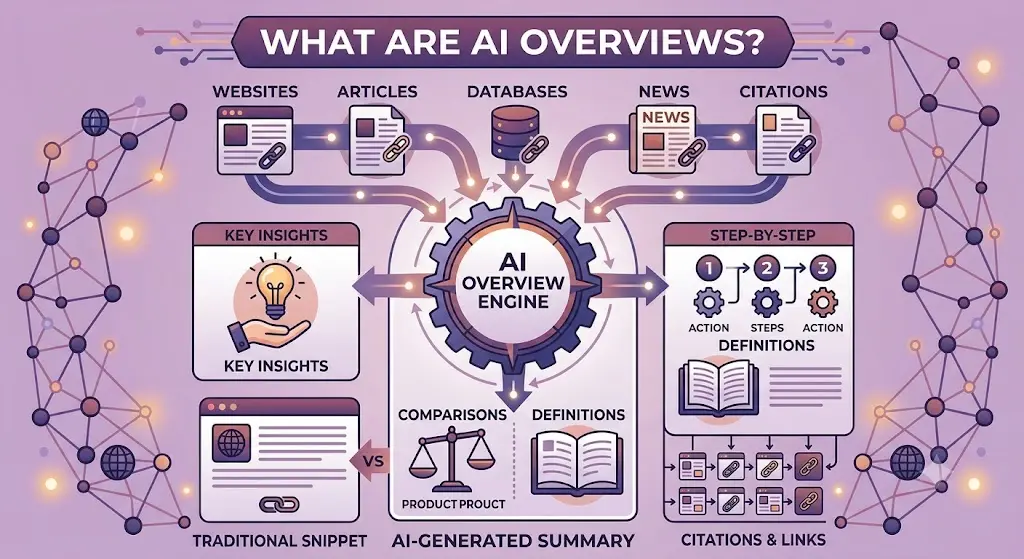
AI Overviews are AI-generated summaries that appear at the top of certain Google search results. Instead of showing only individual web pages, Google compiles information from multiple trusted sources to provide a concise answer directly in the search results.
These summaries often include:
- Key insights
- Step-by-step explanations
- Comparisons
- Definitions
- Supporting citations
- Links to authoritative websites
Unlike traditional featured snippets, AI Overviews synthesize information from multiple pages rather than relying on a single source.
How Are AI Overviews Changing Link Building?
AI Overviews reward websites that demonstrate expertise, authority, and trust across multiple sources. While backlinks remain important, search engines increasingly value editorial mentions, topical relevance, content quality, and brand credibility over sheer link quantity. Modern link building focuses on earning authoritative references rather than simply acquiring backlinks.
Why Link Building Still Matters in the AI Era
Some marketers assumed AI Overviews would reduce the importance of backlinks.
That’s not what we’re seeing.
Backlinks continue to help search engines determine:
- Website authority
- Trustworthiness
- Content relevance
- Topic expertise
- Brand credibility
However, backlinks are now part of a much larger ecosystem.
Search engines evaluate backlinks alongside:
- Content quality
- User experience
- Brand mentions
- Semantic relationships
- Entity recognition
- Original research
- EEAT (Experience, Expertise, Authoritativeness, Trustworthiness)
The role of backlinks hasn’t disappeared—it has evolved.
From Link Quantity to Link Quality
Years ago, SEO campaigns often emphasized acquiring as many backlinks as possible.
Today, that strategy is far less effective.
AI systems prioritize links that come from websites with:
- Strong editorial standards
- Relevant audiences
- Original content
- Consistent publishing history
- Genuine expertise
For example:
A single editorial backlink from a respected technology publication can provide significantly more value than dozens of links from unrelated, low-quality websites.
Quality has become the defining factor.
AI Overviews Prioritize Trusted Sources
AI-generated answers depend on reliable information.
This encourages search engines to favor websites that consistently publish:
- Accurate information
- Well-researched content
- Expert opinions
- Original data
- Industry insights
Backlinks from these trusted sources reinforce credibility and improve the likelihood of your content being referenced.
Instead of asking:
“How many backlinks do I have?”
Businesses should ask:
“Would an AI system consider my website a trustworthy source?”
Topical Authority Is More Important Than Ever
One isolated backlink isn’t enough to establish expertise.
AI systems evaluate whether your website demonstrates consistent authority across an entire topic.
For example, a digital marketing website might publish interconnected content on:
- Link building
- Technical SEO
- Keyword research
- Content optimization
- Local SEO
- Digital PR
Each article supports the others through strategic internal linking and relevant backlinks.
This creates a stronger topical footprint that AI can easily understand.
Brand Mentions Matter Alongside Backlinks
Traditional SEO focused almost exclusively on hyperlinks.
AI search expands the concept of authority.
Brand mentions—even without clickable links—can strengthen your digital presence when they appear across reputable websites.
Examples include:
- Industry reports
- Expert interviews
- Podcast appearances
- News articles
- Conference recaps
- Research publications
Consistent mentions help reinforce your authority within your niche.
Digital PR Is Becoming a Core Link Building Strategy
As AI systems prioritize trusted publishers, Digital PR has become increasingly valuable.
Rather than requesting links directly, Digital PR focuses on creating stories that journalists and publishers naturally want to cover.
Examples include:
Original Industry Research
Publish unique surveys, benchmark reports, or market analyses.
These resources often attract editorial citations.
Expert Commentary
Offer insights on emerging industry trends.
Journalists frequently seek expert opinions when writing news stories.
Data-Driven Content
Statistics, case studies, and proprietary research naturally earn references because they provide evidence rather than opinion.
AI Rewards Helpful, Link-Worthy Content
The easiest links to earn are those you don’t have to ask for.
Content that naturally attracts backlinks includes:
- Original research
- Industry statistics
- Ultimate guides
- Interactive tools
- Templates
- Calculators
- Free resources
- Checklists
- Comprehensive tutorials
When your content genuinely solves problems, other websites are more likely to reference it.
Internal Linking Becomes Even More Valuable
AI systems analyze relationships between pages.
Strong internal linking helps establish:
- Topic clusters
- Content hierarchy
- Semantic relevance
- User navigation
- Crawl efficiency
Instead of isolated articles, build interconnected content ecosystems.
Example:
Pillar Page
Link Building
↓
Supporting Articles
- Anchor Text Optimization
- Link Building Outreach
- Digital PR
- Guest Posting
- AI Overviews
- Broken Link Building
This structure strengthens topical authority.
What Link Building Tactics Are Losing Effectiveness?
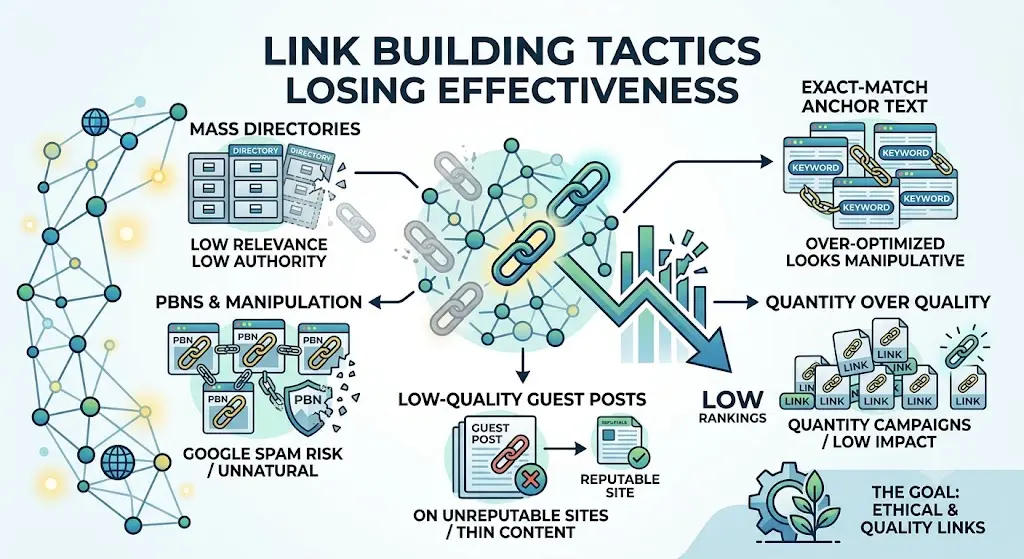
Not every strategy has adapted well to AI-powered search.
Approaches losing value include:
Mass Directory Submissions
Low-quality directories provide little authority and minimal contextual relevance.
Private Blog Networks (PBNs)
PBNs attempt to manipulate rankings and remain risky under Google’s spam policies.
Excessive Exact-Match Anchor Text
Repeating the same keyword-rich anchors can appear manipulative.
Natural language performs better.
Quantity-Based Campaigns
Hundreds of irrelevant backlinks rarely outperform a handful of editorial links.
Low-Quality Guest Posts
Guest posting still works—but only when published on reputable, relevant websites with valuable content.
How to Build Links for AI Search
Create Original Research
AI systems frequently reference unique data.
Publish:
- Surveys
- Industry reports
- Benchmark studies
- Annual statistics
These resources naturally attract citations.
Become an Industry Expert
Publish consistent, authoritative content.
Contribute to:
- Podcasts
- Webinars
- Conferences
- Industry publications
Authority extends beyond your own website.
Invest in Digital PR
Newsworthy campaigns generate:
- Editorial backlinks
- Brand mentions
- Media coverage
- Increased trust
Build Topic Clusters
Instead of publishing unrelated articles, create comprehensive content hubs.
This strengthens semantic relevance.
Improve EEAT Signals
Showcase:
- Author expertise
- Professional credentials
- Transparent sourcing
- Updated content
- Real-world experience
These trust signals support both traditional SEO and AI-driven search.
Measuring Success Beyond Backlinks
The definition of success is changing.
Instead of tracking only:
- Number of backlinks
- Domain Authority
- Domain Rating
Also measure:
- Brand mentions
- AI citations
- Organic visibility
- Referral traffic
- Topical authority
- User engagement
- Search impressions
- Returning visitors
These metrics provide a more complete picture of authority.
Practical Example
Imagine two software companies.
Company A
- 400 backlinks
- Generic guest posts
- Minimal original content
- Few brand mentions
Company B
- 120 editorial backlinks
- Original industry report
- Frequently cited research
- Strong topic clusters
- Expert interviews
- Digital PR campaigns
Although Company A has more backlinks, Company B is far more likely to be referenced in AI-generated search results because it demonstrates stronger expertise and authority.
AI-Era Link Building Checklist
Before launching your next campaign, ask:
✅ Are we earning links from relevant websites?
✅ Does our content provide original value?
✅ Are we creating resources worth citing?
✅ Are we building topical authority?
✅ Do we earn editorial mentions?
✅ Are our backlinks helping users?
✅ Is our brand recognized beyond our own website?
If the answer is yes, your strategy is aligned with modern search.
Common Myths About AI Overviews and Link Building
Myth 1: Backlinks No Longer Matter
Reality: Backlinks remain an important ranking signal, but they now work alongside content quality, EEAT, and topical authority.
Myth 2: AI Only Uses the Biggest Brands
Reality: Smaller websites can be cited if they publish accurate, original, and well-structured content that demonstrates expertise.
Myth 3: More Backlinks Guarantee AI Visibility
Reality: AI systems prioritize relevance and trust over raw backlink numbers.
Myth 4: Link Building Has Become Obsolete
Reality: Link building is evolving, not disappearing. The emphasis has shifted toward editorial quality, digital PR, and authority-building.
Frequently Asked Questions
Do AI Overviews replace traditional search rankings?
No. AI Overviews complement traditional search results by summarizing information from trusted sources while still linking users to relevant websites.
Are backlinks still important for AI Overviews?
Yes. High-quality backlinks continue to support authority and trust, increasing the likelihood that your content will be recognized as a credible source.
What types of backlinks work best in the AI era?
Editorial backlinks from relevant, authoritative websites with genuine audiences provide the greatest value.
How can I increase my chances of being cited by AI?
Publish original research, build topical authority, demonstrate expertise, earn editorial mentions, and create content that answers user questions clearly and accurately.
Does Digital PR help with AI search visibility?
Yes. Digital PR generates trusted brand mentions and editorial coverage that strengthen authority signals for both search engines and AI-powered platforms.
Is link quantity still important?
Quantity matters far less than quality. A smaller number of highly relevant, authoritative backlinks generally delivers better long-term results than a large volume of low-quality links.
Conclusion
AI Overviews are redefining what successful link building looks like. While backlinks remain an essential component of SEO, they are now evaluated within a broader framework of trust, expertise, relevance, and topical authority. Businesses that continue to focus solely on link volume or outdated tactics may find it increasingly difficult to compete in AI-powered search environments.
The most effective strategy today is to create genuinely valuable content, earn editorial backlinks from respected publications, invest in digital PR, and build a recognizable brand that others naturally reference. These efforts not only improve traditional search rankings but also increase the likelihood of being cited in AI-generated answers.
As search continues to evolve, the goal is no longer just to rank—it is to become a trusted source of information. Organizations that embrace this shift will be better positioned to earn visibility, authority, and sustainable organic growth across both search engines and AI-driven discovery platforms.