


Retired electronics are usually hard to recover because they leave in ones and twos, from a thousand different rooms, with no record of what they were. A data center is the easy case. The hardware is already inventoried, already serialized, already sitting in one building with a loading dock and a forklift. If any category of end-of-life equipment ought to be recovered at close to 100 percent, this is the one.
Plenty of it still isn’t, and the reason is rarely technical. The project got planned as a disposal job instead of a sale, and by the time anyone asks what the gear is worth, the answer has already changed.
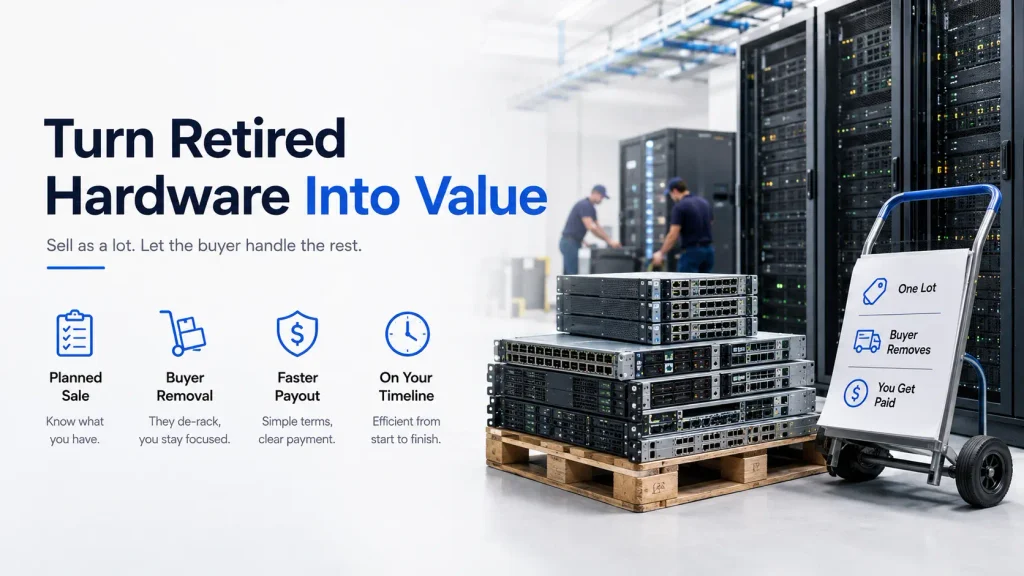
Liquidation is the sale side of that project. You are selling equipment as a lot, and the buyer removes it, instead of listing individual units and shipping them out one at a time as they sell. That distinction changes almost everything downstream: who does the de-racking, who holds the drives, how you get paid, and how long the whole thing takes.
There is no single right way to run it. There are three common situations, and the one you are actually in decides most of your answers.
Four Questions to Settle Before You Call Anyone
Work through these first. What you find will tell you which of the three situations below you are in.
How much is leaving, and over what window? A couple of racks with no deadline behaves nothing like a data hall that has to be empty by the end of a lease term.
Do the storage media still hold regulated or customer data? If yes, sanitization is the critical path of the project, and everything else schedules around it. If the drives were already wiped and verified months ago, you have a logistics job instead.
Do you control the building, the power, and the dock hours? A colo exit means somebody else’s rules on access, elevator use, and freight windows. Your own facility means you set the sequence.
Do you need a fixed number now, or the highest number eventually? Those are different transactions with different risk sitting on different sides of the table.
Hold those four answers while you read on.
When It Is One or Two Racks and Nothing Is Forcing the Date
This is the only situation where selling piece by piece genuinely competes with a bulk sale, and it is worth being honest about the tradeoff.
Individual listings usually produce a higher headline price per unit. A single well-photographed 100-gigabit switch or a tray of DDR4 RDIMMs will fetch more on the open market than the same parts folded into a lot price. Then you pay for that. Someone has to photograph, list, answer questions, pack, ship, handle returns, and store the gear until it moves. On a hundred SKUs, that is a part-time job for several months, and secondary hardware prices move with demand while you are doing it.
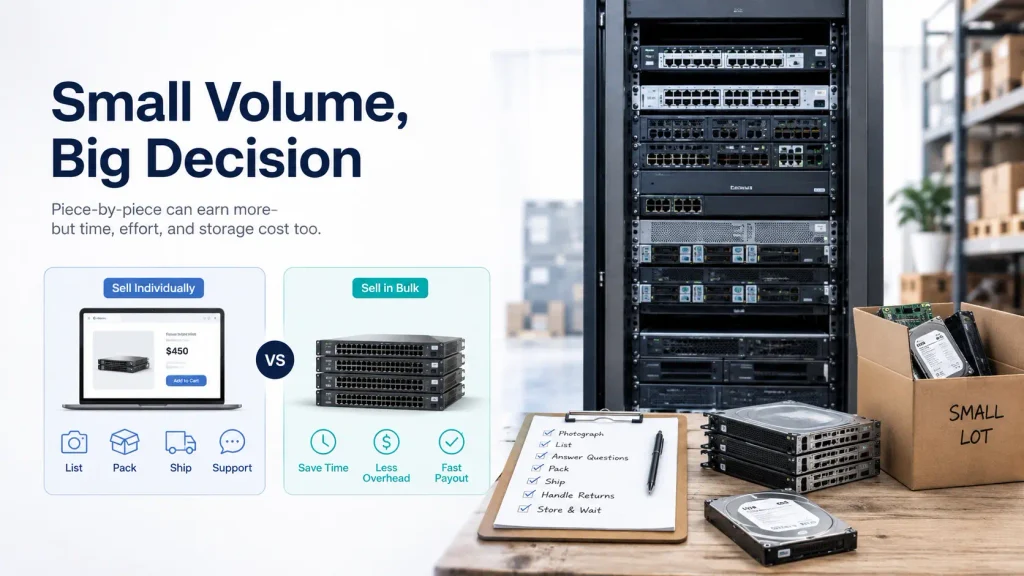
The rough threshold most buyback outfits use sits around 50 drives, or the contents of roughly one full rack. Below that, if you have the time and the storage, selling piece by piece is defensible. Above it, the admin overhead usually eats the premium.
One caveat worth naming: bulk buyers do not pay retail. A liquidation quote is a wholesale number, because the buyer is taking on the testing, the grading, the warranty exposure, and the remarketing. If your only goal is the maximum possible dollar figure on a small volume, and you enjoy logistics, sell it yourself. Most infrastructure teams do not have that time.
When There Is a Date on the Calendar
Once there is a date, the project becomes a de-installation job that happens to end in a sale.
De-installation, or de-racking, is the scheduled physical removal of equipment from live racks: powering down in the right order, labelling, unracking, and packing so the assets arrive intact and identifiable. The phrase “white glove” gets used loosely here. What it should mean in practice is that the crew works to a written sequence, captures serials as gear comes out of the rails, and does not create a pile of anonymous hardware on the dock.
The parts that actually slip schedules are boring:
Dock and elevator windows. Many buildings allow freight only in specific hours, and a full hall does not fit in one of them.
Pallet and packaging supply. Servers travel best on their own pallets, strapped and stretch-wrapped, with drives either still installed and documented or removed and separately manifested.
Freight class and insurance. Palletized LTL freight is standard for this work, and the shipment should be insured at declared value, not at the carrier’s default liability per pound, which is close to meaningless for enterprise hardware.
Cabling and rails. Copper cabling and rail kits have real scrap and reuse value, but only if someone plans for them. Otherwise they end up in a skip on the last day.
Nationwide pickup is common for buyers of any size, and free pickup on qualifying bulk volumes is a normal commercial term rather than a favour. Ask early, because whether the buyer’s crew or your crew does the de-rack changes the price you are quoted.
Before you contact a single buyer, build the inventory file. One row per asset or per identical group, with: manufacturer and model, configuration (CPU, memory, drive count and capacity), quantity, serial numbers where you have them, working or untested status, and physical location down to the rack. Buyers quote from this file. A vague list gets a vague, conservative number, and every hour you spend making the list specific tends to come back in the offer.
Where a Whole Facility or a Colo Exit Differs
A whole-facility liquidation is everything above plus one complication, which is that the clock belongs to somebody else.
The lease or the colo contract sets the real deadline, and it usually includes a “broom clean” condition that people forget until the last week. Racks, cable trays, PDUs, and containment often have to come out too, not just the IT load. Power and cooling equipment (UPS units, battery strings, CRAC units) have their own removal and disposal rules, and batteries in particular are handled separately from IT assets.
Staged pickups are the norm at this scale. You are rarely emptying a facility in one truck. A typical sequence retires the non-production estate first, then the production load once workloads have finished migrating, with storage media handled on its own track, as the next section describes. Each stage gets its own manifest, and each manifest reconciles against the master inventory before the next stage starts.
The buyer set at this scale is narrower than a search result suggests. Broadly you are dealing with enterprise ITAD firms that combine de-installation, data sanitization, and remarketing under one contract; hardware brokers and resellers who buy the desirable gear and leave the rest; auction houses that will take the whole lot but pay auction prices; and downstream recyclers who handle what nobody buys. Most full-facility projects end up using two of those, not one.
When the Drives Still Hold Regulated Data
This is the situation that reorders an entire project plan, and it is the one worth reading twice.
The federal reference point for this work is NIST Special Publication 800-88, Guidelines for Media Sanitization. Revision 2 was published in final form on 26 September 2025, and it changed the emphasis in a way that matters for liquidation contracts. Revision 1 read largely as a technical reference.
Revision 2 is written around establishing a media sanitization program: the policy, the roles, the validation that the sanitization actually worked, and the handling of media in modern environments, including cloud. If your vendor’s paperwork still describes their process purely as “DoD wipe” or cites nothing but Revision 1, that is a fair question to ask them.
Method depends on the media, and this is where a surprising number of projects get it wrong:
Magnetic media (spinning hard drives, LTO and 3592 tape) can be degaussed, overwritten, or shredded. Degaussing works because the data is stored magnetically.
Solid-state media (SSDs, NVMe) cannot be degaussed. A magnetic field does nothing to NAND flash. SSDs need the manufacturer’s secure erase (ATA Secure Erase or NVMe Format), a cryptographic erase that destroys the encryption key, or physical destruction to a small enough particle size. Overwriting alone is unreliable on flash because of wear levelling and over-provisioning.
GPUs, CPUs, and memory do not hold persistent user data. VRAM clears on power loss. You do not need a destruction certificate for a GPU, and paying for one is money you could have kept.
At facility scale, the evidence matters as much as the method. R2v3, the standard maintained by SERI, holds a certified facility responsible for the vendors downstream of it as well as for its own processes. On data destruction specifically, SERI advises buyers to look for facilities certified to Appendix B, the conditional process appendix covering data destruction, whose enhanced processes can provide tracking down to the serial-number level.
Appendix B is not carried by every R2v3 certificate, so the question to ask a facility is which appendices it actually holds. What you want on paper at the end is a serialized reconciliation: every drive that came out of a rack appears on a manifest, and every drive on the manifest appears on a certificate with its serial number and its disposition. A single-page certificate reading “1,400 drives destroyed”, with no serials behind it, gives an auditor nothing to check.
Sanitization and value recovery pull against each other unless one party owns both. Shredding a healthy 16-terabyte drive protects you and destroys an asset; wiping it to a verified standard protects you and keeps it saleable.
Big Data Supply buys full inventories outright, not on consignment. So ask the question that decides the shape of the project: when you sell used data center equipment, does the estate settle in one transaction and one set of paperwork, or in five of each? Whatever cannot be resold is recycled under its R2v3 and RIOS certification, never landfilled.
Putting the purchase and the destruction under one contract has one narrow consequence, and it is the reason the arrangement is worth asking for: the manifest that proves your compliance and the manifest that determines your payment become the same document.
Asset Valuation at Scale: How a Lot Price Gets Built
Lot pricing is not a bulk discount applied to retail prices. It is built from the buyer’s own resale forecast minus their cost to get there.
Three things drive the number. Configuration density is first: a server’s value sits in its CPUs, memory, and drives far more than in its chassis, so a stripped 2U with no RAM prices like scrap while the same chassis loaded prices like a machine. Age and generation is second, and the curve is steep rather than gentle. Volume of identical units is third, and it works in your favour: 200 matched drives are worth more per unit than 200 assorted ones, because the buyer can sell them as a lot instead of one-off.
Then there is how you get paid. Outright buyout means a fixed price, paid on verification, with the buyer carrying all the resale risk. Consignment means the buyer remarkets on your behalf and you split the proceeds, usually at a higher headline recovery and over a much longer, less certain timeline.
The practical rule: take the buyout on commodity gear, and only consider consignment on genuinely scarce, high-demand hardware where the upside is large enough to be worth the wait and the uncertainty. Current-generation AI accelerators are the obvious candidate. Six-year-old rack servers are not, and consigning them mostly means waiting a year to find out you should have taken the cheque.
One number gets left out of most business cases: what disposal would have cost. Recycling, freight, and labour on a facility’s worth of hardware is a real line item. Resale revenue does not just add income; it removes that cost. Compare the two paths on net position, not on gross proceeds, or you will undervalue the sale route.
The Sequencing Mistake That Costs the Most
Hardware loses value fastest in its first months off the rack, and it loses it whether or not anyone is looking.
The common pattern goes like this. A migration finishes. The old gear gets powered down and left in place, or moved to a storage room, because nobody wants to decide on a project. Six months later, someone remembers it. By then, a generation has shipped, the market has moved, and the drives that could have been wiped and sold under a live chain of custody have been sitting in an open storeroom with no manifest, which is now also a compliance problem.
Engage a buyer while the equipment is still racked, powered, and documented. You get better pricing because the buyer can see working status instead of pricing in the risk of untested gear. You get better sanitization, because drives can be wiped in place and verified before they move. And you get a chain of custody that starts at the rack, which is the only place it can honestly start.
Liquidation planned six to twelve months out is a revenue event with a compliance record attached. The same project planned in the final two weeks of a lease is a disposal cost with a paperwork gap in the middle. The hardware is identical. The only variable is when someone made the call.