



If you’ve ever looked at an email and wondered how to ask for a testimonial without coming off as desperate, know that you’re not alone. Many business owners understand that testimonials help build trust and attract customers.. Asking for one can feel awkward especially if the timing isn’t right. A timed request often goes unanswered.
Here’s the simple fix: reach out to a customer who’s already happy, with your service at the right moment. Tell them directly why their feedback means a lot. By saying “Write something nice ” give them a few clear questions to answer. This avoids the frustration of staring at a page and helps you get stronger, more helpful testimonials faster.
This guide covers everything you need to actually do that well:
- Copy-and-paste request templates for email, text, and social
- The best timing for asking (and when to hold off)
- 25 proven questions that produce real, usable answers
- A follow-up sequence for customers who go quiet
- Channel-specific scripts for LinkedIn, SMS, and in-person asks
- Consent, editing, and permission guidance so you stay ethical
- How to build a repeatable testimonial collection system
Let’s get into it.
How to Ask for a Testimonial
If you only read one section, read this one. Here’s the direct, seven-step process.
1. Choose the right customer
Not every happy customer makes a testimonial source. Look for people who recently had success with your product or your service gave you feedback without being asked or have been with you long enough to talk about real results.
Repeat customers and renewals are good choices because loyalty shows that your product works. If you can focus on customers who fit your customer profile because their words will have the most impact on the people you want to turn into customers.
2. Ask at the right moment
Timing is very important. Many people don’t understand how important it is. The best time is right after a customer has a win, finishes a project, solves a problem or gets a result that can be measured.
Asking soon (before they have seen the value) or too late (after the feeling is gone) usually gives a response that is not very thoughtful or meaningful.
3. Make the request personal
Timing is very important. Many people don’t understand how important it is. The best time is right after a customer has a win, finishes a project, solves a problem or gets a result that can be measured.
Asking soon (before they have seen the value) or too late (after the feeling is gone) usually gives a response that is not very thoughtful or meaningful.
4. Tell them exactly what you need
A request that is not clear like “would you mind leaving us a review?” makes the customer unsure what to do. Let them know the way to give feedback (a sentence, a short video, a quote for your website) how long it will take and where it will be shared.
Being clear makes it easier for the customer. When it is easier, more customers actually take the time to leave feedback.
5. Give them questions to answer
This is the biggest way to get better testimonials. By saying “share your experience ” send three to five specific questions (see the full list below).
People react to prompts more easily than to open-ended requests. It is the difference between “write an essay” and “answer these questions.”
6. Make submitting easy
Every extra step, logging in creating an account and finding the page, costs you responses. I believe a simple reply‑to‑this‑email option, a short form or a one‑click link works best.
If you want video, tools that let customers record from their phone browser with no app download convert better, than tools that do not.
7. Ask for permission to publish it
Once you have a testimonial, write down that you can use that testimonial and note the places where that testimonial can appear, such as a website, ads, social media or sales materials.
This step is not good manners; it also protects you legally and keeps the relationship trustworthy. You will read more about consent language later, in this guide.
When Is the Best Time to Ask for a Testimonial?
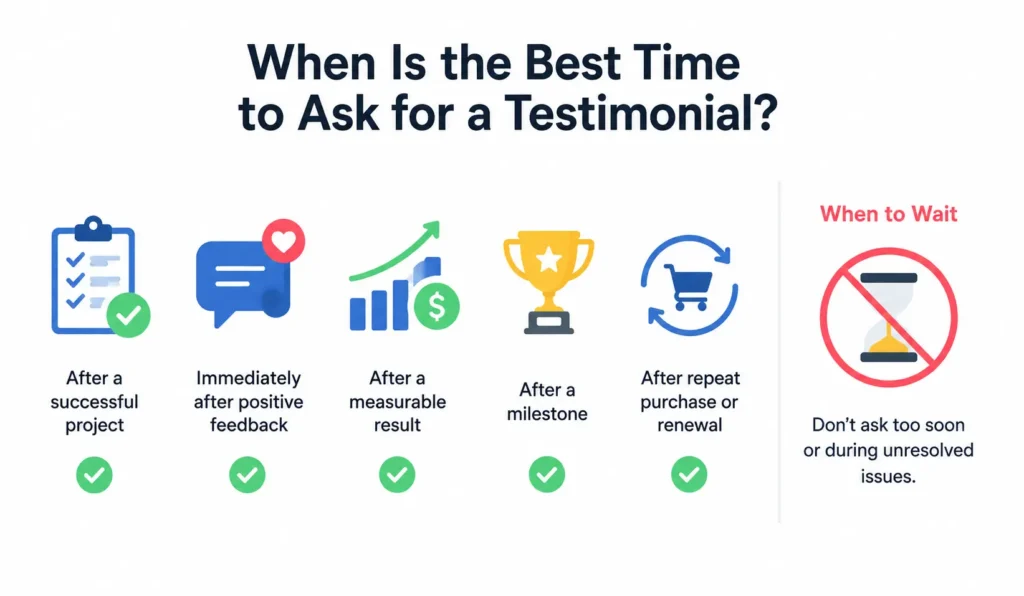
Timing is often the difference between a glowing testimonial and no response at all. Here are the moments that consistently work.
After a successful project
Once a project wraps and the customer is happy with the outcome, that’s prime testimonial territory. The details are fresh, and the emotional payoff (relief, excitement, pride) is at its peak.
Immediately after positive feedback
If a customer emails you unprompted to say how happy they are, that’s your cue. Reply, thank them, and ask if they’d be willing to turn that same feedback into a testimonial. You’re not asking them to invent enthusiasm, you’re just capturing what they already said.
After a measurable result
Numbers make testimonials credible. If a customer hits a goal your product or service helped with, more revenue, saved time, fewer errors, ask while that result is top of mind.
After a milestone
Anniversaries, contract renewals, or a customer reaching a usage milestone (their 100th order, their first year with you) are natural, low-pressure moments to ask.
After repeat purchase or renewal
A second purchase or a renewal is one of the strongest trust signals you can get. It shows the customer chose you again with full knowledge of what to expect, which makes their words more persuasive than a first-time buyer’s.
When should you wait before asking?
Don’t ask right after onboarding, during an unresolved issue, or before the customer has actually experienced the value of your product. Asking too soon often produces shallow, generic praise, or worse, no response at all.
Testimonial Timing Matrix
| Trigger | Best Time to Ask | Why It Works |
| Project completion | Within 1–3 days | Details and emotions are fresh |
| Unprompted positive feedback | Immediately | You’re capturing genuine, already-expressed enthusiasm |
| Measurable result achieved | Same week | Numbers are top of mind and easy to recall |
| Renewal or repeat purchase | At the moment of renewal | Signals real, ongoing trust |
| Support issue resolved | 1–2 weeks after resolution | Enough time to confirm the fix worked |
| New customer, first week | Don’t ask yet | Too early, they haven’t seen real value |
What Makes a Good Testimonial?
A good testimonial isn’t just praise, it’s proof. It shows a real customer, a real problem, and a real result, in language that sounds like an actual person talking.
Problem → Decision → Experience → Result → Recommendation framework
The strongest testimonials tend to follow a natural arc:
- Problem: what challenge the customer was facing
- Decision: why they chose your product or service
- Experience: what it was actually like working with you
- Result: what changed, ideally with specifics
- Recommendation: who else this would help, and why
You don’t need to prompt for all five in one question, but if your collected testimonials touch on most of these, they’ll read as far more credible than generic praise.
Weak testimonial vs. strong testimonial
Weak: “Great service. Highly recommend.”
Strong: “We were losing about 10 hours a week on manual scheduling before switching. Within the first month, that dropped to under two hours, and the support team walked us through setup personally instead of leaving us with a help doc.”
The strong version works because it names a specific problem, a specific outcome, and a specific detail about the experience. That specificity is what makes readers believe it. As UX and content strategist Gill Andrews has pointed out in her writing on testimonials, the most useful ones explain what the customer’s challenge was, what the provider actually did, and what changed as a result, not just how the customer felt about it.
What details make testimonials credible?
Credible testimonials tend to share a few traits:
- A specific problem, not a vague complaint
- A specific, ideally measurable outcome
- Numbers where they’re available (time saved, revenue gained, error rate dropped)
- Concrete details about the experience, not just adjectives
- Context about the customer (role, industry, company size) so readers can see themselves in it
- Natural, conversational language, not corporate-sounding praise
25 Questions to Ask for Better Testimonials
Instead of dumping a random list on your customer, organize your questions by what they’re designed to extract. Pick three to five per request, don’t send all 25 at once.
Questions about the customer’s problem
- What challenge or problem were you dealing with before you found us?
- What had you already tried that didn’t work?
- How was that problem affecting your business or day-to-day work?
Questions about why they chose you 4. What made you choose us over other options you considered? 5. Was there a specific feature, promise, or moment that tipped the decision? 6. What almost stopped you from signing up?
Questions about the experience 7. What was it like working with our team? 8. Was there a moment during the process that stood out to you? 9. How did the experience compare to what you expected going in?
Questions about results 10. What changed after you started using our product/service? 11. Can you put a number on the impact, time, money, or effort saved? 12. What would you say to someone unsure if the results are worth it?
Questions about objections and hesitations 13. What hesitations did you have before signing up? 14. What would you tell someone with the same hesitation now? 15. Was there anything that almost made you walk away?
Questions about recommendations 16. Who would benefit most from this product or service? 17. Would you recommend us, and if so, to whom specifically? 18. What’s one thing you’d tell a friend considering this?
Questions that produce quotable answers 19. If you had to describe your experience in one sentence, what would it be? 20. What surprised you most about working with us? 21. What’s the single biggest difference this has made for you? 22. How would you describe us to someone who’s never heard of us? 23. What’s your favorite thing about the product/service? 24. Is there a specific result you’re proud of that we helped with? 25. What would have happened if you hadn’t made this change?
This organized-by-intent approach gives you far more control over what kind of testimonial you end up with than a long, undifferentiated list, a similar principle to the extensive question banks you’ll find in career and hiring resources like Indeed’s guidance on interview questions, just applied to customer feedback instead.
Testimonial Request Email Templates
Simple testimonial request
Subject: Quick favor?
Hi [Name],
I hope things are going well on your end. I wanted to ask a quick favor, would you be open to sharing a short testimonial about your experience working with us? It would mean a lot, and it really helps other [customers/clients] like you feel confident choosing us.
If you’re up for it, here are a few questions to make it easy: [Insert 3–5 questions]
No pressure at all if now isn’t a good time. Thanks either way!
[Your name]
After a successful project
Subject: We did it!
Hi [Name],
Now that [project] has wrapped up, I wanted to say thank you for trusting us with it. If you have a couple of minutes, I’d love to hear your thoughts on how it went, and with your permission, I’d like to share them as a testimonial.
A few prompts if it helps: [Insert questions]
Thanks again for the opportunity to work together.
After receiving positive feedback
Subject: Thank you, and a small ask
Hi [Name],
Thank you so much for the kind words earlier, it genuinely made our day. Would you be comfortable if we turned that feedback into a testimonial for our website? I’m happy to draft something from what you already said and send it back for your approval.
After achieving a measurable result
Subject: Congrats on hitting [result]!
Hi [Name],
Seeing you hit [specific result] is exactly why we do this work. Would you be willing to share a quick testimonial about the journey to get there? Even a couple of sentences with the numbers would be incredibly valuable for other [customers] considering us.
B2B client testimonial request
Subject: Testimonial request from [Your Company]
Hi [Name],
As we wrap up [quarter/project], I wanted to reach out about featuring your experience with [Your Company] as a testimonial or short case study. This kind of feedback carries a lot of weight with other [industry] teams evaluating us. Would you or someone on your team be open to a quick call or a written response?
Freelancer testimonial request
Subject: Loved working with you!
Hi [Name],
Thanks so much for the opportunity to work on [project]. If you were happy with the outcome, would you mind writing a short testimonial I can add to my portfolio? A couple of sentences on the problem and the result would be perfect.
Agency testimonial request
Subject: A quick ask before we wrap [client] up
Hi [Name],
It’s been a pleasure managing [campaign/project] for your team. Before we close things out, would you be willing to share feedback on the results and the experience working with our agency? We’d love to feature it (with your approval) on our site and in future pitches.
Ecommerce customer testimonial request
Subject: How’s [product] working out for you?
Hi [Name],
It’s been a couple of weeks since your [product] arrived, how’s it going? If you’re happy with it, we’d love a short testimonial (photos welcome!) to share with future customers. It only takes a minute, and as a thank-you we’ll [optional incentive, if applicable].
Testimonial request for a long-term client
Subject: Reflecting on [X years] together
Hi [Name],
It’s hard to believe it’s been [timeframe] since we started working together. I’d love to hear how things have changed for you since then, and if you’re open to it, share that as a testimonial for others considering a long-term partnership with us.
Testimonial Request Templates for Different Channels
Email template
Email works best for detailed testimonials because it gives the customer time to think and write at their own pace. Use the templates above and always include specific questions.
SMS/text template
Hi [Name], it’s [Your Name] from [Company]. Loved working with you on [project]! Would you mind sharing a quick sentence or two about your experience? I can turn it into a testimonial, no pressure at all. 🙂
Keep SMS requests short. Texting works well for quick, informal responses but isn’t the place for a long list of questions.
LinkedIn message
Hi [Name], it was great working together on [project]. If you’re open to it, would you consider writing a short LinkedIn recommendation or a quick testimonial I could feature on our site? Happy to return the favor with a recommendation for you too.
LinkedIn recommendations double as testimonials and are publicly visible, which adds an extra layer of credibility since anyone can verify the reviewer is a real professional. You can see how these typically read by browsing recommendations on LinkedIn profiles in your industry.
In-person request
Asking face-to-face (at an event, in a meeting, or during a store visit) works well because it’s personal and immediate. Keep it casual: “Would you mind if I recorded a quick 30-second testimonial on my phone? Totally fine to say no.” Following up with a text or email afterward to confirm consent is a good practice.
Phone/video request
If you’re already on a call, ask directly: “Before we hang up, would you be open to sharing a quick testimonial about your experience?” This works especially well for B2B relationships where a phone or video call is already the norm.
Social media DM
A direct message on Instagram, X, or Facebook works well for ecommerce and consumer brands, especially when a customer has already tagged you or posted about your product. Reply, thank them, and ask if you can feature or quote their post as a testimonial.
How to Ask for a Testimonial Without Sounding Awkward
Don’t make it sound like a favor
Frame the request around mutual benefit, not charity. You’re not asking the customer to bail you out, you’re giving them a chance to share something they’re already proud of.
Explain why you’re asking
A one-line explanation (“this really helps other small business owners trust us before they sign up”) gives the request context and makes it feel less transactional.
Keep the request short
Long requests feel like homework. Keep your ask to a few sentences, and put the effort into your questions, not your preamble.
Don’t demand praise
I recommend not phrasing the request in a way that forces an answer, such, as “we would love a 5‑star review!” This feels awkward and on some platforms it can break review rules. I suggest asking for their experience instead.
Give them an easy way to say no
Adding a line like “no worries at all if now isn’t a good time” removes pressure and, counterintuitively, tends to increase response rates because it makes the ask feel low-stakes.
Ask for their experience, not a positive review
This difference matters. If you ask specifically for their experience you get something. If that experience is good the positivity shows on its own. Asking directly for a ” review” pushes people to act enthusiastic even if they do not feel it and readers can often notice.
How to Get Better Testimonials Instead of Generic Praise
Replace “Tell us what you think”
This phrase is too open-ended and produces vague answers like “great service!” Swap it for a specific question from the list above.
Ask about the before-and-after
“What was different before and after working with us?” almost always produces a more concrete, structured answer than a general request for feedback.
Ask for specific examples
Push gently for one concrete moment or instance rather than a general impression. “Can you think of a specific example?” is a simple, effective follow-up.
Ask about measurable results
Even approximate numbers (“saved roughly 5 hours a week,” “cut costs by about 20%”) add weight that vague praise never will.
Ask about initial objections
Asking what almost stopped someone from buying, and what changed their mind, produces testimonials that speak directly to hesitant prospects, which is often exactly who’s reading your page.
Ask what surprised them
Surprise makes for naturally interesting, quotable answers, and it often surfaces a benefit you weren’t actively marketing.
Ask what they would tell someone considering your service
This question format tends to produce a natural, ready-to-use recommendation, since you’re essentially asking them to write the pitch for you, in their own words.
What to Do When a Customer Says Yes but Doesn’t Send Anything
Send a simple reminder
People get busy. A short, friendly nudge (“just following up in case this slipped through the cracks, totally understand if you’re swamped!”) is usually all it takes.
Reduce the number of questions
If they haven’t responded, the ask may feel like too much effort. Cut your questions down to just one or two.
Offer a form instead of a blank email
Some people freeze at a blank reply box but will happily fill in a short form. A simple form with 2–3 fields often converts better than an open-ended email.
Offer to conduct a short interview
Offer a 10-minute call where you ask the questions and they just talk. You can transcribe their answers into a testimonial and send it back for approval, this removes the writing burden entirely.
Ask for a voice or video testimonial instead
Some people find it easier to talk than to write. Offering a quick voice memo or video option can unblock customers who’ve gone quiet on a written request.
Testimonial Follow-Up Sequence
Follow-up #1: Gentle reminder (3–5 days later)
Hi [Name], just floating this back to the top of your inbox in case it got buried! No pressure at all, happy to make it even quicker if that helps.
Follow-up #2: Make it easier (7–10 days later)
Hi [Name], totally understand if things have been busy. Would it help if I just asked you one quick question instead? [Insert single best question]
Follow-up #3: Close the loop (2 weeks later)
Hi [Name], no worries if now isn’t the right time for this, I’ll leave the door open in case you’d like to share something down the line. Thanks again for being a great customer!
When to stop following up
Two to three follow-ups is a reasonable limit. After that, back off. Continuing to push can strain the relationship, and a testimonial obtained through pressure rarely reads as genuine anyway.
How to Collect Testimonials With a Feedback Form
What fields to include
Keep it simple: name, a couple of open text questions, and an optional field for a photo or video upload.
The ideal number of questions
Three to five questions are on the spot. If you ask fewer, then you may get answers. If you ask more, completion rates will drop sharply.
Consent checkbox
Always include a checkbox that confirms the customer agrees to let you publish their response. It is best to add a link that shows how it may be used.
Name, job title and company
For B2B testimonials, including a name, title and company makes a difference. Quotes without these details don’t carry the weight. People trust names and real companies more than anonymous comments.
Photo permission
If you want to pair the testimonial with a headshot, ask for explicit permission and give the customer the option to upload their own image.
Video permission
Treat video permission as a checkbox from written testimonial permission because some customers are comfortable with one but not the other. Video permission should be independent of written permission. Checkboxes, for video permission and written testimonial permission should remain separate.
Tools for collecting testimonials
A few popular options, each with different strengths:
- Google Forms: free, simple, good for basic written testimonials
- Typeform: more polished, conversational form experience
- Airtable: useful if you want to organize and tag testimonials as a database
- Dubsado: built for service-based businesses already using it for client management
- HoneyBook: similar, popular with freelancers and creative businesses
- Testimonial.to: purpose-built for collecting written and video testimonials with a shareable link
As designer Minima Designs and business coach Colie James have both noted in their work with creative entrepreneurs, a structured form consistently outperforms an open-ended email request, it removes the blank-page problem that stops a lot of customers from ever responding at all.
Can You Edit a Customer Testimonial?
Minor grammar edits
Yes, fixing typos, punctuation, and small grammar issues is standard practice and doesn’t require separate approval, as long as the meaning stays intact.
Shortening a long testimonial
You can trim a long response for length, but be careful not to cut context that changes the meaning. When in doubt, send the shortened version back for a quick approval.
Removing irrelevant sections
If a customer goes off-topic (mentions an unrelated issue, for example), it’s fine to remove that section, just don’t alter what remains.
When you need customer approval
Always get explicit approval before publishing anything, and especially before making any edit that changes tone, adds claims, or alters numbers.
What you should never change
Never alter facts, invent quotes, add claims the customer didn’t make, or change the substance of what someone said. This isn’t just an ethics issue, in the U.S., the FTC’s endorsement guidelines require that testimonials reflect the genuine, honest opinions of the person giving them.
Email template for approving an edited testimonial
Subject: Quick check before we publish
Hi [Name],
Thanks again for your testimonial! I tightened it up slightly for length, here’s the edited version:
“[edited testimonial]”
Does this still sound right to you? Happy to adjust anything before we publish it.
How to Ask for Permission to Use a Testimonial
Website permission
Confirm explicitly that the customer is okay with their testimonial appearing on your website, and be specific about which pages if that matters to them.
Name and job title
Ask whether they’re comfortable with their full name and job title being attached, or whether they’d prefer first name only or anonymity.
Company logo/name
For B2B testimonials, separately confirm permission to use their company name or logo, since some companies have strict brand guidelines around this.
Photo permission
Get explicit sign-off before using a customer’s photo, even if they submitted it themselves, confirm it’s specifically for the purpose you intend.
Video permission
Treat video the same way as photos, but be even more specific about where it may appear (website only, or also social ads, etc.).
Advertising and social media usage
Usage in paid ads is a different level of exposure than a website quote. Always ask separately before repurposing a testimonial into paid advertising.
Simple testimonial consent template:
“I confirm that the testimonial above reflects my genuine experience with [Company], and I give permission for it to be used on [website / social media / advertising / sales materials], including my [name / title / company / photo / video], as applicable.”
How to Ask for Video Testimonials
When to request a video
Video works best for high-consideration purchases (software, services, larger B2B deals) where seeing a real person builds more trust than text alone.
Questions to ask on camera
Keep it to two or three questions max: the problem they had, the result they got, and who they’d recommend this to. Too many questions on camera leads to a rambling, hard-to-edit video.
How long should the video be?
Somewhere between 30 seconds and two minutes is ideal. Long enough to include real detail, short enough that people will actually watch it.
Phone-recorded vs. professionally recorded
I find phone-recorded videos to feel more authentic and to be much easier to gather on a scale. Recorded videos look polished but they require more coordination and higher cost so reserve professionally recorded videos for your most important customer stories.
How to make customers comfortable
Send the questions in advance so they’re not caught off guard, and reassure them it doesn’t need to be perfect, a natural, slightly imperfect delivery usually reads as more trustworthy than a scripted one.
How to repurpose testimonial videos
One video testimonial can be cut into short social clips, embedded on a landing page, added to an email campaign, or used in a sales deck. The National Association of Realtors has published guidance recommending concise, well-lit testimonial videos that get repurposed across multiple formats, a principle that applies well beyond real estate.
What If the Customer Gives Negative Feedback?
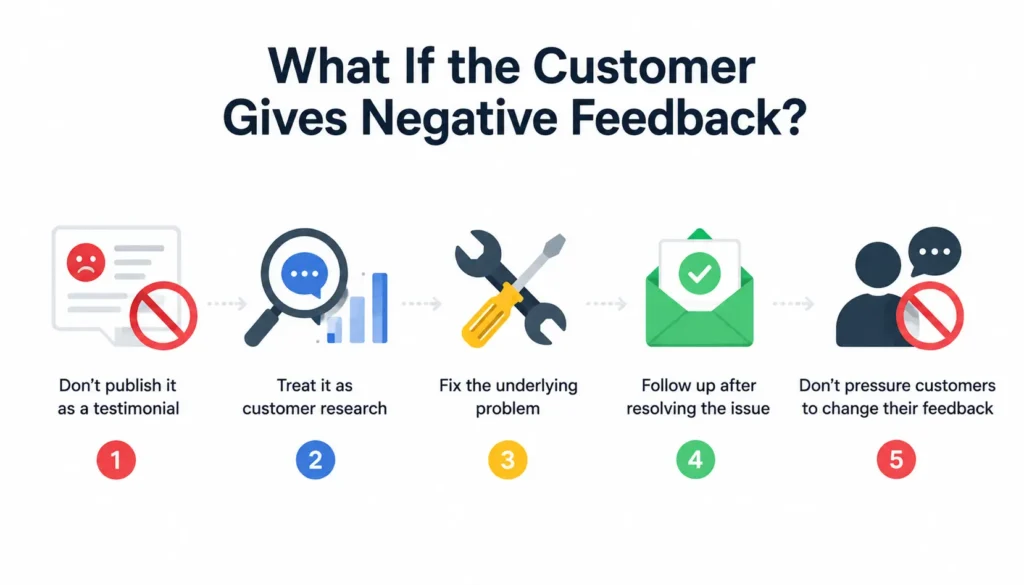
Don’t publish it as a testimonial
This should go without saying, but never repurpose critical feedback as a testimonial, even in edited form. It’s dishonest and, if discovered, seriously damages trust.
Treat it as customer research
Negative feedback, while not usable as a testimonial, is genuinely valuable. Treat it as a free source of insight into what’s not working.
Fix the underlying problem
Where possible, address the root issue the customer raised, not just for them, but for future customers who might hit the same problem.
Follow up after resolving the issue
Once you’ve fixed the issue, follow up with the customer. If they’re satisfied with the resolution, that follow-up moment can become a legitimate future testimonial about how you handled the problem.
Don’t pressure customers to change negative feedback
Never ask a customer to revise honest criticism into something more flattering. Beyond being unethical, this kind of pressure tends to backfire publicly, a quick search on communities like r/smallbusiness turns up plenty of cautionary stories from business owners who tried it.
Should You Offer an Incentive for a Testimonial?
Why incentives can create problems
Paying for or incentivizing a testimonial can bias what the customer says, even unintentionally, people naturally want to reciprocate a gift with more generous praise.
Testimonial incentives vs. review incentives
Testimonials usually require the customer’s control and consent. Public reviews on platforms, like Google, Yelp or industry-specific sites often have rules that prohibit incentivized reviews.
When incentives may violate platform policies
Many review sites clearly say you can’t offer rewards for reviews. They might delete them or punish your profile if they find out. If you give any kind of incentive be sure it’s not connected to writing something, in particular and always look at the site’s rules first.
Better alternatives to monetary incentives
Offering payment focuses on making the task itself easy and meaningful. Offer a thank‑you give early access to something or simply close the loop by showing the customer how testimonials helped others.
The National Association of Realtors is explicit, on this point too: testimonial should reflect experiences, not incentivized praise.
Testimonial vs. Review vs. Case Study
These three formats often get lumped together, but they serve different purposes.
| Testimonial | Review | Case Study | |
| Main purpose | Build trust | Public reputation | Demonstrate results |
| Length | Short–medium | Usually short | Long |
| Detail | Moderate | Low–moderate | High |
| Best placement | Website/landing pages | Review platforms | Website/sales materials |
| Best use | Conversion | Reputation | Complex B2B/service sales |
If you want a broader definition of how testimonials fit into the wider concept of social proof, Wikipedia’s overview of social proof is a solid starting point.
Where to Use Customer Testimonials
Testimonials shouldn’t just sit on a single “testimonials page.” Spread them across:
- Homepage: near the top, to build immediate trust
- Service/product pages: next to the specific offer they relate to
- Landing pages: close to the call-to-action, where hesitation peaks
- Pricing pages: to reassure buyers right before a purchase decision
- Checkout: a short quote near the final step can reduce cart abandonment
- Email marketing: in nurture sequences and cart-recovery emails
- Social media: as standalone posts or graphics
- Sales presentations: to back up claims with third-party proof
- Case studies: as supporting quotes within a longer narrative
- Advertising: in paid social and display ads, with permission
The National Association of Realtors similarly recommends spreading testimonials across websites, social platforms, and marketing and sales materials rather than confining them to one place.
How to Turn One Testimonial Into Multiple Marketing Assets
A single strong testimonial rarely gets used just once. With minor reformatting, one testimonial can become:
- A website quote block
- A standalone social media post
- A LinkedIn post or comment
- A section within a longer case study
- An email subject line or body quote
- A slide in your sales deck
- A short video clip (if collected on video)
- Ad creative for paid campaigns
- Proof text on a landing page
- An answer within your FAQ section
Treat every testimonial you collect as raw material, not a single-use asset, the return on the time you spent asking for it multiplies with every additional place you put it to work.
How to Build a Repeatable Testimonial Collection System
Step 1: Define testimonial triggers
Decide in advance which moments (project completion, renewal, positive feedback, milestone) automatically trigger a testimonial request.
Step 2: Create your questions
Build a bank of questions organized by intent (problem, decision, experience, results, objections, recommendation) so you can mix and match depending on the customer.
Step 3: Create your request templates
Have ready-to-go templates for each channel, email, SMS, LinkedIn, so you’re never starting from scratch.
Step 4: Automate or schedule requests
Where possible, tie requests to existing workflows (a project-management tool, a CRM, or an email automation platform) so they go out consistently without manual effort.
Step 5: Collect consent
Build consent language directly into your form or request so you’re never scrambling for permission after the fact.
Step 6: Store testimonials centrally
Keep all testimonials in one place, a spreadsheet, Airtable base, or dedicated tool, instead of scattered across email threads.
Step 7: Tag testimonials by customer/problem/result
Tagging makes it easy to pull the right testimonial for the right page later (for example, all testimonials from a specific industry or about a specific result).
Step 8: Repurpose them across marketing
Finally, revisit your library regularly and actively push testimonials out into the marketing assets described above, rather than letting them sit unused.
Frequently Asked Questions About Asking for Testimonials
1. How do you politely ask for a testimonial?
Reach out personally, explain briefly why the feedback matters, give a few specific questions to answer, and make it clear there’s no pressure if the timing isn’t right.
2. What is the best way to ask a client for a testimonial?
Ask soon after a successful project or clear result, keep the request short, and provide 3–5 specific questions instead of an open-ended ask.
3. When should you ask for a testimonial?
Right after a win, a completed project, positive feedback, a measurable result, a renewal, or a milestone. Avoid asking too early, before the customer has experienced real value.
4. What questions should you ask for a testimonial?
Focus on the customer’s original problem, why they chose you, what the experience was like, what results they got, and what they’d tell someone else considering you.
5. How do you ask for a testimonial without being awkward?
Keep the ask short, explain your reason for asking, avoid pressuring for praise, and give the customer an easy way to decline.
6. Can you edit a customer testimonial?
Yes, for grammar, length, and clarity, but always get customer approval, and never change facts, numbers, or the substance of what they said.
7. Should you offer an incentive for testimonials?
Generally, no, incentives can bias the response and may violate review platform policies. Focus on making the request easy and meaningful instead.
8. How long should a testimonial be?
A few sentences is usually enough for written testimonials; video testimonials work best between 30 seconds and two minutes.
9. How do you ask for a video testimonial?
Explain the format in advance, send 2–3 questions ahead of time, keep it short, and reassure the customer it doesn’t need to be polished or scripted.
10. What is the difference between a testimonial and a review?
A testimonial is typically collected directly by a business and used in its own marketing, while a review is posted independently by a customer on a public platform like Google or Yelp.
Conclusion
Getting testimonials from customers is mostly three things: good timing, a personal touch and specific questions instead of a vague request. If you miss any of those you often hear nothing or a bland comment such as ” service, highly recommended.” When you get all three right you receive detailed testimonials that really help your business.
Begin by picking one customer. Pick a moment from the timing guide above. Send a template that contains three or four questions. When you notice how much easier the process becomes and how richer the answers feel, make that a repeatable system so that every next testimonial request is just as simple. Over time a steady flow of customer stories becomes a powerful asset, for your marketing appearing on your website in sales conversations and everywhere else.