

If you have ever watched a software project go off track, miss deadlines, have requirements and see a team that looks like it is building three different products at once you have seen what happens when there is no software development methodology.
A software development methodology is the way that keeps everyone rowing in the same direction. A software development methodology is how a team plans, builds, tests, hands over and keeps software working while they coordinate people, processes, requirements and feedback along the way.
Before we go further it is worth clearing up some confusion. Methodology, SDLC, process model and framework are terms that get used the way in job postings, blog posts and even in team meetings. But they are not quite the same thing. Understanding the difference will help you make decisions about how your team actually works, not just what words appear on your resume.
What Is a Software Development Methodology?
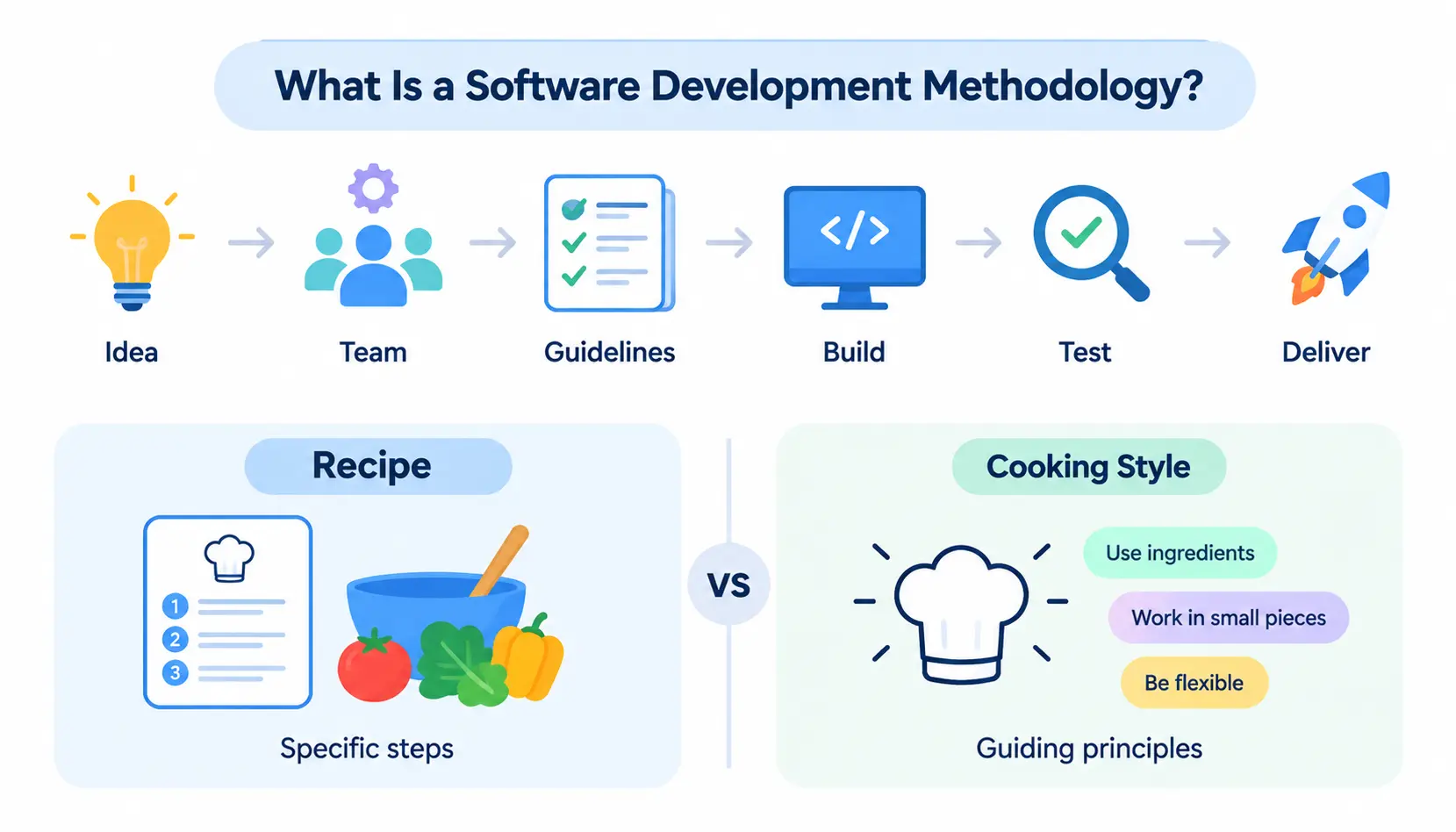
A software development methodology is an organized way to turn an idea into real working software. It gives teams guidelines on how to work from start to finish. It helps answer questions: Who decides what features to build? How do we manage changes in requirements? When should testing happen?. How often do we deliver new versions?
It’s like comparing a recipe to a cooking style. A recipe like Scrum or Waterfall is very specific. It lists steps to follow. A methodology like Agile is more flexible. It’s less about rules and more about principles. Think of it as a guiding idea: “Use ingredients” or “work in small pieces.” That philosophy can support different recipes but the core idea stays the same.
What a software development methodology controls
A methodology shapes almost every part of the development process, including:
- Planning – how work gets scoped, estimated, and scheduled
- Requirements – how needs are gathered and prioritized
- Development – how coding work is structured and sequenced
- Testing – when and how quality checks happen
- Documentation – how much gets written down, and when
- Communication – how the team and stakeholders stay aligned
- Delivery – how and when software reaches users
- Feedback – how input from users and stakeholders loops back in
- Maintenance – how the software is supported after launch
Why software teams use methodologies
Teams don’t adopt a methodology because it looks good in a slide deck. They adopt one because unstructured development is genuinely risky. A clear methodology helps teams:
- Reduce uncertainty by defining how decisions get made
- Organize work so nothing falls through the cracks
- Improve collaboration between developers, designers, and stakeholders
- Manage risks before they become expensive problems
- Control quality through consistent testing and review
- Improve delivery predictability, which matters enormously to clients and leadership
Software Development Methodology vs SDLC vs Process Model vs Framework
This is where a lot of the confusion in the industry actually comes from, so let’s break it down piece by piece.
What is SDLC?
SDLC, or Software Development Life Cycle, refers to the overall sequence of phases a software product moves through – from requirements gathering to design, development, testing, deployment, and maintenance. SDLC is the big-picture map, and you can find a more detailed breakdown on Wikipedia’s Systems Development Life Cycle page. SDLC applies regardless of which specific methodology a team chooses to follow.
What is a software development methodology?
A methodology is the way a team thinks about and works through the software development life cycle. It includes the philosophy and rules that guide how tasks are done. Waterfall and Agile are two known methodologies. They both cover the stages of development but they do it in very different ways. Waterfall moves step by step in order finishing one phase before starting the next. Agile works, in cycles repeating parts of the process over and over. This difference changes how teams plan, build, test and deliver software.
What is a software process model?
A process model is a detailed way to show how the stages of the SDLC are connected and how they happen again and again. The Spiral model, for example, is a process model that shows how development works through a series of repeating steps that include planning, risk analysis, engineering and evaluation.
What is a development framework?
A framework is a concrete implementation of a methodology, with defined roles, artifacts, and ceremonies. Scrum is a framework that implements Agile principles through specific practices like sprints, daily stand-ups, and retrospectives.
What is a development practice?
A practice is a way of doing something inside a system or approach. Examples are pair programming, test-driven development or continuous integration. Practices are the most direct parts of the process.
Simple example of how they fit together
Here’s a simple way to visualize the hierarchy:
SDLC → Methodology → Framework → Practices → Tools
The SDLC is the life cycle every project moves through. The methodology (say, Agile) is the philosophy guiding that movement. The framework (Scrum) is the specific system implementing the philosophy. Practices (sprint planning, stand-ups) are what teams actually do day to day. Tools (Jira, Trello) are what they use to do it.
Worth noting: terminology varies quite a bit across the industry. Some companies use “methodology” and “framework” interchangeably, and you’ll find plenty of disagreement about this even in developer communities like r/programming on Reddit, where practitioners frequently debate the practical differences between these terms in real teams. Don’t get too hung up on perfect terminology – focus on understanding what each concept actually does for your project.
How Does a Software Development Methodology Work?
Regardless of which methodology a team picks, most development work touches these general activities. What differs is the order, emphasis, and repetition.
Requirements and discovery
The team figures out what the software actually needs to do – through interviews, research, or user stories.
Planning
Work gets broken down, estimated, and scheduled, whether that’s a full project plan (Waterfall) or a two-week sprint backlog (Scrum).
Design
Architecture, user experience, and technical decisions are mapped out before or alongside development.
Development
Actual coding happens here, following whatever structure the methodology defines.
Testing and quality assurance
Code gets checked for bugs, performance issues, and whether it meets requirements.
Deployment
The software is released to users, whether that’s a single big launch or dozens of small releases a week.
Maintenance and improvement
After launch, the team fixes bugs, patches security issues, and adds improvements.
Feedback and iteration
User and stakeholder feedback flows back into the process to shape what happens next.
It’s worth repeating: not every methodology performs these activities in the same order, or even performs them all in isolation. Agile methodologies loop through requirements, development, and feedback repeatedly. The waterfall moves through them once, in a straight line.
What Are the Main Types of Software Development Methodologies?
There’s no single “best” methodology for software development services – each was designed to solve different problems. Here’s an honest look at the major approaches teams actually use.
Waterfall
How it works: Waterfall is a linear, sequential approach. Each phase – requirements, design, development, testing, deployment – must be completed before the next one begins.
Advantages: Clear structure, predictable timelines, thorough documentation, and easy budgeting since scope is defined upfront.
Disadvantages: Difficult and expensive to accommodate changes once a phase is complete; customers don’t see working software until late in the process.
Best use cases: Projects with fixed, well-understood requirements – think government contracts, construction-adjacent software, or compliance-heavy systems.
Agile
How it works: Agile breaks work into small, iterative cycles, delivering working software frequently and adjusting based on feedback.
Agile principles: The Agile Manifesto emphasizes individuals and interactions over processes and tools, working software over comprehensive documentation, customer collaboration over contract negotiation, and responding to change over following a plan.
Advantages: Flexible, responsive to change, faster feedback loops, and continuous delivery of value.
Disadvantages: Requires close collaboration and can lose direction without discipline; harder to predict fixed-cost, fixed-scope budgets upfront.
Best use cases: Projects with evolving requirements – most modern web and mobile products fit here.
Scrum
Scrum is the most widely adopted framework built on Agile principles. It organizes work into fixed-length cycles called sprints, usually one to four weeks long.
- Sprints – time-boxed periods where a defined set of work gets completed
- Product backlog – the prioritized list of everything that could be built
- Product owner – the person responsible for maximizing product value and prioritizing the backlog
- Scrum Master – the person who removes blockers and keeps the team following Scrum practices
- Development team – the people actually building the product
- Reviews and retrospectives – sessions to inspect the work delivered and improve the process itself
Scrum’s relationship to Agile is important to clarify: Agile is the philosophy; Scrum is one specific framework for implementing it. Not every Agile team uses Scrum, and not every Scrum team is doing “true” Agile. Many engineering leaders and product managers share their own take on this distinction in posts and discussions on LinkedIn, which can be a useful place to see how the theory plays out on real teams.
Kanban
Kanban focuses on visualizing work and limiting how much is in progress at once.
- Continuous workflow – work flows continuously rather than in fixed sprints
- Work-in-progress limits – caps on how many tasks can be “in progress” at a time, which prevents bottlenecks
- Visual boards – columns like “To Do,” “In Progress,” and “Done” make work status obvious at a glance
- Best use cases: Support teams, maintenance work, or any team with a steady stream of incoming tasks rather than fixed project phases
Spiral
Iterative development: The Spiral model repeats through planning, risk analysis, engineering, and evaluation in expanding loops.
Risk analysis: Each loop includes a dedicated risk-assessment phase, which makes Spiral especially suited to high-stakes projects.
Prototyping: Early loops often produce prototypes to validate direction before heavier investment.
Best use cases: Large, complex, high-risk projects – enterprise systems, aerospace software, or anything where getting it wrong is expensive.
Lean Development
Lean applies manufacturing efficiency principles to software.
- Waste reduction – eliminating anything that doesn’t add value (unnecessary meetings, unused features, excess documentation)
- Value delivery – focusing effort on what customers actually need
- Continuous improvement – regularly refining the process itself, not just the product
Extreme Programming (XP)
XP is an engineering-focused methodology built around technical discipline.
- Short iterations – frequent, small releases
- Pair programming – two developers working together at one workstation to catch issues early
- Test-driven development – writing tests before writing the code they test
- Continuous feedback – constant check-ins with customers and teammates
Rapid Application Development (RAD)
RAD prioritizes speed, using prototypes and user feedback to iterate quickly rather than spending heavy time on upfront planning. It works best when time-to-market matters more than exhaustive documentation.
Prototyping
Prototyping methodology builds early, simplified versions of a product to test ideas and gather feedback before committing to full development. It’s especially useful when requirements are vague or unproven.
DevOps
I think DevOps is best understood not as another methodology but as a culture and set of practices that connects development and operations teams. Then treating “build it” and “run it” as separate jobs, DevOps emphasizes automation, continuous integration and delivery and shared ownership of the product across its entire life cycle. DevOps is less about a fixed process and more about breaking down silos, between teams that used to work.
DevSecOps
DevSecOps extends DevOps by weaving security practices into every stage of development, rather than treating security as a final check before release. Vulnerability scanning, access controls, and compliance checks happen continuously, alongside the code itself.
Software Development Methodologies Compared
| Methodology | Style | Flexibility | Best For | Main Strength | Main Limitation |
| Waterfall | Sequential | Low | Stable requirements | Predictability | Difficult changes |
| Agile | Iterative | High | Changing requirements | Adaptability | Requires collaboration |
| Scrum | Sprint-based | High | Product teams | Structure | Requires discipline |
| Kanban | Continuous flow | High | Continuous work | Flexibility | Less prescriptive |
| Spiral | Risk-driven | High | Complex/high-risk projects | Risk management | Complexity |
| Lean | Value-driven | High | Efficiency | Waste reduction | Requires process maturity |
| XP | Iterative | High | Engineering-heavy teams | Code quality | Requires strong practices |
| RAD | Rapid/iterative | High | Fast prototyping | Speed | Not ideal for every project |
| DevOps | Continuous | High | Frequent delivery | Automation | Organizational change |
Waterfall vs Agile: What’s the Difference?
Since these two come up constantly in interviews, planning meetings, and client conversations, they deserve a direct side-by-side comparison.
Waterfall approach
I find that requirements are locked in early and the project moves through design, development and testing in a sequential pass. Customers typically see the product only near the end.
Agile approach
Work happens in cycles. Software is delivered often. As the team learns more requirements can change. Customer feedback helps shape what comes next.
Waterfall vs Agile comparison
| Factor | Waterfall | Agile |
| Planning | Upfront, comprehensive | Ongoing, incremental |
| Requirements | Fixed early | Evolve over time |
| Customer feedback | Late in the process | Continuous |
| Testing | After development | Throughout development |
| Delivery | One final release | Frequent, incremental releases |
| Change management | Costly and slow | Built into the process |
| Documentation | Extensive | Lightweight, “just enough” |
| Risk | Discovered late | Surfaced early |
| Timeline predictability | High (if requirements hold) | Lower, but more adaptable |
Can Waterfall and Agile be combined?
Yes. In practice many teams do exactly this. A hybrid approach might use Waterfall‑style planning and documentation for phases that require a lot of compliance while running development itself in sprints. Ditstek for example has described using Agile and Waterfall practices in parts of a single project, which shows that organizations often adapt their methods to real needs rather than rigidly adopting one approach and forcing every project into it.
How to Choose the Right Software Development Methodology
There’s no universal answer here – the right choice depends on your specific project. Walk through these ten questions before committing.
1. Assess how stable the requirements are
If requirements are locked and unlikely to change, Waterfall becomes more viable. If they’re likely to evolve, Agile approaches make more sense.
2. Evaluate project complexity
Highly complex projects with many moving parts often benefit from iterative approaches like Spiral or Agile, which surface problems early instead of late.
3. Identify technical and business risks
High-risk projects need methodologies with built-in risk analysis, like Spiral, or frequent checkpoints, like Scrum.
4. Consider team size and experience
Small, experienced teams can often self-organize under lightweight frameworks like Kanban. Larger or less experienced teams may need more structure, like Scrum provides.
5. Determine how often customers need to provide feedback
If your client or user base needs to weigh in constantly, Agile’s short cycles fit better than Waterfall’s single delivery point.
6. Consider delivery frequency
If the business needs frequent releases – weekly or even daily – Agile combined with DevOps practices is usually the better fit.
7. Evaluate documentation and compliance requirements
Regulated industries (healthcare, finance, government) often need the heavier documentation that Waterfall or hybrid approaches naturally produce.
8. Consider available tools and infrastructure
Continuous delivery methodologies depend on solid automation and DevOps tooling. Without that infrastructure, ambitious Agile or DevOps plans can stall.
9. Consider budget and timeline
Fixed-budget, fixed-timeline projects often lean toward Waterfall’s predictability. Flexible budgets can better absorb Agile’s iterative discovery process.
10. Decide whether a hybrid approach makes sense
Many real-world teams land somewhere in between – using structured planning where it’s needed and iterative delivery where it adds value.
Team size, available tools and technology, and specific client requirements consistently come up as the deciding factors in how organizations actually choose a methodology – turning these into a systematic checklist, rather than a vague gut call, makes the decision far more defensible to stakeholders.
Which Software Development Methodology Should You Use?
For projects with fixed requirements
Consider Waterfall. It’s predictable, well-documented, and works well when nothing is expected to change.
For projects with changing requirements
Consider Agile. It embraces change instead of resisting it.
For complex, risk-heavy projects
Consider Spiral. Its built-in risk analysis loops protect against costly late-stage surprises.
For continuous delivery
Consider Agile + DevOps. Together, they support frequent, automated, low-risk releases.
For product teams working in sprints
Consider Scrum. It gives structure and rhythm to ongoing product development.
For continuous incoming work
Consider Kanban. It’s ideal for support queues and maintenance-style workloads.
For rapid experimentation
Consider Prototyping or RAD. Both prioritize speed and quick validation over exhaustive planning.
For highly regulated projects
Regulated industries often need methodology choices that hold up under audit – stronger documentation, formal verification and validation steps, security reviews, and clear governance structures, regardless of whether the underlying approach is Waterfall, Agile, or a hybrid.
Real-World Example: Choosing a Methodology for a Software Project
Theory only gets you so far. Let’s walk through one project and see how different methodologies would actually play out.
Scenario: Building an online booking platform
Imagine a company hiring a development team to build an online booking platform for a chain of clinics – patients need to book appointments, doctors need scheduling tools, and the system has to integrate with an existing patient records system. A virtual medical assistant can complement these digital workflows by helping healthcare practices coordinate appointments, manage patient records, and handle routine administrative tasks.
What Waterfall would look like
The team would gather every requirement upfront – booking rules, integration specs, compliance needs – then move through design, development, and testing in sequence. The clinic wouldn’t see a working product until near the end, and any mid-project change (say, adding SMS reminders) would require significant rework.
What Agile would look like
The team would build the platform in short cycles, starting with a basic booking flow and layering in features – integrations, reminders, doctor dashboards – based on ongoing feedback from clinic staff. Requirements could shift as staff actually use early versions and discover what they need.
What Scrum would look like
The team would work in two-week sprints, with a product owner (likely a clinic operations lead) prioritizing the backlog. Each sprint would end with a review showing working features, followed by a retrospective to improve the next cycle.
Where DevOps would fit
Once the platform is live, DevOps practices – automated testing, continuous integration, and monitoring – would let the team release small updates and bug fixes quickly without risking downtime for a system clinics depend on daily.
Which approach would be most appropriate and why?
Given the compliance considerations (patient records) and the need for the clinic to see and react to working software early, a hybrid approach makes the most sense: Waterfall-style rigor for compliance and data-security requirements, combined with Agile/Scrum for the actual feature development, and DevOps practices to support ongoing releases after launch.
Benefits of Using a Software Development Methodology
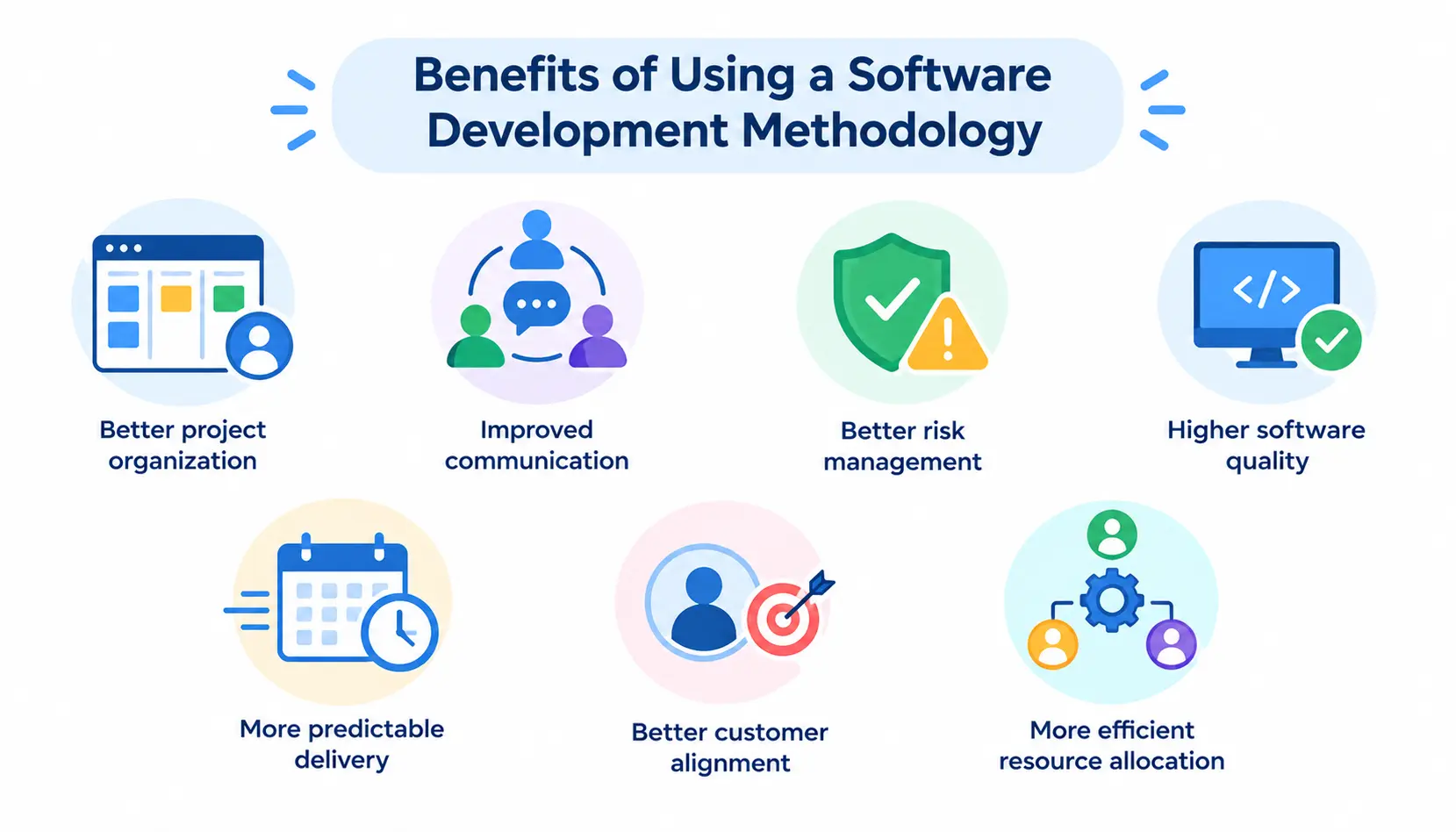
Better project organization
Everyone knows what’s happening, when, and who owns it.
Improved communication
Regular ceremonies and clear roles keep teams and stakeholders aligned.
Better risk management
Structured checkpoints catch problems before they become expensive.
Higher software quality
Built-in testing and review processes catch bugs earlier.
More predictable delivery
Clear processes make it easier to estimate timelines and hit them.
Better customer alignment
Regular feedback loops keep the product aligned with what customers actually need.
More efficient resource allocation
Clear prioritization means people spend time on what matters most.
Challenges of Software Development Methodologies
Choosing the wrong methodology
Forcing Waterfall onto a fast-changing product, or Agile onto a rigid compliance project, causes friction and frustration.
Over-process and unnecessary bureaucracy
Too much process can slow teams down more than no process at all.
Resistance to change
Teams used to one way of working often push back against switching methodologies.
Poor team adoption
A methodology only works if the team actually follows it – half-hearted adoption rarely delivers the promised benefits.
Scope creep
Even Agile teams can suffer from scope creep if backlog prioritization isn’t disciplined.
Inadequate customer involvement
Methodologies that depend on feedback loops fail without a customer willing to engage regularly.
Treating a framework as a rigid rulebook
Frameworks like Scrum are meant to be adapted to a team’s context, not followed like scripture.
Common Software Development Methodology Mistakes
Choosing a methodology because it is popular
Agile isn’t automatically right just because everyone talks about it – fit matters more than popularity.
Treating Agile as “no planning”
Agile still involves planning; it just happens continuously rather than all upfront.
Treating Waterfall as inherently outdated
Waterfall remains genuinely useful for stable, compliance-heavy projects – it’s not obsolete, just situational.
Confusing Scrum with Agile
Scrum is one implementation of Agile principles, not a synonym for Agile itself.
Assuming DevOps replaces Agile
DevOps complements Agile by extending its principles into deployment and operations – it doesn’t substitute for it.
Using a methodology without adapting it
Copying a framework exactly from a textbook or another company, without adjusting for your own team, often causes more friction than benefit.
Ignoring team capability
A methodology that assumes high team maturity (like Kanban’s self-organization) can struggle with a team that needs more structure.
Ignoring project risk
Skipping risk analysis on a genuinely risky project – regardless of methodology – invites expensive surprises later.
Software Development Methodology Best Practices
Start with project requirements
Let the nature of the project – not personal preference – drive the methodology choice.
Define roles and responsibilities
Everyone should know who owns which decisions, regardless of framework.
Establish measurable delivery goals
Concrete goals (sprint velocity, release cadence, defect rates) keep progress visible.
Build quality and testing into the process
Don’t treat testing as an afterthought – build it into every phase.
Maintain appropriate documentation
Match documentation depth to project risk and compliance needs, not to habit.
Gather stakeholder feedback
Regular check-ins prevent late-stage surprises, regardless of methodology.
Review the process regularly
Retrospectives (or their equivalent) help teams improve how they work, not just what they build.
Adapt the methodology to the project
The best teams treat methodologies as adaptable tools, not fixed rules.
Frequently Asked Questions
1. What is a software development methodology?
It’s a structured approach that guides how a team plans, builds, tests, delivers, and maintains software throughout a project.
2. Why is software development methodology important?
It reduces uncertainty, improves collaboration, manages risk, and makes delivery more predictable.
3. What are the most common software development methodologies?
Waterfall, Agile, Scrum, Kanban, Spiral, Lean, Extreme Programming, RAD, and DevOps are among the most widely used.
4. What is the difference between SDLC and software development methodology?
SDLC is the overall life cycle of phases a project moves through; a methodology is the specific philosophy and approach used to move through those phases.
5. What is the difference between Agile and Waterfall?
Waterfall is sequential and plans everything upfront; Agile is iterative and adapts as the project progresses.
6. Is Scrum a methodology or framework?
Scrum is a framework – a specific way of implementing Agile principles, with defined roles and ceremonies.
7. Is DevOps a software development methodology?
Not exactly. DevOps is better described as a culture and set of practices connecting development and operations, rather than a standalone methodology.
8. Which software development methodology is best?
There isn’t a single “best” one – the right choice depends on requirements stability, project complexity, risk, team size, and delivery needs.
9. Which methodology is best for changing requirements?
Agile, since it’s specifically designed to adapt as requirements evolve.
10. Can Agile and Waterfall be combined?
Yes. Hybrid approaches combine Waterfall’s upfront planning and documentation with Agile’s iterative development.
11. What methodology should a startup use?
Most startups benefit from Agile or Lean approaches, since they typically face changing requirements and need to validate ideas quickly.
12. How do you choose a software development methodology?
Assess requirements stability, project complexity, risk, team size, feedback needs, delivery frequency, compliance requirements, and budget before deciding.
Conclusion
At the end of the day, a software development methodology isn’t about following a trend – it’s about picking the approach that fits your project’s requirements, risk level, and team.
Waterfall works when requirements are locked in; Agile and its frameworks like Scrum and Kanban shine when things are expected to change; Spiral protects high-risk projects; and DevOps keeps everything running smoothly after launch.
The teams that succeed aren’t the ones that pick the “trendiest” methodology – they’re the ones that pick the right one for the job, and stay willing to adapt it as the project evolves.








[…] no longer applies only to the writing of code and applications. Present businesses require software development methods that integrate applications, data, analytics, security, and operations. As data keeps growing, […]