

A good-looking website won’t bring you customers on its own. Travellers start most trips with a search, and if your agency isn’t in those results, someone else gets the enquiry. That is why SEO for travel agencies in the UK deserves a proper plan, not a few tweaks to title tags.
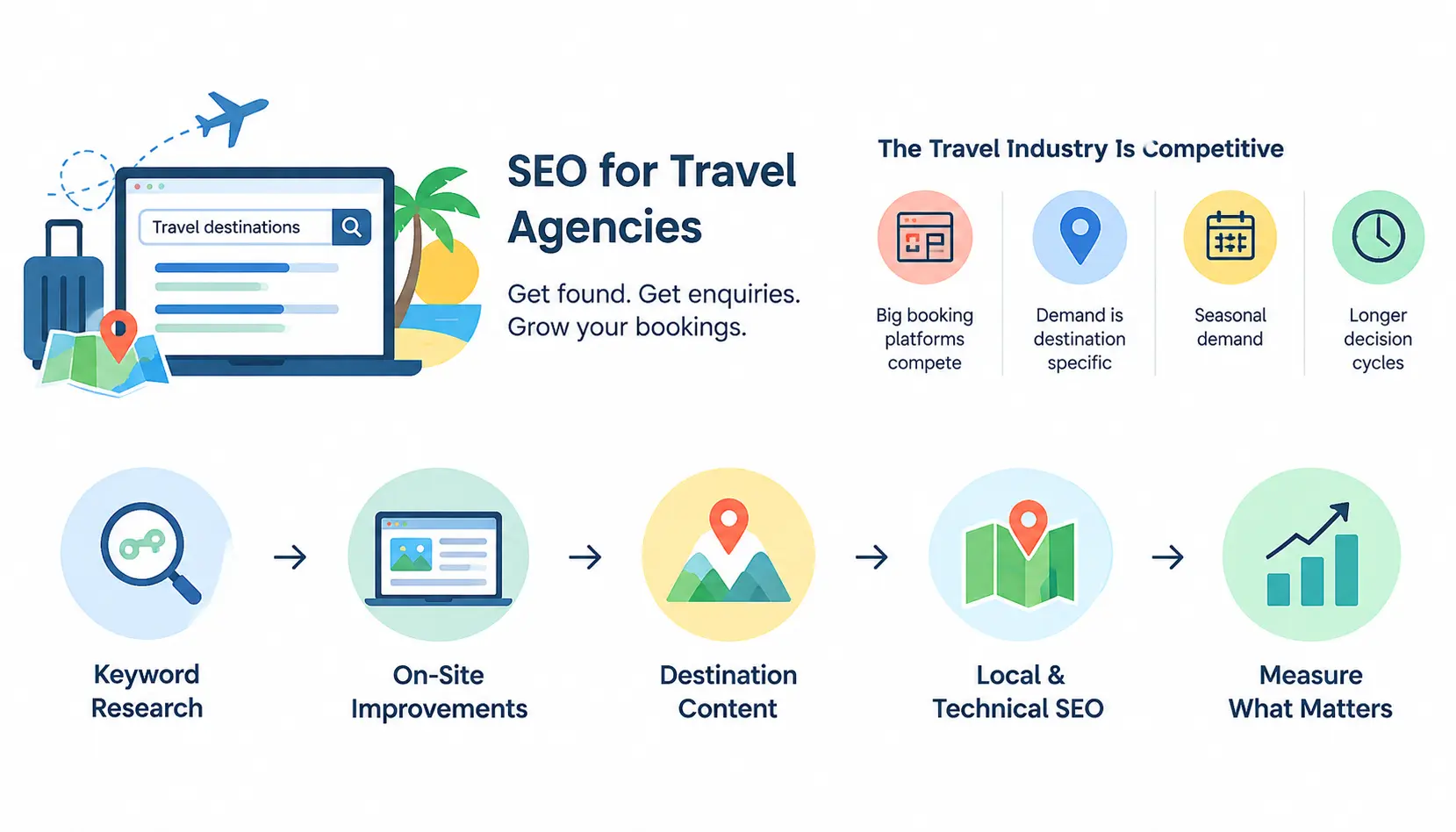
Travel is a tough sector to rank in. You compete with huge booking platforms. Demand is tied to specific destinations. Bookings rise and fall with the seasons. And customers often take weeks or months to decide.
This guide covers how to research keywords, improve your site, build destination content, handle local and technical SEO, and measure what matters. I have kept it practical, and I’ve been clear about what SEO can and can’t promise.
What Is SEO for a Travel Agency?
SEO for a travel agency is the process of improving your website so search engines can find, understand and rank your pages when people search for destinations, holidays and travel advice. The goal is more qualified visitors who enquire or book, not just more traffic.
It covers your content, your site’s technical health, your reputation and how easy it is to use. search engine optimization is a good plain-English background read.
How Travel SEO Works
Search engines send automated programs (crawlers) to visit web pages. They store what they find in an index, then rank indexed pages when someone searches. Ranking depends on how relevant and useful a page looks for that search.
This means three things must work together. Your pages must be reachable, they must clearly match what people search for, and they must be good enough to deserve a top spot.
Why SEO Matters for UK Travel Agencies
Organic search puts your agency in front of people already looking for a trip. These visitors have shown intent, so they tend to be more valuable than people who see a random ad.
Good rankings also build confidence. Many travellers trust a business more when it appears for the searches they care about. And well-built pages generate direct enquiries without paying a commission each time.
Travel SEO vs. General SEO
The fundamentals are the same, but travel brings its own twists.
| Area | General SEO | Travel SEO |
| Demand | Often steady through the year | Strongly seasonal and destination-led |
| Pages | Fewer, broader pages | Many destination, package and itinerary pages |
| Content | Often evergreen | Needs regular updates for prices, dates and availability |
| Decision time | Can be short | Often long, with research over weeks or months |
| Competition | Varies | Large booking platforms and tour operators dominate |
| Technical risks | Standard | Booking engines, filters and date parameters create duplicate URLs |
SEO vs. Paid Search vs. OTAs
Each channel does a different job.
- SEO builds visibility over time and can lower your cost per enquiry in the long run.
- Paid search gives faster visibility, but it stops when you stop paying.
- Online travel agencies (OTAs) give you reach and booking tools, usually in return for commission. Wikipedia explains the OTA model if you want the background.
SEO can help you win more direct bookings. It doesn’t automatically remove the need for the other two channels, and most agencies use a mix.
How to Build an SEO Strategy for a UK Travel Agency
A strategy simply means deciding what to fix and create first, and why. Here is the order I would follow.
Step 1: Audit Your Existing Website
Start by finding out what you already have. Free tools such as Google Search Console will tell you a lot.
Check Indexing and Crawlability
Can Google find and index your important pages? In Search Console, look at the page indexing report. Look for key destination or package pages marked as excluded or not indexed.
Review Mobile Usability and Page Performance
Most travellers browse on their phones, even if some book on a laptop later. Open your own site on a phone. Check whether pages load quickly and whether buttons and forms are easy to use.
Identify Duplicate and Thin Pages
Thin pages have little useful content. Duplicate pages repeat content found elsewhere on your site. Both waste crawl attention and can weaken your best pages.
Review Existing Organic Traffic and Conversions
Note which pages already bring visitors and which turn them into enquiries. This is your baseline. Without it, you can’t prove later that your work made a difference.
Step 2: Identify Your Most Valuable Destinations and Packages
Not every page deserves equal effort. Rank your destinations and packages by four things:
- Business value: margin and average booking value.
- Demand: how many people search for it.
- Competition: how hard it is to rank.
- Conversion potential: how often visitors to that page enquire.
Imagine a small agency selling escorted tours of Japan, Italy and Iceland. If Japan tours earn the best margin and have steady search demand, Japan pages come first, even if Italy gets more raw traffic.
Step 3: Research Travel SEO Keywords
Keyword research means finding the exact words people type into search. Use a tool such as Google Keyword Planner, Search Console data or a paid platform to check search volume and competition. Treat the examples below as illustrations only, and validate each one before you commit.
Destination-Based Keywords
These name a place, such as “holidays in Iceland” or “things to do in Kyoto”. They bring a lot of traffic but intent can be vague.
Holiday Package Keywords
These describe a type of trip, such as “all-inclusive Crete holidays” or “escorted tours of Italy”. They suit category and package pages.
Audience-Specific Keywords
These target a group, such as “family holidays in Spain” or “solo travel tours for over 50s”. They often convert well because the searcher knows what they need.
Transactional and Booking Keywords
These show buying intent, such as “book Northern Lights holiday” or “Japan escorted tour prices”. Match them to pages with clear prices and calls to action.
Long-Tail Travel Keywords
Long-tail phrases are longer and more specific, such as “10-day Japan itinerary for first-time visitors”. Each gets fewer searches, but the visitors are usually further along and easier to win.
Step 4: Map Keywords to the Right Pages
Give every important URL one primary search intent. For example, “Japan escorted tours” belongs on one category page, not on five different ones.
When several pages target the same intent, they compete with each other. Keep a simple spreadsheet listing each URL, its main keyword and its purpose.
Step 5: Prioritise Actions by Business Impact
Split your list into quick wins and bigger projects.
- Quick wins: fixing title tags, improving internal links, updating outdated package details.
- Bigger projects: rebuilding destination pages, resolving booking-engine duplication, producing a content library.
Start with quick wins on your most profitable pages. They build momentum while you plan the larger work.
How to Optimise a Travel Agency Website for Google
Create Dedicated Destination Landing Pages
Every priority destination needs a page built to help someone decide. A thin paragraph and a photo won’t do. Include:
- A destination overview.
- Available packages.
- Sample itineraries.
- Trip duration.
- Price and what’s included.
- Travel dates and availability, where relevant.
- Answers to common questions.
- Clear calls to action, such as “request a quote” or “call us”.
Optimise Holiday Package Pages
Write a unique description for every package. Don’t copy supplier text, because the same wording will appear on many other sites.
Keep details accurate, show the price clearly, explain what’s included and excluded, and use useful photos. Say how to book. Vague pages lose both rankings and trust.
Improve Title Tags and Meta Descriptions
The title tag is the clickable headline in search results. The meta description is the short summary beneath it. Both should describe the page honestly.
A good title for a package page might be: “10-Day Japan Escorted Tour from £X | Agency Name”. Write each one by hand for priority pages. Google may rewrite them, but clear, accurate wording gives it a good starting point.
Strengthen Internal Linking
Internal links connect your pages and show search engines which ones matter. Link destination guides to itineraries, itineraries to package pages, and package pages back to the destination page.
Use descriptive link text such as “our small-group Japan tours”, not “click here”.
Optimise Images for Travel Search
Travel is a visual sector, so images matter. Use descriptive file names (“kyoto-fushimi-inari-gate.jpg”), write helpful alt text, and compress files so pages stay fast. Modern formats such as WebP can cut file size without a visible quality loss.
Use Structured Data Where Appropriate
Structured data is code that labels your content so search engines understand it better. Schema.org provides the shared vocabulary. Types that may suit a travel site include Organization, LocalBusiness, FAQPage, BreadcrumbList and Product or Offer.
Follow Google’s structured data guidelines closely. Markup makes a page eligible for enhanced results. It does not guarantee them.
Travel Content Marketing That Supports SEO
Publish Useful Destination Guides
Travellers have questions long before they book. A strong guide answers them: when to go, how long to stay, where to base yourself and what it costs. People who find honest answers on your site are more likely to come back to you when they’re ready to book.
Create Itineraries and Travel Planning Resources
Good resources include:
- A seven-day itinerary.
- Best time to visit.
- Transport and accessibility information.
- Family travel planning.
- Cultural experiences and activities.
Accessibility details are especially valuable. Many sites skip them, and travellers who need that information remember who provided it.
Build Topic Clusters Around Priority Destinations
A topic cluster is a main destination page supported by related articles that all link to each other. For Japan, that might include an itinerary, a seasonal guide, a food guide and a transport guide, all linking to your Japan tours page.
This shows search engines that you cover the topic in depth.
Match Content to the Customer Journey
People search differently at each stage. Plan content to suit them.
| Journey stage | Example query | Recommended content |
| Discovery | Best places to visit in Japan | Destination guide |
| Planning | Japan itinerary for 10 days | Detailed itinerary |
| Comparison | Small-group tours of Japan | Tour comparison or category page |
| Booking | Japan escorted tour prices | Package landing page |
| Post-booking | Japan packing checklist | Practical travel resource |
Avoid Thin or Repetitive Destination Content
It’s tempting to produce fifty destination pages by swapping the place name in a template. Don’t. Pages that say almost the same thing offer readers nothing new and rarely perform.
Fewer pages with real detail, such as local tips, specific routes and honest pros and cons, will beat many empty ones.
Local SEO for Travel Agencies in the UK
Local SEO is most useful if you have a shop or office, or you serve a defined area. An online-only agency may get less from it.
Optimise Your Google Business Profile
Your Google Business Profile is the listing that appears in Maps and local results. Check that your business is eligible, then fill in accurate details and choose the right categories. Keep opening hours, photos and services up to date. Google’s Business Profile Help explains the rules.
Maintain Consistent Business Details
Your name, address, phone number and opening hours should match everywhere: your website, your profile and any directories. Inconsistent details confuse both customers and search engines.
Build Useful Location Pages
A page for “travel agent in Leeds” makes sense if you genuinely serve Leeds customers. Add real local value, such as your branch details, local team members and departure airports. Avoid cloning the same page for every town.
Encourage and Manage Customer Reviews
Ask happy customers for reviews soon after they return. Reply to every review, positive or negative, politely and accurately. Never pay for reviews or write fake ones. Reviews build trust, and fakes can get you penalised.
Measure Local Search Performance
Track local queries, calls, website visits, direction requests where available and enquiries. Ask new customers how they found you, because some local leads never show up in analytics.
Technical SEO Challenges for Travel Websites
Technical SEO means making sure search engines can access and understand your site. Travel sites have a few special headaches.
Fix Crawling and Indexing Problems
Check your XML sitemap lists the pages you want indexed. Check your robots.txt file isn’t blocking important sections. Make sure key pages are linked from elsewhere on your site, because orphan pages are easy to miss.
Manage Duplicate URLs and Canonical Tags
Filters, sort options, date selectors and booking tools can create hundreds of URLs showing near-identical content. A canonical tag tells search engines which version is the main one.
Work out which URLs deserve to be indexed. A “Greece holidays” category deserves it. A “Greece holidays sorted by price, June, 3 adults” page usually does not.
Improve Core Web Vitals and Mobile Performance
Core Web Vitals are Google’s measures of loading speed, responsiveness and visual stability. You can check them in Search Console or PageSpeed Insights. A fast, steady site is simply nicer to use, especially on mobile data abroad or on the move.
Make Booking Pages Accessible to Search Engines
Many booking engines load content in ways crawlers can’t read, or sit on a separate domain. This can hide your packages from search and split your analytics.
Ask your developer or provider how their system handles crawling and tracking. Make sure your key package information also exists on pages you control.
Handle Seasonal and Unavailable Packages
Not every unavailable page should be deleted or redirected. Choose based on the situation:
- Temporarily unavailable: keep the page, say when it will return and offer similar options.
- Recurring seasonal offer: keep the same URL and update it each year, so it keeps its history.
- Permanently discontinued: redirect to the closest relevant page if one exists. If nothing relevant exists, a clear “no longer available” page may be better than a misleading redirect.
How to Build Authority for a Travel Agency Website
Earn Relevant Travel Industry Links
Links from respected sites act as endorsements. Earn them through ethical digital PR: original research, useful data or expert comment that journalists and bloggers want to cite. Don’t buy links in bulk.
Collaborate With Tourism Organisations and Publishers
Tourism boards, local guides and travel publishers can all be good partners. Offer something useful, such as a guest article, an expert quote or an original photo set. Pure link swaps add little.
Demonstrate Real Travel Expertise
This is where small agencies can beat large ones. Share original photographs, first-hand tips and detailed itineraries based on trips your team has actually taken. Put real names and credentials on your guides.
Google’s guidance on creating helpful, people-first content stresses experience and expertise, which suits agencies with genuine knowledge.
Strengthen Trust Signals
Show accurate business details, transparent package information, clear terms and conditions, relevant credentials and credible author profiles. Customers handing over a large deposit want proof you’re legitimate.
Understand Relevant UK Travel Regulations
UK travel businesses have to get claims right. That covers consumer protection, package travel rules, advertising and any financial protection you mention, such as ATOL or ABTA membership. Only make a claim if it’s true and current.
Rules change and depend on how you trade, so I won’t offer a one-size checklist. Check the latest requirements with ABTA and the Civil Aviation Authority, and take legal advice if you’re unsure.
SEO for Travel Agencies in the Age of AI Search
What AI Search Means for Travel Businesses
More travellers now use AI-assisted tools, including AI summaries in search results, to research destinations, compare options and plan trips. Your content may be read, summarised or cited by these tools.
This area is still changing fast, so treat it as an extension of good SEO, not a separate trick.
Optimise Content to Answer Real Travel Questions
Put a clear, direct answer near the top of the page, then add detail beneath it. Use descriptive headings, accurate facts and original information that can’t be found everywhere else.
Improve Entity Clarity and Business Information
An entity is a clearly identifiable thing, such as your business, a destination or a service. Help search systems understand yours by using consistent names, describing your services plainly and keeping contact details the same everywhere.
Use Structured Data Correctly
Structured data helps machines read your pages. It makes you technically eligible for certain features. It does not guarantee visibility in search or AI answers.
Measure Visibility Beyond Traditional Rankings
Track organic clicks, qualified enquiries and booking outcomes. If your analytics show referrals from AI tools, track those too. No technique guarantees that you’ll be cited in an AI-generated answer, so beware of anyone who says otherwise.
How Much Does SEO Cost for a Travel Agency in the UK?
There’s no standard price. Costs vary widely depending on scope and who does the work. Ask for quotes based on your actual situation.
Factors That Affect Travel SEO Pricing
- Website size.
- Number of priority destinations.
- Competition.
- Content requirements.
- Technical complexity.
- Digital PR.
- Reporting and analytics.
Common SEO Pricing Models
| Model | Best for | Watch out for |
| Monthly retainer | Ongoing improvement | Vague deliverables |
| Fixed-scope project | A clear, one-off goal | Work stopping before results show |
| Technical audit | Finding problems fast | You still need someone to fix them |
| Content project | Building guides and landing pages | Quality and accuracy |
| Consultancy and training | Teams with in-house skills | Needs time from your staff |
How to Evaluate an SEO Proposal
A useful proposal includes:
- A baseline audit.
- A prioritised action plan.
- Clear deliverables.
- A measurement framework.
- A reporting schedule.
- Defined responsibilities.
- Realistic expectations.
Be cautious if it lists activity but never explains what result it should produce.
How to Assess SEO Return on Investment
Return on investment compares what you spend with the extra profit SEO creates. Look at the cost of the work, the additional bookings it brings, the revenue from those bookings, your gross margin on them and how you attribute the sale.
More traffic doesn’t automatically mean more profit. A thousand extra visitors who never enquire add cost, not value.
How Long Does Travel SEO Take to Work?
There’s no universal timeline. Results depend on your site’s condition, your competition, your resources and how much people search for your topics.
Early Improvements
Technical fixes and improvements to existing pages can show early signals, such as better indexing or small gains in clicks. Pages that already have some visibility often respond first.
Medium-Term Progress
New content, better internal linking and sharper page relevance usually build visibility gradually over several months. Expect steady growth rather than a sudden jump.
Long-Term Organic Growth
Over a longer period, authority, consistently good content and ongoing maintenance compound. Competitors keep working too, so SEO is an ongoing effort, not a one-off project.
How to Measure Travel SEO Performance
Organic Search Metrics
- Impressions.
- Clicks.
- Click-through rate.
- Visibility for relevant queries.
- Landing-page performance.
Find all of these in Google Search Console.
Business Metrics
- Qualified enquiries.
- Booking conversion rate.
- Completed bookings.
- Organic booking revenue.
- Customer acquisition cost, where measurable.
- Return on investment.
Measure Performance by Destination
A site-wide average can hide the truth. Italy pages might be growing while Iceland pages are falling. Report by destination and package so you can see where to invest.
Build a Simple SEO Reporting Dashboard
Combine Google Search Console, Google Analytics 4, your booking system and your CRM if you have one. A free tool like Looker Studio can pull these together on one page. Keep it simple enough that you’ll actually look at it each month.
Avoid Vanity Metrics
Rankings, impressions and sessions look good in reports but can mislead. Read them alongside lead quality and commercial outcomes. If traffic rises and bookings don’t, find out why.
A 90-Day SEO Plan for a UK Travel Agency
This framework gives you a starting point for the first three months.
| Period | Priority | Key actions |
| Days 1–30 | Audit and research | Audit the site, research keywords, review competitors and establish baseline metrics |
| Days 31–60 | Optimisation | Improve priority destination and package pages, fix critical technical issues and strengthen internal linking |
| Days 61–90 | Expansion and measurement | Publish supporting content, improve conversion paths, develop authority and review initial performance |
What to Prioritise With a Limited Budget
Focus on the pages tied to your most profitable packages. Fix critical technical issues first. Improve existing content before you write new articles on low-priority topics.
What to Review After 90 Days
Look at completed work, indexing, query visibility, engagement, qualified enquiries and booking data. Then decide what to repeat, change or stop.
Remember that 90 days is an implementation framework. It isn’t a promise of rankings or revenue.
How to Choose the Right Travel SEO Agency in the UK
Look for Relevant Travel Industry Experience
Travel has its own rhythms: destinations, packages, seasonality and long booking journeys. An agency that understands these will spot problems faster and plan content around real demand.
Ask for Evidence of Results
Request verifiable case studies. Check that they separate traffic growth from leads and completed bookings. If they can only show traffic, ask what happened next.
Understand What the Agency Will Actually Deliver
Find out exactly what you’re paying for: technical work, content production, digital PR, local SEO, reporting or conversion optimisation. Different agencies cover different pieces.
Check Reporting and Communication
Look for clear, regular reports, defined responsibilities and access to your own data. You should never be locked out of your own analytics.
Watch for SEO Red Flags
- Guaranteed rankings.
- Unexplained backlink packages.
- Unclear deliverables.
- Reports that only show vanity metrics.
Nobody outside Google controls rankings, so no one can honestly guarantee them.
Specialist Travel SEO Agency vs. General SEO Agency
A specialist can be worth it if you have a complex site, many destinations or heavy competition. A capable generalist may be enough for a small agency with a simple site and a clear plan.
Judge by their thinking and track record, not just the label. If you want to hear how practitioners talk about agencies and tactics, communities like bigseo on Reddit can be useful, though advice there varies in quality.
Common Travel SEO Mistakes to Avoid
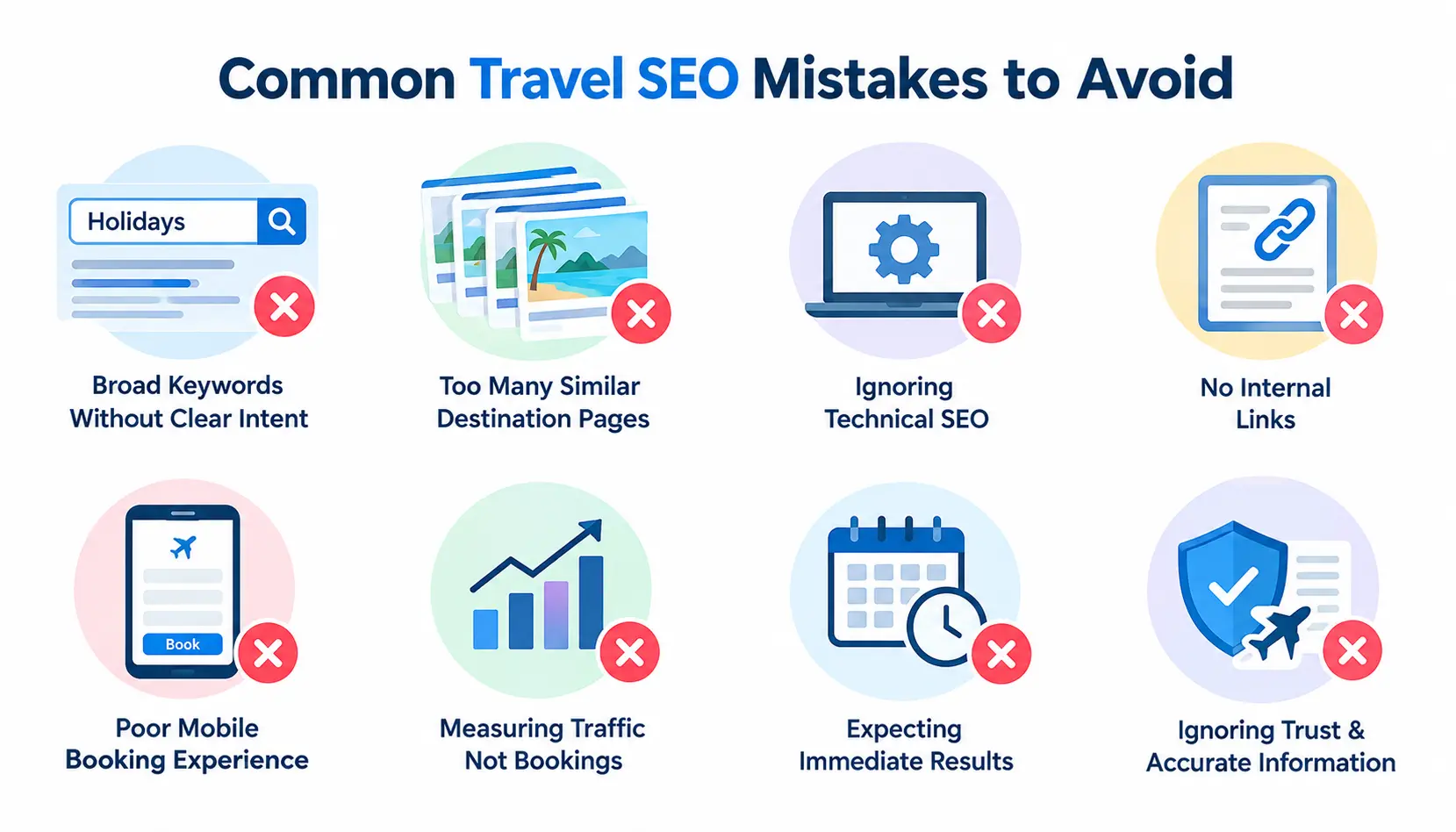
Targeting Broad Keywords Without Clear Intent
“Holidays” is too broad to win or to convert. Aim for phrases where you can match what the searcher wants.
Creating Too Many Similar Destination Pages
Near-identical pages compete with each other and add little value. Build fewer, better pages.
Ignoring Technical SEO
Great content can’t help if search engines can’t crawl or index it.
Publishing Content Without Internal Links
Isolated articles rarely perform. Link every new piece to and from relevant pages.
Neglecting Mobile Booking Usability
If the enquiry form is hard to use on a phone, you lose people at the last step.
Measuring Traffic Instead of Commercial Outcomes
Traffic isn’t the goal. Enquiries and bookings are.
Expecting Immediate Results
SEO builds over time. Judging it after a few weeks leads to bad decisions.
Ignoring Customer Trust and Accurate Travel Information
Outdated prices, unclear terms or wrong claims damage trust and can cause legal problems. Keep everything accurate.
Frequently Asked Questions About SEO for Travel Agencies in the UK
1. What is SEO for a travel agency?
It’s the work of improving your website so it appears for relevant searches and brings in enquiries and bookings. It covers content, technical health, trust and user experience. See the “What Is SEO for a Travel Agency?” section above.
2. How much does travel SEO cost in the UK?
It varies by site size, competition and the work needed. Retainers, projects and audits are all common. Compare proposals on deliverables, not price alone. See the cost section above.
3. How long does SEO take to work for a travel agency?
There’s no fixed timeline. Early signals may appear within weeks after fixes, while meaningful growth usually takes months. Competition and site condition affect the pace.
4. How can a small travel agency rank on Google?
Focus on a few profitable destinations. Build detailed pages that show real expertise, target specific long-tail searches and keep your local profile accurate. Small agencies win by being more useful and specific than the giants.
5. What keywords should a travel agency target?
Use a mix of destination, package, audience-specific, transactional and long-tail keywords. Validate each with a keyword tool and match it to one page.
6. Is local SEO important for travel agencies?
Yes, if you serve customers from a shop, office or defined area. It matters much less for a purely online agency. See the local SEO section.
7. Can SEO help travel agencies compete with Booking.com?
It can help you win some searches, particularly specialist, personal or niche ones where big platforms are generic. You are unlikely to beat them for every broad term, so aim where your expertise gives you an edge.
8. What is the difference between SEO and AEO?
SEO aims to rank pages in search results. AEO, or answer engine optimisation, aims to make your content easy for AI tools and answer features to understand and use. In practice they overlap heavily, and no AEO method guarantees inclusion.
9. How do travel agencies measure SEO ROI?
Compare the cost of SEO with the gross margin from bookings that organic search generates. Use your booking and CRM data, not traffic alone. See the measurement section.
10. Should a travel agency hire a specialist SEO agency?
Only if the complexity of your site or market justifies it. A specialist helps with large, complex sites. A good generalist may be enough for a smaller one.
Conclusion
SEO for travel agencies in the UK works best when you treat it as a business tool. Pick your most valuable destinations. Build helpful pages. Keep your technical foundations sound. Earn trust, and measure results by enquiries and bookings.
You don’t need to do everything at once. Start with an audit, fix what’s broken on your best pages and build from there. Be patient, stay accurate and judge success by revenue, not rankings.