

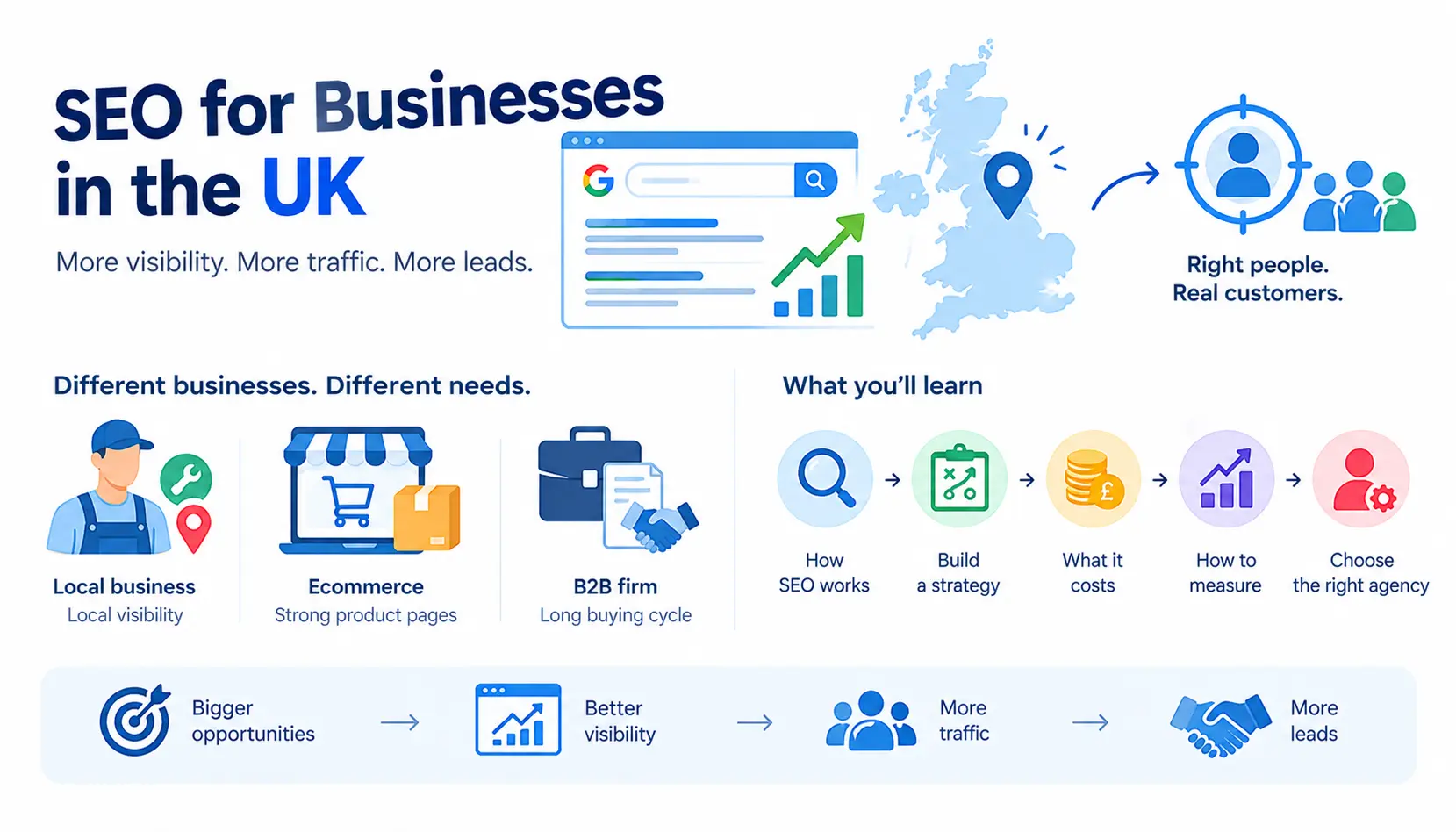
SEO for businesses is the work of making your website easier for search engines to find, understand and recommend, so the right people reach you when they search. Done well, it brings in customers who already want what you offer.
Most UK businesses compete online, and organic search is often where buyers start. But traffic alone does not pay the bills. A page that attracts 5,000 casual readers can earn less than one that attracts 50 people ready to call you.
That is why SEO for UK businesses looks different depending on what you sell. A plumber in Leeds needs local visibility. An online shop needs strong product pages. A B2B firm needs content that supports a long buying process.
In this guide you will learn how SEO works, how to build a strategy, what it costs, how to measure it, and how to choose an agency. No guaranteed results are promised here, because nobody can honestly promise them.
What Is SEO for Businesses?
Search engine optimization, is the practice of improving your website so it appears more often in unpaid search results for relevant searches. For a business, the goal is not rankings for their own sake. It has more qualified enquiries, sales and visibility.
How Search Engine Optimisation Works
Search engines work in three broad steps. First, they crawl the web by following links to discover pages. Second, they index pages by storing and organising what they find. Third, they rank results by judging which pages best match a searcher’s query.
SEO helps at each step. Technical work makes sure your pages can be crawled and indexed. Content work shows what your pages are about. Authority work, such as earning links and good reviews, signals that people trust you. Google explains the basics in its own SEO Starter Guide.
Why SEO Matters for UK Businesses
SEO makes you discover the moment someone is looking for what you sell. Those visitors have chosen to search, which often makes them more relevant than people who see an advert by chance.
SEO can also build long-term visibility. A well-made page can keep attracting visitors for months or years without a payment for each click. That said, results depend on competition, your site and your effort, and no one can guarantee them.
SEO Versus Paid Advertising
SEO and paid ads such as Google Ads solve different problems. Ads switch on quickly and stop when you stop paying. SEO usually takes longer but can keep working without a per-click fee.
| SEO | Paid advertising | |
| Cost model | Ongoing time and investment | Pay per click or impression |
| Speed | Slower to build | Can start quickly |
| Targeting | Based on content and intent | Based on bids, keywords and audiences |
| Best role | Long-term visibility | Short-term demand and testing |
Many businesses use both. Ads can give quick data on which search terms convert, and SEO can then build lasting pages around them.
What Are the Main Types of Business SEO?
Business SEO has several parts. You rarely need all of them at once, so it helps to know what each does.
Technical SEO
Technical SEO makes sure search engines can access and understand your site. Think of it as the foundations of a house. Key areas include:
- Crawlability and indexability, so important pages can be found and stored.
- XML sitemaps and robots.txt files, which guide search engines around your site.
- Canonical URLs and redirects, which handle duplicate or moved pages.
- Mobile usability, because most searches happen on phones.
- Core Web Vitals, which measure loading, responsiveness and visual stability.
- Structured data, where it fits, to describe content such as products or reviews.
On-Page SEO
On-page SEO covers what is on each page. That includes page titles and meta descriptions, clear headings, and content that matches what the searcher wants. It also covers page structure, image optimisation (sensible file sizes and descriptive alt text) and internal links that help visitors move between related pages.
Content SEO
Content SEO is about publishing pages that answer real questions. This includes service pages, product and category pages, and helpful articles. It also means updating old content and covering a topic thoroughly, then linking related pages together so people can find the next step.
Local SEO
Local SEO helps you appear for searches tied to a place, such as “electrician near me” or “accountant in Manchester”. It relies on your Google Business Profile, Google Maps visibility, local service pages, reviews, and consistent business details across the web.
Off-Page SEO and Digital PR
Off-page SEO covers what happens away from your site. The main task is earning relevant backlinks from trusted websites, such as industry publications. Useful digital PR campaigns, brand mentions and a good reputation all help. Avoid manipulative link schemes, which Google lists in its spam policies.
Ecommerce SEO
Online shops face extra challenges. You need strong product and category pages, original product descriptions, and careful handling of faceted navigation (filters like size or colour) that can create thousands of near-duplicate URLs. Canonical tags, product structured data, healthy indexing and good internal linking all matter here.
Which SEO Strategy Is Right for Your Business?
The right plan depends on your business model. This table shows typical priorities.
| Business type | Main objective | SEO priorities |
| Local service business | Generate calls and local enquiries | Local SEO, service pages, reviews |
| Ecommerce store | Increase relevant organic sales | Product and category SEO, technical SEO |
| B2B company | Generate qualified leads | Service pages, industry content, conversion tracking |
| Professional services firm | Build visibility and trust | Expertise-led content, service pages, case studies |
| Multi-location business | Reach customers in multiple areas | Location pages, local profiles, consistent business data |
| National business | Reach a wider market | Keyword strategy, content hubs, technical SEO, digital PR |
SEO for Local and Service-Based Businesses
Imagine a boiler engineer in Sheffield. Most of their customers search for urgent, local help. So the priorities are a complete Google Business Profile, a clear page for each core service, and genuine reviews that mention the work done.
This engineer does not need a 3,000-word blog on the history of heating. They need to be easy to find, easy to trust and easy to call.
SEO for Ecommerce Businesses
Shoppers find products through search engines, and category pages often drive the most valuable traffic. A tidy site structure helps search engines see how products relate to each other.
Focus on useful category pages first, then product pages. Fix technical issues like duplicate URLs and slow loading, because they can quietly limit visibility.
SEO for B2B Businesses
B2B buyers often research for weeks and involve several people. Search can support that journey at each stage, from early questions to comparing suppliers.
Strong service pages, case studies and practical guides help here. Track enquiries, not just visits, because a few qualified leads usually beat large volumes of unrelated traffic.
SEO for Multi-Location Businesses
If you serve several areas, each location deserves a page that is genuinely useful. Include local details such as the team, the address, services offered there and real customer feedback.
Do not copy one page and swap the town name. Google’s guidance is clear that thin, repetitive pages offer little value to users.
How to Create an SEO Strategy for Your Business
A good plan follows a clear order. Here are eight steps you can start today.
Step 1: Set Clear Business Goals
Start with what the business needs. Common goals include:
- More qualified enquiries.
- More online sales.
- More relevant organic traffic.
- Better visibility for high-value services.
- Better conversion rates.
Pick one or two. Every later decision should serve them.
Step 2: Research Keywords and Search Intent
Keyword research shows what your customers type into search engines. Search intent explains why they type it. There are four main types:
- Informational: “what is a heat pump”.
- Commercial investigation: “best heat pump installers”.
- Transactional: “book heat pump installation”.
- Local: “heat pump installer near Bristol”.
Match each intent to the right page. A broad term like “heat pumps” suits a guide. A search like “heat pump installation Bristol” suits a service page, and that visitor is much closer to buying.
Step 3: Analyse Competitors
Look at who ranks for your target searches. Note their landing pages, the topics they cover, the gaps they leave, and the page formats Google favours. Also check local competitors and search features such as map results or featured snippets.
The aim is to find opportunities, not to copy. If everyone writes the same page, you win by being clearer, more useful or more specific.
Step 4: Audit Your Website
A site audit finds what holds you back. Check:
- Crawling and indexing problems.
- Page speed and mobile experience.
- Broken links and wrong redirects.
- Duplicate content.
- Internal linking.
- Important pages that get no organic visibility.
Step 5: Optimise Important Landing Pages
Start with pages closest to revenue. These are usually core service pages, high-value product categories and key location pages. Improve titles, headings, copy, calls to action and internal links on these before you write anything new.
Step 6: Create Helpful, Relevant Content
Supporting articles answer questions customers ask before buying. Each one should link naturally to a relevant service or product page. Write for people first, and base topics on real customer questions from sales calls, emails and reviews.
Step 7: Build Authority and Trust
Search engines look for signs that a business is credible. Share expert contributions, collect genuine reviews, publish credible case studies and earn links from relevant sites. Useful industry resources tend to attract links over time.
Step 8: Measure and Improve
Review your data each month. See which pages gain impressions, clicks and enquiries, then use that to choose the next round of improvements. SEO works best as a cycle, not a one-off project.
In short, the process to start SEO is: set goals, research keywords, check competitors, audit your site, improve key pages, create helpful content, build trust, then measure and repeat.
Local SEO for Businesses in the UK
For many UK firms, local SEO is the fastest route to relevant enquiries.
Optimise Your Google Business Profile
Your Google Business Profile is often the first thing a local customer sees. Keep it accurate and complete. Add the right categories, services, opening hours and real photographs, and review it regularly. Google’s own Business Profile help centre explains the setup.
Create Useful Local Landing Pages
A local page should reflect the place and the service. Mention areas you actually cover, show relevant work and answer questions local customers ask. Quality matters more than the number of pages.
Manage Reviews and Business Information
Authentic reviews build trust with customers and send positive signals. Ask happy customers to leave feedback and reply to every review politely. Make sure your name, address and phone number match across your website, profile and directories.
Track Local SEO Performance
Watch measures such as profile interactions, website visits, calls, direction requests and qualified enquiries where data is available. Ask new customers how they found you as well.
Common Local SEO Mistakes to Avoid
- Duplicate location pages with only the town name changed.
- Wrong or outdated business information.
- Fake reviews, which break platform rules and damage trust.
- Unnatural keyword stuffing.
- Signing up to unnecessary business listings.
How Much Does SEO Cost in the UK?
SEO prices vary widely, so be cautious of any universal figure. The right budget depends on what work is needed, how competitive your market is and how much support you want. Ask any provider to explain what is included at each price.
Factors That Affect SEO Pricing
- Website size and condition.
- Business type.
- Level of competition.
- Local versus national reach.
- Content production needs.
- Development requirements.
- Link earning and digital PR.
- Reporting and strategic support.
In short, the cost of SEO services in the UK rises with site complexity, competition, content volume and the amount of hands-on support you need.
Common SEO Pricing Models
- One-off audits and projects: A fixed fee for a defined piece of work.
- Monthly retainers: Ongoing support, usually for strategy, content and reporting.
- Hourly consulting: Useful for advice or training.
- Project-based technical SEO: Fixes for issues such as migrations or site speed.
- In-house staffing: A salaried hire, giving more control but a higher fixed cost.
What a Small Business Should Budget For
Small businesses should spend where the return is most likely. Fix technical problems on key pages first, then improve service pages, then add content. Compare the potential value of one new customer with the cost of the work, and expand once you see results.
What Should an SEO Proposal Include?
A good proposal is specific. Look for:
- An initial audit and baseline.
- Scope of work and deliverables.
- Responsibilities on both sides.
- Reporting frequency and communication arrangements.
- Contract terms.
- Clear success measures.
How Long Does SEO Take to Work?
There is no fixed answer, and anyone who gives one with certainty is guessing.
Early Improvements Versus Long-Term Growth
Different work pays off on different timelines. Fixing a technical error can help quickly once search engines recrawl the page. Content improvements take longer to be recognised. Beating strong competitors for valuable searches usually takes the longest.
Factors That Affect SEO Timelines
- Your website’s history.
- Competition.
- Technical condition.
- Content quality.
- Resources available.
- Search demand.
- How fast changes are made.
How to Set Realistic Expectations
Record a baseline before you start. Then agree milestones, such as issues fixed, pages improved and enquiries tracked, instead of promising specific positions or revenue.
How to Measure SEO Success
Good measurement links search activity to business results.
Organic Traffic and Search Visibility
Impressions show how often your pages appeared in results. Clicks show how often people chose them. Meaningful visits are those where people take a useful action. Look at all three, not just the biggest number.
Keyword Rankings and Search Intent
Rankings matter, but they vary by location, device and personalisation. Treat them as a signal, and judge them alongside whether the searches match what you sell.
Leads, Conversions, and Revenue
The measures that matter most are:
- Enquiry form submissions.
- Phone calls.
- Qualified leads.
- Ecommerce transactions.
- Organic revenue.
- Conversion rates.
SEO Tools for Business Owners
| Tool | Main use |
| Google Search Console | Search impressions, clicks, indexing and page performance |
| Google Analytics 4 | Website activity and conversion measurement |
| Google Business Profile | Local profile information and available customer interaction data |
| PageSpeed Insights | Page performance diagnostics |
| Screaming Frog SEO Spider | Website crawling and technical checks |
| Ahrefs or Semrush | Keyword research, competitor analysis and backlink research |
Some of these tools, and some features within them, need a paid subscription. Google Search Console and PageSpeed Insights are free.
What Should an SEO Report Include?
A useful report is short and tied to goals. It should cover work completed, search visibility changes, relevant organic traffic, technical issues resolved, leads or sales, progress against goals, and priorities for the next period.
Should You Do SEO Yourself or Hire an Agency?
Both routes work. The right one depends on your time, budget and skills.
Managing SEO In-House
Doing it in-house gives you control and deep product knowledge. The trade-offs are the learning curve and the time needed. Many owners handle basics like their Business Profile and simple page updates themselves.
Hiring a Freelance SEO Consultant
A freelancer offers flexibility and specialist skill, often at a lower cost than an agency. Check their availability and define the scope clearly, so you know what is and is not included.
Hiring an SEO Agency
Agencies bring a wider range of skills, account management and implementation support. They also usually cost more. They suit businesses that need several specialists working together.
How to Choose the Right SEO Partner
Use this checklist:
- Relevant industry experience.
- A clear audit method.
- Realistic recommendations.
- Transparent deliverables.
- Case studies backed by evidence.
- Reporting focused on business goals.
- Clear communication.
- You keep ownership of accounts and data.
- Reasonable contract terms.
Practitioner communities such as SEO and bigseo can help you learn the jargon and spot common warnings. Treat individual opinions there as starting points to check, not as facts.
SEO Agency Red Flags
- Guaranteed rankings.
- Vague deliverables.
- Unexplained link-building tactics.
- Reports that only show rankings.
- Case-study claims with no proof.
- No clear technical plan.
- No access to your own accounts or data.
Questions to Ask Before Signing a Contract
- What is your strategy for my business, and why?
- Who does what, on your side and mine?
- How often will you report, and what will the report show?
- How will we measure success?
- Who implements changes on my website?
- What happens if we want to end the contract, and do I keep my data?
How AI Search Is Affecting SEO for Businesses
AI features are changing search, but the basics still apply.
Google AI Overviews and Other AI-Powered Search Experiences
AI Overviews and similar tools give short, generated answers above or alongside normal results. This can change how people discover information, and sometimes users get what they need without clicking. Google describes how its AI features work with websites in its Search Central documentation.
SEO Foundations That Still Matter
Google states that pages need no special extra steps to appear in these features. The same foundations apply:
- Crawlable and indexable pages.
- Useful, accurate content.
- Clear site structure.
- Relevant expertise.
- Strong technical foundations.
- Reliable business information.
How Businesses Can Improve Their Chances of Being Cited
Write clear, helpful content that answers customer questions directly. Back up claims with evidence, use plain language and keep pages easy to read. These steps make your content more useful to people and easier for systems to understand, but no tactic guarantees a citation.
How to Evaluate AI SEO Services
Ask what exactly will be done and how it will be measured. Real work looks like content improvements, technical fixes and tracked visibility. Be wary of promises of guaranteed AI rankings or citations, because no one controls those outcomes.
Common SEO Mistakes UK Businesses Should Avoid
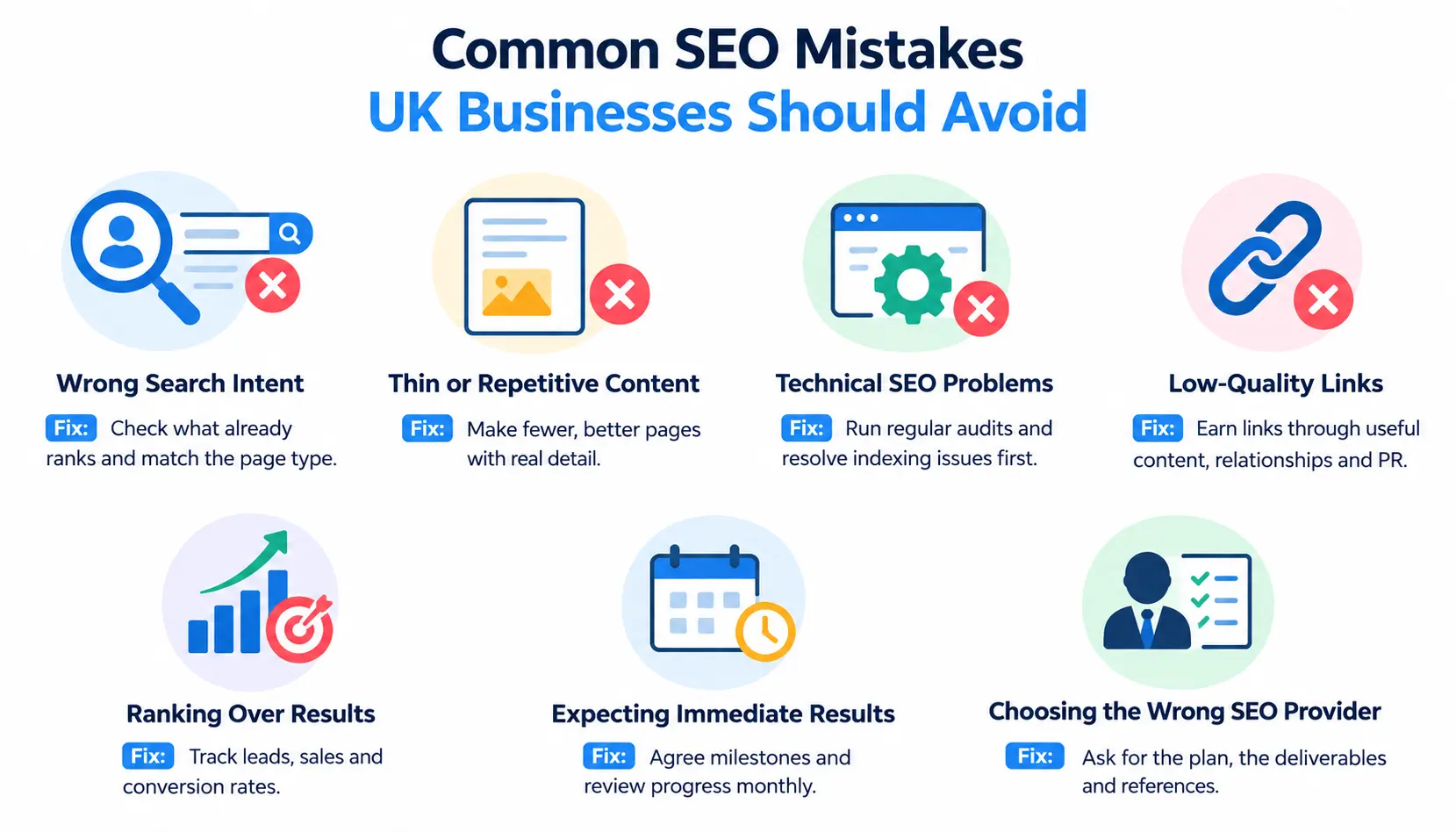
Targeting Keywords Without Understanding Search Intent
A keyword with high volume is useless if searchers want something else. Fix: check what already ranks and match the page type.
Publishing Thin or Repetitive Content
Pages that add nothing new rarely perform. Fix: make fewer, better pages with real detail.
Ignoring Technical SEO Problems
Great content cannot help if search engines cannot reach it. Fix: run regular audits and resolve indexing issues first.
Buying Low-Quality Links
Paid or spammy links can bring penalties. Fix: earn links through useful content, relationships and PR.
Measuring Rankings Instead of Business Results
A top position means little without enquiries. Fix: track leads, sales and conversion rates.
Expecting Immediate Results
SEO builds over time. Fix: agree milestones and review progress monthly.
Hiring an SEO Provider Without Checking Its Methods
Poor tactics can harm your site. Fix: ask for the plan, the deliverables and references.
A Practical SEO Action Plan for Your Business
First: Establish Your Baseline
Record your current organic visibility, key landing pages, technical issues and existing conversions. Without this, you cannot prove progress.
Next: Fix High-Priority Issues
Deal with indexing problems, broken pages and incorrect redirects on important URLs first. These are often quick wins.
Then: Improve High-Value Pages
Optimise the pages closest to your products, services and enquiries.
Build a Sustainable Content Plan
Choose topics based on customer questions and commercial priorities. A small, steady schedule beats a burst of articles followed by silence.
Review Performance Regularly
Use data to spot improvements, problems and new opportunities. Then adjust the plan.
Tip: To decide what to do first, sketch a simple priority matrix. Plot each task by potential business impact against effort. Start with high-impact, low-effort items.
Frequently Asked Questions About SEO for UK Businesses
1. What Is SEO for Businesses?
SEO for businesses is the practice of improving a website so it appears in unpaid search results for relevant searches, helping attract customers.
2. How Can SEO Help a Small Business in the UK?
It makes your business easier to find, brings in relevant visitors and can help turn them into customers, including people searching locally.
3. How Much Does SEO Cost in the UK?
It depends on site size, competition, reach, content needs and support level. See the pricing section above for the main cost drivers.
4. How Long Does SEO Take to Show Results?
It varies. Technical fixes can help sooner, while competitive rankings often take longer. Competition, site condition and effort all play a part.
5. Can I Do SEO Without Hiring an Agency?
Yes. Many owners handle their Business Profile, page titles and basic content. Specialist help is worth considering for technical problems, migrations or competitive markets.
6. Is SEO Better Than Google Ads?
Neither is better in every case. Ads give fast, paid visibility. SEO builds lasting visibility. Many businesses use both.
7. Does Every Business Need Local SEO?
No. It matters most if you serve customers in specific areas or have a physical location. An online-only business selling nationwide may need it less.
8. How Do I Measure SEO ROI?
Track organic enquiries, calls and sales, then compare the value they bring against what you spent on SEO.
9. Can SEO Help My Business Appear in AI Search Results?
Useful content, technical accessibility and credible information support your chances, but nobody can guarantee inclusion.
Conclusion
The best SEO for businesses starts with a clear goal, not a tactic. Know what you want, learn what your customers search for, fix the basics, improve your best pages and measure real results.
SEO for UK businesses rewards patience and honesty. Avoid guarantees, check methods, and focus on being genuinely useful. If you take one step today, record your baseline and fix the issues holding back your most valuable pages.