


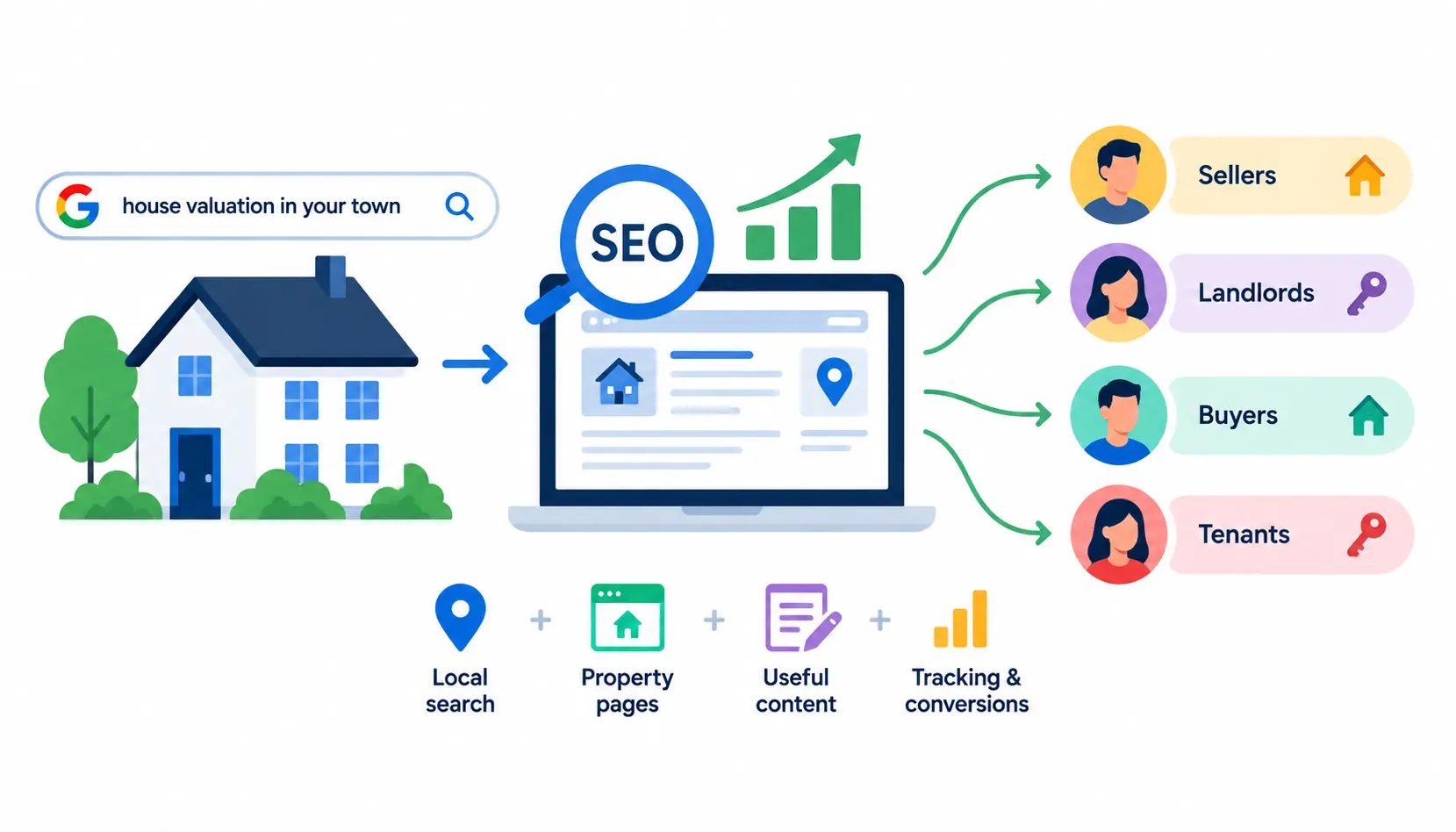
When a homeowner types house valuation in United Kingdom, into Google, who do they see? If it isn’t you, a competitor or a portal gets that conversation.
This guide covers SEO for estate agents in the United Kingdom, from local search to property pages, content and tracking. It is written for agents who want instructions and valuations, not just traffic. Sellers, landlords, buyers and tenants all search differently, so we will cover each.
Traffic and instructions are not the same thing. A page that ranks for flats for sale may bring thousands of visitors and no valuation requests. Good estate agent SEO connects local search, a well-built property website, useful content and honest conversion tracking.
What Is SEO for Estate Agents?
SEO for estate agents is the work of making your website and local profiles easier to find in search results, and more convincing once someone arrives. The goal is enquiries from people in your patch: sellers wanting a valuation, landlords wanting a manager, buyers and tenants wanting a home.
How SEO works for estate agency websites
Search engines work in three steps. They crawl (follow links to discover pages), index (store pages they understand) and rank (choose which pages best match a search). You can read the background on search engine optimisation and Google’s own SEO starter guide.
Ranking depends on intent. Someone searching “estate agents near me” wants a local business. Someone searching “how much is my house worth” wants a valuation tool or an agent. Your pages need to match the need behind the words.
Organic search vs paid search vs property portals
Each channel does a different job.
- Organic search: You own the website audience. Results build over time and there is no cost per click.
- Paid search: Fast visibility, but traffic stops when the budget does.
- Property portals: Strong for buyer and tenant demand, but the portal owns the relationship and you pay to be listed.
Most agencies use a mix. SEO adds a channel you control.
Who benefits most from estate agent SEO?
- Independent estate agents competing with bigger brands.
- Multi-branch agencies that need each branch to be found locally.
- Letting agents and property managers chasing landlord enquiries.
- Commercial property agencies targeting specific business searches.
- Luxury and specialist firms with a narrow, high-value audience.
Why SEO Matters for UK Estate Agents
Reach homeowners searching for valuations
Seller searches are high value. People typing “house valuation in United Kingdom” are often weeks from choosing an agent. A dedicated valuation page with a clear form, local proof and a phone number meets them at that moment.
Attract landlords and property management enquiries
Landlords research before they call. Service pages for lettings and management, plus guides on tenancy basics and what a management service covers, help you appear early. Be open about how fees work where you can, because landlords compare.
Generate buyer and tenant enquiries
Well-written listings, neighbourhood guides and clear service pages bring in buyers and tenants who find you directly. Those visitors are easier to convert into repeat users, alerts and later valuations.
Reduce dependence on third-party property portals
Portals remain important, and SEO will not replace them for most agents. But your own search visibility gives you leads without a per-listing fee and a direct line to the customer. Think of it as balance, not replacement.
Build long-term local brand recognition
Useful content, genuine reviews, local links and consistent business details all reinforce who you are. Over months, people start to recognise your name in results, and recognition makes them more likely to pick up the phone.
How to Do SEO for Estate Agents: The Essential Strategies
In short: audit your site, research local keywords, tidy your Google Business Profile, build useful branch pages, manage property listings, fix technical issues, publish helpful content, earn local links and make enquiring easy. Do them roughly in that order.
1. Conduct an estate agent SEO audit
Check indexing and crawlability
Start with whether Google can see your site. Review robots.txt, XML sitemaps, canonical tags, redirects and your most important landing pages. A single misplaced “noindex” can hide a valuation page for months.
Identify ranking and content gaps
Compare your pages with local competitors. Where do they rank for searches that you do not even target? Note the missing topics and page types.
Prioritise issues by impact and effort
Fix indexing blockers and high-value conversion pages first. Small tweaks to meta descriptions can wait.
2. Conduct keyword research for estate agents
Target seller and valuation keywords
Examples: “house valuation in United Kingdom” and “estate agents to sell my house in [area]”.
Target buyer and tenant keywords
Examples: “flats for sale in [area]” and “letting agents in [town]”.
Target landlord and property management keywords
Examples: “property management in [town]” and “letting agent fees [area]”.
Map each keyword group to the correct page
Give each search intent one main page. Two pages chasing the same query compete against each other, which is called keyword cannibalisation.
| Keyword | Intent | Page type | Conversion goal |
| House valuation in [town] | Seller | Valuation landing page | Valuation request |
| Estate agents in [town] | Seller / buyer | Branch page | Call or form |
| Letting agents in [town] | Landlord / tenant | Lettings branch page | Landlord enquiry |
| Property management in [town] | Landlord | Service page | Management enquiry |
| Flats for sale in [area] | Buyer | Listings or area page | Viewing request |
3. Optimise your Google Business Profile
Your profile drives much of what people see in the local map results. Check Google’s representation guidelines for what counts as an eligible business. A genuine branch with a staffed, customer-facing address qualifies. A service area without a real office usually does not.
Maintain accurate branch details and categories
Use the right primary category, correct opening hours and the real branch phone number.
Add useful business information, services and photographsf
List services such as lettings, sales and valuations. Add real photos of the branch and team.
Encourage genuine customer reviews and respond professionally
Ask happy clients for reviews after a completion. Reply to every review, including critical ones, calmly and specifically. Never buy or fake reviews.
Keep business information consistent across relevant directories
Name, address and phone number should match everywhere. Small differences confuse both people and search engines.
4. Build effective local landing pages
Create a dedicated page for each genuine branch
One page per real branch, with address, map, opening hours and contact details.
Make each location page genuinely useful
Add what only you know: typical local property types, the team’s experience, recent results, schools or transport that affect buyers, and the services offered from that branch.
Avoid doorway pages and near-identical location copy
Swapping the town name in the same text is not a lasting strategy. Google’s spam policies target thin pages made only to catch searches, so each page needs its own purpose and substance.
Connect branches, services and area guides with internal links
Link your branch page to valuation, lettings and area guides, and link back. This helps visitors and helps search engines understand how your pages relate.
5. Optimise property listings for search
Write descriptive titles and useful property descriptions
Include the property type, area and a standout feature. Write original descriptions rather than pasting the same feed text used elsewhere.
Optimise property images and page performance
Compress images, use descriptive file names and alt text, and avoid slow galleries.
Manage sold, let-agreed and expired listings
Every listing needs a lifecycle decision. A sold property with a strong page might stay up as proof of results, labelled clearly. A thin expired page may be better redirected to a relevant area or search page.
Control duplicate URLs created by property filters
Filters for price, bedrooms and sorting can create thousands of near-identical URLs. Decide which versions deserve indexing and block or canonicalise the rest.
Review canonical tags, internal links and indexing rules
Check that each listing points to its preferred URL and that useful listings are linked from category and area pages.
6. Strengthen technical SEO
Improve mobile usability and Core Web Vitals
Most property searches happen on phones. Core Web Vitals measure loading speed, responsiveness and layout stability. Slow image galleries are a common estate agent problem.
Fix broken links, redirect chains and crawl errors
Old listing URLs often lead to errors. Redirect them sensibly and fix internal links that point to dead pages.
Review XML sitemaps, robots.txt and canonicalisation
Your sitemap should list pages you want indexed, not expired or filtered ones.
Use structured data where appropriate
Structured data, such as Schema.org markup, helps search engines understand a page. Useful types include LocalBusiness and Organization. It does not guarantee rich results or better rankings, so treat it as clarity, not a shortcut.
7. Create useful content for buyers, sellers and landlords
Publish local property market guides
Explain what is happening in your area in plain English, using data you can stand behind.
Answer common selling and valuation questions
How long does selling take? What affects a valuation? What happens after an offer is accepted? Real client questions make the best topics.
Create landlord and lettings resources
Cover onboarding, compliance basics, tenant referencing and what a management agreement includes. Check legal points against current official guidance.
Develop neighbourhood guides with genuine local detail
Name actual streets, schools, transport links and local character. Generic text reads the same everywhere and earns little.
Update outdated content and consolidate overlapping pages
Merge pages that cover the same topic and refresh old ones. Group related articles into clusters linked to a main guide.
8. Build authority through local links and reputation
Earn relevant links from local organisations and publications
A link from a local newspaper, chamber of commerce or charity you support carries real local weight.
Share original local property market insights
Publish your own local data and observations. Journalists and community sites cite original information.
Build credible relationships with community organisations
Sponsor a local event, join local business groups and take part in community projects. Links follow genuine involvement.
Avoid paid link schemes and low-quality link building
Bought links can lead to penalties and wasted budget. Be wary of anyone promising “hundreds of backlinks”.
9. Optimise pages to convert organic traffic into enquiries
Make valuation requests easy to complete
Keep the form short. Ask for the address, name and contact details first, and gather the rest during the call.
Add clear contact options and branch information
Show the phone number, branch address and a visible call to action without scrolling.
Demonstrate genuine local experience and expertise
Show named agents, qualifications, recent local sales and client reviews. People hire people.
Track phone calls, forms and qualified leads
Set up conversion tracking for forms and calls. A ranking is only useful if you can see what it produced.
Local SEO for Estate Agents With Multiple Branches
How to structure a multi-branch estate agency website
A simple hierarchy works well:
- Home page
- Branch pages (one per real branch)
- Service pages (sales, lettings, valuations, property management)
- Area guides (linked to the nearest branch)
- Property listings
How to avoid keyword cannibalisation between branches
Separate branches only where the local markets genuinely differ. If two branches cover overlapping towns, give each a distinct page purpose, such as different named areas, teams and local evidence.
How to manage Google Business Profiles across branches
Use one profile per genuine branch, owned by your business. Remove duplicates, close profiles for shut branches and avoid listing virtual offices. Keep the details identical to your website.
How to measure performance by branch
Compare local visibility, organic landing pages, qualified enquiries and instructions by branch.
Worked example (hypothetical):
| Metric (per quarter) | Branch A | Branch B |
| Organic clicks to branch page | 900 | 400 |
| Valuation enquiries | 18 | 14 |
| Qualified leads | 12 | 11 |
| Instructions won | 4 | 4 |
Branch A gets more traffic, but Branch B converts better. The lesson: Branch B needs more visibility, while Branch A needs a stronger page.
SEO for Estate Agents vs Property Portals and Paid Advertising
| Channel | Role | Ongoing spend | Time to impact | Lead intent | Control | Measurement |
| Organic SEO | Own long-term visibility | Ongoing work, no per-click fee | Months | High for local and seller searches | High | Good, with tracking |
| Property portals | Reach active buyers and tenants | Regular listing fees | Immediate | High for property search | Low | Limited |
| Paid search | Capture demand quickly | Pay per click | Immediate | High | Medium | Strong |
| Social media | Build awareness and trust | Time or ad spend | Varies | Mixed, often lower | Medium | Moderate |
The right mix depends on your location, budget, services and growth goals. A new agency may lean on paid search and portals first, while an established one may invest in SEO to lower its cost per lead.
How Much Does Estate Agent SEO Cost in the UK?
Prices vary widely, so be cautious of any single “average”. Ask for scoped quotes instead.
What affects the price of SEO?
- Competition in your area.
- Number of branches.
- Website complexity and platform.
- Content requirements.
- Technical work needed.
- Reporting depth.
What should an SEO package include?
A good package covers an audit, a strategy, hands-on implementation, content, local SEO, technical SEO and measurement.
How to compare agency proposals
Compare deliverables line by line. Check who owns the website, accounts and content, how often you will get reports, who you will speak to and what is excluded. Read the contract length and exit terms carefully.
How to estimate SEO return on investment
Here is an illustrative example. The figures are assumptions, not benchmarks.
| Item | Assumed figure |
| Monthly SEO cost | £1,500 |
| Qualified leads per month | 10 |
| Cost per qualified lead | £150 |
| Instruction rate from leads | 20% (2 instructions) |
| Average fee per instruction | £3,000 |
| Fee income from instructions | £6,000 |
Not every instruction completes, so apply your own completion rate. Replace each number with your own data.
How Long Does SEO Take to Work for Estate Agents?
Early technical improvements and indexing
Fixing crawl and indexing problems can show effects within weeks, once search engines revisit your pages.
Building rankings and local visibility
Content, links and reviews usually take several months to build momentum.
Turning search visibility into consistent enquiries
After visibility comes conversion. Better forms and clearer pages help turn visitors into valuations.
Factors that influence the timeline
Competition, current website health, location, content quality, speed of implementation and your resources all matter. Results vary, and no responsible provider can guarantee a ranking or a deadline.
How to Measure Estate Agent SEO Performance
Track visibility and search demand
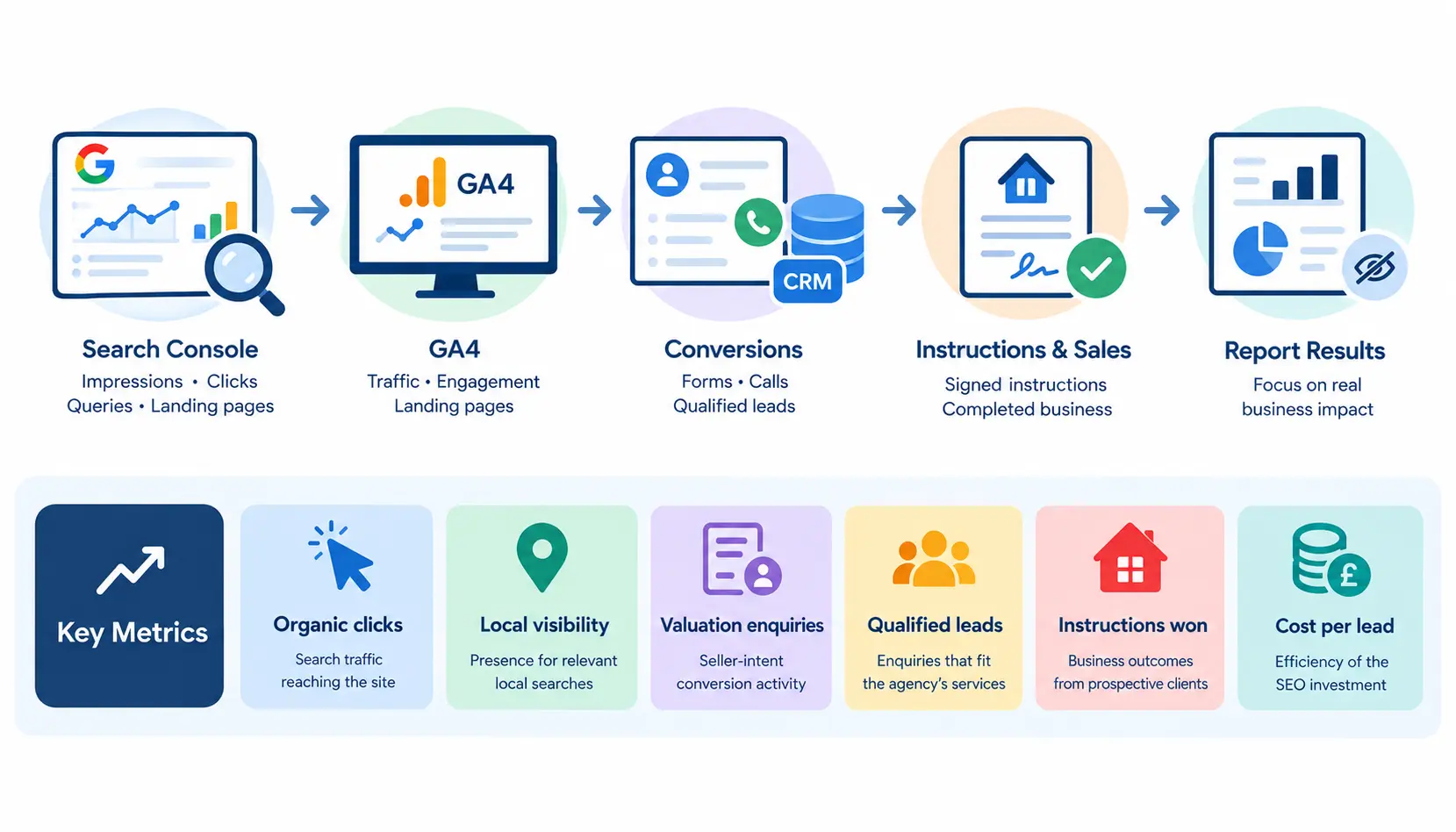
Use Google Search Console for impressions, clicks, queries and landing pages.
Track organic traffic and engagement
Use GA4 to see which landing pages bring visitors and what they do next.
Track valuation enquiries, calls and qualified leads
Set up conversion events for forms and call tracking, and feed leads into your CRM so you can label them as qualified or not.
Measure instructions and completed business
Where you can, link each lead to a signed instruction and a completed sale or let.
Report results without relying on vanity metrics
| Metric | What it tells you |
| Organic clicks | Search traffic reaching the site |
| Local visibility | Presence for relevant local searches |
| Valuation enquiries | Seller-intent conversion activity |
| Qualified leads | Enquiries that fit the agency’s services |
| Instructions won | Business outcomes from prospective clients |
| Cost per qualified lead | Efficiency of the SEO investment |
How AI Search Is Changing Estate Agent SEO
How AI Overviews and conversational search affect discovery
AI summaries and chat-style search now answer some questions directly. Conventional results still exist and no one can say for sure how this will settle, so avoid predictions.
Create clear, reliable answers to property-related questions
Put a short, accurate answer near the top of the page, then add detail. Clear question-style headings make your content easier to quote.
Strengthen local expertise and brand consistency
Show who wrote each guide, keep business details accurate and back claims with evidence.
Measure AI-driven referrals where possible
Attribution is patchy. Treat claims of guaranteed AI visibility with caution and ask for evidence.
What remains important regardless of search changes?
Crawlability, helpful content, technical quality, local relevance and trust. These stay the foundation.
How to Choose the Right Estate Agent SEO Agency
Look for relevant property-sector experience
Ask for work with comparable agencies and markets. Peer discussions can be useful too: communities such as r/estateagents and r/SEO on Reddit show what practitioners say, though treat individual opinions as anecdotes.
Check the technical and local SEO approach
Ask how they handle listings, multiple branches, duplicate content and local landing pages.
Ask how success will be measured
Look for qualified enquiries, valuation requests and instructions alongside rankings and traffic.
Review case studies and references
Check dates, methodology, baseline performance and what the agency actually did.
Identify warning signs before signing
Guaranteed rankings, vague deliverables, weak reporting, questionable links and unclear ownership or exit terms are all red flags.
Use an agency evaluation checklist
- Do they have property-sector examples?
- Do they explain their process in plain English?
- Will you own your site, analytics and content?
- Are deliverables listed clearly?
- Is reporting tied to leads and instructions?
- Can you leave without a heavy penalty?
A Practical 90-Day SEO Action Plan for Estate Agents
Days 1–30: Audit and prioritise
- Establish a baseline in Search Console and GA4.
- Audit indexing, broken URLs and important landing pages.
- Review branch profiles and local competitors.
- Map keywords to valuation, letting and branch pages.
Days 31–60: Implement high-priority improvements
- Fix critical technical problems.
- Improve key branch and valuation pages.
- Resolve important duplicate URL and indexing issues.
- Improve enquiry forms, calls to action and tracking.
Days 61–90: Expand and evaluate
- Publish priority local guides.
- Improve internal links and local authority.
- Review early ranking and conversion data.
- Set the next quarter’s priorities using impact and effort.
This is an implementation schedule, not a promise of rankings or leads within 90 days.
Common SEO Mistakes Estate Agents Should Avoid
Targeting broad keywords without local intent
Risk: Traffic from people outside your area. Fix: Pair services with town and neighbourhood names.
Creating thin or repetitive town pages
Risk: Pages that add little and may be ignored or filtered. Fix: Add local evidence, or merge pages.
Leaving sold and expired property URLs unmanaged
Risk: Wasted crawling and poor visitor experience. Fix: Decide per listing: keep, label or redirect.
Ignoring technical SEO and mobile performance
Risk: Slow pages lose enquiries. Fix: Test on real phones and fix heavy images first.
Building low-quality backlinks
Risk: Penalties and wasted spend. Fix: Earn local links through genuine involvement.
Measuring rankings instead of qualified leads
Risk: Celebrating positions that bring no business. Fix: Report on leads and instructions.
Expecting immediate results or guaranteed rankings
Risk: Abandoning a sound plan too early. Fix: Agree milestones and review quarterly.
Publishing property content without genuine local insight
Risk: Content that sounds like every other agent. Fix: Use your team’s real local knowledge.
Frequently Asked Questions About SEO for Estate Agents
1. What is SEO for estate agents?
It is the practice of improving your website and local profiles so people searching for valuations, homes or lettings in your area find you. It combines local search, technical fixes, useful content and conversion tracking to produce enquiries.
2. Is SEO worth it for a small estate agency?
Often yes, because local searches are specific and a small agency can compete on its own patch. Start with your Google Business Profile, a strong valuation page and reviews, then build from there as the budget allows.
3. How much does estate agent SEO cost in the UK?
It depends on competition, branches, site complexity and scope, so no single figure fits everyone. Ask for itemised proposals and compare deliverables, reporting and contract terms, rather than relying on averages.
4. How long does SEO take to work?
Technical fixes may show effects within weeks, while rankings and steady enquiries usually take several months. Timelines vary with competition and implementation speed, and nobody can guarantee a specific result.
5. How do estate agents rank higher on Google Maps?
Keep your Business Profile accurate, choose the right categories, collect genuine reviews and keep details consistent across directories. Proximity, relevance and prominence all play a part, and you cannot control proximity.
6. Can an estate agent rank in multiple towns?
Yes, but it needs genuine coverage. Give each real branch its own page and create useful area guides for nearby towns. Avoid identical pages with only the town name changed.
7. How should estate agents optimize sold property listings?
Decide for each listing. Keep strong ones, labelled as sold, to show results, and link them to your valuation page. Redirect thin or low-value ones to a relevant area or search page.
8. Is SEO better than property portals?
Neither is simply better. Portals bring immediate buyer and tenant demand for a fee, while SEO builds a channel you own over time. Most agents benefit from using both.
9. Can SEO generate more property valuation leads?
It can, when valuation pages target local seller searches and the enquiry process is easy. Results vary, so track valuation requests and instructions to see what your own SEO produces.
10. How can estate agents appear in AI Overviews?
No one can guarantee it. Give short, accurate answers backed by genuine local expertise, keep pages crawlable and your business details consistent, and focus on being helpful.
Conclusion
The best SEO for estate agents in the United Kingdom is built on five things: local relevance, technically sound property pages, useful content, credible local authority and reliable conversion tracking. Rankings matter only when they lead to valuations and instructions.
If you would like to see where you stand, audit your current visibility, starting with indexing, your Business Profile and your valuation pages. Or talk to us about an estate agent SEO strategy shaped around your branches and your goals.