

Anchor text is a thing but it really matters for search engines to understand what your website is about and how people move around on it.
When you use anchor text the way it helps Google see how different pages are connected makes it easier for users to find what they need and makes your website more trustworthy.. If you use it too much or try to trick the system it can look like spam and hurt your website’s performance.
A time ago some websites would get a high ranking by putting the same keywords in every link.. Now Google is much smarter. It looks at the words around the link and the quality of the link what people are trying to do.
All the other links to your website. If you use anchor text in a way it works much better than trying to force it.
In this guide you will learn what anchor text is, why it is important for search engines the kinds of anchor text how to use it correctly what mistakes to avoid and how to create a good anchor text plan that works for Google and other search tools, like ChatGPT, Perplexity, Gemini and Claude.
What Is Anchor Text?
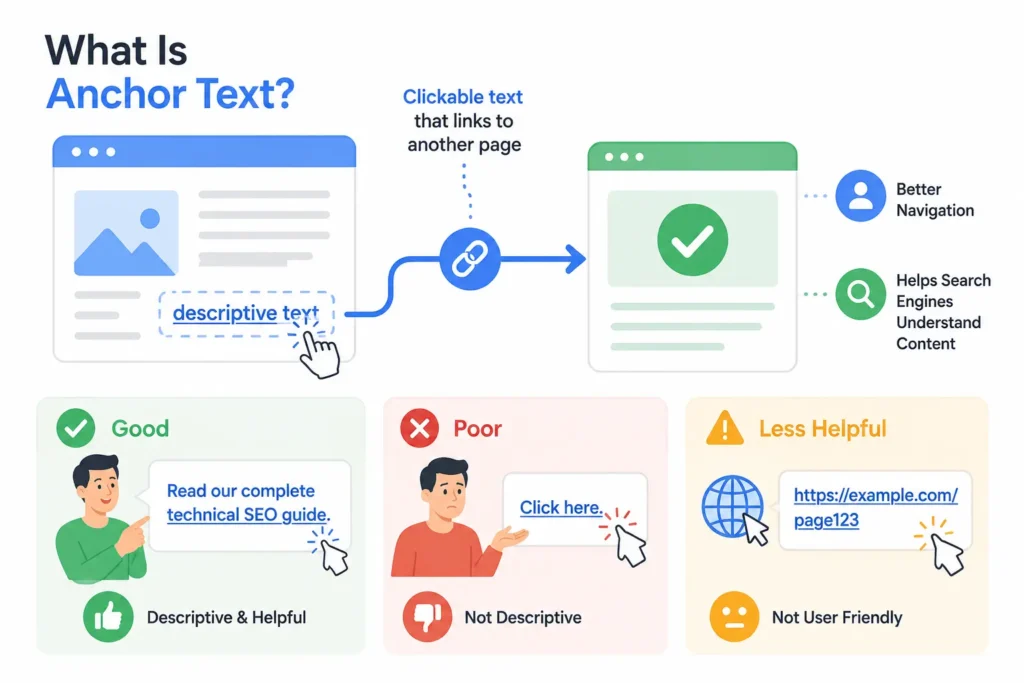
Anchor text is the clickable text within a hyperlink that takes users from one page to another.
Instead of displaying a long URL, websites use descriptive words or phrases that tell readers what they’ll find after clicking.
Well-written anchor text improves navigation while helping search engines understand the topic of the linked page.
Why Anchor Text Matters for SEO
Anchor text provides context about the destination page.
Google analyzes anchor text alongside surrounding content to better understand relationships between pages and determine topical relevance.
Effective anchor text can help:
- Improve internal linking
- Distribute page authority
- Increase crawl efficiency
- Enhance user experience
- Strengthen topical authority
- Help search engines interpret page content
However, anchor text alone won’t improve rankings. It works best as part of a broader SEO strategy that includes high-quality content, relevant backlinks, and strong technical SEO.
How Google Uses Anchor Text
Google evaluates anchor text as one of many ranking signals.
Rather than relying solely on the clickable words, Google also considers:
- The authority of the linking page
- The relevance of the linking website
- The surrounding content
- User intent
- Link placement
- Overall backlink patterns
This means one naturally placed contextual link from a trusted website often carries more value than dozens of repetitive keyword-rich links.
Types of Anchor Text
Understanding different anchor text types helps you build a balanced and natural link profile.
Exact Match Anchor Text
The anchor text exactly matches the target keyword.
Example:
Anchor: “anchor text optimization”
Advantages:
- Strong topical relevance
- Clear keyword association
Potential risk:
Excessive exact-match anchors may appear manipulative if overused.
Partial Match Anchor Text
Contains the primary keyword along with additional descriptive words.
Examples:
- Best practices for anchor text optimization
- Learn effective anchor text strategies
This is often one of the safest and most natural options.
Branded Anchor Text
Uses the company or website name.
Examples:
- HubSpot
- Moz
- Ahrefs
Branded anchors build trust and create a healthy backlink profile.
Naked URL Anchor Text
The URL itself becomes the anchor.
Example:
These appear naturally in references and citations.
Generic Anchor Text
Uses general phrases.
Examples:
- Click here
- Learn more
- Read this guide
These provide little topical context but remain useful when they fit naturally.
Image Anchor Text
When an image contains a hyperlink, Google often uses the image’s alt text as anchor text.
Optimized alt text improves accessibility while providing context for search engines.
Long-Tail Anchor Text
Uses longer, descriptive phrases.
Example:
“Learn how to optimize anchor text without over-optimizing backlinks.”
These often match conversational search intent and perform well in modern SEO.
Characteristics of Effective Anchor Text
Good anchor text serves both users and search engines.
It should be:
1. Descriptive
Readers should immediately understand what they’ll find after clicking.
Good:
“Technical SEO checklist”
Poor:
“Click here”
2. Relevant
Anchor text should accurately describe the destination page.
Avoid misleading users with unrelated descriptions.
3. Natural
Anchor text should fit smoothly within the surrounding sentence.
Forced keywords often reduce readability and create spam signals.
4. Concise
Most effective anchor text uses only a few descriptive words.
Very long anchors may distract readers.
5. Helpful
Always prioritize user experience over keyword placement.
If the anchor helps readers decide whether to click, it’s usually effective.
Best Practices for Anchor Text Optimization
1. Prioritize User Intent
Write anchor text for people first.
Ask yourself:
“What would help readers understand where this link goes?”
If the answer is clear, you’ve likely chosen good anchor text.
2. Use Keyword Variations
Instead of repeating one keyword, diversify naturally.
Example variations:
- SEO anchor text guide
- Anchor text optimization tips
- Internal linking strategies
- Best anchor text examples
Variation creates a healthier backlink profile.
3. Optimize Internal Links
Internal linking is one of the easiest ways to improve SEO.
Link related articles naturally throughout your content.
Benefits include:
- Better crawlability
- Stronger topic clusters
- Improved user navigation
- More efficient PageRank distribution
4. Match Search Intent
Your anchor text should align with the purpose of the destination page.
Examples:
Informational:
“Beginner’s guide to keyword research”
Transactional:
“Compare SEO software”
Commercial:
“Best CRM platforms”
Matching intent improves user satisfaction.
5. Use Contextual Links
Google values links placed naturally within helpful content SERP Insight link insertion guide.
Contextual links usually perform better than:
- Sidebar links
- Footer links
- Large navigation blocks
6. Maintain Anchor Diversity
A healthy backlink profile includes multiple anchor types.
For example:
- Branded anchors
- Partial match
- Generic anchors
- Naked URLs
- Long-tail anchors
Natural diversity reduces optimization risks.
7. Keep Accessibility in Mind
Descriptive anchor text benefits screen reader users.
Avoid vague phrases whenever possible.
Accessible content often aligns with strong SEO practices.
Common Anchor Text Mistakes to Avoid
1. Overusing Exact-Match Keywords
Using the same keyword repeatedly can create an unnatural backlink profile.
Instead of:
“Best SEO agency”
Repeated hundreds of times,
Use natural variations.
2. Keyword Stuffing
Avoid forcing multiple keywords into one anchor.
Poor:
“Affordable best SEO company digital marketing services”
Good:
“SEO consulting services”
3. Using “Click Here” Everywhere
Generic anchors provide little context.
Replace them with meaningful descriptions whenever possible.
4. Linking Irrelevant Pages
Anchor text should accurately reflect the destination.
Misleading links reduce trust and hurt user experience.
5. Ignoring Internal Linking
Many websites focus only on backlinks.
Internal anchor optimization often produces faster SEO improvements because you control every link on your website.
6. Excessive Linking
Too many links can overwhelm readers.
Include links only when they genuinely improve the content.
7. Using the Same Anchor Across Every Page
Repeating identical anchor text hundreds of times may look manipulative.
Variation creates a more natural website architecture.
Internal vs. External Anchor Text
1. Internal Anchor Text
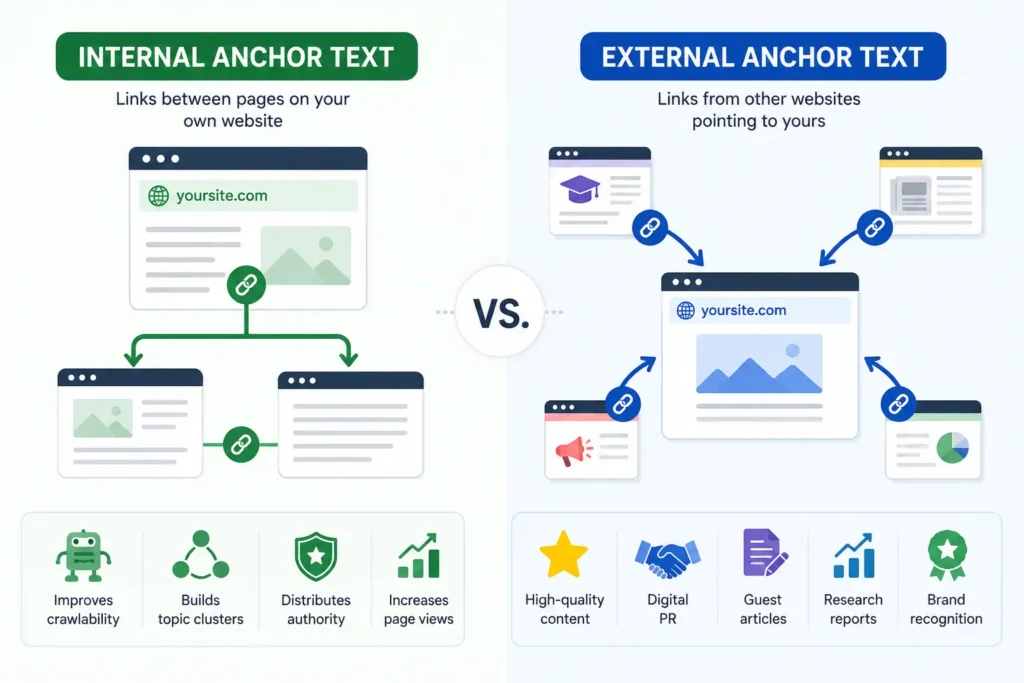
Links between pages on your own website.
Benefits:
- Improves crawlability
- Builds topic clusters
- Distributes authority
- Increases page views
2. External Anchor Text
Links from other websites pointing to yours.
While you can’t fully control external anchor text, you can influence it through:
- High-quality content
- Digital PR
- Guest articles
- Research reports
- Brand recognition
How to Audit Your Anchor Text Profile
Regular audits help identify optimization opportunities.
Step 1: Review Anchor Distribution
Look for:
- Exact match anchors
- Branded anchors
- Generic anchors
- Partial matches
- Long-tail phrases
Step 2: Identify Over-Optimization
Warning signs include:
- Repeated commercial keywords
- Large numbers of identical anchors
- Unnatural backlink patterns
Step 3: Improve Internal Links
Update older articles with descriptive anchors pointing to newer content.
This strengthens topical authority across your website.
Step 4: Monitor New Backlinks
Review newly acquired backlinks regularly to ensure they appear natural and relevant.
Anchor Text Optimization for AI Search (GEO)
AI-powered search engines don’t just analyze keywords—they evaluate context, relationships between pages, and how well content answers user questions. Clear, descriptive anchor text helps AI systems better understand your site’s structure and the purpose of linked content.
To optimize for AI-driven search:
- Use conversational, descriptive anchor text.
- Link related pages within topic clusters.
- Avoid repetitive exact-match anchors.
- Keep surrounding content informative and relevant.
- Ensure linked pages genuinely satisfy the promise made by the anchor text.
This approach improves both discoverability and user trust across traditional search engines and AI assistants.
What Is the Best Anchor Text for SEO?
The best anchor text is descriptive, relevant, and natural. It clearly tells users what they can expect after clicking while fitting seamlessly into the surrounding content. A balanced mix of branded, partial-match, generic, and long-tail anchors creates a healthy link profile that supports long-term SEO.
Frequently Asked Questions (People Also Ask)
1. Does anchor text still matter for SEO?
Yes. While it’s only one ranking signal, anchor text helps search engines understand linked pages and improves user navigation when used naturally.
2. How many exact-match anchor texts should I use?
There is no fixed percentage. Focus on maintaining a natural mix of anchor types instead of repeatedly using the same keyword.
3. Is “click here” bad for SEO?
Not always, but descriptive anchor text generally provides more value for users, accessibility, and search engines.
4. Should internal links use keywords?
Yes, when they fit naturally. Descriptive keyword variations help search engines understand the relationship between your pages.
5. Can too much anchor text optimization hurt rankings?
Yes. Over-optimized anchor text, especially repeated exact-match keywords, can appear manipulative and reduce the effectiveness of your SEO efforts.
Conclusion
Anchor text is a small element with a significant influence on how users navigate your website and how search engines interpret your content. Rather than chasing outdated tactics like excessive exact-match keywords, modern SEO rewards clarity, relevance, and natural language.
The most effective anchor text strategy is built on user intent. Choose descriptive phrases that accurately represent the destination page, diversify your anchor types, and use internal links to strengthen topical relationships across your site. Regular audits can also help you identify over-optimization and improve the overall health of your link profile.
As search evolves with AI-powered experiences, well-structured anchor text will continue to play an important role in helping both search engines and intelligent assistants understand your content. By focusing on helpful, contextual, and user-friendly links, you’ll create a stronger foundation for sustainable organic visibility and long-term SEO success.