


Choosing an online reputation management company is an important decision. You are giving someone the responsibility of influencing what people see when they search for your name or your brand. This guide will help you compare online reputation management companies based on pricing, services, and the results they can deliver.
It also covers everything you need to know before signing a contract with an ORM provider. Since high-quality content plays a major role in building and protecting your online reputation, you may also want to explore our guide to the Best Content Marketing Agencies to learn how strategic content can strengthen your brand’s visibility and credibility.
An online reputation management company is like a helper that keeps an eye on what people are saying about you or your business on the internet. Then they try to make it better or protect it.
The online reputation management company usually does three things: they watch for new things people are saying about you, they respond to comments and try to get more good things said about you and they try to get rid of the bad things that people are saying about you or your brand.
Some online reputation management companies give you a tool that you can use yourself to manage your reputation. Others do all the work for you so you do not have to lift a finger.
Some online reputation management companies, like Reputation.com and Birdeye give you both a tool to use and people who will do the work for you so you can choose what you want from the online reputation management company.
How ORM Works
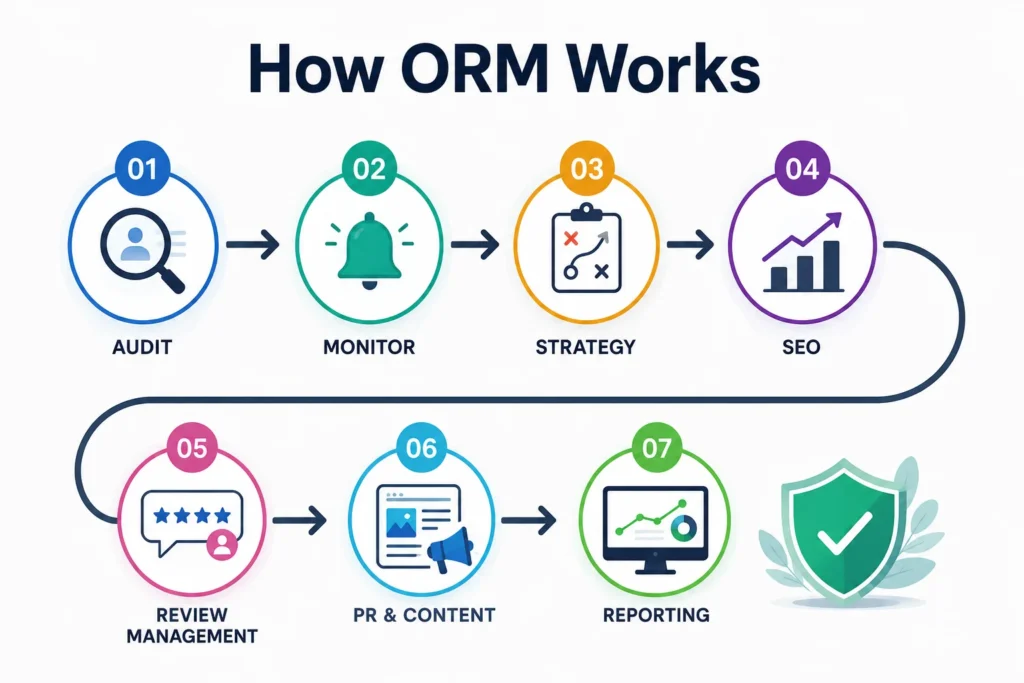
Most engagements follow a similar sequence, whether the client is a dentist with a few bad reviews or an executive dealing with a damaging news article.
- Audit. The provider searches your name or brand across Google, review sites, social platforms, and news archives to map out what exists today.
- Monitor. Ongoing alerts track new mentions, reviews, and search results as they appear.
- Strategy. Based on the audit, the team builds a plan: which reviews to request, which content to create, which results need to be addressed directly.
- SEO. New, positive, high authority pages are built and optimized so they outrank weaker or negative content in search results.
- Review management. The team requests new reviews from satisfied customers and responds to existing ones, good and bad.
- PR and content. Press placements, interviews, and owned content (bios, profiles, articles) add credible material that search engines trust.
- Reporting. Clients get regular updates on rankings, review scores, and sentiment so they can see what changed.
Why Reputation Matters
The way people search for things has changed. Now buyers and hiring managers do not just look at the page of Google results. They also read summaries made by artificial intelligence from Google AI Overviews, ChatGPT, Gemini, and Perplexity.
These summaries use the information that is already available on the internet. If there is one negative thing about you online, it can influence how an AI assistant describes your business or personal brand. It is no longer just about how you appear on a Google search results page. This is why managing your online reputation has become just as important as traditional SEO.
Some companies now refer to this as AI search reputation or answer engine visibility. However, it is also important to remember that search results are not always perfect. If you’re wondering whether search rankings and information can be inaccurate, read our guide on Is Google Always Right? to understand how Google’s results are generated and why they can sometimes be misleading.
At the same time, what people say about a business in online reviews has a major impact on trust. A low star rating or unanswered negative reviews can drive away potential customers before they even contact your business. Strong online reputation management helps ensure that both search engines and AI-powered search assistants present your business in the best possible light.
Quick Comparison of the Best Online Reputation Management Companies
| Company | Best For | Starting Price | Key Services | Model |
| Reputation.com | Enterprise, multi-location brands | Custom, typically $3,000 to $5,000+/month | Reputation scoring, review management, social listening, competitor benchmarking | Software + managed service |
| NetReputation | Individuals and businesses needing content suppression or removal | Around $550 to $2,500/month, project pricing from $2,500 | Search result suppression, review management, content removal assistance | Agency |
| Thrive Agency | Small to mid-sized businesses wanting ORM bundled with digital marketing | Custom quote | Review management, SEO, content marketing, social media | Agency |
| Coalition Technologies | Ecommerce and mid-market brands needing SEO-led reputation work | Custom quote | SEO, review generation, content strategy | Agency |
| Birdeye | Multi-location businesses wanting an all-in-one CX platform | From $299/location/month | Review monitoring and generation, listings, messaging, AI response agents | Software (SaaS) |
| Podium | Local businesses focused on fast review generation via text | Custom quote (Core, Pro, Signature tiers) | SMS review requests, messaging, AI lead and review agents | Software (SaaS) |
| ReviewTrackers | Multi-location brands needing detailed review analytics | From $89/month/location | Review monitoring across 100+ sites, sentiment themes, review generation | Software (SaaS) |
| BrandYourself | Individuals and professionals managing personal search results | Free DIY tier; paid plans from roughly $99/month | Personal search result monitoring, profile optimization, guided suppression | Software + coaching |
| WebiMax | Businesses and individuals wanting full service reputation repair | Custom quote | Review management, content removal, SEO, social reputation | Agency |
| BrightLocal | Agencies and small businesses focused on local SEO plus reviews | From $39/month | Local rank tracking, citation building, review monitoring, white label reporting | Software (SaaS) |
Prices shift often and most agencies quote based on the size of the problem, so treat these as starting ranges, not fixed rates. Ask for a written quote before comparing providers side by side.
Top 10 Best Online Reputation Management Companies
1. Reputation.com
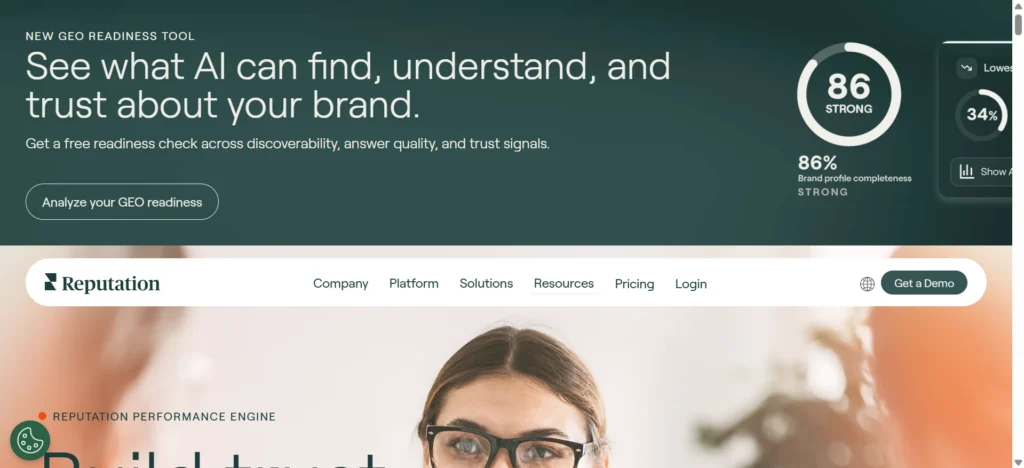
Overview: Reputation.com is one of the longest running names in the space, built as an enterprise platform for large, multi-location brands. It combines a reputation scoring system with review management, social listening, and competitor benchmarking in one dashboard.
Key Features:
- Proprietary Reputation Score that benchmarks a brand against local competitors
- Review generation and response tools across major platforms
- Social listening and sentiment tracking at the location and enterprise level
- Compliance features suited to regulated industries like healthcare and financial services
Pros: Deep enterprise features, strong for multi-location brands, respected in automotive, healthcare, retail, and hospitality.
Cons: Pricing is not published and requires a sales call, and the platform is generally out of reach for very small businesses.
Pricing: Custom quoted, generally starting around $3,000 to $5,000 per month for core access, with enterprise crisis or SEO add-ons pushing costs above $10,000 per month.
Best For: Large or multi-location companies in regulated or highly competitive industries that need enterprise grade reporting and compliance support.
2. NetReputation
Overview: NetReputation is an agency focused heavily on removing or suppressing damaging search results, alongside standard review and reputation monitoring work.
Key Features:
- Search result suppression campaigns for negative articles, mugshots, or outdated content
- Review monitoring and response management
- Dedicated account managers for each campaign
- Personal and business reputation packages
Pros: Strong track record with search suppression work, transparent published pricing ranges, personal and business options.
Cons: Suppression campaigns can take many months, and heavier cases (multiple negative articles on authoritative sites) get expensive quickly.
Pricing: Individuals and small businesses typically pay between $550 and $2,500 per month, with project based campaigns ranging from around $2,500 for a short engagement to $10,000 to $15,000 for a six month or longer push.
Best For: Individuals or businesses with a specific negative article, review cluster, or search result they want addressed directly.
3. Thrive Agency
Overview: Thrive is a full service digital marketing agency that folds reputation management into a broader package alongside SEO, PPC, and social media.
Key Features:
- Review generation and monitoring tied into local SEO campaigns
- Content marketing to build positive, authoritative pages
- Social media management as part of the same retainer
Pros: Useful if you already want SEO and marketing help and don’t want to manage multiple vendors.
Cons: Reputation work is one piece of a marketing bundle rather than a specialist focus, so dedicated ORM depth may be lighter than a pure play reputation firm.
Pricing: Custom quoted based on scope.
Best For: Small and mid-sized businesses that want reputation management combined with ongoing SEO and marketing.
4. Coalition Technologies
Overview: Coalition Technologies is an SEO-first agency that treats reputation as an extension of search visibility, particularly for ecommerce and mid-market brands.
Key Features:
- SEO-led content strategy to build pages that outrank negative results naturally
- Review generation tied to ecommerce and local listings
- Conversion focused website and landing page work
Pros: Strong technical SEO team, good fit for brands that see reputation and organic visibility as the same problem.
Cons: Less focused on crisis response or personal reputation cases than dedicated ORM firms.
Pricing: Custom quoted.
Best For: Ecommerce and mid-market companies that want reputation work built on a strong SEO foundation.
5. Birdeye
Overview: Birdeye is a customer experience platform that treats reviews, listings, messaging, and social presence as one connected system, with AI agents handling much of the day to day work.
Key Features:
- AI agents that request reviews, draft responses, and flag urgent negative feedback
- Business listing management across 200+ sites
- Unified inbox for texts, webchat, and social messages
- Competitor benchmarking and sentiment reporting
Pros: Broad feature set beyond just reviews, strong ratings on review sites like G2, good for businesses that also want social media and messaging in one tool.
Cons: Pricing is per location, so costs add up fast for brands with many sites; some users note the fuller feature set takes time to learn.
Pricing: Plans start around $299 per location per month on an annual contract, rising to roughly $449 per location per month for the tier that adds social media management.
Best For: Multi-location businesses that want reviews, listings, messaging, and social all in a single AI-driven platform.
6. Podium
Overview: Podium built its name on getting customers to leave reviews through text message requests, and has since expanded into AI-driven lead and review management.
Key Features:
- SMS-based review requests with high response rates
- AI review response drafting
- Unified messaging across text, webchat, and Google
- Lead capture and appointment scheduling tools
Pros: Fast setup, strong for businesses that want quick review volume growth, praised for ease of use.
Cons: Lighter on social media management and multi-location reporting compared to Birdeye, and pricing is not published.
Pricing: Custom quoted across Core, Pro, and Signature tiers.
Best For: Local businesses, especially those in home services, retail, or healthcare, that want to grow review volume quickly through text.
7. ReviewTrackers
Overview: ReviewTrackers is built specifically around monitoring and analyzing reviews at scale, which makes it a strong fit for brands juggling many locations.
Key Features:
- Review aggregation from 100+ sites
- Sentiment and theme analysis that surfaces recurring complaints or praise
- Review generation through email and SMS campaigns
- Performance scoring dashboard
Pros: Strong analytics depth for spotting patterns across large review volumes, useful for hospitality and retail chains.
Cons: Fewer marketing features like social media management or listings compared to Birdeye.
Pricing: Starts around $89 per month for a single location, with volume discounts for multi-location accounts.
Best For: Multi-location brands that want detailed insight into what reviews are actually saying, not just star counts.
8. BrandYourself
Overview: BrandYourself focuses on personal reputation, helping individuals control what shows up when someone searches their name.
Key Features:
- Personal search result monitoring
- Guided tools to build and optimize profiles that rank well
- Coaching-based suppression strategy for individuals
- Free DIY tier alongside paid managed plans
Pros: Accessible entry point for individuals who cannot afford enterprise-level agency pricing, useful for job seekers and professionals.
Cons: Lighter service than a full agency campaign, better suited to moderate issues than serious crisis situations.
Pricing: Free basic tier, with paid plans generally starting around $99 per month.
Best For: Individual professionals, job seekers, and executives who want to manage their personal search presence without hiring a full agency.
9. WebiMax
Overview: WebiMax is a full service digital marketing and reputation agency that handles both business and personal reputation repair, including content removal support.
Key Features:
- Review management and generation
- Content removal assistance for outdated or damaging pages
- SEO and social reputation management
- Personal and executive reputation packages
Pros: Handles both business and personal cases, broad service menu under one contract.
Cons: Pricing is not public, and clients need to request a custom quote to compare against competitors.
Pricing: Custom quoted.
Best For: Businesses or individuals wanting one agency to handle reviews, content removal, and broader digital marketing together.
10. BrightLocal
Overview: BrightLocal is a local SEO platform that bundles review monitoring with citation building and rank tracking, popular among agencies managing many small business clients.
Key Features:
- Local search rank tracking by city and keyword
- Automated citation building across 1,500+ directories
- Review monitoring and Google Business Profile sync
- White label reporting for agencies
Pros: Affordable compared to enterprise platforms, strong for agencies serving multiple local clients, clear published pricing.
Cons: Not built for large multi-location brands needing deep customer experience management.
Pricing: Plans start at $39 per month, with advanced citation management tiers up to around $89 per month.
Best For: Small businesses and marketing agencies that want local SEO and review monitoring bundled at an affordable price.
Best ORM Companies by Business Type
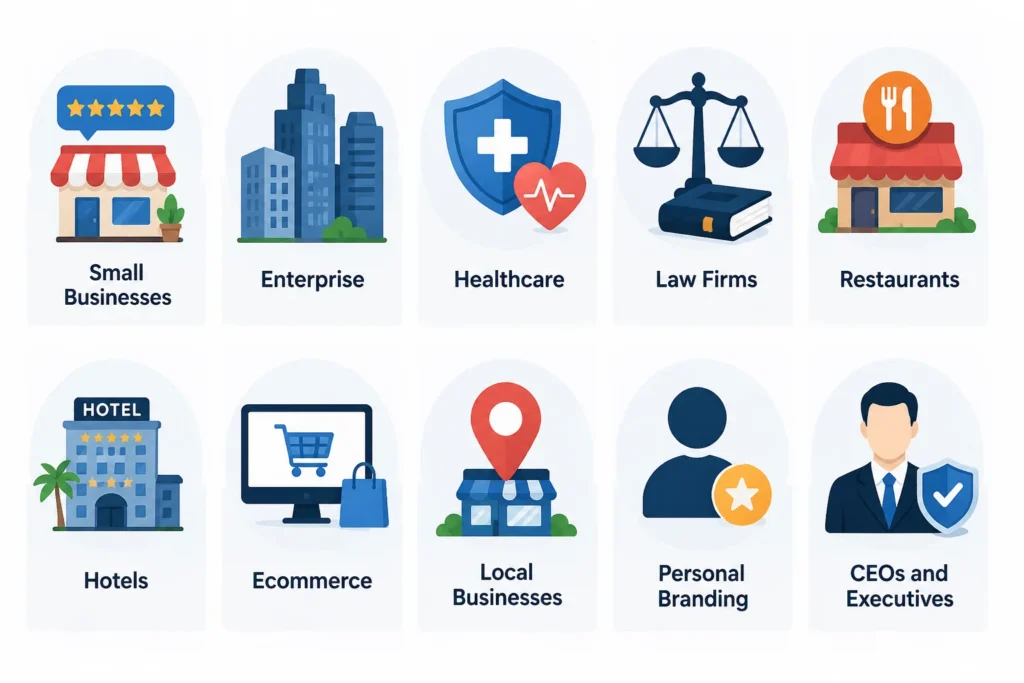
Small Businesses: BrightLocal and Podium offer the best balance of price and review generation speed without a long-term enterprise contract.
Enterprise: Reputation.com and Birdeye scale across hundreds of locations with the compliance and reporting large organizations need.
Healthcare: Reputation.com’s compliance-friendly platform fits regulated environments where patient feedback and privacy rules intersect.
Law Firms: NetReputation and WebiMax are common choices for firms managing sensitive search results tied to individual attorneys or cases.
Restaurants: Podium and Birdeye both specialize in fast review generation, which matters most for foot-traffic driven businesses.
Hotels: ReviewTrackers was originally built with hospitality clients in mind and remains strong for tracking sentiment across travel review sites.
Ecommerce: Coalition Technologies pairs reputation work with the SEO and conversion expertise ecommerce brands also need.
Local Businesses: BrightLocal remains the most cost-effective option for single-location businesses focused on local search visibility.
Personal Branding: BrandYourself is purpose-built for individuals managing their own name in search results.
CEOs and Executives: NetReputation and WebiMax both run dedicated executive reputation campaigns for crisis situations and long-term personal brand protection.
Services Offered by Reputation Management Companies
Review Monitoring: Tracking new reviews across Google, Yelp, Facebook, industry-specific sites, and app stores in one dashboard.
Review Generation: Sending automated requests, usually by email or text, to customers after a purchase or visit to increase review volume.
Review Responses: Writing or auto-drafting replies to both positive and negative reviews, which search engines and customers both notice.
SEO Reputation Management: Building and optimizing new, positive content so it ranks above outdated or negative search results, sometimes called SERM (search engine reputation management).
Brand Monitoring: Tracking mentions of a brand or person across news, blogs, and forums, not just review sites.
Social Media Reputation: Monitoring comments and mentions on social platforms and responding before small issues become public complaints.
Crisis Management: Rapid response planning and execution when a business or individual faces sudden negative press or viral backlash.
Content Removal Assistance: Reaching out to webmasters or platforms to request takedown of outdated, false, or damaging content, and pursuing legal routes where content violates platform policy or law.
Wikipedia and Knowledge Panel Support: Helping ensure a Wikipedia page or Google Knowledge Panel accurately reflects a person or brand, since both carry heavy weight in search results and AI summaries.
How to Choose the Best Reputation Management Company
1. Questions to Ask
- Can you show a case study similar to my situation, with before and after results?
- What is included in the monthly fee versus billed separately?
- How long is the contract, and what happens if I want to cancel?
- Who will be my main point of contact, and how often will I get reports?
- What tactics do you use to manage or remove negative content, and are they compliant with Google and platform policies?
2. Red Flags
- Guarantees to remove any negative review or article, since legitimate removal depends on platform policy and legal grounds, not agency willpower
- No willingness to explain their actual tactics
- Pressure to sign a long contract before an audit or consultation
- Reviews of the agency itself that mention fake reviews, incentivized reviews, or review gating, all of which violate most platform policies and carry real legal risk
3. Pricing Transparency
Ask for a written breakdown of what is included at each price tier. Agencies that only offer a sales call with no example pricing range are not necessarily untrustworthy, but you should still get a number in writing before signing anything.
4. Contracts
Watch for auto-renewal clauses and early termination fees. Reputation work is naturally a longer-term commitment, but you should still know your exit terms up front.
5. Case Studies
Ask specifically for results in your industry or a comparable situation. A general “we improved reviews” case study means less than one showing a real before-and-after in your market.
How Much Does Reputation Management Cost?
Reputation management pricing varies widely because the cost depends on the size of the problem, not just the size of the business.
1. Small Business Pricing
Small businesses and individuals with light monitoring needs typically pay between $500 and $2,500 per month for basic review management and monitoring.
2. Enterprise Pricing
Large organizations needing 24/7 monitoring, crisis response teams, and content suppression at scale generally spend $10,000 to $50,000 or more per month.
3. One-Time Projects
Single issue campaigns, like removing one damaging article or a small batch of fake reviews, can run from around $500 to $5,000 depending on complexity and how authoritative the source is.
4. Monthly Retainers
Ongoing retainers for mid-sized companies commonly fall between $2,500 and $10,000 per month, covering active review generation, content creation, and monitoring across more platforms.
Executive and personal reputation cases follow a similar curve: basic monitoring starts around $500 to $1,000 per month, while a full crisis-level campaign for a public figure can reach $15,000 to $25,000 or more per month depending on severity.
Agency vs ORM Software
| Factor | Full Service Agency | ORM Software Platform |
| Who does the work | The agency’s team | You, using the tool |
| Best for | Complex cases, crisis response, content removal | Ongoing review monitoring and generation |
| Typical cost | $500 to $50,000+/month depending on scope | $39 to $500+/month per location |
| Time commitment | Low, mostly reporting check-ins | Higher, requires someone on staff to run it |
| Speed of setup | Slower, campaign planning required | Fast, often live within a day |
Many businesses use both: a software platform like Birdeye or ReviewTrackers for daily review management, alongside an agency for occasional projects like content removal or a search suppression campaign.
AI in Online Reputation Management
AI has changed how reputation platforms operate and how reputation itself gets measured.
1. AI Sentiment Analysis
Instead of just counting one to five star ratings, modern platforms read the actual text of reviews to identify recurring themes, like slow service or billing confusion, so businesses know exactly what to fix.
2. AI Review Responses
Tools like Birdeye and Podium now draft personalized responses to reviews automatically, which speeds up response time and helps maintain a consistent, professional tone across hundreds of reviews.
3. Brand Monitoring with AI
AI-driven monitoring can scan far more sources than a human team alone, flagging a new mention or a sudden spike in negative sentiment within hours instead of days.
4. Predictive Reputation Analytics
Some big companies are trying to catch problems with their reputation before people start talking about them. For example they might see that a lot of people are complaining inside the company or that it is taking a time to respond to people. This can be a sign that a lot of people are going to start saying things about the company soon.
Now people are also trying to make sure that computer programs like Google AI Overviews, ChatGPT, Gemini and Perplexity are talking about companies and people in a way. This is important because when you first hear about a company or person it is often from one of these computer programs just like you would find out from a search results page. Google AI Overviews, ChatGPT, Gemini and Perplexity are really good at giving people their impression of a company or person.
Benefits of Hiring an ORM Company
- Frees up internal time that would otherwise go to manually monitoring reviews and mentions
- Brings experience with what actually works for suppression and content strategy, avoiding wasted effort on outdated tactics
- Provides steady reporting so you can see whether your reputation is actually improving
- Reduces the risk of a small issue growing into a public crisis by catching problems early
- Often improves local SEO rankings as a side effect, since review volume and freshness are ranking factors for Google Business Profile visibility
Common Reputation Management Mistakes
- Ignoring negative reviews instead of responding, which signals to future customers that feedback goes unanswered
- Buying fake reviews or paying for incentivized reviews, both of which violate platform policies and can result in account penalties
- Expecting a permanent fix instead of ongoing maintenance, since new content and reviews appear constantly
- Hiring based on price alone without checking for real case studies or reviews of the agency itself
- Focusing only on Google while ignoring industry-specific review sites where your actual customers spend time
Industry Statistics and Trends
The online reputation management market was worth about $7.75 billion in 2026. It is expected to increase to around $14 billion by 2031. This growth is mostly because of online reputation management tools that use intelligence and the fact that people are using artificial intelligence search summaries to make buying decisions.
Online reputation management is now a part of what makes a company valuable. That is why even small businesses are setting aside money to manage their reputation all the time. They do not just do it once. Online reputation management is a process for these businesses. The online reputation management market is really important, for companies
Frequently Asked Questions
What is the best online reputation management company?
There is no single best option for everyone. Reputation.com and Birdeye lead for enterprise and multi-location brands, NetReputation and WebiMax are strong for content removal and personal cases, and BrightLocal or Podium fit smaller local businesses on a budget.
How much does online reputation management cost?
Most small businesses and individuals pay between $500 and $2,500 per month, mid-sized companies pay $2,500 to $10,000 per month, and enterprise or crisis-level campaigns can run $10,000 to $50,000 or more per month.
Is online reputation management worth it?
For most businesses, yes. A single negative article or a pattern of unanswered reviews can quietly cost far more in lost customers than a monitoring or repair campaign costs to run.
Can ORM remove negative Google results?
Sometimes. Legitimate removal usually depends on the content violating a platform’s policy, defamation law, or being outdated enough to fall off through natural SEO suppression. No legitimate company can guarantee removal of accurate, policy-compliant content.
Can reputation management remove bad reviews?
Only in specific cases, such as reviews that violate a platform’s guidelines (fake reviews, harassment, or reviews from someone who was never a customer). Agencies can request removal through the platform, but the platform makes the final call.
How long does reputation management take?
Simple review monitoring and generation can show results within weeks. Search suppression or content removal campaigns typically take three to twelve months, and severe cases with multiple negative sources can take longer.
Conclusion
If you have a business with many locations and you need to keep track of things and follow rules then Reputation.com or Birdeye are the best choices. If you have an article or review that you want to get rid of, NetReputation or WebiMax are the ones to go to. They are really good at making those things go away.
Small businesses that just want to get reviews and be seen by people in their area will do well with Podium or BrightLocal. If you are a person who wants to look good when people search for you online you should try BrandYourself first. Do not pay a company to do it for you until you have to.
No matter what you choose, make sure you get a price in writing. Ask to see an example of something they did for someone like you. Stay away from companies that promise to get rid of things that’re true and follow the rules. Taking care of your reputation is something you have to keep doing. It is not something you can just do one time and forget about it. Reputation management is a thing you have to keep at it all the time. It is not a one time purchase it is something that Reputation.com and other companies, like Birdeye can help you with.