

DR and DA aren’t the same metric, and neither tells the whole story. Learn what actually predicts link value and why traffic data matters more.
If you’ve ever checked a website’s Domain Rating in Ahrefs and gotten 45, then checked the same site in Moz and gotten a Domain Authority of 32, you’ve probably wondered which number is right.
Neither is wrong they measure authority differently, using different data, updated on different schedules.
Once you understand what each metric actually does, the confusion mostly disappears, and you can use them the way experienced link builders do: as directional signals, not gospel.
What Is Domain Rating (DR)?
Domain Rating is Ahrefs’ metric for estimating the strength of a website’s backlink profile relative to every other site in its index, scored 0–100.
Ahrefs launched DR in 2016 to give users a fast, single-number read on how “linked to” a domain is, based on the size and quality of sites linking into it. It’s built almost entirely from link graph data: how many unique referring domains point to a site, how strong those domains are, and how links are distributed across the site. The scale is logarithmic, so the gap between DR 20 and 30 is far smaller in real terms than the gap between DR 70 and 80 each point gets harder to earn as the score climbs.
Because Ahrefs crawls the web near-continuously, DR can shift within days of a site gaining or losing backlinks, making it one of the more “live” authority metrics available.
What Is Domain Authority (DA)?
Domain Authority is Moz’s metric for predicting how likely a website is to rank in search results, also scored 0–100.
Moz introduced DA in 2013 as a comparative score not a direct measure of link strength, but a prediction of ranking potential relative to competing sites. Rather than just tallying links, Moz runs its index through a machine-learning model trained to correlate link and domain signals with actual rankings. DA tries to answer “how well would this domain likely perform in the SERPs,” not just “how many good links does it have.” Moz’s index refreshes more slowly than Ahrefs’ historically closer to monthly so DA tends to lag behind real-time link changes.
Key Differences at a Glance
| Domain Rating (DR) | Domain Authority (DA) | |
|---|---|---|
| Created by | Ahrefs (2016) | Moz (2013) |
| Measures | Raw backlink strength | Predicted ranking likelihood |
| Methodology | Link graph analysis | ML ranking prediction |
| Scale | 0–100, logarithmic | 0–100, logarithmic |
| Updates | Near real-time | Roughly monthly |
| Page-level version | URL Rating (UR) | Page Authority (PA) |
Why the same site gets different scores
- Different crawlers, different indexes. Ahrefs, Moz, and Semrush each run their own crawler and maintain separate link indexes — none sees the whole web, and none sees the same slice of it.
- Different update speeds. A site that just earned strong links might show a DR bump before its DA catches up.
- Different scoring logic. DR is closer to a direct tally of link equity; DA runs link data through a predictive model. Similar underlying data can still produce different scores.
Is DR or DA a Google Ranking Factor?
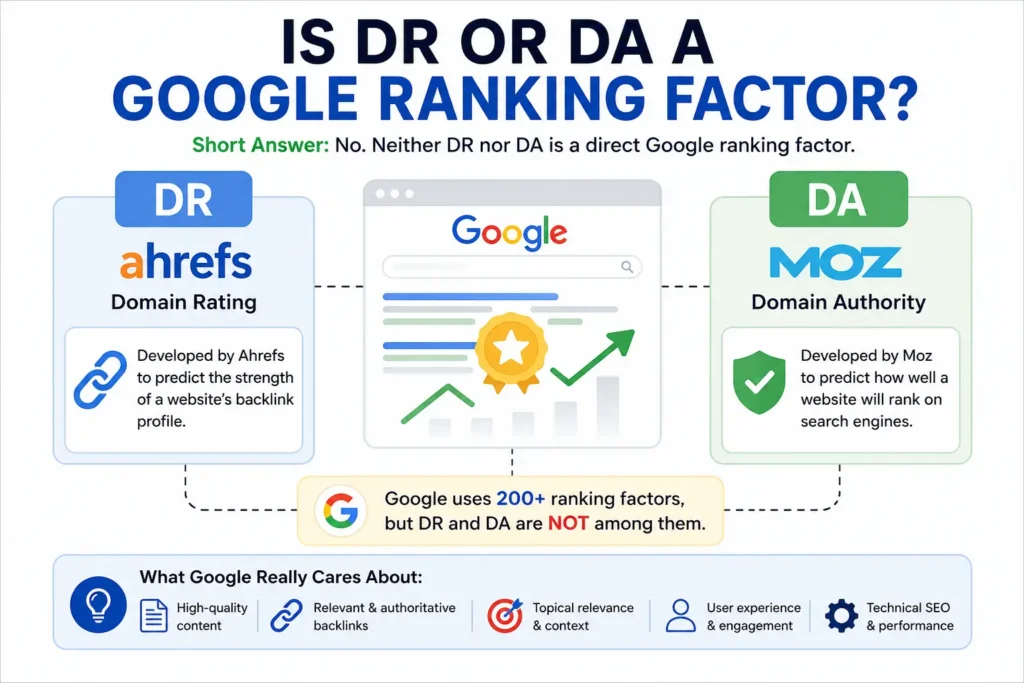
No. Neither DR, DA, nor Authority Score is used by Google’s algorithm they’re third-party estimates built to approximate authority from public link data. Google’s own Search team has repeatedly said as much.
It’s true that higher-scored sites tend to rank better on average, but that’s correlation, not causation: both the score and the ranking stem from the same underlying cause a strong backlink profile and solid overall SEO.
A high DR doesn’t cause good rankings any more than a thermometer causes warm weather.
A 2023 peer-reviewed study in Profesional de la información, examining roughly 3,150 domains across 61 queries, found strong statistical agreement (Spearman’s rho above 0.9) between Moz, Semrush, and Ahrefs scores.
The tools disagree on exact numbers but largely agree on relative authority even though none of them reflects Google’s actual algorithm.
DR vs. DA vs. Semrush AS vs. Majestic TF/CF
Most comparisons stop at DR vs. DA, but two more metrics deserve consideration.
Semrush Authority Score (AS) blends link signals with estimated organic traffic and spam-risk indicators — making it harder to inflate through link buying alone, since a site with purchased links but no real traffic still scores poorly.
Majestic Trust Flow (TF) and Citation Flow (CF) take a different approach: CF estimates link quantity, TF estimates link quality based on proximity to trustworthy seed sites. A high CF paired with a low TF is a classic red flag for thin or spammy link profiles a signal DR and DA don’t surface directly.
| Metric | Strength | Best for |
|---|---|---|
| Ahrefs DR | Live backlink strength | Fast link prospecting |
| Moz DA | Ranking-potential prediction | Quick comparisons |
| Semrush AS | Traffic + spam-adjusted authority | De-risking paid link decisions |
| Majestic TF/CF | Quality-to-quantity ratio | Spotting manipulated profiles |
Don’t Ignore Page-Level Metrics
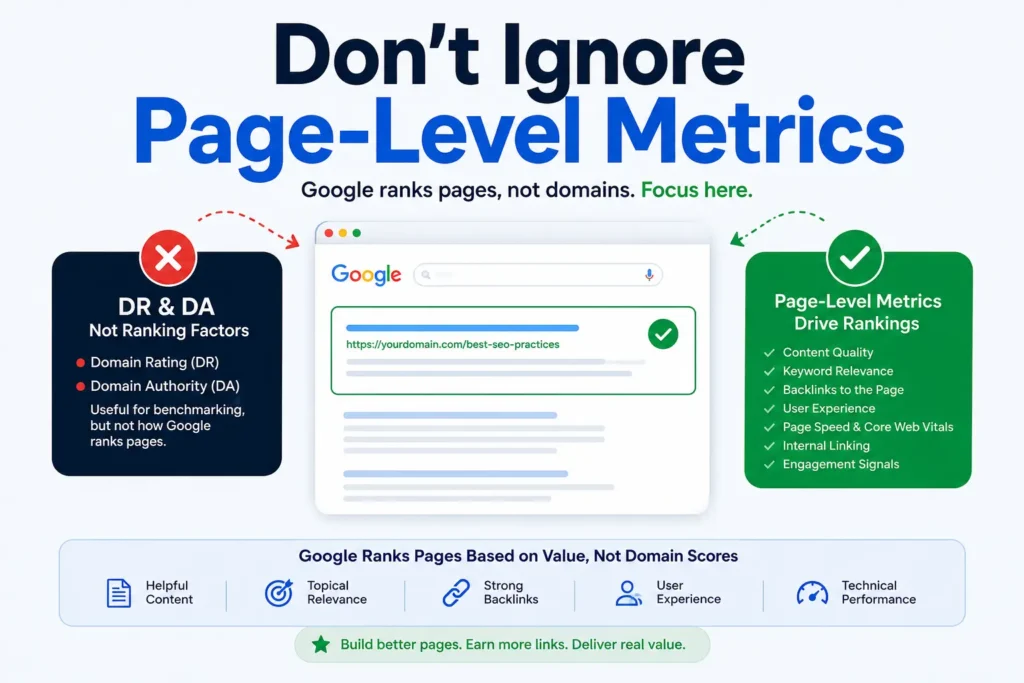
Domain-level scores get the attention, but they can mislead when evaluating a single page. Ahrefs URL Rating (UR) measures one page’s link strength independent of its domain; Moz Page Authority (PA) does the same within Moz’s model.
This matters more than most guides suggest. A domain can carry a high DR overall while the specific page you’d get a link from a low-traffic blog category, say has a comparatively weak UR. If you’re vetting a guest post, the strength of the exact page your link will live on matters more than the domain’s headline score.
A Real-World Comparison
Checking a handful of real domains across tools side by side shows how much these scores can diverge:
| Domain type | Ahrefs DR | Moz DA | Semrush AS |
|---|---|---|---|
| Established national media site | 90+ | 85+ | 85+ |
| Mid-size niche SaaS blog | 55–65 | 40–50 | 45–55 |
| Small local business site | 15–25 | 10–20 | 10–20 |
| New site with purchased links | 30–40 | 15–25 | Under 20 |
The pattern: the more established and traffic-rich a site is, the closer the scores converge.
The thinner or more artificial a link profile, the wider the gap particularly with Semrush AS coming in lower, since it penalizes weak traffic and spam risk that DR and DA don’t account for. A big gap between DR and AS is often a sign that authority is more “borrowed” than earned.
Which Metric Should You Trust? A Decision Framework
Vetting guest post sites: Start with DR for speed, cross-check with Semrush AS to catch spam-inflated scores, and check the specific page’s UR or PA rather than only the domain-wide number.
Client or stakeholder reporting: DA tends to be the more familiar number to non-SEO audiences, given its longer history and free-tool availability. Pair it with a plain-language note that it’s a third-party estimate, not a Google metric.
Competitive benchmarking: Pick one primary tool and stick with it, so your trend line stays consistent — mixing DR one quarter and DA the next makes progress look erratic even when SEO is improving.
Tracking your own site: Track the score alongside referring domain growth and organic traffic. A rising DR or DA paired with flat traffic is a warning sign that link growth isn’t translating into real visibility.
Why Traffic Data Matters More Than DR or DA
Authority scores are, at best, a proxy for a proxy. What they’re trying to estimate is how well a site can rank and earn visibility but organic traffic is a direct read on that outcome, not an estimate of it.
A site with a modest DR but strong, consistent organic traffic is demonstrably ranking for real terms. A site with a high DR but minimal traffic is a red flag often a sign of a link profile built for the score itself rather than genuine visibility.
Both Ahrefs (Site Explorer’s traffic estimate) and Semrush (Traffic Analytics) provide estimated monthly organic traffic for any domain, broken down by top pages and keywords roughly the same effort as pulling a DR score, but far more informative.
Before treating any site as a strong link target, check:
- DR or DA (quick authority snapshot)
- Semrush AS or Majestic TF/CF (quality cross-check)
- Estimated organic traffic (is authority translating into visibility?)
- Traffic trend over the last 6–12 months
- Top organic keywords (relevant to your niche, or generic/unrelated?)
If a site scores well on authority but fails on traffic and relevance, treat that as a caution flag.
Can DR or DA Be Faked?
Yes , which is exactly why relying on a single score is risky. Private blog networks and bulk link-buying operations exist specifically to manipulate these scores. Since DR and DA are calculated largely from link data, a site can accumulate low-quality but technically “counted” links and see its score climb, even without real audience or traffic.
Red flags: a strong DR/DA paired with very low estimated traffic, keyword rankings clustered around obscure or irrelevant terms, a referring domain list dominated by similarly low-quality sites, and thin or repurposed content.
Because Semrush AS factors in traffic and spam risk, artificially inflated DR scores often don’t hold up under an AS or traffic cross-check another reason to pair metrics rather than trust one in isolation.
How to Check Your DR and DA
Ahrefs: Use Site Explorer or the free DR checker enter the domain to see DR alongside referring domains and traffic estimates.
Moz: Use the free Domain SEO Analysis tool enter the domain and analyze to see DA, Page Authority, and Spam Score.
Semrush: Enter the domain into Domain Overview or the Authority Score checker to see AS alongside traffic and toxicity data.
All three offer limited free checks, fine for occasional lookups. For ongoing link-building or competitive tracking, a paid subscription to at least one is worth it for historical trend data and bulk checking.
How to Improve Both DR and DA
Earn quality referring domains. Both scores respond primarily to the number and strength of unique linking domains ten links from ten reputable sites beat a hundred from one low-quality site. One tactic that’s often overlooked in favor of new guest posts is link insertion into existing, already-ranking content since the page already has authority and traffic built up, a link placed there tends to pass more value than a brand-new post starting from zero
Fix your internal linking. Authority isn’t only earned externally it’s distributed internally. A solid internal linking structure passes equity from your strongest pages to newer or weaker ones.
Invest in digital PR and content-driven links. The most durable path is creating content genuinely worth linking to original data, tools, research paired with proactive outreach. This produces the editorially-earned links that move both scores meaningfully.
What not to do. Buying links in bulk or using PBNs might produce a short-term bump, but it risks a Google manual action and is increasingly easy for tools like Semrush to flag. The sustainable strategy is also the more boring one: earn links through content and relationships.
What Is a Good DR or DA Score?
There’s no universal “good” number. A DR of 40 might be exceptional in a small, low-competition niche and unremarkable in a saturated space like SaaS or personal finance, where top results often sit above DR 70. The only benchmark that matters is the score of the sites currently ranking for your target keywords pull the DR or DA of the top five results and use that as your real target.
Frequently Asked Questions
Is Domain Rating the same as Domain Authority? No. Different companies, different methodologies, different update schedules despite both using a 0–100 scale.
What’s a good DR or DA score? It depends on your niche. Benchmark against sites currently ranking for your target keywords rather than a fixed number.
Why is my DA different on Ahrefs and Moz? Ahrefs reports DR, not DA the two use entirely separate indexes and models, so a direct comparison isn’t meaningful.
Does DA affect Google rankings? No. It’s a third-party metric, not a factor Google’s algorithm uses directly.
How often do DR and DA update? DR updates frequently, near real-time. DA updates more slowly, historically closer to monthly.
Can you fake Domain Authority? To an extent, through bulk or low-quality link acquisition though tools like Semrush’s spam and traffic signals make inflated scores easier to spot.
What’s a good DR for guest posting? There’s no fixed threshold check the specific page’s URL Rating and traffic rather than relying on domain-wide DR alone.
Is Semrush AS better than DR or DA? Not strictly “better,” but its traffic and spam signals make it a useful cross-check when vetting link opportunities.
Does domain age affect DA? Not directly. DA is link-based, not age-based older domains often score higher simply because they’ve had more time to accumulate links.
DR (Ahrefs) and DA (Moz) measure related but distinct things: raw backlink strength versus predicted ranking potential.Neither is a Google ranking factor both correlate with, but don’t cause, search performance.Scores diverge because of different indexes, update speeds, and models not because one tool is “wrong.”Cross-checking DR or DA against Semrush AS, Majestic TF/CF, and organic traffic gives a far more reliable picture than any single score alone.The most trustworthy signal isn’t the authority score itself it’s whether that authority is backed by real, sustained traffic.