


If you’ve spent any time talking to link building vendors, you’ve probably heard “niche edit” and “link insertion” used as if they mean the same thing.
Sometimes they’re pitched as two different products with two different price tags. Sometimes the same email uses both terms in the same paragraph.
Here’s the short answer: niche edits and link insertions describe the same underlying mechanism adding a link into an already-published, already-indexed page.
The confusion exists because “niche edit” is the older, more informal industry term, while “link insertion” (and its more refined form, SERP Insight Link Insertion) describes a more disciplined version of the same tactic, built around search performance data rather than domain metrics alone.
They’re not opposites. One is a subset of the other, done with more rigor.
This guide breaks down exactly where the terms overlap, where they diverge in practice, and how to decide which approach fits your campaign.
What Is a Niche Edit?
A niche edit is the practice of getting a link added into an existing article that’s already live on a publisher’s site instead of having new content written for you.
The link is inserted into a relevant paragraph of an older post, usually one that already ranks for related terms.
The typical niche edit workflow looks like this:
- Find a page with a reasonably strong Domain Rating in your niche
- Contact the site owner or editor
- Pay a placement fee
- The editor adds your link into the body content
Niche edits are popular because they’re fast and cheaper than guest posting there’s no new article to write, review, or publish.
But the traditional version of this tactic has a well-known weakness: it’s usually chosen based on domain-level metrics alone, without checking whether the specific page is actually still ranking, still getting traffic, or still relevant.
What Is a Link Insertion?
This is sometimes branded as SERP Insight Link Insertion, but the underlying idea validate before you buy applies to any well-run link insertion campaign.Link insertion is the broader, more neutral term for the same mechanism placing a link inside existing content.
Most agencies now use link insertion as the umbrella term and “niche edit” as one style of executing it, particularly the cheaper, less-vetted version sold through marketplaces.
A more rigorous version of link insertion adds a research layer before outreach even starts: pulling actual SERP data to confirm the target page is currently ranking, that its traffic is stable or growing, and that its topic is genuinely close to yours.
This is sometimes branded as SERP Insight Link Insertion, but the underlying idea validate before you buy applies to any well-run link insertion campaign.
The Core Distinction in One Sentence
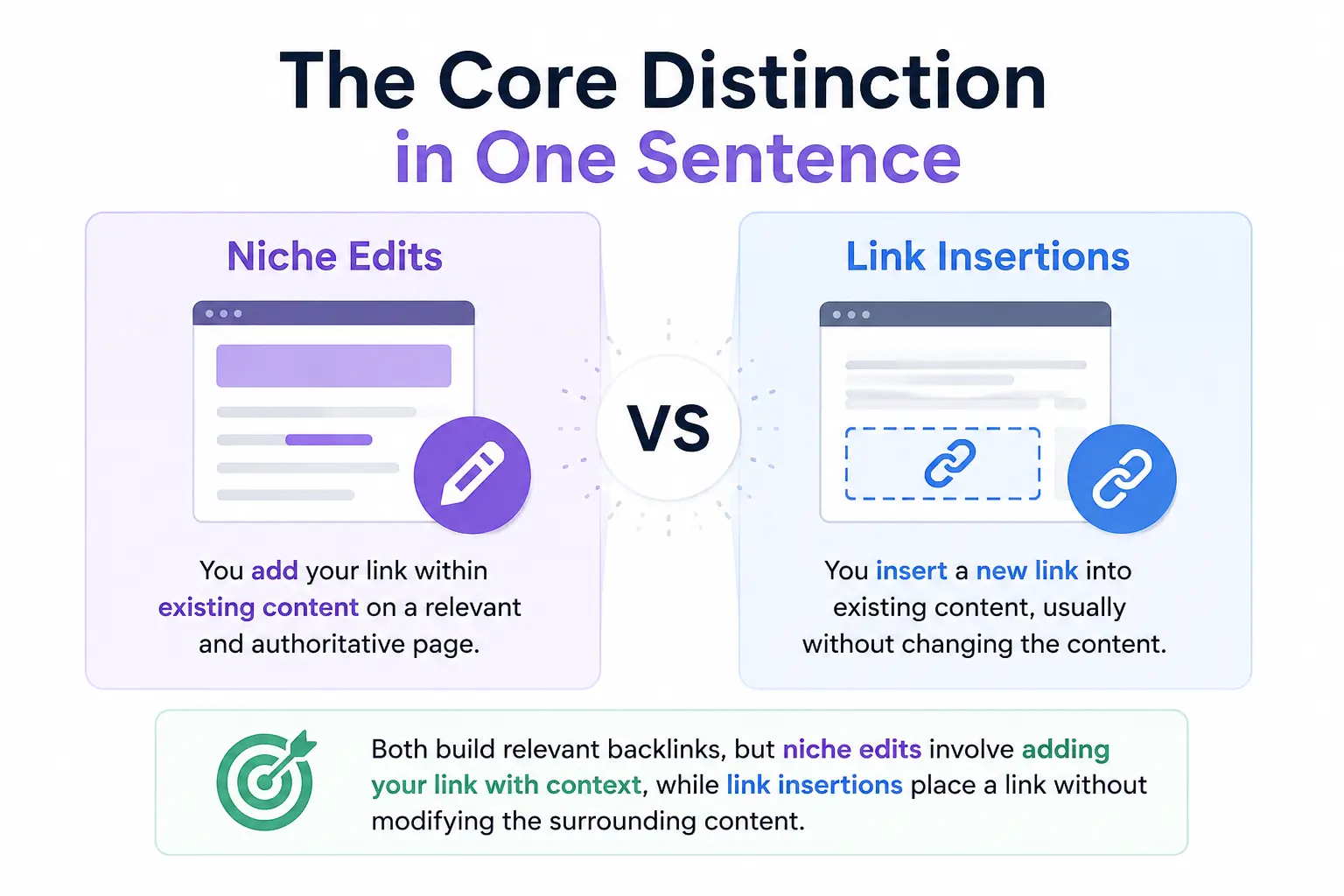
If a niche edit is find a page with decent authority and ask for a link, a well-run link insertion is find a page that’s currently ranking, currently relevant, and currently trusted by Google then ask for a link.
The mechanics of the link itself are identical either way. The difference is entirely in the vetting process that happens before outreach.
Niche Edits vs. Link Insertions: Side-by-Side Comparison
| Factor | Traditional Niche Edit | Data-Validated Link Insertion |
|---|---|---|
| Primary selection criteria | Domain Rating / Domain Authority | Current rankings, traffic trend, topical relevance |
| Research phase | Minimal often skipped | SERP analysis, indexation check, traffic verification |
| Typical cost | Low ($50–$200) | Low–Medium ($150–$1,000+) |
| Speed to placement | Fast (days) | Fast to medium (days–weeks) |
| Risk of dead-weight pages | Higher page may be deindexed or declining | Lower page is confirmed active and ranking |
| Relevance control | Often loosely checked | Explicitly scored before outreach |
| Best suited for | High-volume, budget-constrained campaigns | Targeted campaigns on specific ranking pages |
Pros and Cons of Each Approach
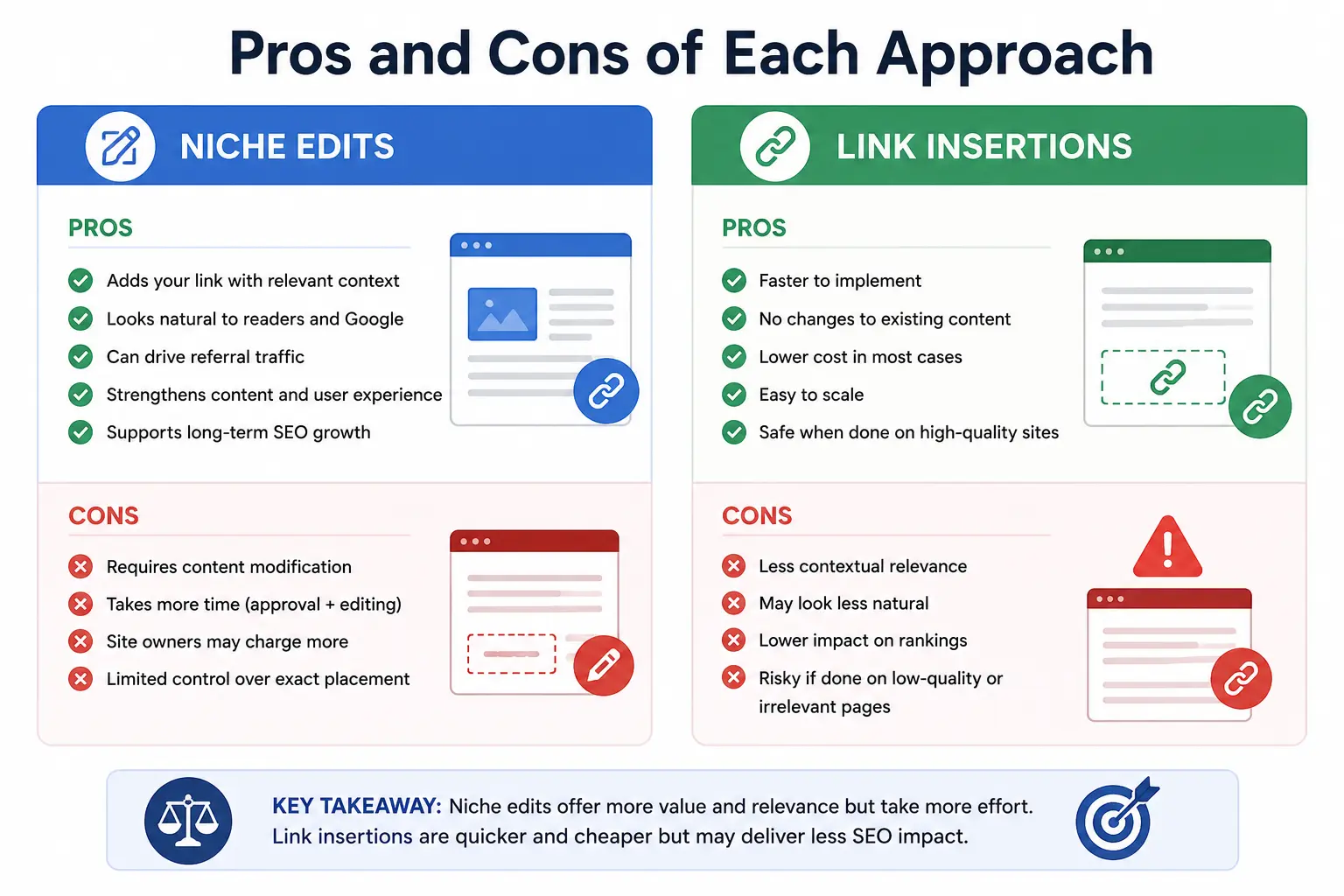
Niche Edits: Pros and Cons
Pros
- Lower cost per link, especially at volume
- Faster to execute less time spent on qualification
- Widely available through marketplaces and outreach networks
- Useful for building link volume when budget is the main constraint
Cons
- Higher risk of buying a link on a page that’s already losing rankings
- Domain Rating alone doesn’t confirm the page still passes real value
- Easier to end up with a link on a topically irrelevant page
- More exposure to the “link farm” pattern Google’s spam systems are built to catch
Link Insertions (Data-Validated): Pros and Cons
Pros
- Higher confidence the host page is actively indexed and trusted
- Relevance is checked before money changes hands, not after
- Better ranking potential, since the link inherits real, current authority
- More defensible if a client or stakeholder asks why this page?
Cons
- Takes more time per placement due to the qualification step
- Typically costs more, since vetted, high-traffic pages command higher prices
- Requires access to SERP and traffic data tools (Ahrefs, Semrush, or similar)
- Still carries the same fundamental Google spam-policy exposure as any paid placement
When to Use Which
| Your Situation | Recommended Approach |
|---|---|
| Tight budget, need volume of links quickly | Niche edits, with basic manual vetting |
| Targeting a specific page stuck on page 2 of search results | Data-validated link insertion |
| Competitive niche (finance, legal, SaaS) | Data-validated link insertion the risk of a weak link is higher in scrutinized niches |
| Early-stage site with limited existing authority | Niche edits can work, but keep volume low and pacing natural |
| Agency work where you need to justify placements to a client | Data-validated link insertion you have data to show your reasoning |
A Practical Example
Imagine a mid-size SaaS company trying to move a product comparison page from position 14 to the first page for its primary keyword.
Niche edit approach: The team buys 10 links from sites with DR 40+ in the productivity software space. Three of those pages, it turns out, have been quietly losing organic traffic for months the links pass almost no value, and one host page gets deindexed a few weeks later.
Data-validated link insertion approach: The team pulls the top 30 ranking pages across 8 related keywords, filters out pages with declining traffic or weak topical overlap, and ends up with 6 placements on pages that are actively ranking right now. Over 10 weeks, the target page moves from position 14 to position 6.
Same mechanism link inserted into existing content but very different outcomes, because the second approach filtered out the pages that looked good on paper but weren’t actually delivering value anymore.
Risk and Google’s Guidelines
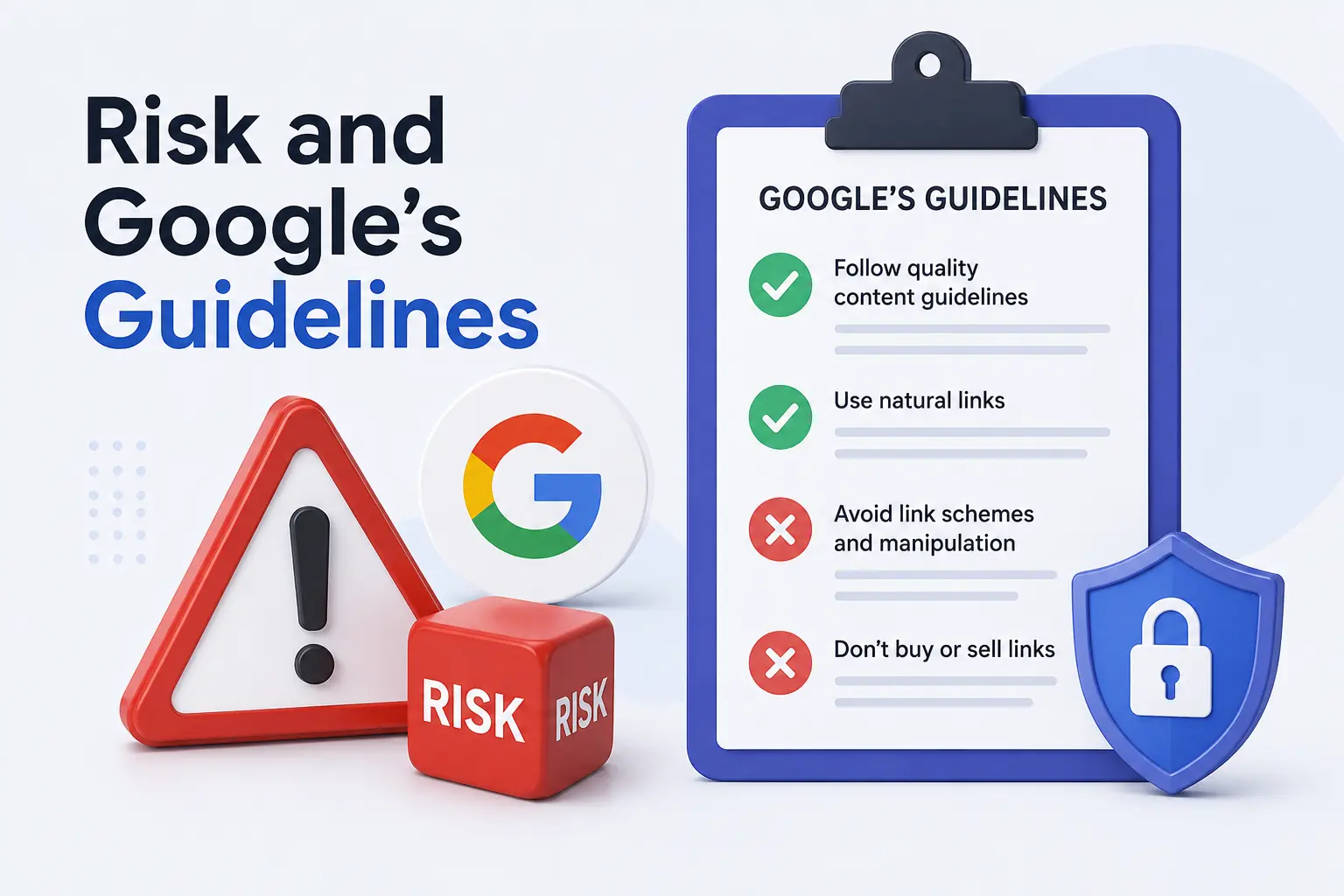
This is the part where niche edits and link insertions are identical: Google’s spam policies don’t distinguish between the two terms.
Per Google’s Search Essentials documentation, any link exchanged for money, product, or service that passes ranking credit is treated as a link scheme violation unless it carries a rel="sponsored" or rel="nofollow" attribute. That applies whether you call it a niche edit, a link insertion, or a “content contribution fee.”
Renaming the tactic doesn’t change how it’s evaluated. What actually affects your risk level is:
- Volume and pacing – a handful of well-placed links looks very different from 50 placements in a month
- Relevance – links on topically unrelated pages are far more likely to be discounted or flagged
- Anchor text diversity – repeating the same exact-match anchor across placements is one of the more detectable spam patterns
- Host page quality – thin content, excessive outbound links, or a page that reads as a link-farm vehicle increases exposure for both sides of the transaction
Vetting the page more carefully – which is really what separates a “link insertion” from a bargain-bin “niche edit” reduces this risk. It doesn’t eliminate it, because the underlying tactic is still a paid placement either way.
Common Mistakes When Choosing Between the Two
- Assuming a low price means low risk. Cheap niche edits are often cheap because they skip the vetting that would otherwise catch a declining or irrelevant page.
- Treating Domain Rating as a proxy for current value. A page can carry a strong historical DR while having lost most of its organic traffic.
- Ignoring topical relevance in favor of raw authority. A high-DR link from an unrelated niche typically does less for you than a moderate-DR link from a genuinely relevant page.
- Over-indexing on volume. A sudden spike in new links to an older page is a pattern that’s easier for automated spam detection to flag, regardless of what you call the tactic.
How to Vet a Page Before Buying Either Type of Link
Regardless of which term a vendor uses, the qualification checklist should be the same. Before agreeing to a placement, confirm:
- Organic traffic – Is the page currently receiving meaningful search traffic, not just historical peak traffic from a year or two ago?
- Traffic trend – Has traffic been stable or growing over the last 6–12 months, or is it clearly declining?
- Keyword rankings – Does the page rank in the top 20 for terms relevant to your niche right now?
- Topical relevance – Is the page’s core subject genuinely close to your target page’s topic, not just loosely adjacent?
- Index status – Is the page confirmed indexed in Google today, verified with a
site:search or Search Console rather than assumed? - Editorial quality – Is the content well-written and free of obvious link-farm patterns, such as excessive outbound links or thin, templated text?
- Internal linking – Does the site link to this page internally, which suggests it’s a genuinely maintained part of the site rather than an orphaned page kept alive to sell links?
A page that fails three or more of these checks is a weak candidate no matter how attractive its Domain Rating looks on paper. This checklist is what separates a properly vetted link insertion from a rushed niche edit bought on Domain Rating alone.
Tools Commonly Used to Tell Them Apart
Distinguishing a well-vetted link insertion opportunity from a low-quality niche edit usually comes down to having the right data in front of you before outreach:
| Tool | What it helps you verify |
|---|---|
| Ahrefs or Semrush | Current keyword rankings and organic traffic trend for the host page |
| Google Search Console | Whether the target page’s own rankings move after the link goes live |
| A spam-score checker (Moz, Semrush) | Whether the host domain shows link-farm characteristics |
| Screaming Frog | Whether the host site links to the page internally, confirming it’s actively maintained |
A manual site: search | Quick, free confirmation that the page is currently indexed |
None of these tools are exclusive to link insertions as opposed to niche edits they’re simply the difference between skipping the qualification step and doing it properly.
Frequently Asked Questions
Are niche edits and link insertions the same thing? They describe the same core mechanism adding a link to already-published content. Niche edit is the more informal, often less-vetted version; link insertion is now commonly used as the broader umbrella term, sometimes including a more rigorous, data-validated qualification process.
Which is safer, a niche edit or a link insertion? Neither is inherently safer under Google’s guidelines both are paid placements and both carry the same policy exposure. A more carefully vetted link insertion reduces the risk of buying a link on a weak or irrelevant page, but it doesn’t remove the underlying risk of paid link placement.
Is a niche edit the same as a guest post? No. A guest post involves writing new content for a publisher; a niche edit or link insertion adds a link into content that already exists.
How much does a niche edit or link insertion typically cost? Prices generally range from $50 to over $1,000 per link, depending on the host page’s traffic, relevance, and how thoroughly it’s been vetted before purchase.
What should I check before buying either type of link? Organic traffic trend, current keyword rankings, index status, topical relevance, and the site’s general editorial quality not Domain Rating alone.
“Niche edit” and “link insertion” aren’t two competing tactics they’re two names for the same idea, at different levels of rigor. If a vendor’s pitch is entirely built around Domain Rating with no mention of current traffic, rankings, or relevance, you’re likely looking at a bargain-bin niche edit regardless of what it’s called. If the process includes SERP analysis, traffic verification, and relevance scoring before outreach, you’re looking at a properly executed link insertion the more defensible version of the same tactic, and the one worth paying more for.