



What Is Techsslaash.com – And Why Are People Talking About It?
Techsslaash.com markets itself as a content-sharing platform where writers, educators, and tech enthusiasts can publish articles, earn rewards, and build an audience. On the surface, the pitch is familiar and appealing: contribute knowledge, grow your presence, and get compensated for your expertise.
But a closer look at the platform’s data, ownership structure, and user reports reveals something far more troubling than a simple startup finding its footing. This is a platform where virtually every measurable signal contradicts the image it projects.
This review examines Techsslaash.com from every angle – SEO metrics, reward transparency, content authenticity, social presence, and the technical mechanics behind its suspicious traffic numbers — to help writers and readers make an informed decision before investing their time or intellectual property.
The Traffic Numbers: Impressive on Paper, Impossible in Practice
The first thing that catches the eye when analyzing Techsslaash.com is its headline metrics. According to data from Ahrefs, the site boasts a Domain Rating (DR) of 70 a level of authority that rivals established media publications – alongside a peak of 2.7 million monthly organic visitors.
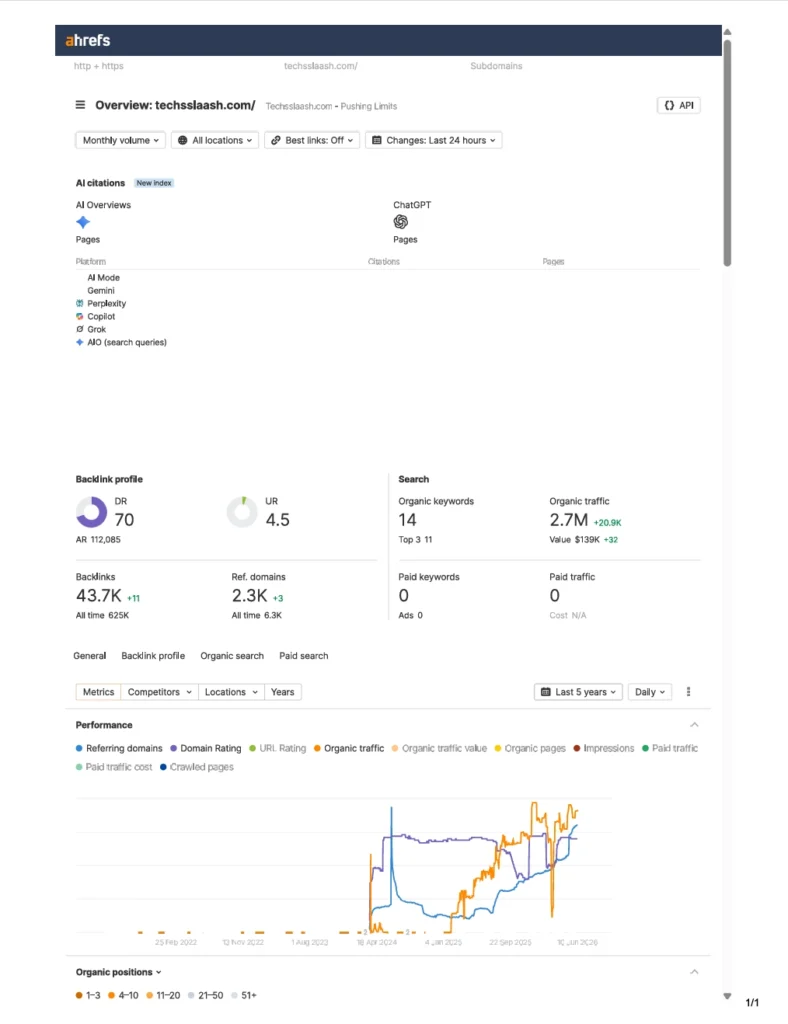
For a platform that apparently burst onto the scene in early 2024, those numbers would be remarkable. In fact, they would be unprecedented. And that is precisely the problem.
The 14-Keyword Paradox
Legitimate websites that attract millions of monthly visitors do so by ranking for tens of thousands of search queries across a wide range of topics. A cooking blog with two million visitors might rank for 40,000 different keyword variations. A tech news site pulling similar numbers might rank for 100,000 or more.
Techsslaash.com reportedly ranks for just 14 organic keywords.
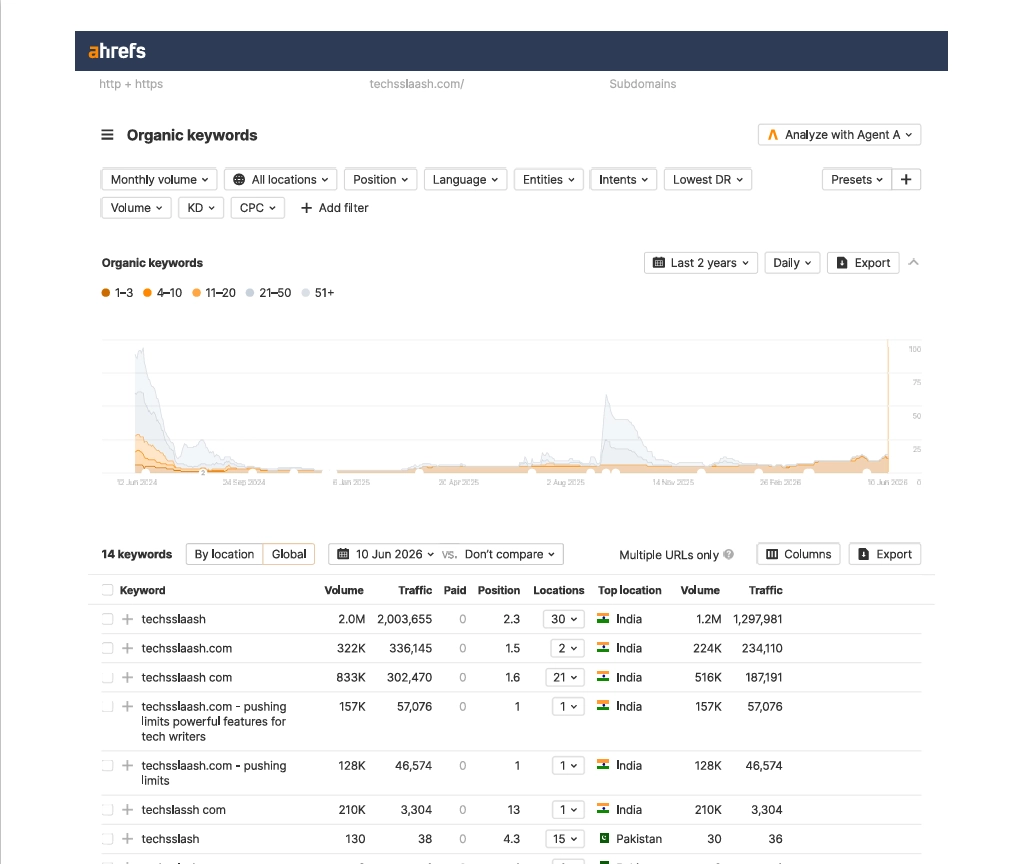
Generating 2.7 million visits from 14 search terms is not an anomaly – it is a mathematical impossibility under normal organic growth conditions. Real traffic is diverse, long-tail, and spread across hundreds or thousands of topically relevant queries. When virtually all traffic concentrates on a handful of branded terms, it signals that the visitors are not arriving through genuine search discovery.
The Hockey-Stick Graph Problem
Traffic growth for organic content platforms is typically gradual and compounding – it builds month over month as content indexes, earns backlinks, and gains topical authority. Techsslaash.com’s traffic history shows something entirely different: a sudden, near-vertical spike beginning in early 2024, consistent with purchased or redirected traffic rather than earned audience growth.
Expired Domain Abuse: The Hidden Mechanism
How does a recently registered domain achieve a Domain Rating of 70 almost overnight? The answer likely lies in a well-documented black-hat SEO tactic called expired domain abuse.
When high-authority domains expire – sites that built years of legitimate backlinks and editorial trust, they go up for sale. Bad actors purchase these domains specifically to inherit their accumulated SEO authority.
By redirecting the expired domain’s link equity to a new operation, they can make a brand-new site appear seasoned and credible to search engines. The metrics look real because the underlying domain history is real, but the current operation is entirely new.
For Techsslaash.com, this would explain how a platform with no verifiable history, no established team, and no community presence could present a DR of 70 to the world.
The Reward System: All Promise, No Proof
Central to Techsslaash.com’s pitch is the idea that contributors will be “rewarded” for the content they publish. The specifics, however, are deliberately absent.
No Defined Earning Model
Unlike Medium, which publishes detailed documentation of its Partner Program, including how reading time translates to earnings, or Substack, which clearly explains subscription-based revenue sharing, Techsslaash.com provides no equivalent transparency.
There is no FAQ explaining the reward structure. There is no documented rate per view, per article, or per engagement metric. There is no minimum payout threshold, no payment schedule, and no accepted payment method listed anywhere on the platform.
This is not an oversight. Platforms built around compensating creators invest heavily in explaining that compensation, because it is their primary recruiting tool. The absence of any such documentation suggests there is nothing substantive to explain.
What Contributors Are Actually Reporting
User reports aggregated by scam-tracking sources describe a consistent pattern: writers submit and publish content, then receive no confirmation, no payment, and in some cases, no credit. Articles appear on the site without the author’s byline or their ongoing consent. Contributors describe being unable to edit or retract their work once published.
This is not the experience of a platform experiencing growing pains. It is the experience of a platform that never intended to compensate its contributors in the first place.
Vague “Rewards” as a Recruitment Device
The deliberate ambiguity around what “rewards” means — whether cash, points, digital vouchers, or something else entirely — serves a specific function. Vague incentives attract contributors without creating any legal or financial obligation to fulfill them. It is a recruitment mechanism, not a compensation structure.
The Keyword Profile: Engineered Branding, Not Organic Discovery
A detailed look at the keyword data behind Techsslaash.com’s traffic dismantles any remaining case for organic legitimacy.
Brand-Name Traffic Dominance
Of the site’s reported 2.7 million monthly visitors, approximately 2 million arrive by searching the brand name “techsslaash” directly. This is the inverse of how successful content platforms grow. Organic platform growth means users find content through topic searches — “how to learn Python,” “best budget laptops 2024,” “beginner coding tutorials” , and then discover the platform hosting that content.
When 74% of all traffic comes from people already searching for the brand by name, it raises an obvious question: how did 2 million people come to know this brand name well enough to search for it directly, without the platform appearing in any mainstream coverage, social media, or community discourse?
Geographic Concentration and Coordinated Activity
The traffic is also geographically concentrated in a way that defies organic patterns. Over 1.2 million of the monthly visitors originate from India alone, with further significant clusters in Pakistan and Egypt. While these are large, internet-active populations, the concentration suggests a directed or incentivized traffic source — users being paid fractions of a cent to visit the site, or bot traffic originating from specific regional server clusters.
Keyword Variants and Brand Inflation
The remaining keyword traffic beyond the core brand name consists largely of repetitive variations: “techsslaash.com – pushing limits,” minor spelling variants, and navigational queries. This pattern is consistent with artificial search activity designed to inflate brand keyword rankings and signal engagement to analytics platforms, rather than genuine user interest in the content itself.
Content Quality: Scraped, Unverified, and Unattributed
If the traffic is artificial and the reward system is opaque, a natural follow-up question is: what is the platform actually doing? The answer points to an ad revenue operation built on content arbitrage.
The Content Farm Model
By aggregating large volumes of content, regardless of its quality, originality, or attribution, Techsslaash.com creates what advertisers call “inventory”: pages on which ads can be served. The platform does not need the content to be good. It does not need visitors to read it, engage with it, or return for more. It only needs pages to exist and impressions to register.
Investigative findings indicate that significant portions of the content on Techsslaash.com are scraped from legitimate sources without consent or credit. Writers find their work published under someone else’s name or no name at all. This is not an editorial failure, it is the business model.
No Moderation Infrastructure
A legitimate content platform employs editors, moderators, or at minimum automated quality filters to maintain standards. There is no evidence of any such infrastructure at Techsslaash.com. The content ecosystem appears entirely unvetted, which is consistent with a platform that exists to generate inventory rather than serve readers.
The Ghost Footprint: No Company, No Team, No Community
One of the most telling indicators of a platform’s legitimacy is its social and professional presence. Established platforms, even early-stage startups, have LinkedIn company pages, team profiles, community forums, and at least some press coverage.
LinkedIn Returns Nothing
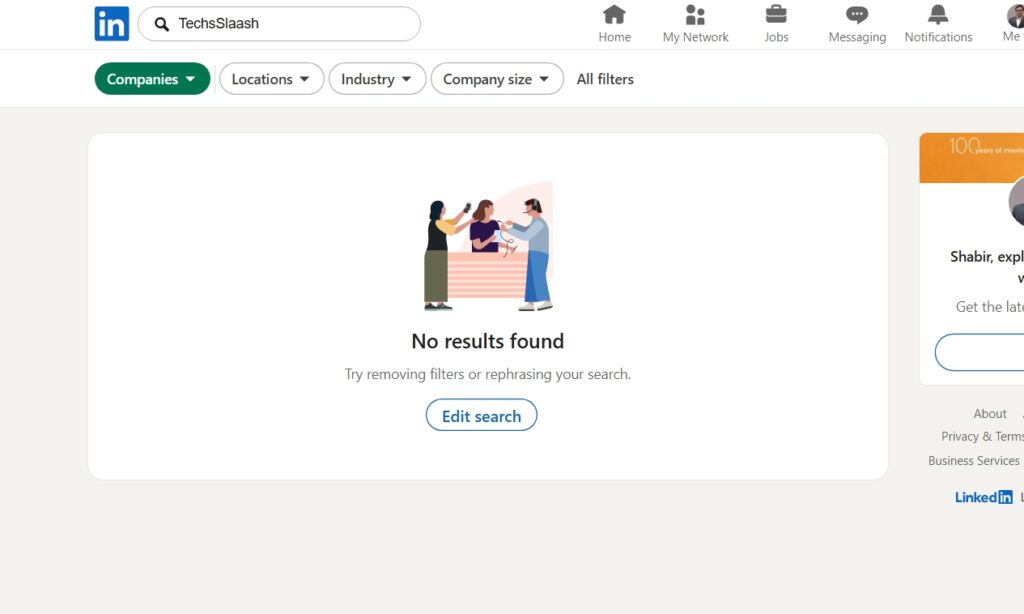
A search for “Techsslaash” as a company on LinkedIn returns no results, not a sparse page, not a recently created profile, but nothing at all. There are no listed employees, no job postings, no founders, and no executives. For a platform claiming millions of users and positioning itself as a serious knowledge-sharing ecosystem, the complete absence of any professional identity is not just unusual. It is disqualifying.
Reddit and Community Silence

Reddit, the internet’s default venue for user reviews of platforms both good and bad, yields virtually no discourse about Techsslaash.com. Platforms that attract millions of genuine visitors generate questions, reviews, complaints, tutorials, and referrals across dozens of subreddits. The silence around Techsslaash.com confirms that its visitor numbers do not represent real people having real experiences with the platform.
No Press, No Partnerships, No Industry Presence
There are no press mentions in tech media, no conference appearances, no partnership announcements, and no industry recognition of any kind. A platform of this alleged scale, 2.7 million monthly visitors and a DR of 70 would be newsworthy. The fact that no one in the technology or media industry has written about it as a success story speaks volumes.
How to Evaluate Any “Reward Platform” Before You Contribute
The Techsslaash.com case offers a practical framework for evaluating any platform that promises to compensate creators for their content.
Ask for a documented earning model. Any legitimate platform can tell you exactly how, when, and how much it pays. If the answer is vague or absent, walk away.
Check the keyword-to-traffic ratio. A site ranking for fewer than 50 keywords but claiming millions of visitors has a traffic source it is not disclosing. Use free tools like Ahrefs, Semrush, or Ubersuggest to spot-check any platform’s keyword profile before contributing.
Look for community discourse. Search Reddit, Twitter/X, and relevant forums for the platform’s name plus terms like “payment,” “review,” or “experience.” The absence of any community discussion for a supposedly large platform is a warning sign.
Verify company identity. A legitimate platform has named founders, a registered business entity, and verifiable team members. Hidden ownership — particularly through WHOIS privacy protection on a recently registered domain, should raise immediate concerns.
Do not transfer ownership of your content. Until you have verified that a platform is legitimate, avoid publishing original work that you have not retained copies of. Review the terms of service carefully for clauses that claim ownership of submitted content.
Legitimate Alternatives for Writers and Educators
For creators looking to genuinely monetize their expertise, several established platforms offer transparent compensation models and real audiences.
Medium operates a Partner Program that pays based on member reading time. Earning data is publicly documented, and the platform has a verifiable track record of payouts to hundreds of thousands of writers.
Substack enables writers to build direct newsletter subscriptions, keeping the majority of revenue generated. The platform’s business model is publicly documented, and thousands of writers earn verifiable incomes through it.
Vocal Media offers a transparent per-read payment model alongside creator challenges with documented prize structures. The platform has published payout documentation and maintains an active creator community.
Ghost is an open-source publishing platform that allows writers to own their audience and monetize through memberships, with full control over their content and revenue.
The Verdict: High Metrics, Zero Substance
Techsslaash.com represents a specific and increasingly common type of digital deception: a platform that weaponizes the language of creator empowerment while providing none of the infrastructure that empowerment requires.
Its Domain Rating of 70 was almost certainly inherited through expired domain abuse. Its 2.7 million monthly visitors almost certainly do not represent real people reading real content. Its reward system has no documented mechanism and no verified history of payment. Its content is likely scraped from legitimate writers without consent. And its complete absence of any social, professional, or community footprint confirms that the enterprise has no genuine roots in the creator economy it claims to serve.
The core lesson is one that applies far beyond this single platform: in the modern web, metrics can be manufactured. Traffic can be bought. Domain authority can be inherited. Claims can be made without evidence. The only reliable signals of legitimacy are transparency, community, and a track record that real people can verify.
Before investing your time, your writing, or your professional reputation in any platform, run the checks. The tools are free, the process takes minutes, and the alternative is contributing to a system designed to exploit the very expertise it pretends to reward.
Last updated: June 2026. Platform metrics and availability may change. Always conduct your own due diligence before publishing on any third-party platform.