

Google has become the internet’s go-to source for answers. Whether you’re checking a fact, researching a health condition, comparing products, or looking up the latest news, chances are Google is the first place you turn. But does that mean Google is always right?
The short answer is no.
While Google is one of the most advanced and reliable search engines ever created, it is not designed to determine absolute truth. Instead, Google’s algorithms rank information based on relevance, authority, and user intent.
As a result, inaccurate, outdated, misleading, or AI-generated content can sometimes appear at the top of search results.
This doesn’t mean Google is unreliable. In fact, it provides accurate information for most everyday searches. However, understanding where Google gets its information, how search rankings work, and why mistakes can happen is essential for making informed decisions online.
In this guide, you’ll learn how Google Search works, why Google can sometimes be wrong, real examples of search inaccuracies, the impact of AI-generated answers, and how to verify information before trusting it.
Is Google Always Right?
No, Google is not always right. While Google is one of the most accurate search engines available, it does not verify every piece of information on the internet.
Google ranks content based on relevance, authority, and usefulness, which means inaccurate, outdated, or misleading information can sometimes appear in search results and AI-generated answers.
Why Google Is Usually Accurate but Not Infallible
Most of the time, Google gets things right because it processes enormous volumes of data, rewards authoritative sources, and constantly refines how it evaluates quality.
When you search for something like what is the capital of France, you are going to get the right answer, fast and confidently.
But when you search for something nuanced a medical symptom, a contested political topic, a recent news event, or a complex technical question the results become far less reliable.
The web is full of outdated articles, opinion pieces dressed up as fact, SEO-optimized content designed to rank rather than inform, and in some cases, outright misinformation.
Understanding why Google sometimes gets things wrong helps you use it far more effectively. Let’s break it all down.
What People Mean When They Ask “Is Google Always Right?”
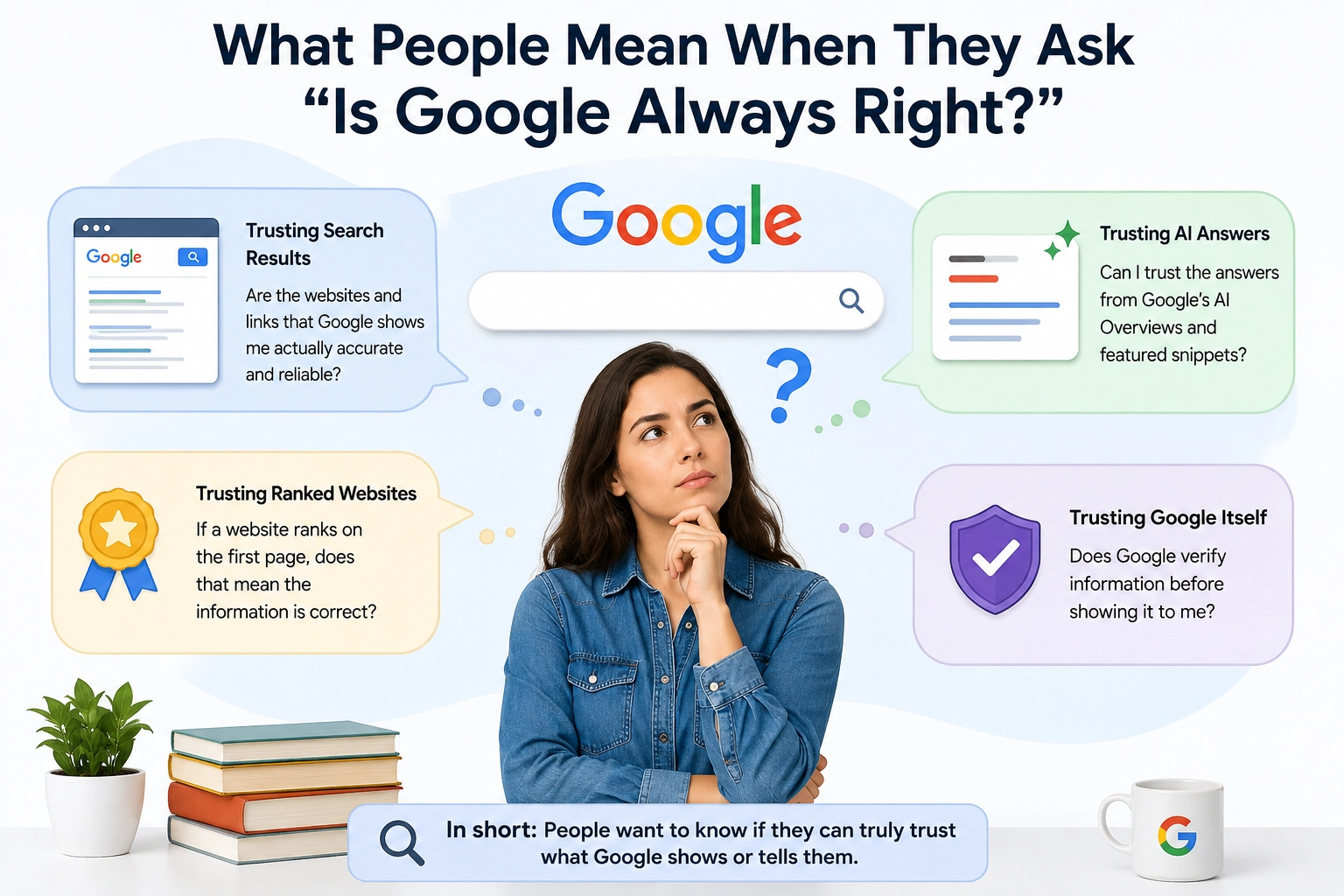
Trusting Search Results
When most people ask this question, they are really asking whether the links Google shows them can be trusted. The answer is: it depends entirely on the source.
Google surfaces the pages it believes are most relevant and authoritative for your query. It does not read those pages and certify them as factually correct.
Trusting AI Answers
With the rise of AI Overviews (formerly called Search Generative Experience), Google now offers direct AI-written summaries at the top of many search results pages.
These look like answers from Google itself, which makes people trust them more , but they introduce a whole new layer of potential error, as we will explore later.
Trusting Ranked Websites
Ranking high on Google does not mean a website is correct. It means Google’s algorithm has assessed the page as relevant, well-structured, and likely authoritative for a given search.
A well-formatted article with good backlinks can rank number one even if it contains outdated or inaccurate information.
How Google Search Actually Works
Before you can understand where Google goes wrong, it helps to understand how it works. The process has three core stages.
Crawling
Google uses automated programs called crawlers (or spiders) to browse the web constantly. These bots follow links from page to page, discovering new content and revisiting old content to check for updates.
Not every page gets crawled some are blocked intentionally by website owners, and some are simply never discovered.
Indexing
Once a page is crawled, Google processes and stores information about it in its massive index essentially a library of hundreds of billions of web pages.
The index records what the page is about, what words it contains, how it is structured, and many other signals.
Ranking
When you type a search query, Google sorts through its index and returns results ordered by how well they match your intent. The ranking algorithm weighs hundreds of factors simultaneously, but the main ones are:
Relevance
Does the page actually address what the user is searching for? Google uses natural language processing to understand the meaning behind a query, not just the literal keywords.
Authority
Is the website and page trusted? Google measures this partly through links if many high-quality websites link to a page, that is a signal it is credible and useful.
User Experience
Is the page fast, mobile-friendly, easy to read, and free of intrusive ads? Google rewards pages that provide a good experience.
Search Intent
Google tries to understand why you are searching, not just what you are searching for. A query like “best running shoes” suggests you want recommendations, not a Wikipedia article on the history of footwear.
None of these factors relevance, authority, user experience, or intent directly measure whether information is factually true.
Why Google Is Not Always Correct
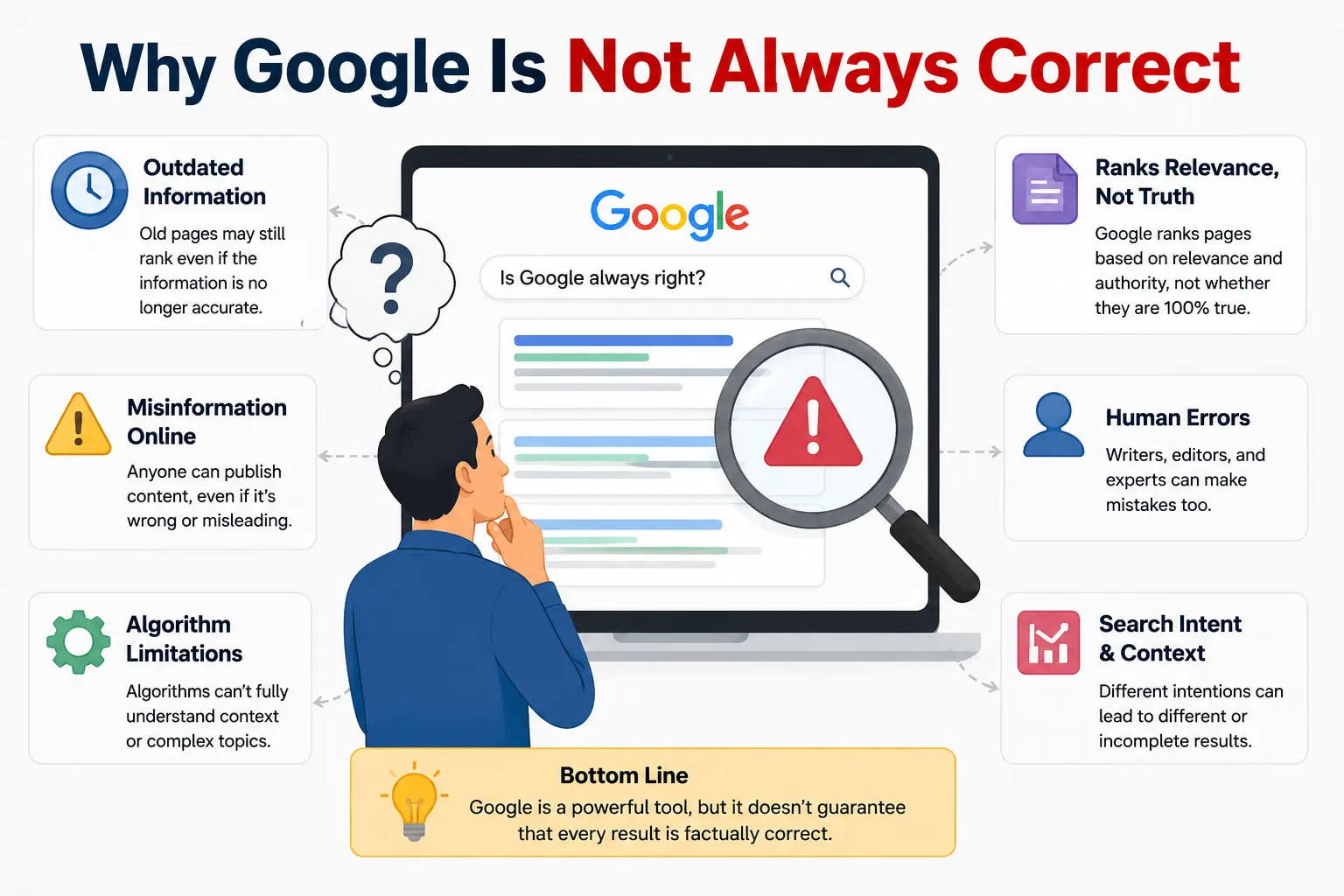
Search Engines Rank Relevance, Not Truth
This is the most important thing to understand about Google: it ranks content that matches what people are looking for, not content that has been verified as accurate.
If millions of people search for and click on an article that contains a factual error, Google’s signals could actually push that article higher because engagement metrics suggest it is satisfying user intent.
Truth and popularity are not the same thing, and Google is fundamentally a popularity-and-relevance engine.
Outdated Information
The web is full of content that was accurate when it was written but has since become outdated. Medical guidelines change. Laws are updated. Scientific understanding evolves.
Google can and does surface older pages if they have strong authority signals, even when newer, more accurate information exists elsewhere. This is particularly dangerous in areas like health, finance, and technology.
Misinformation from Websites
Anyone can publish a website. Anyone can write an article, dress it up with authoritative-sounding language, add citations to other unreliable sources, and get it indexed by Google.
Misinformation websites have become sophisticated enough to fool even experienced readers and Google’s algorithm is not immune to being fooled.
Algorithm Limitations
Google’s algorithm is extraordinarily complex, but it has blind spots. It can struggle to detect subtle forms of bias, context-dependent truths, and content that is technically accurate but deeply misleading.
Sarcasm, nuance, and satire can be misread. A page that is technically correct on one point can be deeply wrong in its overall conclusions, and Google cannot always tell the difference.
Context and Ambiguity Problems
Some questions have different answers depending on who is asking, where they live, or what they mean.
Is this medication safe? might have a very different answer for a healthy adult versus someone with a specific condition. Google presents one result for everyone, regardless of context.
Human-Created Errors
Google’s systems are built and maintained by humans. Quality raters, algorithm engineers, and content policy teams make judgment calls every day.
Those calls are not always correct, and sometimes well-intentioned systems produce unintended outcomes surfacing bad information or suppressing good information.
Real Examples of Google Getting Things Wrong
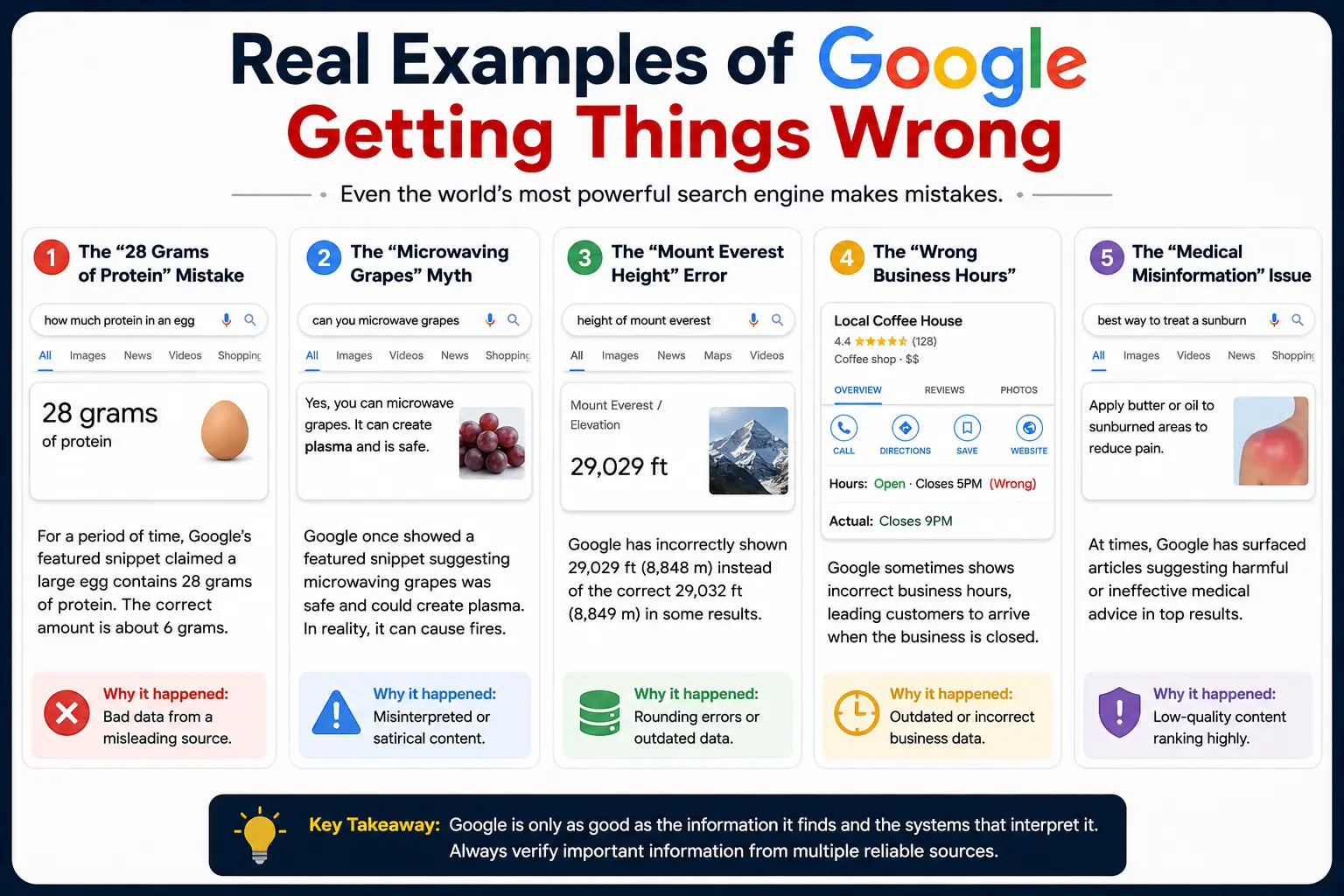
Incorrect Featured Snippets
Featured snippets are the highlighted answer boxes at the top of Google results. They are designed to give you a quick, direct answer but they have a well-documented history of getting things badly wrong.
In past incidents, Google’s featured snippets have stated that spiders are not insects when they are arachnids (correct), but have also surfaced wildly incorrect answers about historical events, scientific facts, and legal information simply because those answers appeared prominently in a highly-ranked article.
Knowledge Graph Mistakes
The Knowledge Graph is the panel that appears on the right side of Google results for entities like people, places, companies, and movies. It pulls structured data from sources like Wikipedia.
When Wikipedia is wrong or outdated, Google’s Knowledge Graph is wrong too and because it looks like an official Google answer, people rarely question it.
AI Overview Errors
When Google launched AI Overviews widely in 2024, users quickly began documenting cases where the AI-generated summaries gave dangerous or absurd advice.
One widely-shared example showed Google’s AI suggesting that users add glue to pizza to help the cheese stick, based on a joke post from Reddit. Another showed a medical-sounding answer that contradicted established health guidelines.
These were not edge cases they revealed a systemic problem with AI-generated summaries relying on unvetted sources.
For brands and publishers, this is now worth monitoring rather than just worrying about, an AI overviews tracker shows which queries trigger AI Overviews and which sources get cited in them, making it possible to see when your own content is being summarised accurately and when an Overview is drawing on something unreliable.
Viral Search Failures
Certain search queries periodically surface results that go viral because they are so obviously wrong. These moments sometimes called Google fails highlight that even the world’s most sophisticated search engine can be tripped up by unusual queries, poorly structured content, or gaps in its training data.
Medical and Health Information Errors
Health searches are among the highest-stakes queries people make, and they are also some of the most prone to error.
Google has worked hard to surface authoritative health information (partnering with institutions like the Mayo Clinic and WHO), but outdated articles, alternative medicine sites, and content that oversimplifies complex conditions still surface regularly.
Searching symptoms in particular can lead to alarming misdiagnoses a phenomenon so common it has a name: cyberchondria.
Are Google AI Overviews Always Accurate?
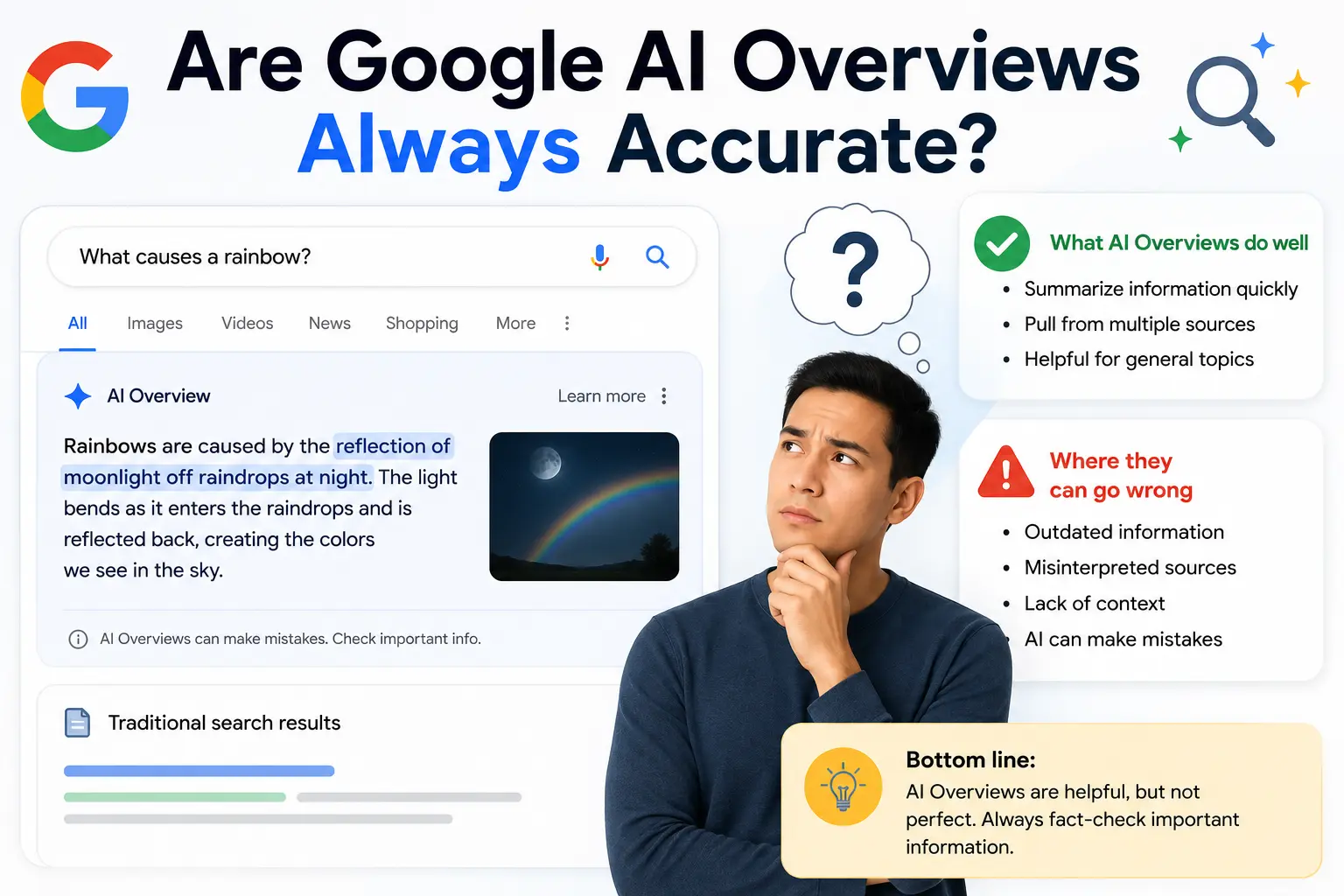
What AI Overviews Are
AI Overviews are AI-generated summaries that appear at the very top of certain Google search results pages. They are designed to give you a direct, conversational answer without having to click through to individual websites.
They represent Google’s most ambitious move yet to transform from a search engine into an answer engine.
How AI Generates Answers
Google’s AI Overviews are powered by large language models (similar to ChatGPT) that have been trained on massive amounts of text. When you search, the AI reads relevant web pages in real time and synthesizes a summary. The process is designed to be fast and helpful but it introduces significant new risks.
Common AI Mistakes
AI-generated answers can confidently present information that is partially wrong, out of context, or drawn from unreliable sources. Because the AI writes in fluent, authoritative-sounding language, users often do not realize when it has made an error.
AI does not have uncertainty built into its presentation it presents wrong answers with the same confident tone as correct ones.
Hallucinations Explained
Hallucination is the term used in AI to describe when a language model generates information that sounds plausible but is simply not true.
The model is not lying it is pattern-matching based on its training and making confident guesses that turn out to be wrong.
This can happen with names, dates, statistics, quotes, and facts. In a search context, a hallucinated AI answer can be indistinguishable from a correct one at a glance.
When AI Answers Should Not Be Trusted
You should be especially cautious about AI Overviews when searching for medical symptoms or drug interactions, legal advice specific to your situation, recent news and current events, precise statistics or numerical data, and highly technical or specialized topics. In these areas, always click through to primary sources rather than relying on the AI summary alone.
Does Google Fact-Check Information?
What Google Verifies
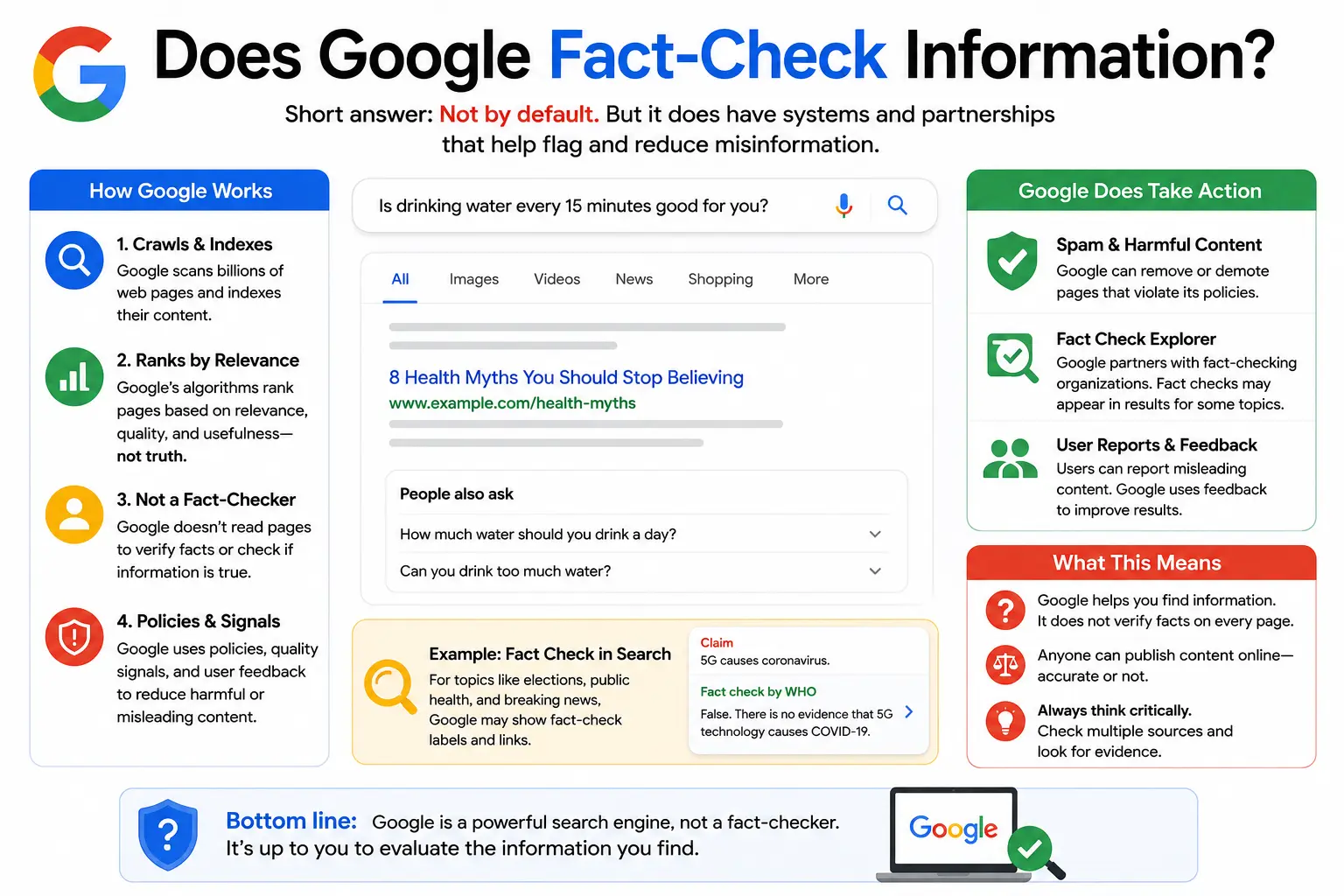
Google does verify certain types of information. It uses structured data and partnerships with authoritative institutions to ensure things like current weather, sports scores, flight statuses, and basic factual queries (capitals of countries, famous dates) return reliable answers. For these types of queries, Google is highly accurate because it is pulling from structured, verified data feeds.
What Google Does Not Verify
Google does not fact-check the articles, blog posts, opinion pieces, and informational pages in its search index. It evaluates them based on signals like links, engagement, and page quality not by reading them and confirming their accuracy.
If an article claims that a certain vitamin cures cancer, Google does not have a team of scientists reviewing that claim before deciding whether to rank the article.
Google’s Search Quality Systems
Google does employ thousands of human quality raters who use detailed guidelines to assess search results. These raters do not directly change rankings, but their assessments inform how the algorithm is trained over time.
Google also uses its E-E-A-T framework (Experience, Expertise, Authoritativeness, Trustworthiness) to evaluate whether sources seem credible. These systems help but they are not infallible, and they operate at scale across billions of queries and trillions of pages.
Google Doesn’t Decide What Is True
A common misconception is that Google determines what is true and false. In reality, Google is designed to organize information, not act as the ultimate judge of truth.
Google evaluates:
- Relevance
- Authority
- User experience
- Search intent
- Content quality
Google does not directly evaluate:
- Absolute truth
- Scientific certainty
- Personal circumstances
- Universal agreement
As a result, highly ranked content may sometimes contain outdated, incomplete, or inaccurate information. This is why users should evaluate sources critically rather than assuming that a top-ranking result is automatically correct.
Can Websites Manipulate Google Rankings?
SEO vs Manipulation
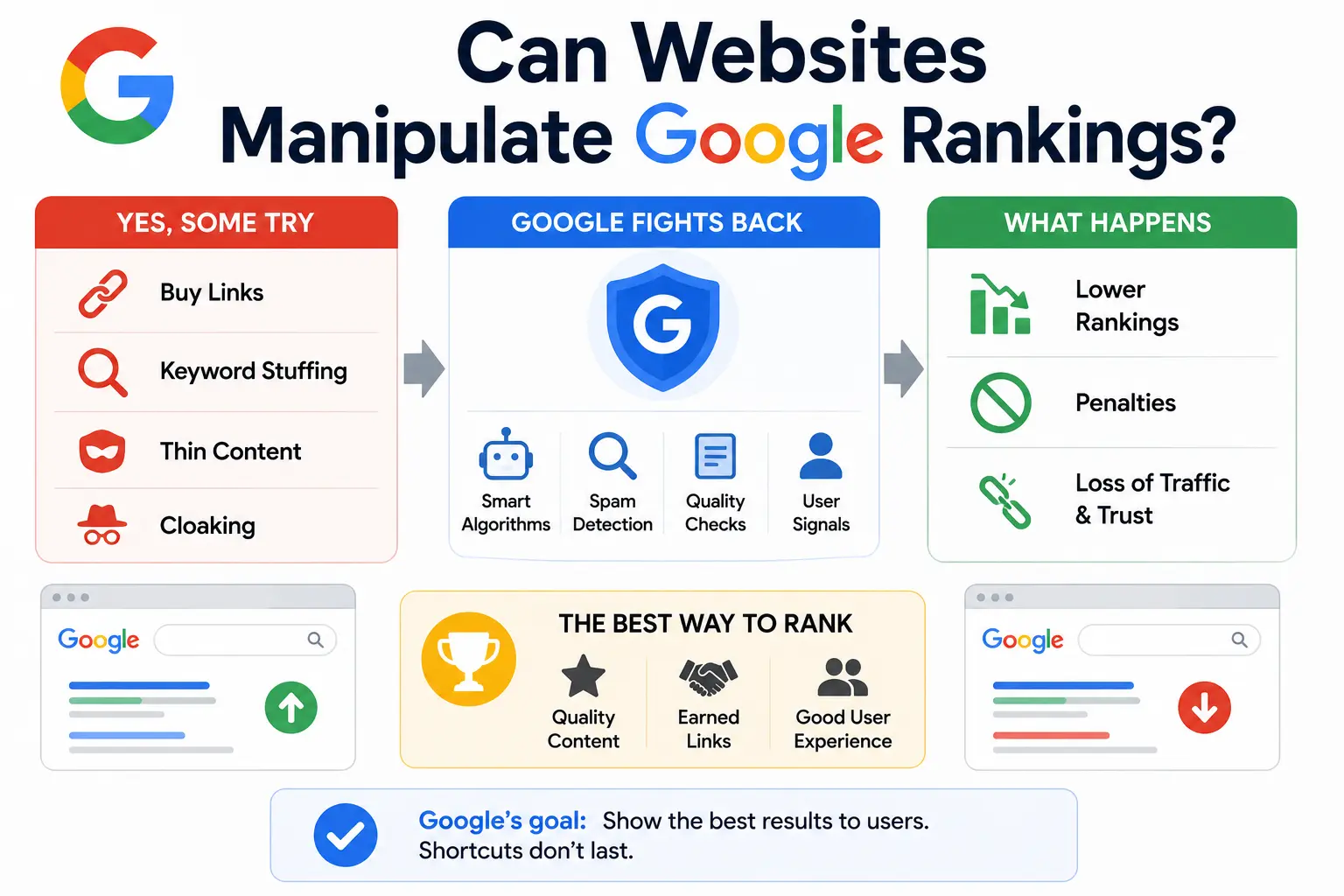
Search Engine Optimization (SEO) is the legitimate practice of making websites easier for Google to understand and more likely to rank well. Good SEO includes writing clearly, structuring content logically, earning links from reputable sites, and ensuring fast load times. There is nothing inherently deceptive about this.
Manipulation, however, is a different matter.
Spam Techniques
Some website owners try to game Google’s algorithm using techniques Google explicitly prohibits buying links in bulk, stuffing pages with keywords, creating thin content at massive scale, cloaking (showing Google different content than what users see), and more. Google continuously works to detect and penalize these tactics, but the arms race between spammers and Google’s systems is ongoing.
Algorithm Exploitation
Even legitimate SEO, taken to an extreme, can produce content that ranks well but serves readers poorly. A long, well-formatted article with strong keywords and good backlinks can outrank a shorter, more accurate piece not because it is better, but because it ticks more algorithmic boxes. This is one reason why the top result on Google is not always the most correct result.
Why Ranking #1 Doesn’t Mean Correct
Google’s ranking signals are proxies for quality they correlate with trustworthiness, but they do not guarantee it. A piece of content can be thoroughly optimized, link-rich, and beautifully structured while still containing significant inaccuracies. Always evaluate the content itself, not just its position in the results.
Google vs Other Ways to Find Information
Google vs Bing
Bing, Microsoft’s search engine, works on similar principles to Google crawling, indexing, and ranking based on relevance and authority signals.
Bing has grown more capable with the integration of AI-powered search through Copilot. For most queries, the results are comparable, though Google’s index is larger and its AI systems are more refined. Neither is definitively more accurate, but Google tends to have broader coverage.
Google vs ChatGPT
ChatGPT and similar AI chatbots do not search the web in real time (unless explicitly connected to a browsing tool). Instead, they generate answers from their training data, which has a knowledge cutoff date.
This means ChatGPT can be confidently wrong about recent events and may hallucinate facts even on timeless topics. Google, by contrast, surfaces current web content which means it can be wrong in different ways, but it can also point you to primary sources. Neither is a reliable sole source.
As more searches shift to AI chatbots, GEO is emerging as the discipline for making sure your content actually gets cited in those AI-generated answers, not just ranked in traditional search.
Google vs Perplexity
Perplexity is an AI-powered search engine that combines real-time web search with AI summarization and provides citations for its answers.
This approach makes it easier to verify information than a standard AI chatbot, because you can see exactly which sources the AI drew from. Perplexity can still hallucinate or misrepresent sources, but the transparency of citation makes it somewhat more verifiable than Google’s AI Overviews in their current form.
Google vs Academic Sources
For research that demands accuracy medical decisions, legal questions, scientific understanding, historical facts academic sources like Google Scholar, PubMed, or university library databases are substantially more reliable than standard Google search.
These sources have been peer-reviewed, meaning other experts have evaluated the work for accuracy before publication. For high-stakes questions, always try to trace information back to a primary academic or official source.
How to Verify Information You Find on Google
Check Source Authority
Ask yourself: who published this? Is it a recognized institution, a credentialed expert, or an established news organization? Or is it an anonymous blog, a website with no clear authorship, or a domain that was created recently? Authority is not a guarantee of accuracy, but it raises the probability of reliable information.
Cross-Reference Multiple Sources
If something is true, multiple credible and independent sources should agree on it. Search for the same claim across different websites and different search queries.
If only one or two sources support a claim and others contradict it, treat that claim with skepticism.
Evaluate Author Expertise
Look for a byline. Does the author have relevant credentials, professional experience, or a track record of accurate writing on this topic?
Many inaccurate articles online are written by generalist content writers who have no specialized knowledge in the subject they are covering.
Check Publication Dates
Information can become outdated quickly, especially in fields like medicine, technology, finance, and law. Always check when an article was published and when it was last updated.
A 2017 article about AI capabilities is not going to reflect the current state of the field.
Use Fact-Checking Websites
Dedicated fact-checking organizations like Snopes, FactCheck.org, PolitiFact, and the AP Fact Check team spend their time investigating specific claims that circulate widely online.
If you encounter something surprising or suspicious, search for it on these platforms before accepting it as true.
Signs You Should Not Fully Trust a Google Result
Lack of Citations
Credible informational content cites its sources. If an article makes factual claims especially about health, science, law, or history without linking to or naming any primary sources, that is a warning sign.
Anonymous Authors
Trustworthy content is almost always attributed to a named author or organization. Anonymous content is harder to evaluate for expertise or accountability.
Sensational Headlines
Headlines designed to provoke strong emotions outrage, fear, disbelief are often engineered to generate clicks, not to accurately represent the content or the facts.
Treat sensational framing as a reason to read more carefully, not a reason to share immediately.
Contradictory Sources
If multiple credible sources disagree with the claim in the result you are reading, that disagreement deserves serious attention.
The outlier might be right but it might also be wrong. Consensus among credible sources is a meaningful signal.
Unverified Claims
Any specific statistic, quote, or data point that cannot be traced back to an original, verifiable source should be treated with skepticism.
Made-up or misrepresented statistics circulate constantly online, sometimes for decades after being debunked.
Why Google Is Still One of the Most Reliable Search Engines
Search Quality Improvements
Despite its limitations, Google has invested massively in improving search quality over the decades. Algorithm updates like Panda, Penguin, Hummingbird, BERT, and the Helpful Content Update have each been aimed at surfacing genuinely useful, accurate, well-crafted content over low-quality, manipulative, or thin pages.
These updates have made Google substantially better than it was ten years ago.
E-E-A-T Principles
Google’s E-E-A-T framework which stands for Experience, Expertise, Authoritativeness, and Trustworthiness represents one of the most sophisticated public frameworks any search engine has developed for evaluating content quality.
It signals that Google is trying to reward content written by people with genuine knowledge and accountability, not just content that has been technically optimized.
Continuous Algorithm Updates
Google releases thousands of algorithm updates every year, many of them small tweaks, some of them major shifts.
This continuous improvement means that Google’s quality is a moving target and the general direction of that movement has been toward better, more reliable results over time.
Large-Scale Information Processing
Google processes more than eight billion searches per day. The scale of this operation, and the feedback signals it generates, allows Google to identify patterns, detect manipulation, and refine its understanding of what users actually find useful in ways that smaller search engines simply cannot match.
Frequently Asked Questions
Is Google ever wrong?
Yes, Google can and does surface inaccurate information. This happens most often when the web pages it ranks contain errors, when content is outdated, when AI-generated summaries misrepresent sources, or when low-quality content has been optimized to appear credible. Google’s ranking signals are proxies for quality, not guarantees of accuracy.
Can Google AI hallucinate?
Yes. Google’s AI Overviews are powered by large language models, and like all such models, they can generate confident-sounding information that is simply not true.
This phenomenon called hallucination has been documented in Google’s AI Overviews since their launch, particularly in areas where the AI draws on low-quality or satirical web sources.
Does Google verify every website?
No. Google does not verify the factual accuracy of individual web pages before indexing or ranking them. It evaluates pages based on technical quality signals, authority indicators, and relevance not by confirming the truth of the content.
Why do Google answers differ from ChatGPT?
Google surfaces real-time web content from its index, while ChatGPT generates answers from its training data (which has a cutoff date). They can differ because they are drawing on different sources of information, processed in different ways. Neither should be treated as a definitive source without verification.
Should I trust the first search result?
Ranking first is a strong signal of relevance and perceived authority but it is not a guarantee of accuracy. Evaluate the source and content independently, regardless of its position in the results.
How accurate are AI Overviews?
AI Overviews are often accurate for well-established facts and general knowledge, but they have demonstrated significant errors in cases involving recent events, nuanced topics, medical information, and queries that lead the AI to draw on unreliable sources. They should be treated as a starting point, not an endpoint.
What should I do when Google gives conflicting answers?
When Google returns conflicting results, that is usually a sign that the topic is genuinely contested, that information has changed over time, or that some sources are unreliable. Cross-reference with primary sources, look for academic or institutional authority, and use fact-checking tools to navigate the disagreement.
Is Google Always Right?
The Balanced Answer
Google is one of the most sophisticated information retrieval systems ever built. It is right far more often than it is wrong, and it is constantly improving. But it is not infallible. It ranks relevance, not truth. It surfaces content from the web, including all the errors, biases, outdated information, and manipulated content the web contains.
The introduction of AI-generated answers adds a new dimension of risk not just surfacing bad content, but synthesizing it into confident-sounding summaries that are harder to question.
When You Should Trust Google
You can generally trust Google for well-established factual queries capitals of countries, historical dates, unit conversions, sports scores, weather forecasts, and other structured data. You can also trust it to point you toward authoritative sources when you evaluate those sources critically.
When You Should Verify Information Yourself
Always verify independently when the stakes are high. If you are making a medical decision, a legal choice, a financial investment, or a significant life choice based on information you found through Google, trace that information back to a primary, authoritative source before acting on it. Use Google as the beginning of your research, not the end of it.
The most powerful version of Google is the one you use with a critical eye treating its results as leads to follow up, not verdicts to accept.