

imagine ordering a carton of milk, a phone charger, or a pack of medicines and having them at your doorstep in under 30 minutes. No waiting for next-day delivery. No trip to the store. Just instant gratification.
That is exactly what quick commerce promises and delivers.
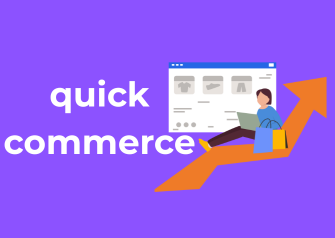
Quick commerce (also called Q-commerce) is one of the fastest-growing segments in the global retail industry. It is fundamentally changing the way consumers shop and the way businesses operate. From India’s Blinkit and Zepto to Turkey’s Getir, quick commerce platforms are racing to make ultra-fast delivery the new normal.
In this complete guide, you will learn everything about quick commerce what it is, how it works, who the major players are, what the challenges are, and where the industry is heading in 2026 and beyond.
Whether you are a business owner, investor, marketer, or simply a curious consumer, this guide will give you a thorough understanding of one of the most exciting revolutions in modern retail.
What Is Quick Commerce?
Quick Commerce Definition
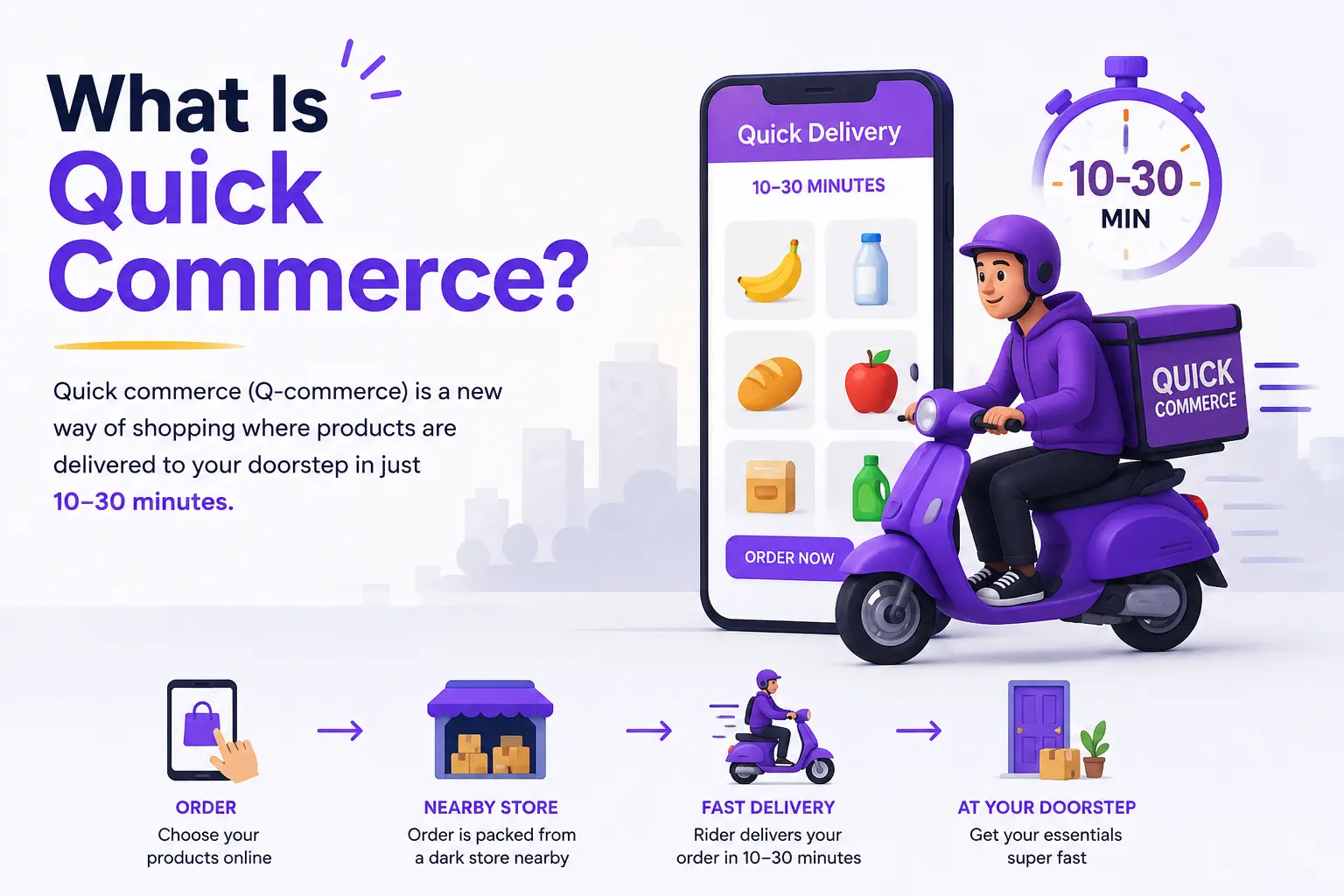
Quick commerce (Q-commerce) is a retail fulfilment model that focuses on delivering products to customers in an extremely short time typically between 10 and 30 minutes from the moment an order is placed.
Unlike traditional e-commerce, which may take one to seven days for delivery, quick commerce is built around the idea of instant need fulfilment. It primarily targets everyday essentials such as groceries, snacks, beverages, medicines, personal care products, and household items products people need right now, not tomorrow.
Quick commerce operates through a network of dark stores (small, hyperlocal warehouses) positioned close to high-demand residential areas, allowing delivery partners to reach customers in minutes.
In simple terms: Quick commerce = right product + right location + right now.
Why Quick Commerce Is Growing So Fast
Quick commerce is not just a trend it is a structural shift in consumer behaviour driven by several powerful forces:
1. The Demand for Instant Gratification
Today’s consumers are accustomed to instant results instant streaming, instant messaging, instant food delivery. Quick commerce extends this expectation to everyday shopping. When someone runs out of cooking oil mid-meal, they do not want to wait a day. They want it in 20 minutes.
2. Rapid Urbanisation
Cities are growing denser. Urban populations are time-poor and convenience-first. Quick commerce thrives in densely populated urban centres where dark stores can cover large customer bases within a short radius.
3. Smartphone and App Adoption
With affordable smartphones and widespread internet access especially in markets like India ordering through an app has become second nature. Quick commerce platforms have built frictionless mobile experiences that make ordering in under a minute possible.
4. Post-Pandemic Behavioural Shifts
The COVID-19 pandemic accelerated the adoption of online grocery shopping by several years. Consumers who shifted to online grocery buying during lockdowns have largely maintained those habits, creating a permanent and growing demand base for quick commerce.
5. Convenience as a Core Value
Modern consumers especially Millennials and Gen Z actively choose brands that save them time. Convenience is no longer a luxury; it is a baseline expectation.
How Does Quick Commerce Work?
Quick commerce is not just fast delivery slapped onto a regular supermarket model. It requires a fundamentally different operational infrastructure. Here is how it works end to end:
Dark Stores and Micro Fulfilment Centers
The backbone of any quick commerce operation is the dark store a small, compact retail fulfilment centre that is not open to the public.
Unlike a traditional supermarket or warehouse, a dark store is strategically located inside or near residential neighbourhoods. It stocks a curated inventory of 1,500 to 5,000 SKUs (Stock Keeping Units) the most frequently ordered items in that particular area.
Key features of dark stores:
- Compact in size (typically 1,000 to 3,000 sq ft)
- Stocked based on local demand data and AI-driven forecasting
- Designed for speed items are arranged for fast picking, not for customer browsing
- Operate 24/7 in many markets
- Multiple dark stores are placed across a city to ensure maximum coverage
Micro fulfilment centres (MFCs) are a more advanced version of dark stores, sometimes incorporating automated picking systems and robotics to speed up order processing even further.
Hyperlocal Delivery Networks
Once an order is placed, the clock starts ticking. Quick commerce companies rely on hyperlocal delivery networks a fleet of delivery riders (on bikes, scooters, or bicycles) who are stationed at or near dark stores.
How the delivery process works:
- Customer places an order via the app
- The order is instantly routed to the nearest dark store
- A store picker assembles the items (usually in under 3–5 minutes)
- A delivery rider picks up the packed order
- The rider delivers to the customer typically within a 1–3 km radius
Route optimisation software ensures riders take the fastest possible path, while real-time tracking keeps customers informed about exactly where their order is.
Technology Behind Quick Commerce
Quick commerce is a technology-first business. Without sophisticated tech infrastructure, delivering in 30 minutes at scale is impossible. Here is the technology that powers it:
AI-Driven Inventory Management
AI systems analyse historical order data, time of day, local events, weather patterns, and seasonal trends to predict what products will be in demand at each dark store and when. This prevents stock-outs and reduces wastage.
Demand Forecasting
Machine learning models continuously update stock replenishment decisions. If a cricket match is on and beer is trending, the system adjusts inventory proactively.
Delivery Management Systems (DMS)
These platforms manage the entire last-mile operation assigning orders to riders, optimising routes in real time, tracking deliveries, and managing rider performance.
App and UX Technology
The customer-facing app is engineered for speed and simplicity. One-tap reordering, personalised homepages, and instant checkout are all designed to minimise friction.
Quick Commerce vs Traditional E-Commerce
Many people confuse quick commerce with regular e-commerce. While both involve online ordering, they are fundamentally different in almost every way.
| Feature | Quick Commerce | Traditional E-Commerce |
|---|---|---|
| Delivery Time | 10–30 Minutes | 1–7 Days |
| Product Range | Limited (1,500–5,000 SKUs) | Extensive (millions of SKUs) |
| Order Value | Typically Smaller (₹200–₹800) | Typically Larger (₹500–₹50,000+) |
| Customer Need | Immediate / Unplanned | Planned / Considered |
| Fulfilment Model | Local Dark Stores | Large Centralised Warehouses |
| Delivery Radius | 1–3 km | City-wide, National, or Global |
| Primary Categories | Groceries, FMCG, Medicines | All product categories |
| Customer Mindset | “I need this right now” | “I want to get the best deal” |
Key Differences Explained
Speed vs Selection: Quick commerce sacrifices breadth of selection in exchange for extreme delivery speed. A quick commerce platform might stock 3,000 items; Amazon stocks hundreds of millions.
Planned vs Impulse: Traditional e-commerce is mostly planned you decide you need a new pair of shoes and order them. Quick commerce serves impulse and emergency needs you just ran out of bread.
Infrastructure: Traditional e-commerce runs from large, centralised fulfilment centres that serve entire cities or regions. Quick commerce requires many small dark stores distributed across a city.
Benefits of Quick Commerce
Faster Delivery
The most obvious benefit is speed. Getting groceries, medicines, or essentials in under 30 minutes is a game-changer for consumers. Emergency situations a sick child needing medicine, a dinner party running short of ingredients are resolved instantly.
Better Customer Convenience
Quick commerce eliminates the need to plan shopping in advance. Consumers can live more spontaneously, knowing that everyday necessities are just a few taps away at any time of day or night. This is especially valuable for working professionals, parents, and elderly individuals.
Increased Customer Loyalty
When a platform consistently delivers quickly and reliably, customers develop strong loyalty. The convenience becomes habit-forming. Research consistently shows that delivery speed is one of the top factors influencing repeat purchase behaviour in grocery and FMCG categories.
Higher Purchase Frequency
Because quick commerce is designed for top-up shopping rather than bulk buying, customers tend to order more frequently. Instead of a weekly grocery run, a household might place three to four quick commerce orders per week for immediate needs.
Improved User Experience
The best quick commerce apps are designed to be delightfully simple. Reordering favourites in one tap, accurate delivery ETAs, and real-time tracking all contribute to an experience that feels effortless something traditional retail struggles to match.
Challenges of Quick Commerce
Quick commerce is exciting, but it is not without significant challenges. These are the major hurdles the industry continues to grapple with:
High Operational Costs
Running a network of dark stores across a city with rent, staff, inventory, utilities, and technology is expensive. Add in the cost of maintaining a hyperlocal delivery fleet, and the unit economics can be brutal, especially in the early growth phase.
Profitability Concerns
Many quick commerce companies have historically operated at a loss, subsidising deliveries and offering heavy discounts to acquire and retain customers. Achieving profitability requires reaching sufficient order density in each zone — enough orders per dark store per day to make the fixed costs worthwhile.
Inventory Management Issues
Because dark stores stock a limited range of products for a specific local area, inventory decisions are high-stakes. Stocking the wrong items leads to wastage; stocking too little leads to stock-outs and customer disappointment. Managing this across dozens or hundreds of dark stores simultaneously is a complex ongoing challenge.
Delivery Logistics Challenges
Maintaining a fleet of riders who can deliver reliably in 10–30 minutes in all weather conditions, at all hours, across different city zones is operationally demanding. Rider availability during peak hours, traffic congestion, and bad weather all affect delivery times and customer satisfaction.
Competition and Price Wars
The quick commerce market is intensely competitive. In India, Blinkit, Zepto, Swiggy Instamart, and BB Now compete aggressively for the same customers. This competition drives prices down and increases customer acquisition costs, further squeezing margins.
Popular Quick Commerce Business Models
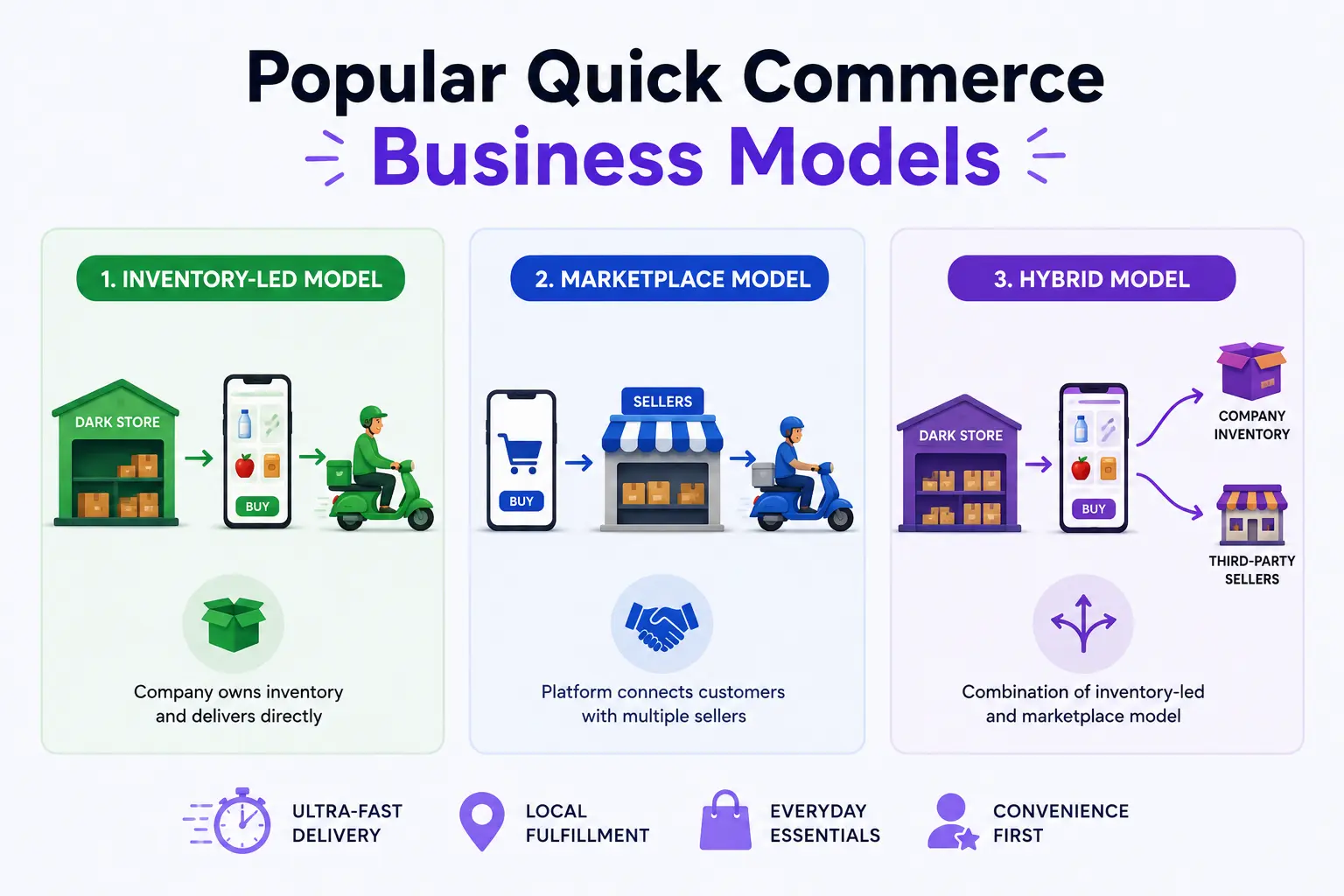
Inventory-Led Model
In the inventory-led model, the quick commerce company owns or leases the inventory itself. It purchases products from brands or distributors, stores them in its own dark stores, and fulfils orders directly.
Advantages: Full control over product quality, pricing, and availability. Consistent customer experience.
Disadvantages: High capital requirements. Risk of inventory wastage, especially for perishables.
Examples: Blinkit, Zepto
Marketplace Model
In the marketplace model, the platform connects customers with local retailers, kirana stores, or supermarkets rather than stocking inventory itself. The platform facilitates the transaction; the local store handles inventory and sometimes fulfilment.
Advantages: Asset-light. Scalable without heavy capital investment. Supports local businesses.
Disadvantages: Less control over availability, quality, and delivery times. Inconsistent experience.
Examples: Dunzo (historically), some aspects of Swiggy Instamart
Hybrid Model
The hybrid model combines elements of both inventory-led and marketplace approaches. The platform operates its own dark stores for high-velocity products while also partnering with local retailers for a broader range of items.
Advantages: Balances speed and selection. Reduces capital risk while maintaining quality for core products.
Disadvantages: Operationally complex. Requires managing two different supply chains simultaneously.
Examples: Amazon Fresh, BigBasket Now
Top Quick Commerce Companies
Blinkit (India)
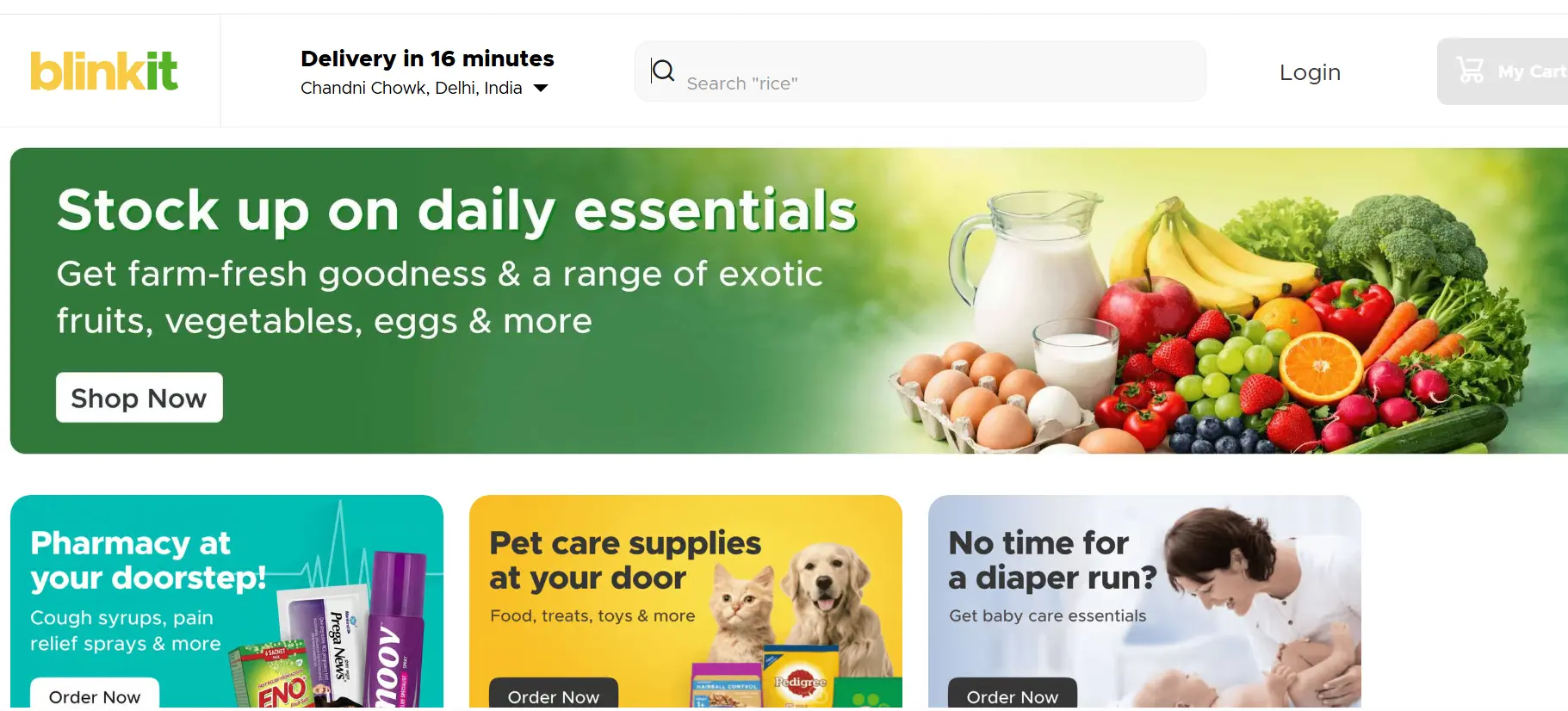
Formerly known as Grofers, Blinkit is India’s leading quick commerce platform, acquired by Zomato in 2022. Blinkit operates a large network of dark stores across major Indian cities and promises delivery in under 10 minutes for most orders. It has expanded beyond groceries to include electronics, beauty products, clothing, and more. As of 2025, Blinkit has become a key growth driver for the Zomato group.
Zepto (India)
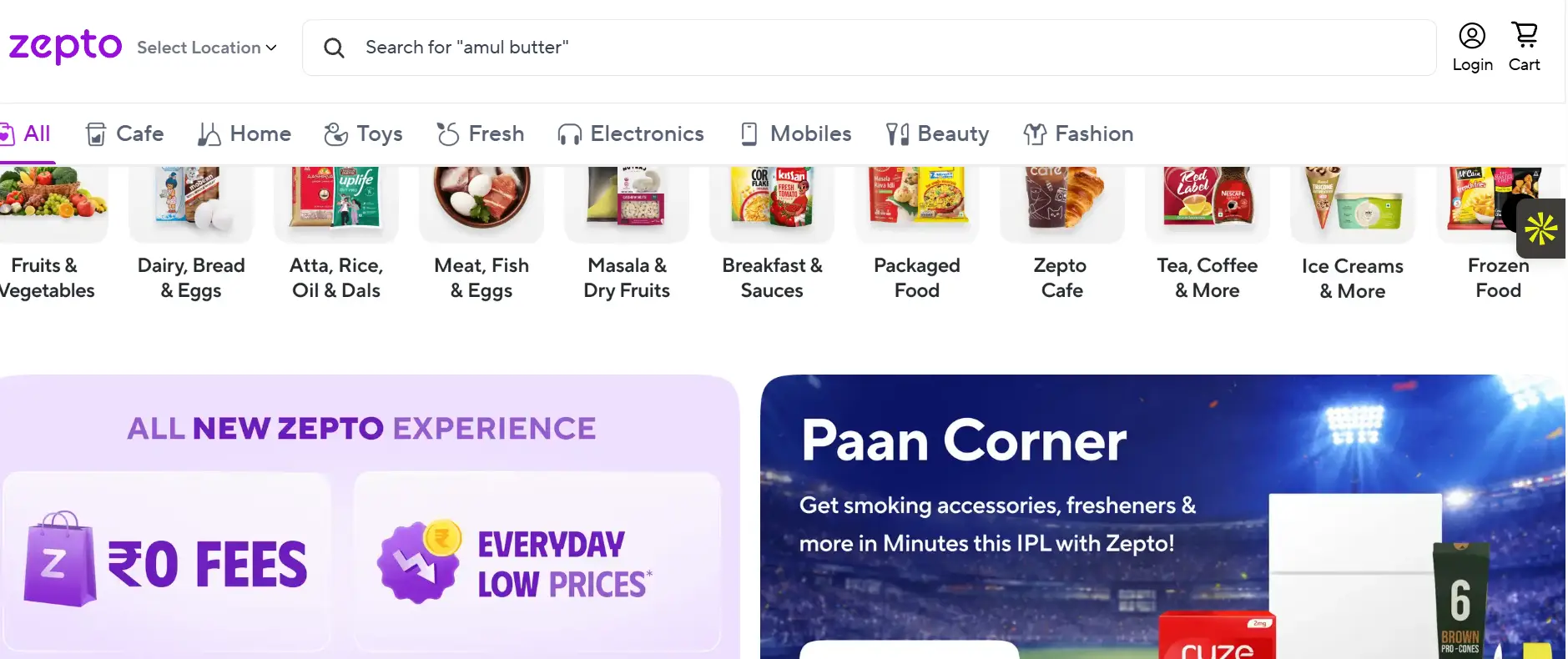
Zepto was founded in 2021 by two Stanford dropouts and quickly became one of the most-talked-about quick commerce startups in India. Known for its 10-minute delivery promise, Zepto operates an extensive dark store network and has raised significant funding to fuel rapid expansion.
As startups like this scale and issue equity to employees, 409A valuation companies become part of the annual compliance routine, appraising shares to keep stock options fairly priced. It is widely regarded as one of the most operationally efficient quick commerce platforms in India.
Swiggy Instamart (India)
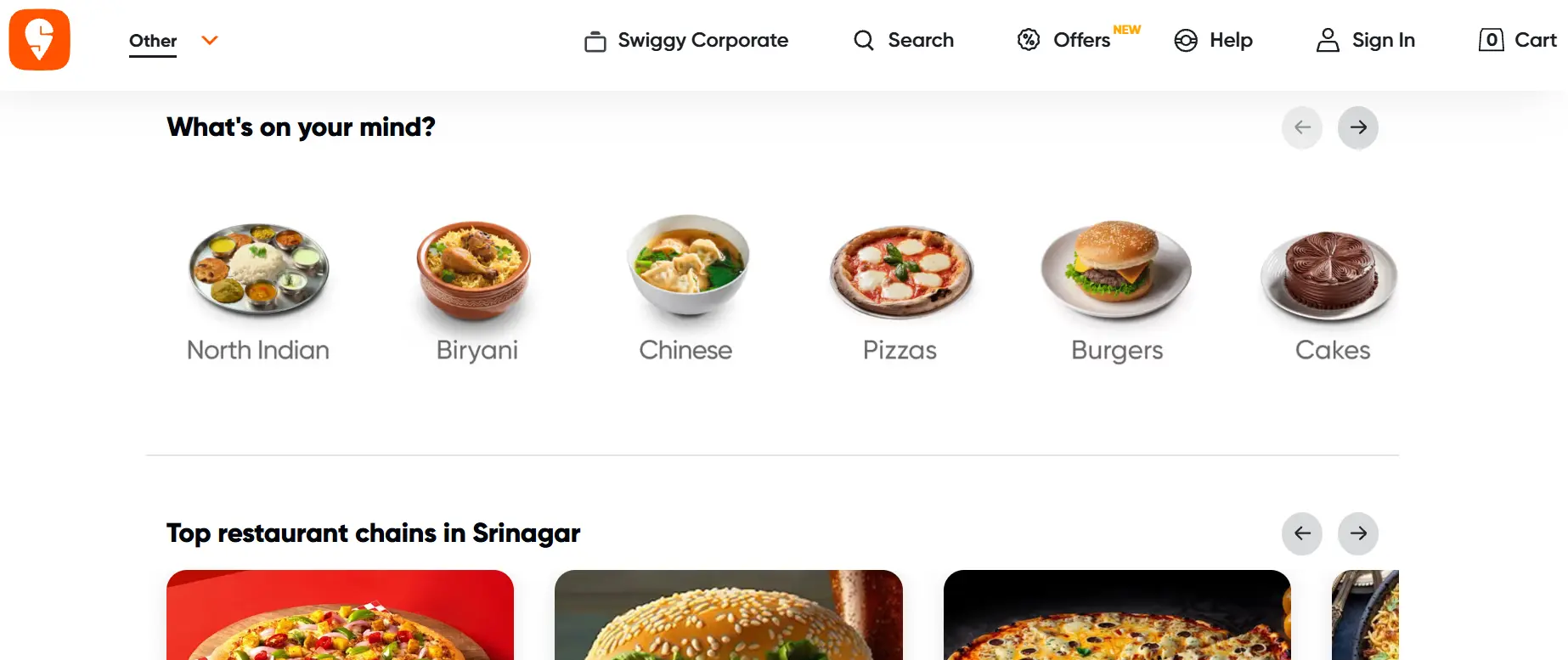
Swiggy Instamart is the quick commerce arm of Swiggy, one of India’s largest food delivery platforms. By leveraging Swiggy’s existing delivery infrastructure and brand recognition, Instamart scaled rapidly and now competes directly with Blinkit and Zepto across major Indian cities. It delivers groceries and daily essentials in 10–30 minutes.
BB Now (India)
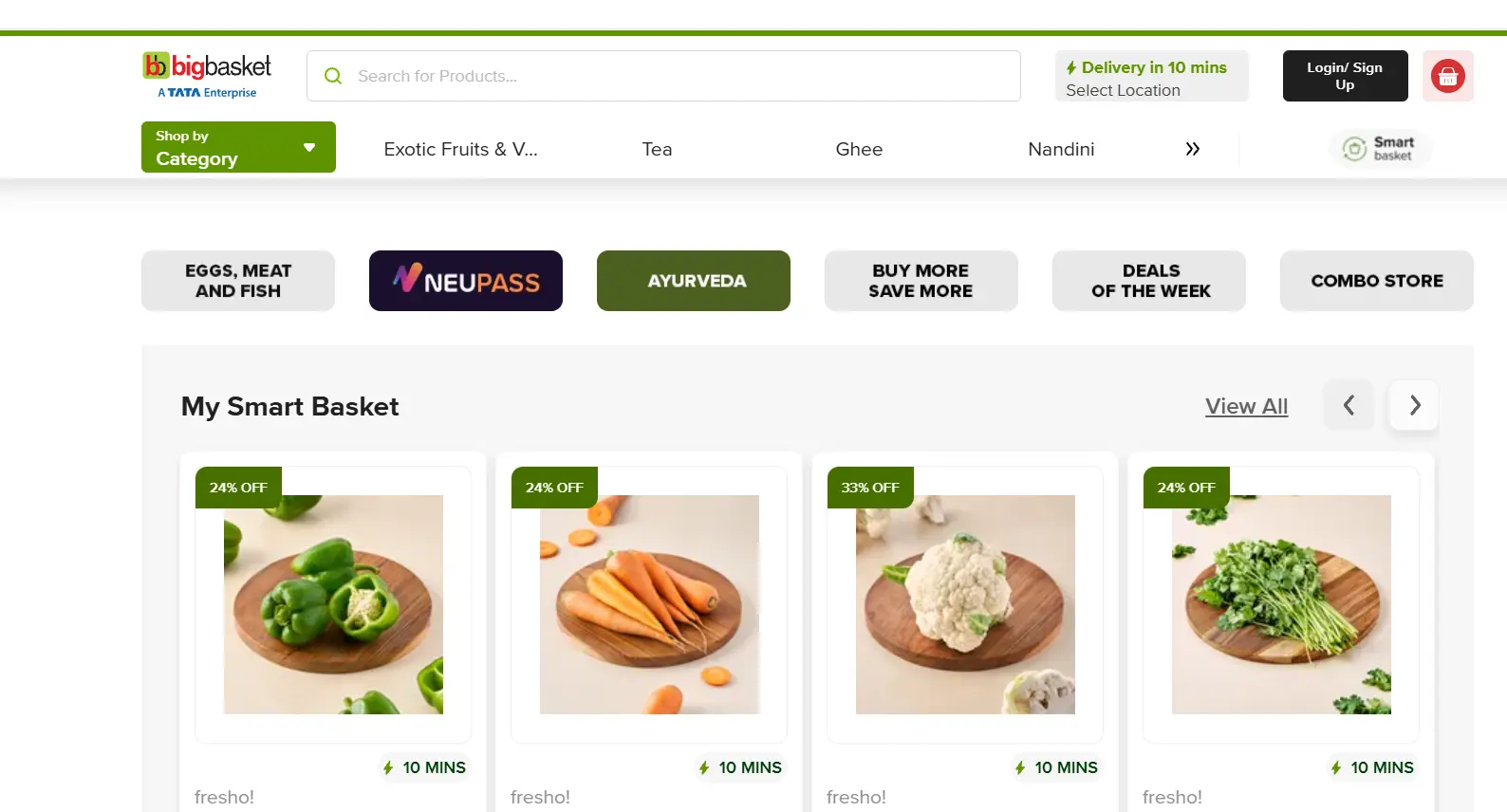
BB Now is BigBasket’s quick commerce offering an extension of one of India’s largest online grocery platforms (owned by the Tata Group). BB Now targets customers who want the trust and range of BigBasket with the speed of quick commerce, operating through a network of BB Express stores.
Getir (Global Example)
Getir is a Turkish quick commerce pioneer that played a major role in popularising the model globally. Founded in 2015 in Istanbul, Getir expanded aggressively into Europe and the US, operating in cities across Turkey, the UK, Germany, and the Netherlands. Though it has since scaled back some international operations due to profitability pressures, Getir remains one of the most important case studies in the global quick commerce story.
Industries Benefiting from Quick Commerce
Grocery Delivery
Groceries are the bread and butter of quick commerce (literally). Everyday essentials vegetables, fruits, dairy, packaged foods, beverages are the most frequently ordered categories. Grocery delivery alone accounts for the majority of quick commerce transaction volume globally.
Pharmacy and Healthcare
Quick commerce is transforming healthcare access. Platforms now deliver over-the-counter medicines, prescription drugs (where regulations allow), health supplements, baby care products, and medical devices in minutes. This is particularly valuable for elderly consumers and parents dealing with sick children.
Food and Beverage
Beyond cooked food delivery (which is a separate category), quick commerce handles packaged and raw food items snacks, beverages, cooking ingredients, and beverages. Late-night snack runs and party supply restocking are particularly popular use cases.
Electronics Accessories
Quick commerce has expanded into electronics accessories phone chargers, USB cables, earphones, power banks, and mobile covers. The ability to get a replacement charger in 15 minutes, rather than waiting a day, is a compelling value proposition for tech-dependent consumers.
Beauty and Personal Care
Shampoos, skincare products, cosmetics, razors, sanitary products this category has seen strong growth on quick commerce platforms. The unplanned and often urgent nature of personal care needs makes it a natural fit for the model.
Quick Commerce Market Size and Growth
Global Market Trends
The global quick commerce market has grown explosively over the past few years. Valued at approximately USD 25–30 billion in 2023, the market is projected to grow at a compound annual growth rate (CAGR) of 20–25% through 2028, potentially reaching USD 70–80 billion.
Key growth markets include India, Southeast Asia, the Middle East, and parts of Europe. While some Western markets (particularly the US) have seen consolidation and exits by players unable to achieve profitability, the model continues to expand in emerging markets where density, mobile adoption, and demand align favourably.
Quick Commerce Growth in India
India is arguably the world’s most exciting quick commerce market. With a large, young, digitally native population, dense urban centres, and relatively low delivery costs (due to affordable labour), India has the perfect conditions for quick commerce to flourish.
The Indian quick commerce market was valued at approximately USD 3–4 billion in 2024 and is growing at well over 40–50% annually. Blinkit, Zepto, and Swiggy Instamart together process millions of orders daily. Industry analysts expect India to become one of the top two or three quick commerce markets in the world within the next five years.
Tier-2 cities like Jaipur, Lucknow, Chandigarh, and Indore are increasingly becoming new frontiers for expansion, as dark store economics improve and consumer awareness grows.
Consumer Behaviour Changes
Quick commerce is not just changing how people shop it is changing how they think about shopping:
- Smaller, more frequent orders are replacing the traditional weekly grocery run
- Impulse purchases have increased as friction between need and fulfilment drops to near zero
- Pantry stocking behaviour is declining as consumers trust that items will be available instantly when needed
- Price sensitivity is lower for quick commerce than traditional grocery, as consumers pay a premium for convenience
- Brand discovery is increasingly happening through quick commerce app homepages and recommendations
Future Trends in Quick Commerce
AI-Powered Operations
Artificial intelligence will become even more central to quick commerce operations. From hyper-accurate demand forecasting that minimises waste, to AI-powered customer personalisation, smart pricing, and automated inventory replenishment AI will be the competitive differentiator separating winners from losers in this space.
Expansion Beyond Groceries
Quick commerce started with groceries but is rapidly moving into new categories. In 2026 and beyond, expect to see quick delivery of:
- Branded apparel and fashion accessories
- Home décor and small furniture items
- Pet care products
- Books and stationery
- Gifting and flowers
- Toys and baby products
The vision of many leading platforms is to become the “instant everything” store.
Sustainable Delivery Models
Environmental concerns are growing, and regulators and consumers alike are paying more attention to the carbon footprint of delivery operations. Future quick commerce models will increasingly embrace:
- Electric delivery vehicles and bicycles
- Sustainable packaging (minimal plastic, compostable materials)
- Carbon offset programmes
- Optimised delivery routes to reduce total vehicle kilometres
Automation and Smart Warehouses
As labour costs rise and order volumes grow, quick commerce platforms will increasingly invest in automation within their dark stores. Automated picking robots, conveyor systems, and AI-directed warehouse layouts will reduce picking time from minutes to seconds and improve accuracy.
Some platforms are already experimenting with drone delivery for select use cases a model that could dramatically expand the delivery radius while reducing costs in the long run.
Personalised Shopping Experiences
Future quick commerce apps will know what you need before you do. By analysing your order history, dietary preferences, household size, and even the time of day, platforms will proactively suggest replenishments, create personalised “quick lists,” and offer predictive ordering so your staples are always stocked without you having to think about it.
Is Quick Commerce Profitable?
Profitability has been the most discussed and debated question in quick commerce. The honest answer is: it depends on scale, market, and operational efficiency.
Revenue Opportunities
Quick commerce platforms generate revenue through multiple streams:
- Delivery fees charged per order
- Platform fees or subscription models (e.g., loyalty memberships with free delivery)
- Trade margins on products (in inventory-led models)
- Advertising revenue from FMCG brands paying for prime placement on the app
- Private label products with higher margins
Operational Expenses
The cost structure is challenging:
- Dark store rent, fit-out, and utilities
- Inventory procurement and wastage (especially for perishables)
- Rider salaries, incentives, and benefits
- Technology development and maintenance
- Marketing and customer acquisition costs
Profitability Challenges
The path to profitability requires:
- Order density enough daily orders per dark store to cover fixed costs
- Average order value (AOV) growth higher basket sizes improve margins
- Reduction in delivery subsidies as the market matures and customer habit forms, platforms can reduce discounts
- Improved inventory management reducing wastage directly improves unit economics
Long-Term Outlook
Leading platforms like Blinkit have demonstrated that quick commerce can achieve positive contribution margins at the unit level when order density is high enough. As the market consolidates around two or three dominant players per market, and as those players reach critical scale, profitability at the platform level becomes achievable. The long-term outlook for established players in strong markets is cautiously optimistic.
How Businesses Can Start a Quick Commerce Model
If you are a business looking to enter or leverage quick commerce, here is a step-by-step framework:
Step 1: Choose a Niche
Do not try to sell everything from day one. Start with a focused product category groceries, medicines, pet supplies, or beauty products where you have supply chain expertise and where demand is clear. A focused niche allows you to optimise inventory and build a loyal customer base before expanding.
Step 2: Set Up Dark Stores
Identify high-density residential zones in your target city. Lease small retail spaces (1,000–3,000 sq ft) within those zones. Design these spaces purely for fast picking not for customer access. Start with one or two dark stores, prove the model, and expand.
Step 3: Build a Delivery Network
Hire and train delivery riders. Establish clear SLAs (service level agreements) for picking time and delivery time. Consider a mix of in-house riders for core hours and gig workers for peak periods. Invest in basic route optimisation tools from the outset.
Step 4: Invest in Technology
Build or license a reliable customer app, a picker app for dark store staff, and a delivery management system for riders. These three technology layers must communicate seamlessly in real time. Technology is not optional in quick commerce it is the business.
Step 5: Optimise Customer Experience
Focus obsessively on delivery accuracy, product quality, and app reliability. Respond quickly to complaints. Build a subscription or loyalty model to improve retention. Use push notifications and personalised recommendations to drive repeat orders. In quick commerce, customer experience is your biggest competitive weapon.
Frequently Asked Questions
What is quick commerce?
Quick commerce (Q-commerce) is a retail model that delivers everyday products primarily groceries, medicines, and household essentials to customers within 10 to 30 minutes of placing an order, through a network of local dark stores and hyperlocal delivery fleets.
How is quick commerce different from e-commerce?
While e-commerce typically delivers in one to seven days from large centralised warehouses, quick commerce delivers in under 30 minutes from small dark stores located close to customers. Quick commerce serves immediate, unplanned needs; e-commerce serves planned purchases across a much wider product range.
What products are best suited for quick commerce?
Products that are needed immediately, consumed frequently, and are not worth waiting a day for are ideal. This includes groceries, fresh produce, beverages, packaged snacks, medicines, baby care items, personal hygiene products, and electronics accessories.
Why is quick commerce growing rapidly?
It is growing because of increasing urban populations, widespread smartphone adoption, consumer preference for convenience, post-pandemic shifts to online grocery shopping, and significant investment by venture capital backing platform expansion and customer acquisition.
What are dark stores?
Dark stores are small, neighbourhood-level fulfilment centres that are not open to the public. They stock a curated range of fast-moving products and are designed for rapid order picking and hyperlocal delivery — typically covering a radius of 1–3 km.
Is quick commerce profitable?
At the platform level, many quick commerce companies are still working towards profitability. However, at the unit economics level (per order or per dark store), leading platforms like Blinkit have demonstrated positive contribution margins when order density is high. Profitability improves significantly with scale, operational efficiency, and reduced customer acquisition costs.
Which are the top quick commerce companies?
In India: Blinkit, Zepto, Swiggy Instamart, and BB Now. Globally: Getir (Turkey/Europe), GoPuff (USA), and various regional players across Southeast Asia and the Middle East.
Conclusion
Quick commerce has moved from a novelty to a necessity in just a few years. It is no longer a “nice-to-have” for consumers it is rapidly becoming the expected standard for how everyday products should be delivered.
For businesses, quick commerce represents both a significant opportunity and a serious competitive threat. Companies that ignore it risk losing relevance with convenience-first consumers. Those that embrace it strategically and operationally can build powerful, loyalty-driven businesses with strong recurring revenue.
For consumers, the benefit is simple: the store comes to you, in minutes.
As AI, automation, and infrastructure continue to mature, quick commerce will become faster, broader in scope, and increasingly sustainable. The 10-minute delivery of today will likely feel slow compared to what is possible five years from now.
One thing is certain: the age of waiting days for products you need right now is coming to an end. Quick commerce is not just the future of retail it is already the present.