

If you’ve been pitched SERP Insight Link Insertion by an agency or freelancer, you’re probably wondering whether it’s a real strategy or just a rebranded version of something you already know. Fair question the SEO industry loves a new name for an old idea.
Here’s the short answer: SERP Insight Link Insertion is a real, data-driven approach to link building. It’s not fundamentally different from a niche edit, but it changes how you find and qualify placements before you ever contact a publisher. That distinction matters more than it sounds, and it’s the difference between a campaign that moves rankings and one that wastes a budget.
This guide breaks down what SERP Insight Link Insertion actually is, how it works step by step, when it beats the alternatives, and how to avoid the mistakes that make most link insertion campaigns fail.
What Is SERP Insight Link Insertion?
Definition
SERP Insight Link Insertion is a link-building method where you place a contextual backlink into an existing, already-ranking page but only after analyzing that page’s search performance data (rankings, traffic trends, and relevance) to confirm it will pass meaningful value. Unlike a generic niche edit, the selection process starts with SERP data, not just domain metrics.
Why the SEO Industry Uses This Strategy
Traditional link insertions (often called niche edits) are chosen mostly by domain-level metrics: Domain Rating, Domain Authority, or raw traffic estimates from a third-party tool. The problem is that a page can have a high Domain Rating and still be dead weight deindexed, losing traffic, or completely irrelevant to your niche.
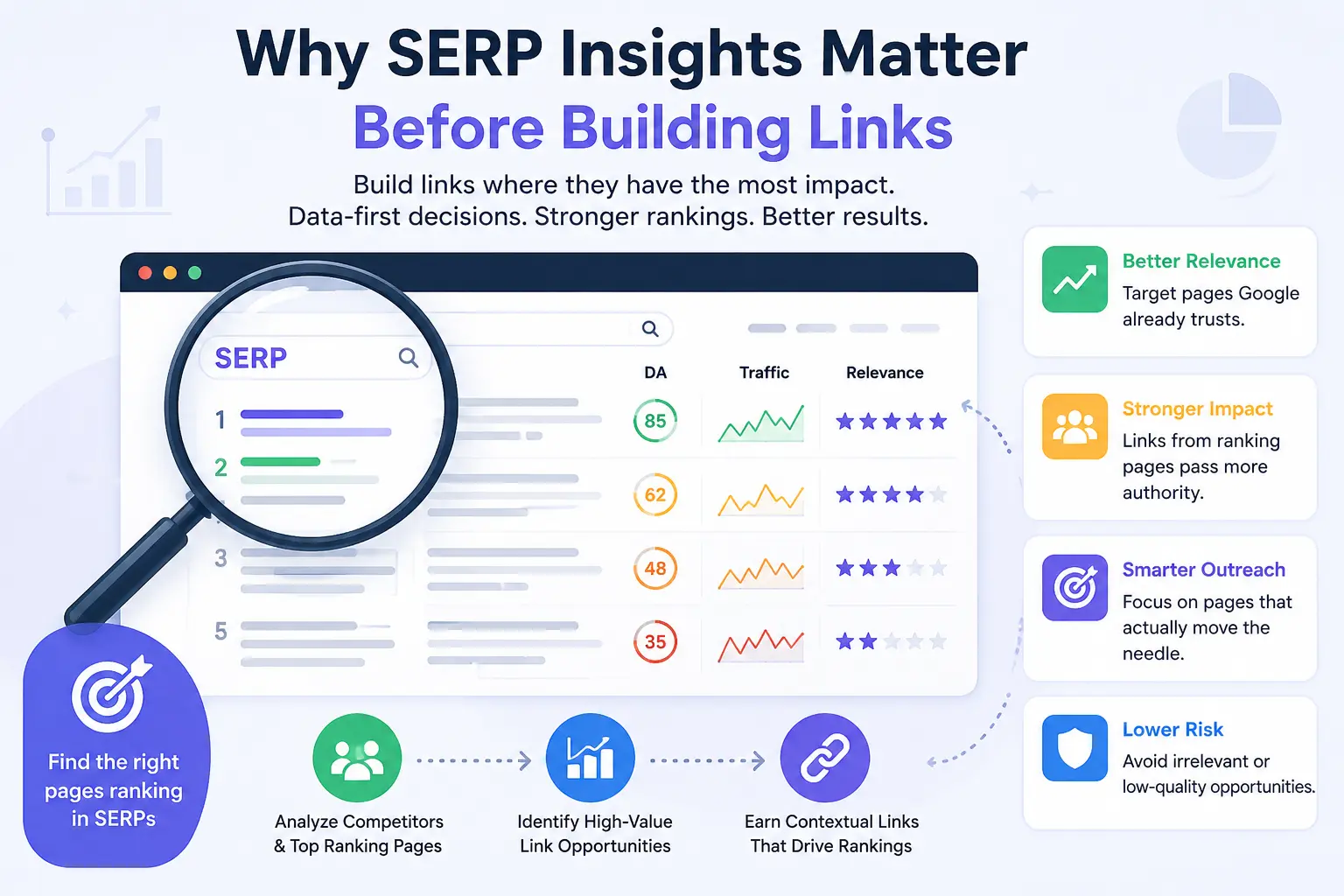
SERP Insight Link Insertion adds a filtering layer. Before you ever reach out, you pull actual SERP data: is the page ranking for relevant terms, is that ranking stable or declining, and is the topic close enough to yours that a link from it makes contextual sense.
This is closer to how an experienced link builder already worked SERP Insight Link Insertion just formalizes that judgment into a repeatable process.
How It Differs From Traditional Link Insertions
A traditional niche edit workflow usually looks like: find a page with decent Domain Rating in your niche, ask for a link, pay, done. SERP Insight Link Insertion inserts a research phase before outreach you’re validating the page’s current search visibility and traffic trajectory, not just its historical authority score.
The mechanics of the link itself (an editor adding your link into existing body content) are the same either way.
Why SERP Insights Matter Before Building Links
Understanding Google’s Ranking Signals
Google’s own documentation on how search works confirms that links are treated as one signal among many, weighted by relevance and quality rather than raw quantity.
A link from a page Google trusts for that topic carries more weight than a link from a high-authority page on an unrelated subject. This is why SERP-level relevance checks outperform domain-level checks alone.
Why Existing Ranking Pages Pass More Value
A page that’s actively ranking has already proven two things: Google indexes and trusts it, and it satisfies user intent for its target keywords.
A link placed inside that content inherits some of that established trust, assuming the topic overlaps with yours. A page that used to rank but has since dropped out of the index passes little to nothing, regardless of its Domain Rating.
Role of Topical Relevance
Relevance is the variable most agencies underweight. A backlink from a marginally related blog post, even a well-ranking one, does less for you than a link from a page that’s genuinely about your subject.
Google’s helpful content guidance repeatedly emphasizes topical depth and user-first relevance over raw link volume, which is a strong signal that relevance-first link selection will keep paying off.
How SERP Insight Link Insertion Works (Step-by-Step)
Here’s the full workflow, from research to reporting.
- Keyword Research – Identify the keywords and topics your target page needs to rank for, so you know what kind of host pages to look for.
- SERP Analysis – Pull the current search results for those (and closely related) keywords to build a list of candidate host pages.
- Page Qualification – Check each candidate against traffic, indexation, and relevance criteria (detailed in the scoring framework below).
- Prospect Identification – Find the site owner, editor, or content manager responsible for that specific page.
- Outreach Strategy – Contact the publisher with a clear, relevant reason for the link — not just a payment offer.
- Link Placement – The publisher (or their editor) inserts your link into the existing content, ideally in a contextually natural spot.
- Anchor Text Optimization – Agree on anchor text that reads naturally and avoids over-optimization (more on this below).
- Performance Tracking – Monitor whether the linked page holds its rankings, and whether your target page’s rankings move as a result.
Keyword Research
Start with the keywords your target page is trying to rank for, plus 5–10 closely related terms. This list becomes your search query set for the next step. Skipping this step is the single most common reason link insertion campaigns end up buying links from pages that are only loosely on-topic.
SERP Analysis
Search each keyword and record the top 10–20 ranking URLs. This is your raw prospect pool. At this stage, you’re not filtering yet you’re just casting a wide net across pages that Google already considers relevant for your topic space.
Page Qualification
This is where SERP Insight Link Insertion earns its name. Run each candidate page through a scoring framework before spending any outreach time on it (see the Link Opportunity Score section below).
Prospect Identification
Once you’ve shortlisted pages, find the right contact. For smaller sites this is often the author or site owner listed on an About page; for larger publishers, it’s usually a content or SEO editor. Email finder and email verification Tools like Hunter.io can speed up finding a verified email address tied to the domain.
Outreach Strategy
Lead with relevance, not money. Publishers get flooded with paid link requests, and the ones that get ignored are almost always generic.
A message that references the specific page, explains why your resource is a genuine addition for their readers, and is short, tends to convert better than a templated pitch (a sample template is included later in this guide).
Link Placement
Once a publisher agrees, they (or you, if you have contributor access) add the link inside the existing body text — not in a footer, sidebar, or “resources” tacked onto the bottom. Contextual placement inside a relevant paragraph is what separates a real link insertion from a low-value directory-style link.
Anchor Text Optimization
Match the anchor text to how a human would naturally reference your page, not to your target keyword verbatim. Overusing exact-match anchors is one of the fastest ways to trigger scrutiny under Google’s spam policies.
Performance Tracking
Track two things over the following 4–8 weeks: whether the host page keeps ranking (a sign the link is stable and the page isn’t about to be deindexed), and whether your target page’s rankings for its target keywords move. Google Search Console and a rank tracker are sufficient for this.
SERP Insight Link Insertion vs Other Link Building Strategies
| Strategy | How the link is placed | Typical cost | Speed | Relevance control | Risk level |
|---|---|---|---|---|---|
| SERP Insight Link Insertion | Inserted into existing, ranking content | Low–Medium | Fast (days–weeks) | High (SERP-validated) | Medium |
| Guest Posting | New article written and published for you | Medium–High | Medium (weeks) | Medium (you control the article, not the host page history) | Medium |
| Niche Edits (traditional) | Inserted into existing content, chosen by domain metrics only | Low–Medium | Fast | Low–Medium | Medium–High |
| Digital PR | Earned coverage from newsworthy content/campaigns | High | Slow (months) | High | Low |
| HARO / journalist requests | Earned mention from responding to reporter queries | Low (time-intensive) | Slow, unpredictable | Medium | Low |
| Broken Link Building | Replacing a dead link with yours | Low | Slow | Medium | Low |
| Resource Page Links | Added to a curated list page | Low | Medium | Medium | Low–Medium |
The practical takeaway: SERP Insight Link Insertion is fast and relatively affordable, but it sits in the same risk category as any paid link placement. It works best as one channel in a broader link-building mix, not the only one.
Benefits of SERP Insight Link Insertion
- Faster Indexation — Because the host page is already indexed and crawled regularly, links inside it tend to get discovered by Google quickly.
- Higher Relevance — SERP-based qualification filters out off-topic pages before you spend time on outreach.
- Stronger Link Equity — Links from pages that are currently ranking pass more real authority than links from stagnant or declining pages.
- Better Ranking Potential — Combined relevance and authority give the linked page a meaningfully better shot at ranking improvement than a random niche edit.
- Cost Efficiency — No content creation costs, unlike guest posting.
- Referral Traffic — Since the host page is actively getting search traffic, the link can drive real visitors, not just link equity.
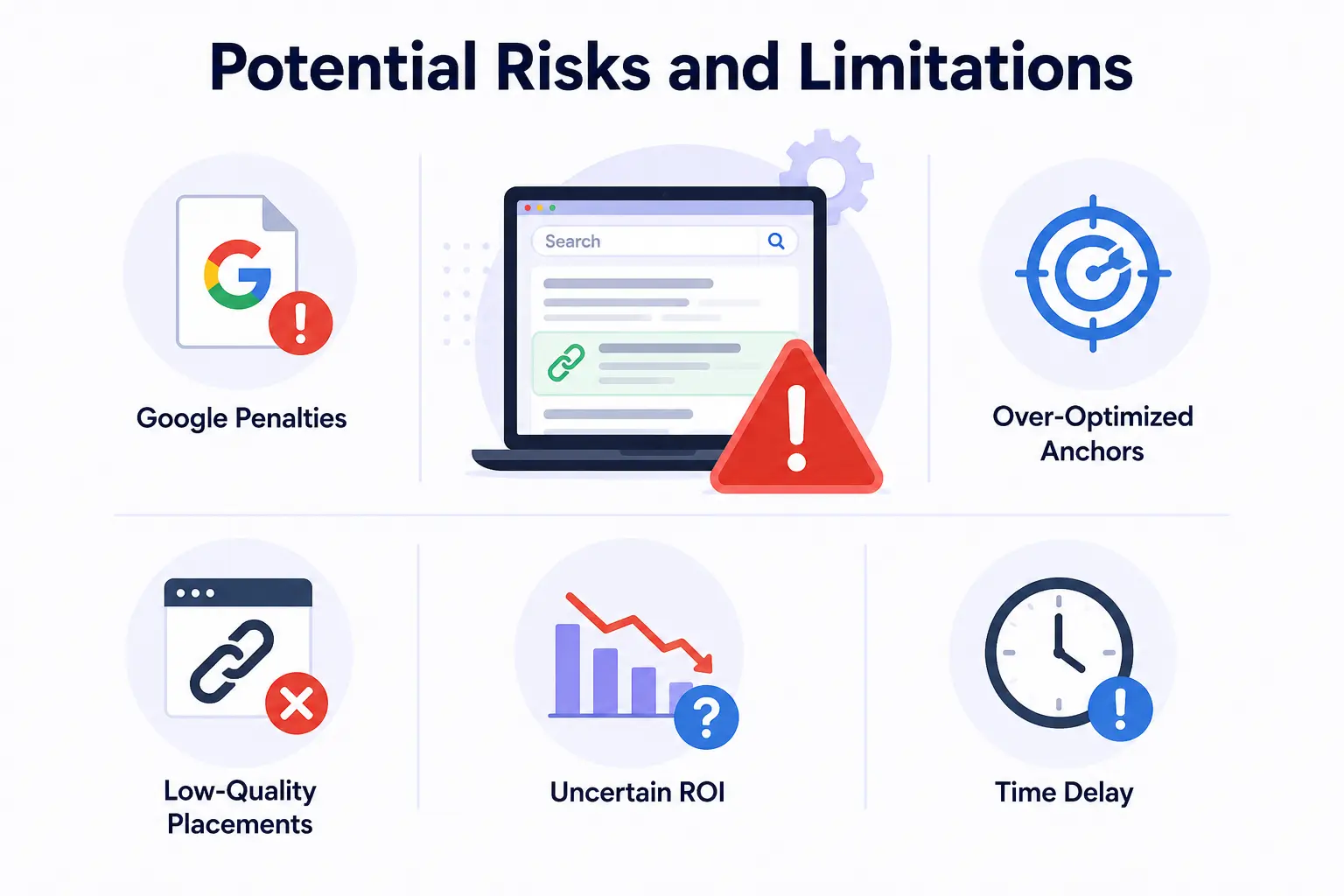
Potential Risks and Limitations
Google’s Guidelines
Google’s spam policies explicitly list buying or selling links that pass ranking value as a violation, regardless of what the tactic is called. This applies to SERP Insight Link Insertion exactly as it applies to any other paid placement. Renaming the tactic doesn’t change how Google’s systems, including SpamBrain, evaluate it.
Paid Links
Most link insertion transactions involve payment, even if it’s framed as a content contribution or sponsorship fee. If you go this route, understand you’re accepting some risk, and weigh it against the potential ranking benefit.
Spam Signals
Buying links from pages with unnatural anchor text patterns, sudden traffic spikes from paid promotion, or high volumes of outbound paid links can trigger spam signals. Vetting the page (see the scoring framework) reduces this risk but doesn’t eliminate it.
Over-Optimized Anchors
Using exact-match keyword anchors repeatedly across multiple link insertions is one of the more detectable patterns for automated spam systems. Vary anchor text and lean toward branded or natural-phrase anchors.
Link Decay
Pages get updated, links get removed during redesigns, and rankings shift. A link that’s valuable today may lose its host page’s ranking within a year. Budget for periodic audits, not a one-time purchase.
How to Evaluate a Link Opportunity
Before reaching out to any publisher, score the candidate page. Below is a practical framework you can adapt.
Link Opportunity Score – Evaluation Checklist
- Organic Traffic — Does the page currently receive meaningful search traffic (not just historical peak traffic)?
- Traffic Trend — Is that traffic stable or growing over the last 6–12 months, or clearly declining?
- Keyword Rankings — Does the page rank in the top 20 for terms relevant to your niche?
- Relevance — Is the page’s core topic genuinely close to your target page’s topic?
- Editorial Quality — Is the content well-written, accurate, and free of obvious link-farm patterns (excessive outbound links, thin content)?
- Spam Score — Does the domain show signs of being a link farm (checked via a spam-score tool)?
- Internal Linking — Does the site link to this page internally, suggesting it’s a real, maintained part of the site rather than an orphaned page kept alive for selling links?
- Index Status — Is the page confirmed indexed in Google right now (verify with a site: search or Search Console, not just an assumption)?
A page that fails three or more of these checks is a weak candidate, regardless of how attractive its Domain Rating looks.
Best Tools for SERP Insight Link Building
| Tool | Primary use in this workflow |
|---|---|
| Ahrefs | SERP analysis, traffic estimates, backlink audits |
| Semrush | Keyword research, position tracking, site audits |
| Moz | Domain Authority and spam score checks |
| Majestic | Trust Flow / Citation Flow for link quality signals |
| Screaming Frog | Crawling target sites to confirm indexation and internal linking |
| Hunter.io | Finding verified contact emails for outreach |
| BuzzStream | Managing outreach campaigns and relationship tracking |
| Pitchbox / Respona | Scaling outreach with personalization at volume |
| Google Search Console | Confirming indexation and tracking post-placement performance |
| Google Analytics 4 | Measuring referral traffic and conversions from placed links |
Real Campaign Example
To make this concrete, here’s an illustrative walkthrough based on a typical mid-size B2B SaaS campaign.
Campaign Goals: Improve rankings for a product comparison page stuck on page 2 for its primary keyword.
Prospect Selection: The team pulled the top 30 ranking pages across 8 related keywords, then filtered using the Link Opportunity Score checklist above. Roughly 40% of candidates were eliminated at this stage for declining traffic or weak topical overlap.
Outreach: Of 25 qualified prospects contacted with a personalized, relevance-first pitch, 9 responded positively — a response rate well above the low single digits typical of generic mass outreach.
Link Placement: 6 links were secured within existing, actively-ranking articles, with natural, varied anchor text.
Ranking Changes: Over the following 10 weeks, the target page moved from position 14 to position 6 for its primary keyword, with secondary keyword rankings improving as well.
Lessons Learned: The pages that moved the needle most weren’t the highest-DR sites — they were the ones with the strongest topical overlap and the most stable traffic trend, reinforcing that relevance beats raw authority in this tactic.
How to Measure Success
- Ranking Growth — Track target keyword positions weekly for at least 8–12 weeks post-placement.
- Organic Traffic — Watch for lift on the linked page in Search Console and GA4.
- Referral Traffic — Check direct click-throughs from the host page’s link.
- Link Indexation — Confirm the host page (and your link within it) stays indexed; deindexation kills the value.
- Conversion Rate — For commercial pages, track whether new organic traffic converts.
- ROI — A simple way to frame it: Cost of placement → Traffic increase → Conversion rate → Revenue generated → Compare against total spend
If a $300 link insertion contributes to a page that generates even a handful of extra qualified leads a month, it typically pays for itself well within a quarter though results vary heavily by industry and page type, so track your own numbers rather than assuming a benchmark applies.
Common Mistakes to Avoid
- Buying Low-Quality Links – Chasing Domain Rating without checking actual traffic or indexation.
- Ignoring Relevance – Placing links on high-authority but topically unrelated pages.
- Exact-Match Anchor Overuse – Repeating the same keyword-rich anchor across multiple placements.
- Choosing DR Over Traffic – A high Domain Rating with declining or zero organic traffic is a red flag, not a green light.
- Poor Outreach – Sending generic, payment-first pitches that get ignored or flagged as spam.
Choosing the Right Link Building Agency
Questions to Ask
- Do you show live traffic and ranking data for candidate pages before placement, or only Domain Rating?
- What’s your process if a placed link gets removed or the host page loses rankings?
- Can you share anonymized examples of past campaign results?
- How do you vary anchor text across a campaign?
Red Flags
- Guarantees of a specific ranking position or timeline
- No transparency about which sites they’ll use until after payment
- Pricing based purely on Domain Rating tiers with no traffic or relevance criteria
- Reluctance to explain their vetting process
Pricing Expectations
| Tier | Typical price per link | What you’re getting |
|---|---|---|
| Budget | $50–$150 | Minimal vetting, often domain-metric-only selection |
| Mid-range | $150–$400 | SERP-validated placements, moderate relevance filtering |
| Premium | $400–$1,000+ | Highly relevant, high-traffic pages with strong editorial standards |
Prices vary significantly by niche, with finance, legal, and SaaS typically commanding higher rates than general lifestyle niches.
Vendor Evaluation Checklist
- Shows real traffic/ranking data before placement, not just DR
- Explains their SERP qualification process clearly
- Provides a sample or case study on request
- Offers anchor text diversity, not one anchor per order
- Has a policy for replacing links that get removed
Future of SERP Insight Link Building
AI Overviews
As AI Overviews and other AI-generated summaries pull from a narrower set of trusted, authoritative sources, being cited within a page that AI systems already treat as authoritative may carry additional weight beyond traditional ranking value. This is still an evolving area, and no vendor can currently guarantee AI Overview citation as an outcome.
Topical Authority
Google’s broader shift toward rewarding topical depth (as reflected in its helpful content guidance) means link insertion strategies that ignore topical fit will likely underperform further over time, while relevance-first approaches like SERP Insight Link Insertion should hold up better.
Entity SEO
Search engines increasingly evaluate content based on entities and their relationships, not just keywords. A link from a page that’s clearly connected to your industry’s core entities carries signal value beyond the raw backlink itself.
Editorial Signals
Expect continued scrutiny on editorial integrity pages with a pattern of unnatural outbound paid links are more likely to be discounted or flagged, which reinforces why vetting editorial quality (not just metrics) matters.
Google’s Evolving Algorithms
Google’s ranking systems are updated continuously, and link-based tactics that work today can lose effectiveness as spam detection improves. Treat any link-building tactic, including this one, as part of a diversified strategy rather than a permanent silver bullet.
Frequently Asked Questions
What is SERP Insight Link Insertion? It’s a link-building method that places a contextual backlink into an existing, already-ranking page, after validating that page’s current search performance and topical relevance.
Is SERP Insight Link Insertion safe? It carries the same general risk profile as any paid link placement. Careful vetting reduces but doesn’t eliminate risk under Google’s spam policies.
Does Google allow link insertions? Google’s guidelines prohibit buying or selling links that pass ranking value, which applies to this tactic when payment is involved. Editorially earned insertions (no payment, purely because a publisher found your resource valuable) are not restricted.
Are link insertions better than guest posts? Neither is universally “better” — link insertions are typically faster and cheaper, while guest posts give you more content control and can double as a content marketing asset.
How much does a link insertion cost? Typically $50 to over $1,000 per link, depending on the host site’s traffic, relevance, and vetting standard.
How long do link insertions take to work? Most campaigns see measurable ranking movement within 6–12 weeks, though timelines vary by niche competitiveness.
What is the difference between a niche edit and a link insertion? In practice, they’re the same mechanism — inserting a link into existing content. “SERP Insight” specifically refers to using search performance data to choose the placement, rather than relying on domain metrics alone.
How do you find SERP Insight opportunities? Run SERP analysis for your target keywords, then qualify each ranking page against traffic, relevance, and indexation criteria before outreach.
Can beginners use SERP Insight Link Insertion? Yes, but the qualification step has a learning curve. Beginners should start with a small batch and manually verify each metric rather than relying solely on tool scores.
What metrics should I check before buying a link? Organic traffic trend, keyword relevance, index status, internal linking, and spam score — not Domain Rating alone.
Are contextual backlinks still effective? Yes. Google’s own signals documentation continues to treat relevant, contextual links as a meaningful ranking factor, provided they’re not part of a manipulative scheme.
Do AI Overviews reduce the value of backlinks? Not necessarily — early evidence suggests AI Overviews still draw from pages that rank well organically, meaning backlink-driven ranking improvements can still indirectly support AI visibility, though this relationship is still developing.
How can I measure the success of a link insertion campaign? Track ranking position changes, organic and referral traffic, indexation stability, and conversion rate over 8–12 weeks post-placement.
Final Verdict
Who Should Use This Strategy?
Businesses with an existing content foundation that need targeted ranking improvements for specific pages, and who have the patience to properly vet placements rather than buying links purely on Domain Rating.
Who Should Avoid It?
Anyone unwilling to accept the inherent risk of paid link placements under Google’s guidelines, or anyone looking for a guaranteed, risk-free ranking shortcut, that doesn’t exist in any link-building tactic.