

Two people fill out your contact form on the same day. One read a blog post called “What is SEO?” and left a one-line message. The other searched for an agency to hire, checked your pricing page twice, read a case study, and asked for a consultation.
Both are “organic leads.” Only one is likely ready to talk to sales this week.
This is why teams need a way to score leads based on SEO intent signals. Traffic and form fills tell you very little on their own. The search that brought someone to your site, the pages they viewed, and how well they match your ideal customer tell you much more.
In this guide, I’ll walk you through a practical 10-step framework. You’ll learn what SEO intent signals are, how to assign points to them, how to calculate a final score, and how to connect it all to your CRM. You’ll also see worked examples, tool options, common mistakes, and the KPIs that show whether your model works.
The payoff is simple. Your sales team spends time on prospects most likely to buy, and your marketing team nurtures the rest without wasting effort.
What Is SEO Lead Scoring?
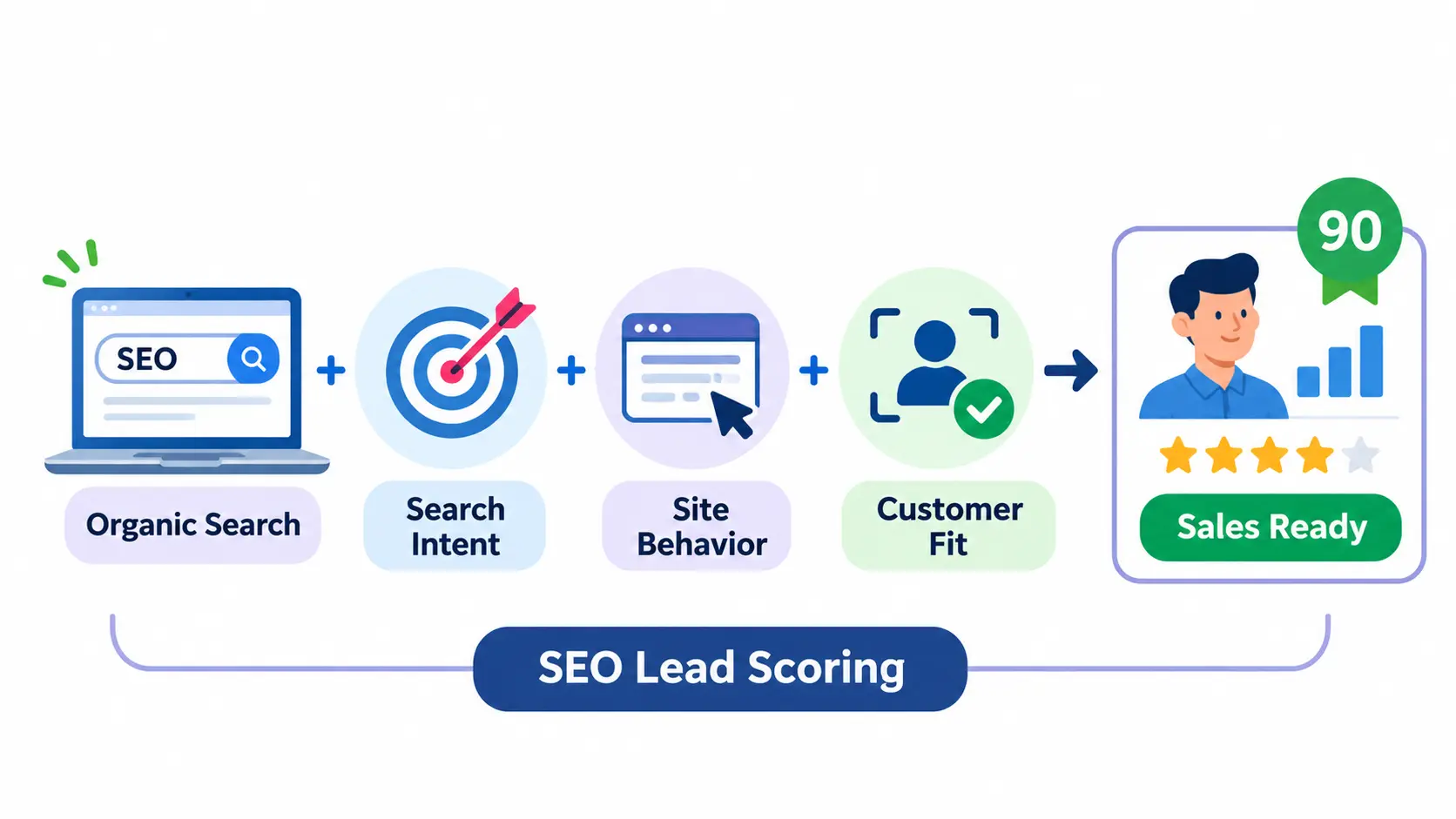
SEO lead scoring is the practice of assigning points to leads that come from organic search, based on the intent behind their searches, their behavior on your site, and how well they fit your target customer. The higher the score, the more ready the lead is for a sales conversation.
It builds on the general idea of lead scoring, which ranks prospects by their perceived value to a business. The SEO version simply adds a new layer: what the person was trying to find when they arrived.
How SEO Lead Scoring Works
The process has four moving parts:
- Intent: What kind of search or landing page brought the person in?
- Engagement: What did they do on your site afterward?
- Fit: Do they match your ideal customer profile (ICP)?
- Conversion: What action did they take, and how strong is it?
Each part earns points. Negative signals, like spam or job-seeking, remove points. The total becomes a score your CRM stores and your team can act on.
Why SEO Intent Signals Matter for Lead Qualification
Search queries are one of the clearest public records of what someone wants. A person typing “how to improve SEO” is learning. A person typing “hire an SEO agency” is shopping.
Without this context, every lead looks the same in your CRM. Sales reps then follow up in the order leads arrive, not in the order they are likely to buy. That wastes time and frustrates both teams.
Traditional Lead Scoring vs. SEO Intent-Based Lead Scoring
Traditional scoring often leans on email opens, form fields, and job titles. SEO intent-based scoring adds the “why” behind the visit. Here is how they compare:
| Factor | Traditional lead scoring | SEO intent-based lead scoring |
| Main data sources | Form fields, email activity, CRM records | Landing pages, keyword themes, on-site behavior, plus CRM and form data |
| Scoring factors | Job title, company size, email clicks, form fills | Search intent stage, page type, repeat visits, pricing page views, plus fit data |
| Buyer intent | Often inferred from engagement after contact | Inferred from the first touch, before any form is submitted |
| Practical use | Ranking contacts already in the database | Ranking organic leads and deciding which content attracts buyers |
The two approaches work best together. Think of SEO intent as an extra input, not a replacement for your current model.
What Are SEO Intent Signals?
SEO intent signals are clues from organic search behavior and website activity that show where a prospect sits in the buying journey. They can be as simple as the type of page someone landed on, or as detailed as a pattern of visits over several weeks.
No single signal proves someone will buy. But several signals pointing the same way give you a reliable picture. Let’s look at five groups.
Keyword Search Intent Signals
Search intent is usually split into four types. Each hints at a different stage.
- Informational keywords: The person wants to learn. Example: “what is lead scoring.” These show awareness, not buying readiness.
- Navigational keywords: The person wants a specific site or brand. Example: “your brand login” or “your brand pricing.” These show existing familiarity.
- Commercial investigation keywords: The person is comparing options. Example: “best SEO agency” or “agency A vs. agency B.” These show active evaluation.
- Transactional keywords: The person is ready to act. Example: “hire an SEO agency” or “SEO consultation near me.” These show strong buying intent.
These categories are a common way to describe how people search. They are not perfect, since one query can carry mixed intent. Treat them as a guide.
Organic Landing-Page Signals
The first page someone sees often says more than the keyword itself. This matters because, for most visitors, you can see the landing page even when you can’t see the exact query.
- Educational blog pages: Low to moderate intent. The visitor is researching.
- Product and service pages: Higher intent. The visitor is looking at what you sell.
- Comparison pages: High intent. The visitor is choosing between options.
- Pricing pages: Very high intent. The visitor is checking cost and fit.
- Case studies: High intent. The visitor wants proof you can deliver.
- Contact and consultation pages: The strongest page-level signal. The visitor wants to talk.
Website Engagement Signals
What visitors do after landing shows whether interest is growing.
- Repeat website visits
- Time spent on relevant content
- Visits to multiple related pages
- Pricing page visits
- Case study views or downloads
- Demo and consultation requests
The key word is relevant. Ten minutes spent on an unrelated blog post means less than two minutes on your pricing page.
Conversion and Form Submission Signals
Not all conversions are equal. Rank them by how close they are to a purchase decision:
- Contact form submissions
- Quote requests
- Demo requests
- Newsletter subscriptions
- Resource downloads
A demo request is a strong buying signal. A newsletter signup usually is not. Your scoring should reflect that gap.
Company and Account-Level Intent Signals
In B2B, buying decisions involve several people. So it helps to look at the company, not just the individual.
- Company research activity across your site
- Relevant business news, such as funding or expansion
- Multiple contacts from the same organization
- Industry and company fit
- Third-party intent data from external providers
This is the idea behind account-based marketing: treat a target company as the unit of focus, not only one visitor.
How Search Intent Helps Identify High-Quality Leads
Search intent helps you separate people who are curious from people who are ready. Here is how to read each type when it shows up in your lead data.
Informational Intent: Identifying Early-Stage Prospects
Someone who arrives through an educational article is usually learning. They may not know your category well, and they may not have a budget yet.
That does not make them worthless. They may become buyers later. But they need helpful content first, not a sales call. Score them low and nurture them.
Commercial Investigation Intent: Identifying Potential Buyers
Searches like “best,” “top,” “alternatives,” and “vs.” suggest the person has a problem and is weighing solutions. They are often in a formal or informal evaluation.
This is the stage where your comparison pages and case studies matter most. Leads from these pages deserve a clear score boost and a personal follow-up.
Transactional Intent: Identifying Purchase-Ready Prospects
Searches that include words like “hire,” “pricing,” “quote,” “services,” or “consultation” show strong commercial interest. The person is looking for a provider or a price.
In my experience, these leads convert at a noticeably higher rate than blog-driven leads. Still, check this against your own data rather than trusting any general claim, including mine.
Navigational Intent: Understanding Brand-Specific Interest
Branded searches mean the person already knows you. That could be a current customer looking for support, a past lead returning, or a new prospect checking your reputation.
Context decides the score. A branded search followed by a pricing page visit is a strong signal. A branded search followed by a login page visit is not a sales lead at all.
How to Score Leads Based on SEO Intent Signals: A Step-by-Step Process
Here is the full process. You can build a first version in a spreadsheet and move it into your CRM later.
Step 1: Identify Organic Leads and Their Landing Pages
You can’t score what you can’t trace. Start by connecting each lead to the session that created them.
- Track the organic landing page for every session.
- Identify the pages where conversions happen.
- Connect lead records with website sessions, for example by passing UTM or source data into hidden form fields.
- Preserve the original acquisition source, so later visits don’t overwrite it.
That last point is a common failure. If a lead first arrived from search but later returned through a direct visit, many setups record only the latest source. Store the first one separately.
Step 2: Classify Keywords According to Search Intent
Next, sort your target keywords into intent groups.
- Group informational keywords.
- Group commercial investigation keywords.
- Identify transactional keywords.
- Separate branded and navigational searches.
- Organize everything into topic clusters.
A simple spreadsheet works fine. List each keyword, its intent type, and the page that targets it. Then every landing page inherits an intent label. Regularly monitoring keyword rankings also helps identify which search terms bring relevant organic traffic and which pages need further optimization.
Step 3: Assign Scores to Different SEO Intent Signals
Now build a points matrix. Here is an example for an SEO agency:
| SEO intent signal | Example | Suggested points |
| Informational keyword | What is SEO? | 2 |
| Problem-aware keyword | How to improve SEO | 4 |
| Commercial keyword | Best SEO agency | 7 |
| Transactional keyword | Hire an SEO agency | 10 |
| Service landing page | SEO services | 8 |
| Comparison page | SEO agency A vs. B | 9 |
| Pricing page | SEO service pricing | 10 |
| Consultation request | Book an SEO consultation | 12 |
These values are illustrative. They are a starting point, not a standard. Adjust them using your own sales data, such as which pages your closed customers visited before buying.
Step 4: Evaluate Website Engagement and Behavioral Signals
Add points for actions that show growing interest.
- Review repeat visits within a set window, such as 30 days.
- Monitor interactions with relevant pages.
- Give extra weight to pricing and comparison page engagement.
- Track case study consumption.
- Measure meaningful return visits, not just any return.
- Avoid rewarding irrelevant pageviews, like visits to your careers page.
Cap points for repeated actions. Otherwise, one person refreshing a page ten times could look like a hot lead.
Step 5: Evaluate Lead Quality Using Firmographic and Demographic Data
Intent tells you when someone might buy. Fit tells you whether they should. Score both.
- Job title and decision-making authority
- Industry and company size
- Geographic suitability
- Business requirements that match what you offer
- Overall alignment with your Ideal Customer Profile (ICP)
A high-intent visitor from a company you can’t serve is still a poor lead. Fit points protect your team from chasing the wrong deals.
Step 6: Apply Negative Lead Scoring
Negative scores keep your list clean. Subtract points for:
- Job-seeking visitors
- Spam submissions
- Irrelevant industries
- Duplicate leads
- Vendors soliciting your team
- Unqualified or unsupported requirements
Some of these deserve a large penalty, such as spam. Others, like a personal email address in a B2B form, may only need a small one.
Step 7: Calculate the Total Lead Score
Use a simple formula:
Lead Score = Intent + Engagement + Fit + Conversion − Penalties
Here is what each part adds:
- Intent: points from the search type and landing page
- Engagement: points from visits and page interactions
- Fit: points from firmographic and demographic match
- Conversion: points from the action taken, such as a quote request
- Penalties: points removed for negative signals
Set a maximum of 100 so scores stay easy to read. If your raw points go beyond that, scale them down.
Step 8: Categorize Leads According to Buying Readiness
Turn scores into groups your team can act on:
| Score | Lead category | Recommended action |
| 80–100 | High intent | Prioritize sales follow-up |
| 60–79 | Qualified interest | Personalized follow-up |
| 40–59 | Developing interest | Targeted lead nurturing |
| 20–39 | Early research | Educational content |
| 0–19 | Low intent | Passive nurturing or review |
These thresholds are starting recommendations, not universal standards. A company with a long sales cycle may need different cutoffs than a fast-moving one.
Step 9: Connect Lead Scoring With CRM and Sales Workflows
A score no one sees does nothing. Put it where your team works.
- Store lead scores in CRM records.
- Create automated lead assignment rules based on score ranges.
- Notify sales reps when a lead crosses the high-intent line.
- Trigger personalized nurturing campaigns for mid-range leads.
- Track sales acceptance and conversion outcomes.
The last item feeds your improvement loop. Without outcome data, you can’t tell if the model works.
Step 10: Review and Optimize Your Lead Scoring Model
Your first model will be wrong in places. That’s normal.
- Compare lead scores with actual conversions.
- Review feedback from sales reps.
- Identify misleading signals, like a page that gets points but never leads to deals.
- Adjust scoring weights.
- Remove outdated rules.
- Reevaluate regularly, for example every quarter.
Sales feedback is gold here. If reps keep saying “the 85s are not ready,” your weights need work.
Practical Example: How to Calculate an SEO-Based Lead Score
Let’s use a hypothetical B2B company that sells SEO services. It gets organic leads through its website, and it uses the scoring matrix above. The numbers below are illustrative only.
Example of a High-Intent Organic Lead
A marketing director at a mid-sized software company searches for an SEO agency. She lands on the services page, reads a case study, returns two days later, checks pricing, and submits a consultation form.
| Activity | Points |
| Commercial keyword category | 10 |
| Service page visit | 8 |
| Case study visit | 7 |
| Repeat visit | 5 |
| Pricing page visit | 10 |
| Consultation form submission | 12 |
| Relevant company fit | 15 |
| Total | 67 |
A score of 67 puts her in the “qualified interest” range. She should get a personalized follow-up quickly, ideally within a business day.
Why does she outrank someone who only reads a general article? Because every signal points the same way. She searched like a buyer, looked at buyer pages, came back, asked about cost, and fit the ICP. That pattern is far stronger than any single action.
Example of a Low-Intent Organic Lead
Now take a second visitor. A student searches “what is SEO,” reads one blog post for three minutes, and subscribes to the newsletter. The email is from a university domain.
| Activity | Points |
| Informational keyword | 2 |
| Educational blog page | 2 |
| Newsletter subscription | 3 |
| Company fit | 3 |
| Total | 10 |
This lead lands in the “low intent” group. There is no business need, no buying behavior, and no clear fit. Sales should not call. A light email nurture, or simple review, is enough.
How to Interpret and Act on Different Lead Scores
Here is how marketing and sales can respond to each range:
- 80–100 (High intent): Sales reaches out the same day. Review the pages they viewed first, so the first message is relevant.
- 60–79 (Qualified interest): A rep sends a personal, helpful note. Reference their topic, not a generic pitch.
- 40–59 (Developing interest): Marketing nurtures with case studies, comparisons, and guides. Re-score as they engage.
- 20–39 (Early research): Send educational content. Don’t push for a meeting.
- 0–19 (Low intent): Keep them on a passive list or remove them if they look like spam.
Remember that scores change. A lead at 35 today can reach 70 next month after two pricing visits. Update scores as new activity comes in.
Best Tools to Track SEO Intent Signals and Score Leads
You don’t need every tool below. Pick based on your team size, budget, and sales process.
Google Analytics 4 for Website Behavior Tracking
Google Analytics 4 (GA4) shows how visitors behave on your site: landing pages, sessions, events, and conversions. Effective SEO tracking helps you understand which organic landing pages generate engagement, conversions, and valuable business results. It is the usual starting point for engagement data. You can mark key actions, such as pricing page views or form submissions, as events. See the GA4 help center for setup guidance.
GA4 does not score leads by itself. You would pass its data into a CRM or spreadsheet.
Google Search Console for Organic Search Insights
Google Search Console shows which queries and pages bring impressions and clicks to your site. It helps you see which keywords drive traffic to high-intent pages. Its help documentation explains the reports in detail.
One important limit: Search Console gives aggregate query performance. It does not give a dependable record of the exact keyword each individual lead searched. So use it to learn which topics and pages attract buyers, then score leads mostly by landing page and behavior.
HubSpot for Intent Signals and Lead Scoring
HubSpot combines a CRM, forms, email, and a built-in lead scoring tool. It lets you add points for page views, form submissions, and contact properties, and subtract points for negative signals. HubSpot explains how its scoring tool works in its knowledge base. Features vary by plan, so check what your subscription includes.
Salesforce for CRM-Based Lead Qualification
Salesforce is a widely used CRM platform. It suits larger teams with complex sales processes and custom workflows. You can store scores, route leads, and report on outcomes. Advanced scoring features may need add-ons or extra setup, so confirm with Salesforce.
6sense for Account-Level Intent Intelligence
6sense focuses on account-level intent. It aims to show which companies appear to be researching topics related to your offer, even before they contact you. It fits B2B teams running account-based programs.
Apollo.io for Prospecting and Sales Intelligence
Apollo.io combines a contact database with outreach tools. It helps enrich leads with company and role data, which supports the fit portion of your score. It is often used by smaller and mid-sized sales teams.
ZoomInfo for Company and Buyer Intent Data
ZoomInfo provides company and contact data, plus intent data from third-party sources. It can add context about which companies show interest in certain topics. Like other intent data, treat it as one signal, not proof.
How to Choose the Right Lead Scoring Tool
Compare tools on these points:
- SEO data availability: Can it use landing page and source data?
- Behavioral tracking: Does it capture page views and key events?
- CRM integration: Does it sync scores to your sales system?
- Automation: Can it assign leads and trigger emails?
- Account-level intelligence: Does it show company-level activity?
- Reporting and analytics: Can you compare scores with revenue?
- Pricing and scalability: Will it still fit as you grow?
If you’re just starting, GA4, Search Console, and a CRM you already own are enough. Add account-level tools later when your volume justifies the cost.
How AI Improves SEO Intent-Based Lead Scoring
AI does not replace your scoring model. It helps you find patterns faster and update the model more often.
Identifying Patterns in Organic Search Behavior
Machine learning can look at thousands of past leads and find which landing pages, visit patterns, and traits led to customers. A human might miss that a certain combination of two pages predicts sales. A model can surface it.
Predicting Buyer Readiness Using Multiple Signals
Instead of fixed points, predictive models weigh many signals together and estimate the likelihood that a lead will convert. This is useful when you have enough historical data to train on. Without it, simple rule-based scoring is often more reliable.
Automating Lead Qualification and Prioritization
AI can enrich records, flag duplicates, group similar leads, and route high-scoring prospects to the right rep. This saves time, especially when lead volume is high.
Using Predictive Analytics to Improve Scoring Accuracy
Predictive tools can compare scores with real outcomes and suggest new weights. Over time, the model learns which signals matter in your market. You still need to check the suggestions against sales feedback.
Limitations of AI-Based Lead Scoring
AI has real limits, so use it with care:
- False positives: A model may rank a lead high due to a misleading pattern.
- Incomplete data: Missing tracking or consent gaps weaken predictions.
- Bias: Models learn from past data. If past sales favored one type of customer, the model may repeat that bias.
- Attribution gaps: Cross-device browsing and privacy settings break the link between searches and leads.
- Need for human review: Reps should check high-value leads and report errors.
Treat AI scores as a guide for prioritization, not a final verdict.
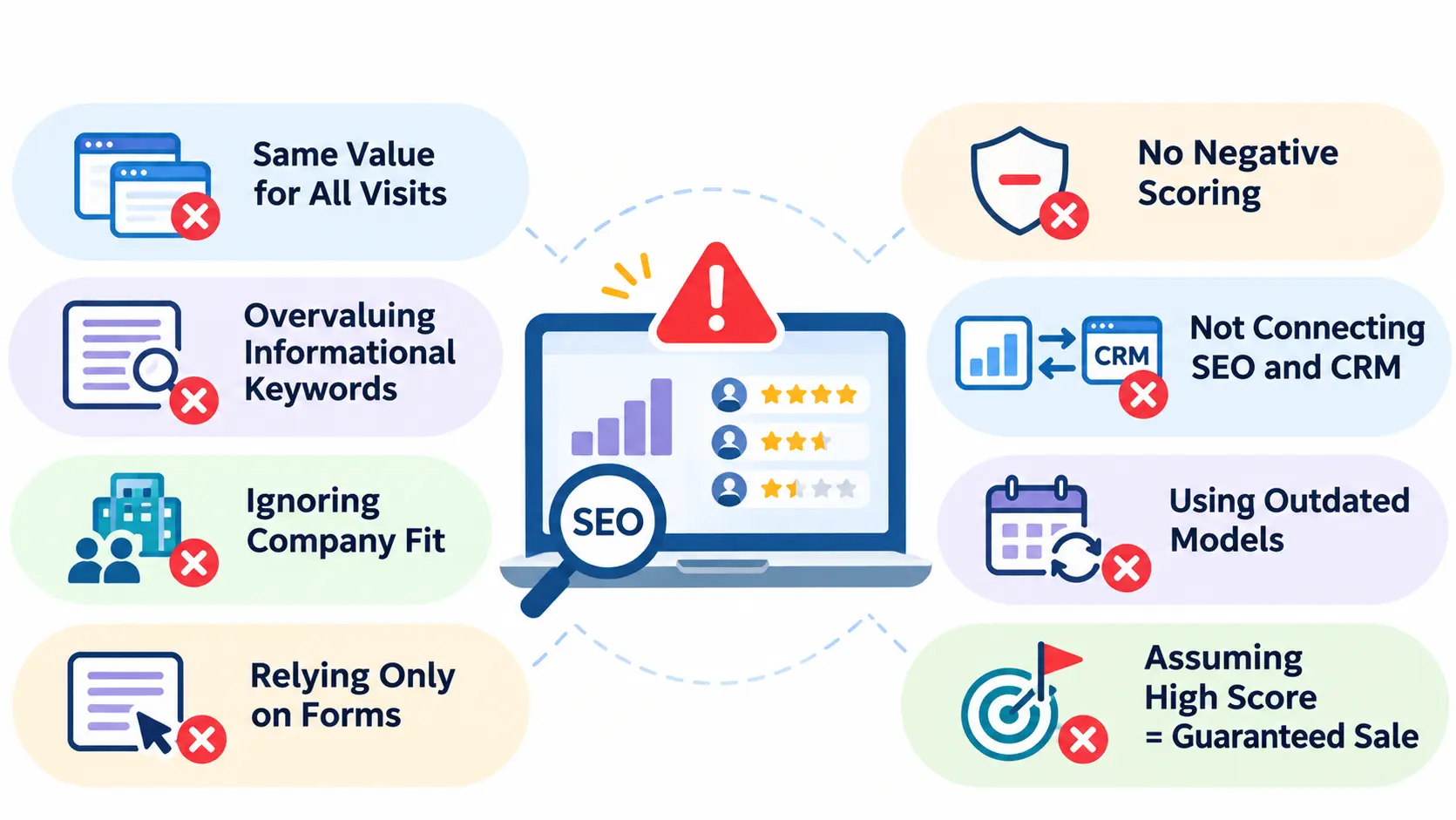
Common Mistakes to Avoid When Scoring Leads Based on SEO Intent
These are the errors I see most often when teams build their first model.
Treating Every Website Visit Equally
A visit to your pricing page and a visit to your careers page are not the same. Give points based on how closely the page relates to buying.
Giving Too Much Weight to Informational Keywords
Informational traffic is often your largest source. That volume can inflate scores and fill your pipeline with people who are only learning. Keep informational points low.
Ignoring Company and Contact Fit
High intent from the wrong company wastes sales time. Always include fit data in the score.
Relying Only on Form Submissions
Many buyers research for weeks before filling out a form. If you wait for a submission, you miss early signals. Track behavior too.
Ignoring Negative Scoring
Without penalties, spam, job seekers, and vendors can rise to the top. Add negative rules from day one.
Failing to Connect SEO and CRM Data
If your analytics data and CRM are separate, you can’t see which organic pages create customers. Connect them, even in a basic way.
Using Outdated Scoring Models
Your site, offers, and market change. A model built two years ago may reward pages you no longer have. Review it on a schedule.
Assuming a High Score Guarantees a Purchase
A score shows likelihood, not certainty. A lead with 90 points can still choose a competitor or lack budget. Use the score to decide who to contact first, not to forecast revenue on its own.
Best Practices for Improving SEO-Based Lead Scoring Accuracy
These habits make the difference between a model that sits unused and one your team trusts.
Focus on Commercial and Transactional Search Intent
Build content for commercial and transactional searches, such as service pages, comparison pages, and pricing pages. Businesses can strengthen their online visibility and attract qualified prospects through professional SEO and digital marketing services. These attract people closer to a decision. Then give those pages more scoring weight.
Combine Keyword Intent With Website Engagement
Intent alone can mislead. Someone may click a “best agency” result and leave after five seconds. Pair the entry signal with behavior to confirm real interest.
Use Both Behavioral and Firmographic Scoring
Behavior shows interest. Firmographics show fit. A good model needs both, so a visitor can’t reach a top score on only one.
Assign Different Scores to Different Conversion Actions
A consultation request should score far above a newsletter signup. Give each action a weight based on how often it leads to a sale.
Align Sales and Marketing Qualification Criteria
Sit down with sales and agree on what a “good lead” means. Ask reps which signals they trust. Communities such as sales and SEO on Reddit often show how practitioners talk about lead quality and where teams disagree. Treat those threads as opinions to test, not proof.
Regularly Validate Scores Against Revenue Outcomes
Check how many leads in each score band became customers. If the 60–79 group converts better than the 80–100 group, something is off. Fix the weights.
Maintain Data Privacy and Responsible Tracking Practices
Track users in line with the laws that apply to you, such as GDPR or similar rules, and with your cookie consent setup. Be clear in your privacy policy about what you collect. Responsible tracking protects both your customers and your business. Check with a legal professional for your specific case.
How to Measure the Success of Your SEO Lead Scoring Strategy
A scoring model only helps if it improves results. Track these metrics before and after you launch it.
| Metric | What it measures | Why it matters |
| MQL rate | Share of leads that reach marketing-qualified status | Shows if your score finds interested prospects |
| SQL rate | Share of MQLs that sales accepts as qualified | Shows if marketing and sales agree on quality |
| Lead-to-customer conversion rate | Share of leads that become customers | Shows the true value of your scoring |
| Sales acceptance rate | Share of passed leads that reps agree to work | Reveals trust in the score |
| Organic lead conversion rate | Share of organic visitors who become leads | Shows how well SEO pages convert |
| Sales cycle length | Time from first contact to closed deal | May shorten when you prioritize high-intent leads |
| Revenue from organic leads | Income traced to organic search | Connects SEO work to business results |
Here is a quick note on each:
- MQL rate: If almost every lead becomes an MQL, your threshold is too low.
- SQL rate: A rising SQL rate suggests your score is finding better leads.
- Lead-to-customer rate: This is the final test of the model.
- Sales acceptance rate: Low acceptance usually means reps don’t trust the score.
- Organic lead conversion rate: Use it to find pages that need improvement.
- Sales cycle length: Compare high-score and low-score leads.
- Revenue from organic leads: This is the metric leadership cares about most.
Frequently Asked Questions About SEO Intent-Based Lead Scoring
1. What Is SEO Lead Scoring?
SEO lead scoring is a method of ranking organic leads by buying readiness. It assigns points based on search intent, landing pages, website behavior, and fit with your ideal customer. Sales then focuses on the highest-scoring prospects first.
2. How Do You Score Leads Based on SEO Intent Signals?
Track organic leads and their landing pages, classify keywords by intent, assign points to each signal, add engagement and fit points, subtract penalties, and calculate a total. Then connect the score to your CRM and review results regularly.
3. What Are Examples of High-Intent SEO Keywords?
High-intent keywords include phrases like “hire an SEO agency,” “SEO services pricing,” “book a consultation,” “request a quote,” and “[your category] near me.” Comparison phrases such as “best” and “vs.” also show active evaluation.
4. Which SEO Signals Indicate That a Lead Is Ready to Buy?
Strong signals include searches for services or pricing, visits to pricing and comparison pages, case study views, repeat visits, and consultation or demo requests. They are strongest when the lead also matches your ideal customer profile.
5. How Do You Calculate a Lead Score?
Add points for intent, engagement, fit, and conversion actions. Then subtract penalties for negative signals. A simple formula is Lead Score = Intent + Engagement + Fit + Conversion − Penalties. Adjust the weights using your own sales data.
6. What Is the Difference Between Lead Scoring and Lead Grading?
Lead scoring measures interest and behavior, such as page visits and form submissions. Lead grading measures fit, such as job title, industry, and company size. Many teams use both: the score shows interest, and the grade shows how well the lead matches the ideal customer.
7. Can Google Analytics Help With Lead Scoring?
Yes, but only partly. Google Analytics 4 tracks landing pages, events, and conversions, which feed the behavior portion of a score. It does not calculate lead scores itself, so you need a CRM or spreadsheet to combine its data with fit information.
8. How Does AI Improve Intent-Based Lead Scoring?
AI can spot patterns across many signals, predict which leads are likely to convert, and automate routing. It works best with plenty of clean historical data. It still needs human review, since it can produce false positives and reflect past bias.
9. How Often Should Lead Scoring Models Be Updated?
Review your model at least once a quarter, and sooner after major changes to your site, offers, or market. Compare scores with real conversions each time, and adjust weights based on sales feedback.
10. What Is the Difference Between MQL and SQL?
An MQL, or marketing qualified lead, shows enough interest and fit to pass from marketing to sales. An SQL, or sales qualified lead, has been reviewed by sales and judged ready for a real sales conversation. The SQL stage comes later.
Conclusion
Not every organic lead is equal. The best way to find the strong ones is to score leads based on SEO intent signals and combine them with behavior and fit.
Start small. Classify your keywords by intent, tag your landing pages, and build a simple points table. Add engagement, fit, and negative scoring. Connect the result to your CRM, and check it against real sales outcomes.
Your first model will not be perfect, and it doesn’t need to be. Each review makes it sharper. Over time, your sales team will spend less time on weak leads and more on the people who are ready to talk.
Pick one step from this guide and do it this week. A simple spreadsheet with intent-based points is a good place to begin.