

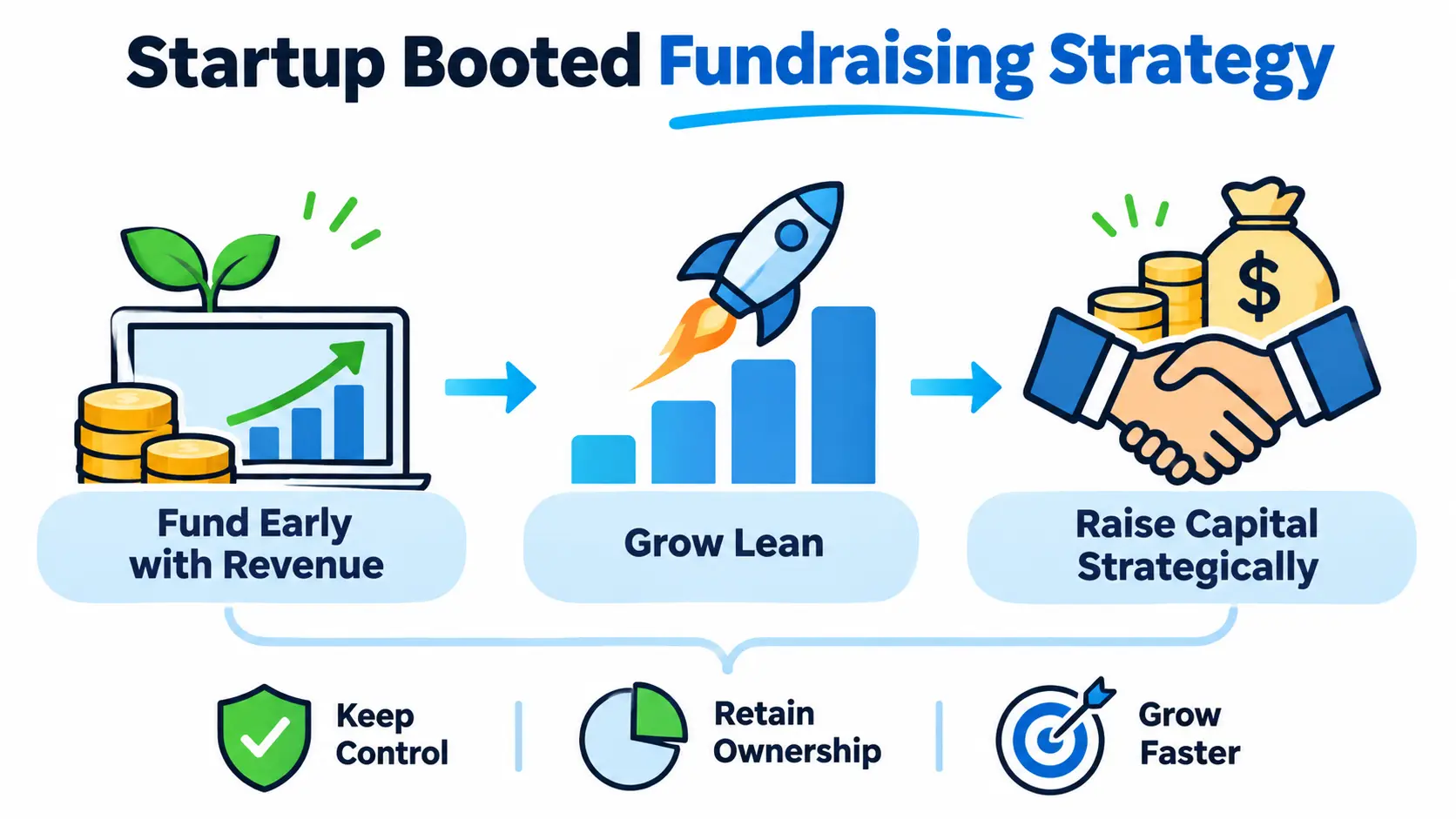
A startup booted fundraising strategy sits in the middle. You fund early growth with customer revenue and lean spending, then raise outside capital only when it clearly speeds up something that already works. You keep more ownership, and you negotiate from strength instead of need.
I have seen founders on both sides of this. Some raised too early and spent a year chasing a story instead of customers. Others refused help for so long that a well-funded competitor took their market.
This guide shows you how to avoid both traps. You will learn how the approach works, which funding sources fit, how to track your numbers, and how to approach investors on your terms.
What Is a Startup Booted Fundraising Strategy?
A startup booted fundraising strategy is a funding plan where a company grows first on revenue and founder resources, then adds selective outside capital at moments that justify it. It combines bootstrapping with planned, milestone-based fundraising.
Understanding the Meaning of Startup Booted Fundraising
“Booted” here is shorthand for bootstrapped. The founder starts with savings, early sales, and tight control of costs. Fundraising is not the starting point. It is a tool you pick up later, if and when you need it.
How Bootstrapping and Fundraising Work Together
Think of bootstrapping as building proof. Every paying customer shows that someone values what you make. That proof makes later fundraising easier and cheaper.
When you do raise, the money goes into a machine that already runs. Investors are no longer betting on an idea. They are funding growth.
Key Principles Behind a Revenue-First Funding Strategy
Five principles hold this approach together:
- Customer-funded growth. Paying users, preorders, and pilots cover early costs.
- Lean operations. You spend only where it moves a metric.
- Revenue reinvestment. Early profit goes back into product, marketing, and retention.
- Strategic external capital. Outside money has a defined job and a defined milestone.
- Founder ownership. You protect equity and decision-making power for as long as it makes sense.
Why Are More Startups Choosing a Bootstrapped Fundraising Strategy?
Founders choose this path because it gives them control, resilience, and better terms later. Cheaper software, no-code tools, and global freelancers also mean you can reach early revenue with far less cash than a decade ago.
Increasing Competition for Venture Capital
Venture capital funds a small share of companies, and many good businesses never fit its model. Investors look for very large outcomes. If your market is solid but modest, you may be better served by revenue than by a pitch deck.
Maintaining Founder Ownership and Decision-Making Control
Every round gives away some ownership and often some control. Staying independent longer lets you set pricing, hiring pace, and product direction without a board vote.
Building a Sustainable Revenue Model
A business that earns more than it spends can survive a slow market. That matters when funding tightens and investors ask harder questions.
Reducing Financial Dependency on Investors
If you must raise in six weeks or shut down, you will accept bad terms. If you have twelve months of runway, you can say no.
Improving Investor Negotiation Power
Revenue, retention, and clean books give you leverage. Investors compete for traction. They rarely compete for a plan.
Bootstrapping vs Traditional Fundraising: What Is the Difference?
Bootstrapping funds growth from the founder’s money and revenue. Traditional venture fundraising funds growth by selling equity to outside investors. The first trades speed for control. The second trades control for speed.
How Bootstrapped Startups Operate
Bootstrapped teams are small and focused. They sell early, price for profit, and watch cash weekly. Growth is steady and limited by what the business can afford.
How Venture-Backed Startups Operate
Venture-backed teams spend ahead of revenue to capture a market fast. They hire quickly and answer to investors who expect large returns. That pressure suits some businesses and crushes others.
Comparing Both Funding Approaches
| Factor | Bootstrapping | Venture Capital |
| Funding source | Personal funds and revenue | External investors |
| Ownership | Generally retained | Diluted |
| Growth approach | Revenue-driven | Capital-driven |
| Financial pressure | Cash flow | Investor expectations |
| Decision-making | Founder-led | May involve investors |
| Risk | Limited available capital | Equity and growth obligations |
| Scalability | Depends on available resources | Can accelerate expansion |
Which Funding Approach Is Better for Your Startup?
Neither is better in general. Ask three questions:
- Does your market reward speed, such as a winner-take-most network or marketplace?
- Can customers pay you early?
- Do you want a very large outcome, or a durable business you control?
If you answered yes to the first and no to the second, outside capital may be necessary. Otherwise, start by bootstrapping and keep the option to raise open.
Benefits and Challenges of a Startup Booted Fundraising Strategy
The main benefit is control. The main challenge is limited cash. Knowing both up front helps you plan around the hard parts.
Major Benefits
- Greater founder control. You decide what to build and when.
- Reduced equity dilution. You keep more of what you create.
- Improved financial discipline. Limited cash forces clear priorities.
- Stronger customer relationships. You listen closely because customers pay your bills.
- Sustainable business growth. You build on income, not on the next round.
Common Challenges
- Limited capital availability. Big bets are off the table.
- Slower expansion. Funded competitors may move faster.
- Increased founder responsibilities. You will wear many hats.
- Cash flow uncertainty. A late invoice can hurt.
- Difficulty competing with funded businesses. Marketing budgets will not match.
How to Overcome Common Bootstrapping Challenges
Focus on one customer type and one problem. Ask for payment upfront, such as annual plans or deposits, to smooth cash flow. Automate repeated tasks before hiring. Keep a cash buffer, and decide in advance what you will do if sales dip for two months.
If competitors outspend you, win on service, niche expertise, or speed of response. Large rivals struggle to copy those.
Best Funding Sources for a Startup Booted Fundraising Strategy
The best sources match your stage. Early on, use money that costs no equity. Later, add capital that fits your growth plan.
1. Personal Savings and Founder Contributions
This is the fastest and cheapest source. Only invest what you can afford to lose, and set a limit before you start.
2. Customer Revenue and Profit Reinvestment
Revenue is the best funding because it also validates demand. Reinvest into whatever drives the next sale or reduces churn.
3. Friends and Family Funding
This money comes quickly but carries personal risk. Put terms in writing, explain that the money could be lost, and avoid casual handshake deals.
4. Government Grants and Startup Programs
Many governments and universities offer grants, tax credits, or incubator support. They do not take equity, but applications take time and often come with reporting rules. Check your national or regional small business agency for current programs.
5. Crowdfunding Platforms
Crowdfunding raises small amounts from many people. On reward-based platforms such as Kickstarter and Indiegogo, backers receive the product or a perk, not equity. Other models include equity crowdfunding and donation-based campaigns, which have different legal rules. A successful campaign also proves demand before you build at scale.
6. Angel Investors
Angel investors are individuals who invest their own money, often at an early stage. Good ones also bring introductions and advice. They do take equity, so choose carefully.
7. Revenue-Based Financing
Revenue-based financing gives you capital in exchange for a share of future revenue until a fixed amount is repaid. It suits businesses with steady, predictable sales. It does not dilute ownership, but it reduces monthly cash.
8. Small Business Loans and Debt Financing
Loans keep your equity intact, but you must repay them regardless of how the business does. Many lenders ask for personal guarantees. Borrow only against cash flow you can predict.
9. Strategic Partnerships
A larger company may fund a pilot, co-develop a feature, or give you distribution. This can be powerful, but watch for exclusivity clauses that limit your options.
10. Paid Pilots, Preorders, and Customer Prepayments
Charging early customers is the most underused source on this list. A paid pilot proves that someone will pay, and the cash funds the build.
Comparing Different Startup Funding Sources
| Funding source | Equity required | Repayment | Advantages | Potential risks | Best stage |
| Personal savings | No | No | Fast, full control | Personal financial risk | Idea / pre-revenue |
| Customer revenue | No | No | Proves demand | Slower growth | All stages |
| Friends and family | Sometimes | Sometimes | Quick, flexible | Strained relationships | Pre-seed |
| Grants and programs | No | Usually no | Non-dilutive | Slow, competitive | Early |
| Crowdfunding | Rarely (reward-based) | No, but you must deliver | Demand validation | Public pressure, fulfilment costs | Pre-launch |
| Angel investors | Yes | No | Advice and network | Dilution | Pre-seed / seed |
| Revenue-based financing | No | Yes, share of revenue | No dilution | Reduces cash flow | Steady revenue |
| Loans | No | Yes | Keeps equity | Fixed obligations | Predictable cash flow |
| Strategic partnerships | Sometimes | Varies | Distribution, credibility | Dependence, exclusivity | Early to growth |
| Paid pilots / preorders | No | Deliver the product | Cash plus validation | Delivery risk | Early |
How to Build a Startup Booted Fundraising Strategy Step by Step
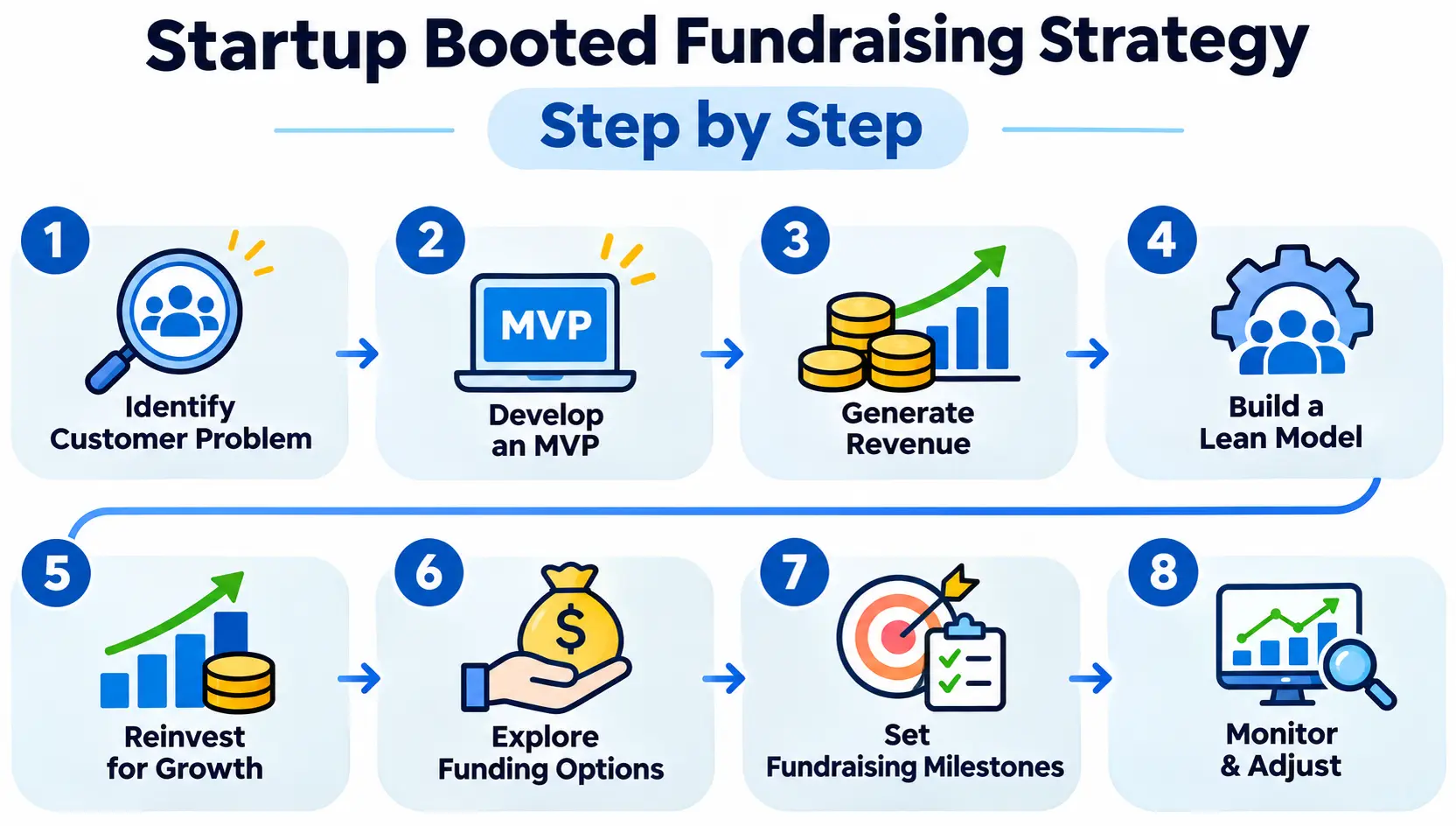
Start with a customer problem, earn revenue from it, and raise money only against clear milestones. Here is the sequence I recommend.
Step 1: Identify a Specific Customer Problem
Talk to at least 20 potential customers before you build. Ask how they solve the problem today, what it costs them, and what they have already paid for. If nobody has paid for a workaround, the problem may not be painful enough.
Step 2: Develop a Minimum Viable Product (MVP)
A minimum viable product is the smallest version that solves the core problem. It can be a landing page, a spreadsheet, or a manual service behind a simple interface. The goal is to test demand, not to impress. For startups that need to turn a validated idea into a working product, custom software development can help build an MVP around their core requirements.
Step 3: Generate Revenue Through Early Customers
Sell yourself, one customer at a time. Offer preorders or paid pilots at a fair price, not a free trial. Early customers also tell you what to fix.
Step 4: Build a Lean Operating Model
Use low-cost software, contractors for one-off work, and part-time help before full-time hires. Review each recurring cost every quarter and cancel what you do not use.
Step 5: Reinvest Revenue Into Business Growth
Rank spending in this order: product fixes customers ask for, retention, then acquisition. Keeping a customer is almost always cheaper than finding a new one.
Step 6: Identify Suitable Funding Opportunities
Compare non-dilutive options, such as grants, loans, and revenue-based financing, against equity. Pick the cheapest capital that fits your goal.
Step 7: Establish Fundraising Milestones
Tie each raise to a number. For example: “Reach $25,000 in monthly recurring revenue and under 3% monthly churn, then raise to build a sales team.” Milestones keep you from raising out of fear.
Step 8: Monitor Financial Performance and Adjust
Review cash, revenue, and costs every month. Update your forecast when assumptions fail. A plan that never changes is probably not being used.
How to Manage Startup Finances and Extend Your Cash Runway
Runway is how many months you can operate before cash runs out. Extending it gives you time to improve your numbers and negotiate better.
Understanding Startup Burn Rate
Burn rate is the amount of cash you spend each month. Gross burn is total monthly spending. Net burn is spending minus revenue. Net burn is the number that drives runway.
How to Calculate Startup Runway
Runway (months) = Cash in bank ÷ Net monthly burn
Example: you have $60,000 in the bank. You spend $15,000 a month and earn $10,000. Net burn is $5,000, so runway is $60,000 ÷ $5,000 = 12 months.
Creating a Realistic Startup Budget
List fixed costs first, such as salaries, software, and rent. Then add variable costs, such as ads and contractors. Assume revenue will come in lower and later than you hope.
Managing Monthly Cash Flow
Profit on paper does not pay bills. Track when cash actually arrives. Invoice quickly, offer a small discount for annual payment, and chase overdue accounts weekly.
Controlling Operational and Marketing Expenses
Test marketing channels with small budgets and keep only the ones that return more than they cost. Negotiate software contracts and avoid long commitments before you are sure of demand. Explore these small business marketing strategies to identify cost-effective channels for customer acquisition and sustainable growth.
Identifying Your Startup’s Break-Even Point
Break-even is the point where revenue equals costs. Divide fixed monthly costs by the profit each customer contributes. If fixed costs are $6,000 and each customer leaves $50 after variable costs, you need 120 customers.
Financial Modeling for Bootstrapped Startups
A financial model is a simple forecast of your revenue, costs, and cash. It tells you when you will run low and how much you need.
What Is Startup Financial Modeling?
Startup financial modeling means building a spreadsheet that projects the business forward based on stated assumptions. It is a decision tool first and an investor document second.
Important Components of a Startup Financial Model
- Revenue projections.
- Operating expenses.
- Cash flow forecasts.
- Balance sheet.
- Profit and loss statement.
- Customer acquisition costs.
- Gross margins.
- Break-even analysis.
Early on, a revenue forecast, expense list, and cash flow forecast are enough. Add the rest as you grow.
Bottom-Up vs Top-Down Revenue Forecasting
Top-down forecasting starts with a market size and assumes a small share. Investors distrust it because it is easy to inflate. Bottom-up forecasting starts with how many customers you can reach and convert, multiplied by price. It is more credible and more useful to you.
A Practical 12-Month Startup Financial Forecast
Here are the first four months of an illustrative forecast. Extend the same structure across all twelve months.
| Month | Customers | Revenue | Expenses | Net Cash Flow |
| January | 50 | $2,500 | $2,000 | $500 |
| February | 60 | $3,000 | $2,200 | $800 |
| March | 75 | $3,750 | $2,500 | $1,250 |
| April | 90 | $4,500 | $2,800 | $1,700 |
Illustrative figures only, not actual startup performance data.
How to Use Financial Models to Make Better Funding Decisions
A model shows the month cash turns negative and how deep the gap goes. That gap is roughly your funding need. Test scenarios too: what if churn doubles or sales take twice as long? If the plan only works in the best case, adjust it.
Key Financial Metrics Every Startup Founder Should Track
Track a few numbers consistently instead of many occasionally. These seven cover most decisions.
Monthly Recurring Revenue (MRR) and Annual Recurring Revenue (ARR)
MRR is predictable subscription revenue per month. ARR is MRR × 12. They show whether growth is steady.
Customer Acquisition Cost (CAC)
CAC is total sales and marketing spend divided by new customers won in the same period. If you spend $3,000 and win 30 customers, CAC is $100.
Customer Lifetime Value (LTV)
Customer lifetime value estimates the gross profit a customer brings over their time with you. A common rule of thumb is that LTV should be at least three times CAC, though this varies by business.
Gross Profit Margin
Gross margin is (revenue minus direct costs) ÷ revenue. It shows how much of each sale is left to pay for everything else.
Customer Churn and Retention Rate
Churn is the share of customers who leave in a period. Retention is the share who stay. High churn makes every growth tactic more expensive.
Monthly Burn Rate and Cash Runway
Watch these every month. A falling runway should trigger a decision, not a surprise.
Unit Economics and Break-Even Point
Unit economics ask whether you make money on a single customer after acquisition and service costs. If not, scaling only magnifies the loss.
When Should a Bootstrapped Startup Raise External Capital?
Raise when you can name what the money will do, and the evidence shows it will work. If you cannot connect each dollar to a milestone, wait.
Signs Your Startup Is Ready for Fundraising
- Customers pay and stay.
- Acquisition channels work, but you cannot afford to scale them.
- Unit economics are healthy.
- Demand is growing faster than your capacity.
- You have a clear plan for the next 12–18 months.
Situations Where Bootstrapping Is Still the Better Option
Stay independent if you are profitable, growth is steady, and your market does not punish slower movers. Do not raise just because peers announce rounds.
When Venture Capital Becomes Necessary
Venture capital makes sense when the market is winner-take-most, when the product needs heavy upfront investment such as hardware or deep research, or when a competitor is buying the market quickly.
How to Determine the Right Fundraising Amount
Build the number from your plan. Add monthly operating expenses, hiring, product development, and marketing. Subtract expected revenue to get net burn. Multiply by the months needed to reach your next milestone, then add a reserve.
Example:
- Operating expenses: $12,000 per month
- New hires: $8,000 per month
- Product development: $2,000 per month
- Marketing: $3,000 per month
- Expected revenue: –$5,000 per month
- Net burn: $20,000 per month
- Runway target: 18 months, so $360,000
- Contingency reserve (20%): $72,000
Total to raise: about $432,000, which you might round to $450,000.
How to Prepare Your Startup for Investors
Prepared founders raise faster and with less stress. Build these materials before your first meeting.
Build a Strong Startup Pitch Deck
Keep it short and honest. Cover these slides:
- Problem
- Solution
- Product
- Target market
- Business model
- Traction
- Competition
- Go-to-market strategy
- Team
- Financial projections
- Use of funds
- Fundraising requirements
Lead with traction. For a bootstrapped company, real revenue is your strongest slide.
Create an Investor-Ready Financial Model
Use clear assumptions, separate inputs from formulas, and show a base case and a downside case. Investors will test your numbers, so know them cold.
Organize Your Startup Data Room
A data room is a shared folder with your key documents: incorporation papers, contracts, financial statements, metrics, and IP records. Having it ready signals professionalism and speeds up due diligence.
Prepare Your Cap Table
A cap table lists who owns what. Clean up old promises and unsigned equity before investors find them.
Collect Customer Testimonials and Business Performance Evidence
Gather case studies, retention data, and short quotes from happy customers. Proof from real users carries more weight than any claim in a deck.
How to Find and Approach the Right Startup Investors
Start with investors who already back companies like yours. Warm introductions beat cold messages, and relationships built early beat both.
Identifying Relevant Angel Investors and Venture Capital Firms
Look at which companies a firm has funded, at what stage, and in which sector. Check their typical cheque size. Skip anyone who does not match your stage.
Using Startup Accelerators and Founder Networks
Accelerators, alumni groups, and communities such as startups can offer advice and introductions. Treat Reddit as a place to learn from other founders’ experiences, not as a source of investment advice you accept without checking.
Building Investor Relationships Before Fundraising
Share a short update every month or two, even before you raise. When you finally ask, they already know your progress. Many founders also research and connect with investors on LinkedIn to follow their interests and mutual contacts.
Writing Effective Investor Outreach Emails
Keep it under 150 words. Open with why this investor, give two or three proof points, state your ask, and make the next step easy.
Following Up With Potential Investors
Follow up after a week, then again after another week with a new update such as a signed customer. After that, move on politely.
Investor outreach email template
Subject: [Company] – [one-line result], raising $[amount]
Hi [Name],
I saw your investment in [portfolio company] and thought our work might interest you.
[Company] helps [customer] solve [problem]. We have [X paying customers], [$Y] in monthly revenue, and [Z%] retention, funded entirely by revenue so far.
We are raising $[amount] to [specific milestone]. Would you be open to a 20-minute call next week? I can send a short deck first.
Thanks, [Name]
Understanding Equity Dilution, SAFE Notes, and Convertible Notes
Before you sign anything, understand how it changes your ownership. Small wording differences can cost real money later.
What Is Equity Dilution?
Dilution happens when new shares are issued, so each existing share represents a smaller percentage of the company. You still own the same number of shares, but they are a smaller slice.
How Founder Ownership Changes After Investment
Suppose two founders own 100% of a company. An investor puts in $500,000 at a $4.5 million pre-money valuation. Post-money valuation is $5 million, so the investor owns 10%. The founders now own 90% together.
If you later add a 10% option pool for employees and raise another round, your share drops again. Plan for several rounds, not one.
What Is a SAFE Agreement?
A SAFE (Simple Agreement for Future Equity) lets an investor give you money now in exchange for shares in a later priced round. It is not debt and has no interest or repayment date. Y Combinator publishes standard SAFE documents that many startups use.
What Is a Convertible Note?
A convertible note is a short-term loan that converts to equity at a later round. It usually carries interest and a maturity date.
SAFE vs Convertible Note: Key Differences
| Feature | SAFE | Convertible note |
| Legal form | Contract for future equity | Debt |
| Interest | No | Usually yes |
| Maturity date | No | Yes |
| Repayment risk | None | Possible at maturity |
| Complexity | Simpler | More terms to negotiate |
Important Investment Terms Founders Should Understand
- Pre-money valuation: your company’s value before new money comes in.
- Post-money valuation: pre-money plus the new investment.
- Valuation cap: the maximum valuation at which a SAFE or note converts.
- Discount rate: a reduced price early investors get compared with later investors.
- Board seats: the right to appoint directors who vote on major decisions.
- Liquidation preference: the right of investors to be paid first when the company is sold. See liquidation preference.
- Voting rights: the power shareholders hold over key decisions.
- Option pool: shares reserved for employees, which usually dilutes existing owners.
Have a startup lawyer review every document. This article is educational and not legal or financial advice.
Common Mistakes to Avoid in Startup Booted Fundraising
Most errors come from raising for the wrong reason or at the wrong time.
Raising Capital Before Validating Customer Demand
Money cannot fix a product nobody wants. Validate first, raise second.
Giving Away Too Much Equity Too Early
Early equity is the most expensive. Raise the smallest amount that gets you to a real milestone.
Ignoring Cash Flow and Financial Forecasting
Many companies with growing sales still run out of cash. Update your forecast monthly.
Choosing Investors Without Checking Their Compatibility
You will work with them for years. Speak to founders they have backed, including those whose companies failed.
Confusing Revenue Growth With Profitability
Rising sales mean little if each customer loses you money. Check margins and unit economics.
Raising Without a Clear Use-of-Funds Plan
Vague plans produce wasted spending. Write down where each dollar goes and what result it should create.
Delaying Fundraising When Capital Is Actually Necessary
Bootstrapping is a strategy, not a vow. Raising while you are growing is far easier than raising with two months of cash left.
Real-World Examples of Successful Bootstrapped Startup Growth
These companies show how revenue-first growth works. Each followed a different path, so read their histories closely.
Mailchimp: Growing Through Customer Revenue
Mailchimp began in 2001 and grew for years without outside venture funding, reinvesting revenue from its email marketing customers. It was later acquired by Intuit in 2021. The lesson: patient, customer-funded growth can build a very valuable company.
Basecamp: Building a Sustainable Business
Basecamp, from 37signals, grew from a web design consultancy that used its own project tool and turned it into a product. The company has long stressed profitability and independence, although it did accept a minority investment from Bezos Expeditions in 2006. The lesson: a small, profitable team can last.
GitHub: Bootstrapping Before Institutional Investment
GitHub launched in 2008 and was profitable for years without outside funding. It took its first major venture round, from Andreessen Horowitz, in 2012, and Microsoft acquired it in 2018. The lesson: bootstrapping first can lead to a stronger position when you do raise.
Lessons Founders Can Learn From These Businesses
All three earned money before they sought it. None of them stayed purely bootstrapped forever, and each outside event came after the business had proven itself. Verify details on any company you cite yourself, since funding histories are often simplified.
Best Tools for Managing Startup Finances and Fundraising
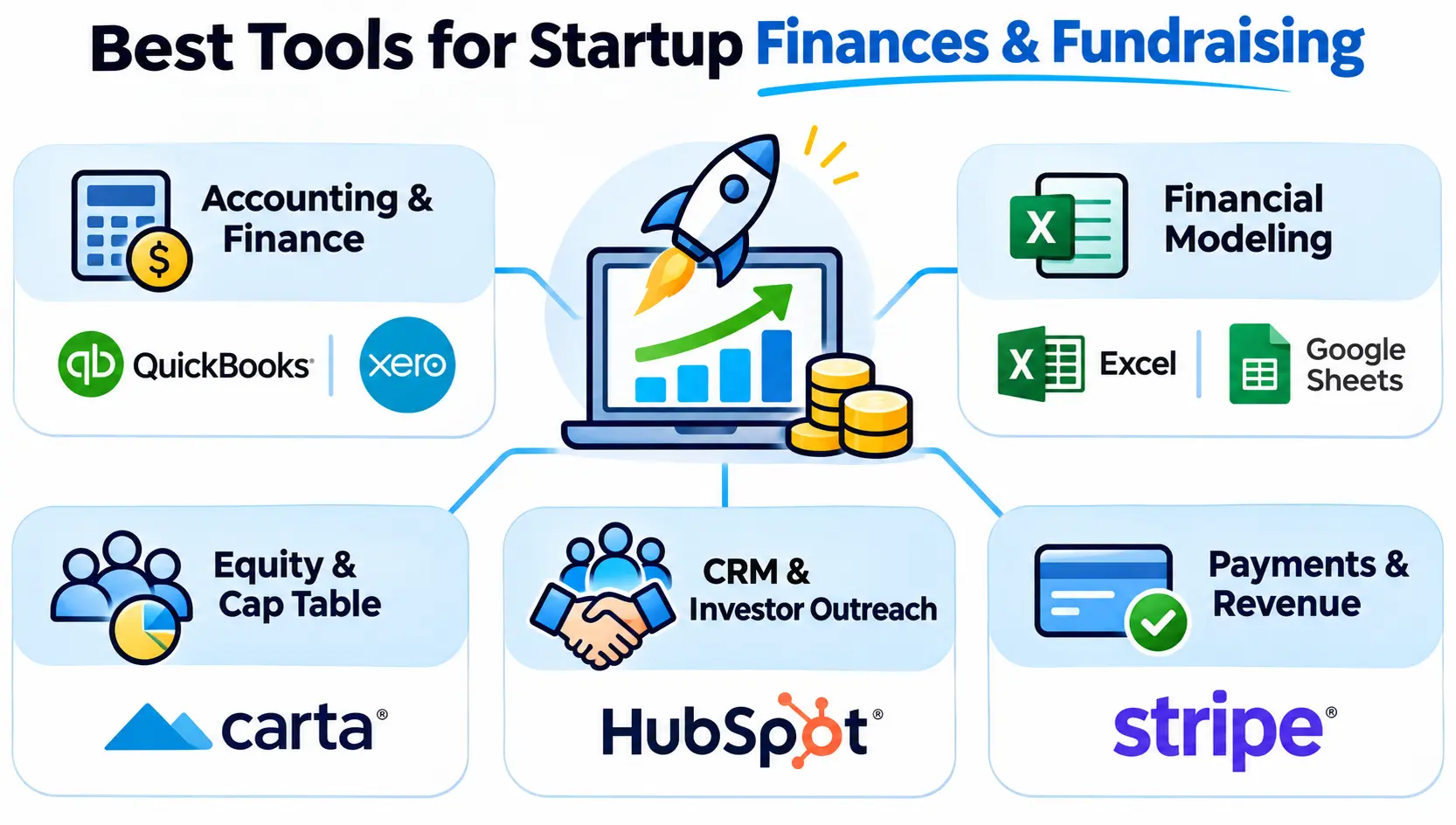
Choose tools that solve a specific job. Do not buy a stack you will not use. You can also explore these startup growth tools to find practical solutions for CRM, analytics, automation, and customer management.
Accounting and Financial Management Tools
QuickBooks and Xero track income, expenses, invoices, and taxes. Use one from day one so your books are clean when investors ask.
Financial Modeling and Forecasting Tools
Excel and Google Sheets are enough for most early-stage models. They are flexible, familiar to investors, and easy to share.
Equity and Cap Table Management Tools
Carta helps you track shareholders, issue equity, and model future rounds. Spreadsheets work at first, but a dedicated tool prevents errors as the cap table grows.
Customer Relationship and Investor Outreach Tools
HubSpot and similar CRM platforms let you track customers and also manage your investor pipeline, including who you contacted, when, and what they said.
Payment and Customer Revenue Management Tools
Stripe handles online payments, subscriptions, and invoicing. It also provides revenue data that feeds directly into metrics such as MRR and churn.
Frequently Asked Questions About Startup Booted Fundraising Strategy
1. What is a startup booted fundraising strategy?
It is a funding approach where a startup grows with revenue and founder resources first, then raises outside capital selectively once it has proof of demand and a clear use for the money.
2. Is bootstrapping better than raising venture capital?
Not always. Bootstrapping keeps control and ownership. Venture capital provides speed and resources. The right choice depends on your market, goals, and how quickly you must grow.
3. Can a bootstrapped startup raise funding later?
Yes. Many do, often on better terms because they can show revenue, retention, and lower risk.
4. How can startups raise money without giving up equity?
Use customer revenue, paid pilots, preorders, grants, crowdfunding (reward-based), revenue-based financing, or loans.
5. What are the best funding sources for early-stage startups?
Savings, early customer payments, and preorders usually come first. Angel investors, grants, and small loans can follow as the business matures.
6. When should a startup start fundraising?
Start when you have clear traction, a specific milestone to reach, and at least six to nine months of runway. Fundraising often takes longer than expected.
7. How much equity should founders give investors?
There is no fixed number. Early rounds commonly sell somewhere around 10–25%, but this varies widely. Raise only what your milestone requires.
8. What financial metrics do investors look at?
They usually review MRR or ARR, growth rate, CAC, LTV, gross margin, churn, burn rate, and runway.
9. How do you calculate the startup runway?
Divide your cash balance by your net monthly burn. With $60,000 cash and $5,000 net burn, you have 12 months.
10. Can a startup grow without venture capital?
Yes. Many companies grow through customer revenue, reinvestment, and non-dilutive funding. Venture capital is one option, not a requirement.
Conclusion
A startup booted fundraising strategy gives you a simple order of operations. Prove demand, earn revenue, understand your numbers, and then raise money for a specific purpose.
This path will not suit every startup. If your market demands speed, raise earlier. But even then, the habits you built, such as lean spending and clear metrics, will make you a stronger founder.
Your next step is small. Calculate your runway this week, write down your next milestone, and decide what the business needs to reach it. Then choose the funding source that gets you there at the lowest cost to your ownership and control.