

An Android cloud phone is an Android device that runs on a remote server instead of in your pocket. You control it from a browser, desktop app, or mobile app, and it keeps running even when you close the tab.
That sounds simple, but the market is messy. Some products give you real physical phones in a data center. Others give you virtual Android instances. A few are developer tools or AI-agent infrastructure that happen to run Android.
This guide compares ten of the best Android cloud phones in [this_year] using one consistent framework. It also explains how the categories differ, what to check before you pay, and how to avoid common mistakes.
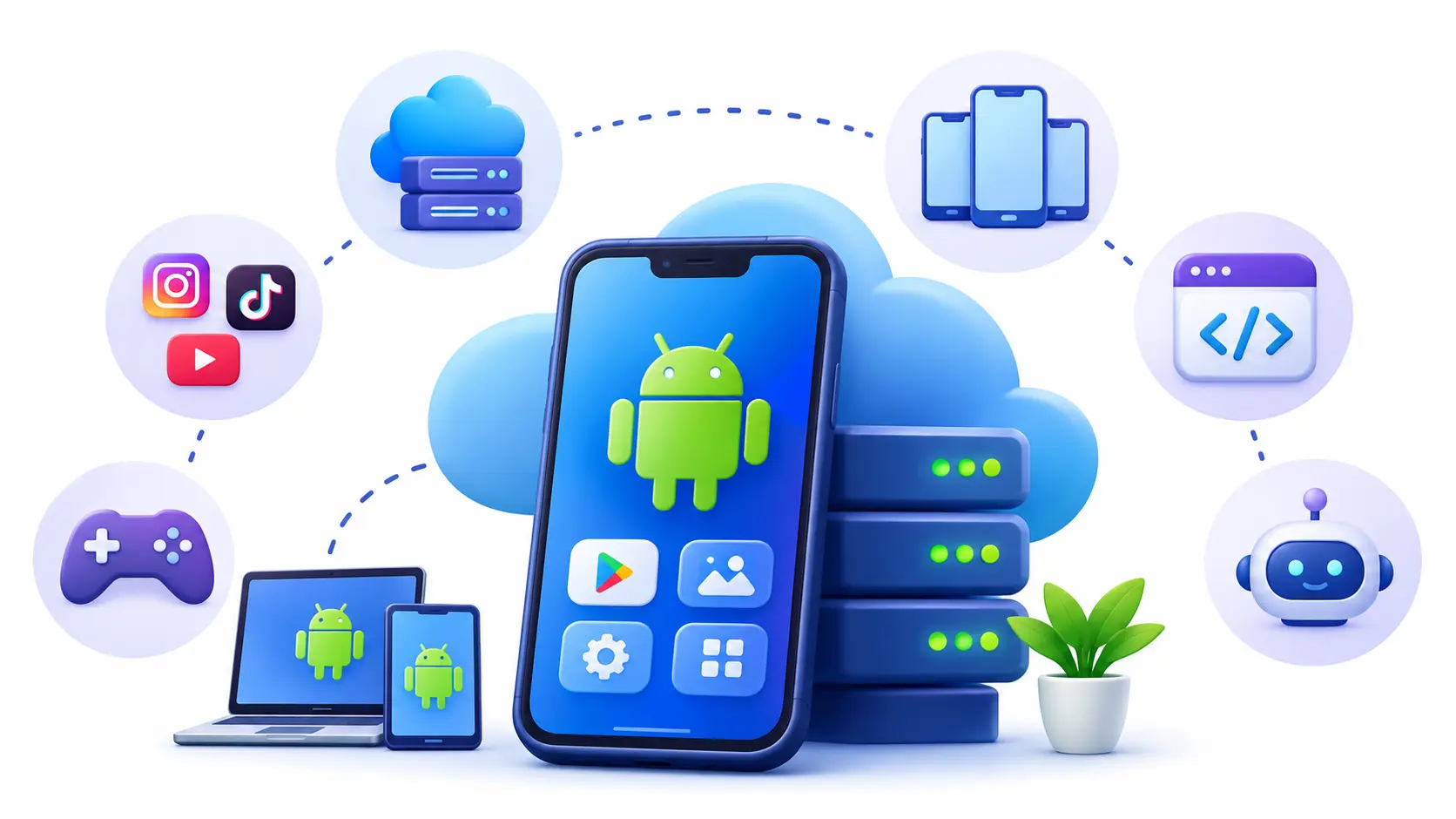
Best Android Cloud Phones in [this_year] at a Glance
The ten products below are a shortlist, not a ranking of ten identical tools. Some are built for account operators and agencies. Others are built for developers or AI agents. Comparing them fairly means judging each against its own purpose.
How this comparison works. Each provider is reviewed against the same criteria: Android environment (physical or virtual), device management, automation, team features, pricing model, and trade-offs. Pricing is described by model, not by number, because plans change. Always confirm current rates on the provider’s pricing page.
Quick picks by user type:
- Multi-account workflows: BitCloudPhone
- Social media teams: GeeLark
- Large device fleets: DuoPlus
- Flexible Android access: VMOS Cloud
- Always-on remote Android: Redfinger
- Browser plus mobile workflows: Multilogin, GoLogin, MoreLogin
- App development and testing: Genymotion
- AI-agent workflows: MobileRun
| Provider | Best for | Device type | Pricing | Key feature |
| BitCloudPhone | Multi-account workflows | Confirm on provider site | Check provider site | Device management |
| GeeLark | Social media | Virtual Android (confirm) | Check provider site | Automation |
| DuoPlus | Large device fleets | Virtual Android (confirm) | Check provider site | Bulk management |
| VMOS Cloud | Flexible Android access | Confirm on provider site | Check provider site | Device configurations |
| Redfinger | Remote Android access | Confirm on provider site | Check provider site | Persistent sessions |
| Multilogin | Browser + mobile workflows | Confirm on provider site | Check provider site | Unified management |
| GoLogin | Browser + Android workflows | Confirm on provider site | Check provider site | Browser profiles |
| MoreLogin | Synchronized workflows | Confirm on provider site | Check provider site | Synchronization |
| Genymotion | App development | Virtual Android | Check provider site | Developer testing |
| MobileRun | AI-agent workflows | Confirm on provider site | Check provider site | API integration |
Do not treat virtual Android and physical Android hardware as interchangeable. They behave differently, and I explain why later in this guide.
10 Best Android Cloud Phones in [this_year]
Each review follows the same order so you can scan across products. Remember that the last two entries serve more specialized audiences.
1. BitCloudPhone – Best for Multi-Account Management
What it is. BitCloudPhone is a cloud phone service aimed at people who run several mobile accounts and want them organized in one place.
Main features. Expect a dashboard for creating, naming, and grouping remote Android devices. Confirm the exact Android versions and device type (physical or virtual) on the official site.
Multi-device management. This is its core pitch. Grouping devices by project or client keeps larger setups manageable.
Pricing. Check the current plans. Confirm whether billing is per device, per month, or by usage.
Advantages. Focus on multi-account organization; simple mental model for account operators.
Disadvantages. Less public documentation than larger brands, so verify specs and support quality yourself.
Who should use it. Freelancers and small teams who manage many mobile accounts and want a dedicated tool.
2. GeeLark – Best for Social Media Management
Overview. GeeLark is built around social media and e-commerce teams that need many separate Android environments.
Android environment. It is generally positioned as a virtual cloud phone. Confirm the current architecture on its site.
Social media workflows and automation. It is known for automation features such as scheduled tasks and no-code workflows. Test them with your own apps before committing.
Team collaboration. Team roles and shared device access are part of the pitch. Check which plans include them.
Pricing. Plans typically scale with device count and features. Verify current tiers.
Pros and cons. Strong automation focus for social teams. The trade-off is that automation tools add a learning curve, and platform rules still apply to what you automate.
Best use cases. Agencies posting across many client accounts; small brands testing content on several profiles.
3. DuoPlus – Best for Large-Scale Device Management
Overview. DuoPlus targets users who need many cloud phones at once.
Dashboard and bulk operations. Its main appeal is managing fleets: applying settings, installing apps, or running actions across many devices together.
Android versions and automation. Check which Android versions are offered and what automation or API options each plan includes.
Pricing structure. Fleet-oriented pricing usually rewards volume. Ask whether bulk discounts apply at your scale.
Pros and cons. Good fit when you are past five or ten devices. For one device, a simpler tool may cost less.
Best use cases. Agencies, e-commerce operators, and teams running repetitive mobile tasks at scale.
4. VMOS Cloud – Best for Flexible Android Environments
Overview. VMOS Cloud provides virtual Android devices you access remotely. It is popular with people who want a flexible, configurable Android environment.
Virtual Android and device configurations. You can typically choose among device configurations and Android versions. Confirm current options.
App compatibility. Virtual environments can differ from real phones. Test the apps you rely on before paying for a long plan.
Pricing options. It has historically offered several plan lengths and tiers. Check what is available now.
Pros and cons. Flexible and approachable. Because it is virtual, some apps with strict device checks may behave differently.
Best use cases. Individual users and small teams who want configurable remote Android without a big commitment.
5. Redfinger – Best for Remote Android Access
Overview. Redfinger is one of the longer-running cloud Android services. It is built around keeping an Android device online remotely.
Remote access and persistent operation. The device keeps running in the cloud, so background tasks continue after you disconnect.
Gaming and business apps. Many people use it for idle games and long-running app tasks. Others use it for light business app access.
Plans. Plans have usually been tiered by performance and duration. Confirm current options.
Pros and cons. Easy to understand and good for always-on use. It is less focused on team management than agency-oriented tools.
Best use cases. Gamers, hobbyists, and anyone who needs one or a few always-on Android devices.
6. GoLogin – Best for Browser Profile Integration
Overview. GoLogin is also a browser profile tool. It has been adding Android-related capabilities, so verify what is currently live.
Cloud Android and browser profiles. The appeal is pairing browser profiles with cloud Android under one account.
Supported workflows. Check which mobile workflows are supported and which are still browser-only.
Pricing. Typically plan-based. Confirm how Android features are priced.
Pros and cons. Familiar interface for existing users. Android features may be newer than its browser features.
Best use cases. Existing GoLogin users who want to add Android without switching vendors.
7. MoreLogin – Best for Synchronized Operations
Overview. MoreLogin combines browser profile management with a cloud phone product.
Cloud phone features and synchronization. Synchronized control lets you perform one action across multiple devices, which saves time in repetitive workflows.
Browser integration. Like other profile platforms, it lets you manage web and mobile from one place.
Pricing. Check how cloud phones are billed relative to browser profiles.
Pros and cons. Good for repetitive, multi-device actions. Synchronization is only useful if your workflow actually repeats across devices.
Best use cases. Teams that run the same tasks on many devices at once.
8. Genymotion – Best for Android App Development and Testing
Overview. Genymotion is a developer tool, not a consumer cloud phone. Its cloud product provides virtual Android devices for testing apps.
Virtual infrastructure and testing. It lets developers spin up Android virtual devices in the cloud and test across versions and configurations.
Developer integrations. It is designed to plug into CI pipelines and development workflows. Review its documentation for supported tools.
Pricing. Developer-oriented, often usage-based. Confirm current billing.
Pros and cons. Excellent for QA and engineering teams. Not designed for social media account management.
Best use cases. Mobile developers and QA teams testing apps across Android versions.
9. MobileRun – Best for AI Agent and Mobile Automation Workflows
Overview. MobileRun is positioned around AI agents that operate mobile devices. Confirm its current product scope on the official site.
AI-agent integration, API, and SDK. The idea is that an agent can call an API to control a remote Android device, instead of a person tapping a screen.
Device persistence and automation. Check whether device state persists between sessions, since agents often need continuity.
Pricing. Likely usage or developer-plan based. Verify directly.
Pros and cons. Promising for teams building agents. It is not aimed at casual users who just want a second phone in the cloud.
Best use cases. Developers and automation teams building AI-driven mobile workflows.
A note on categories. Genymotion and MobileRun serve developers and AI builders. The other eight are closer to everyday cloud phone tools. I included both groups because people search for “Android cloud phone” with very different goals.
What Is an Android Cloud Phone?
An Android cloud phone is a remotely hosted Android device you operate over the internet. The phone’s processor, memory, and storage live on a provider’s servers. You see and control it through a streamed screen.
The idea builds on cloud computing, where computing resources run in remote data centers. Android itself is open-source, which is why providers can run it on many kinds of hardware. Understanding the differences between web apps and mobile apps also helps explain how cloud phones provide remote access to Android applications.
How Does an Android Cloud Phone Work?
The process has a few moving parts:
- Remote infrastructure. The provider runs Android on servers in a data center.
- Screen streaming. The device’s screen is sent to you as video, and your taps and swipes are sent back.
- App installation. You install apps on the remote device, usually through an app store, an uploaded APK, or provider tools.
- Storage. Apps and files are stored on the remote device, not on your computer.
- Remote controls. You use a dashboard to restart, reset, or configure the device.
Because the device stays on the server, it can keep running after you log off.
What Are the Different Types of Android Cloud Phones?
Physical Android Cloud Phones
These are real smartphones hosted in a data center and controlled remotely. They run native Android on real hardware. They tend to cost more, and capacity per server is limited.
Virtual Android Cloud Phones
These are Android instances running as virtual machines or containers on server hardware. Many instances can share one server, which makes them cheaper and easier to scale. The trade-off is that behavior can differ from a real phone.
Android Emulators Hosted in the Cloud
An emulator imitates a device’s hardware in software. A hosted emulator is simply an emulator running on a remote machine. Google’s own Android Emulator documentation explains how emulation is used in development. Emulators are great for testing but are not meant to mirror a real phone perfectly.
Many providers blur these terms in marketing. Always ask directly which one you are buying.
Why Do People Use Android Cloud Phones?
Managing Multiple Mobile Accounts
A freelancer with ten client accounts can keep each one on its own remote device. Nothing gets mixed up, and nothing needs to sit on a personal phone.
Running Android Applications Remotely
Some people need an Android app on a laptop or an iPhone. A cloud phone gives them that without buying extra hardware. Businesses involved in ecommerce app development can also use remote Android environments to test app functionality and compatibility.
Social Media Management
Agencies use cloud phones to give each client or brand a separate mobile environment. Teams can share access without passing phones around.
Mobile Gaming and Background Tasks
Casual gamers use cloud phones to keep idle games running while their own device is off. This is one of the oldest uses.
Android App Development and Testing
Developers test apps across Android versions without owning every device. Proper testing of mobile applications helps identify compatibility, functionality, and performance issues before deployment. Discussions in communities like android dev show how often device fragmentation comes up in real projects.
AI Agents and Mobile Automation
AI agents need a device to act on. A cloud phone with an API gives them one, without tying up a personal phone.
Remote Team Collaboration
A small business can share one company app account across staff by sharing a cloud device, with permissions set by an admin.
Android Cloud Phones vs Android Emulators vs Physical Smartphones
| Feature | Cloud phone | Android emulator | Physical smartphone |
| Remote access | Yes | Depends on setup | Requires remote access software |
| Local hardware requirements | Generally low | Depends on emulator | Physical device required |
| Android environment | Remote | Emulated | Native |
| Maintenance | Provider-dependent | User-managed | User-managed |
| App compatibility | Environment-dependent | Emulator-dependent | Native Android compatibility |
| Scalability | Plan-dependent | Hardware-dependent | Requires more devices |
| Pricing | Subscription or usage | Free or paid software | Hardware purchase |
When Should You Choose a Cloud Phone?
Choose a cloud phone when you need remote access, always-on operation, or several devices without buying hardware.
When Is an Android Emulator Better?
An emulator is better for development and testing, especially when you want free tools and full control over the environment.
When Should You Use a Physical Smartphone?
Use a real phone when you need full native compatibility, such as banking apps, camera features, or apps that check hardware closely.
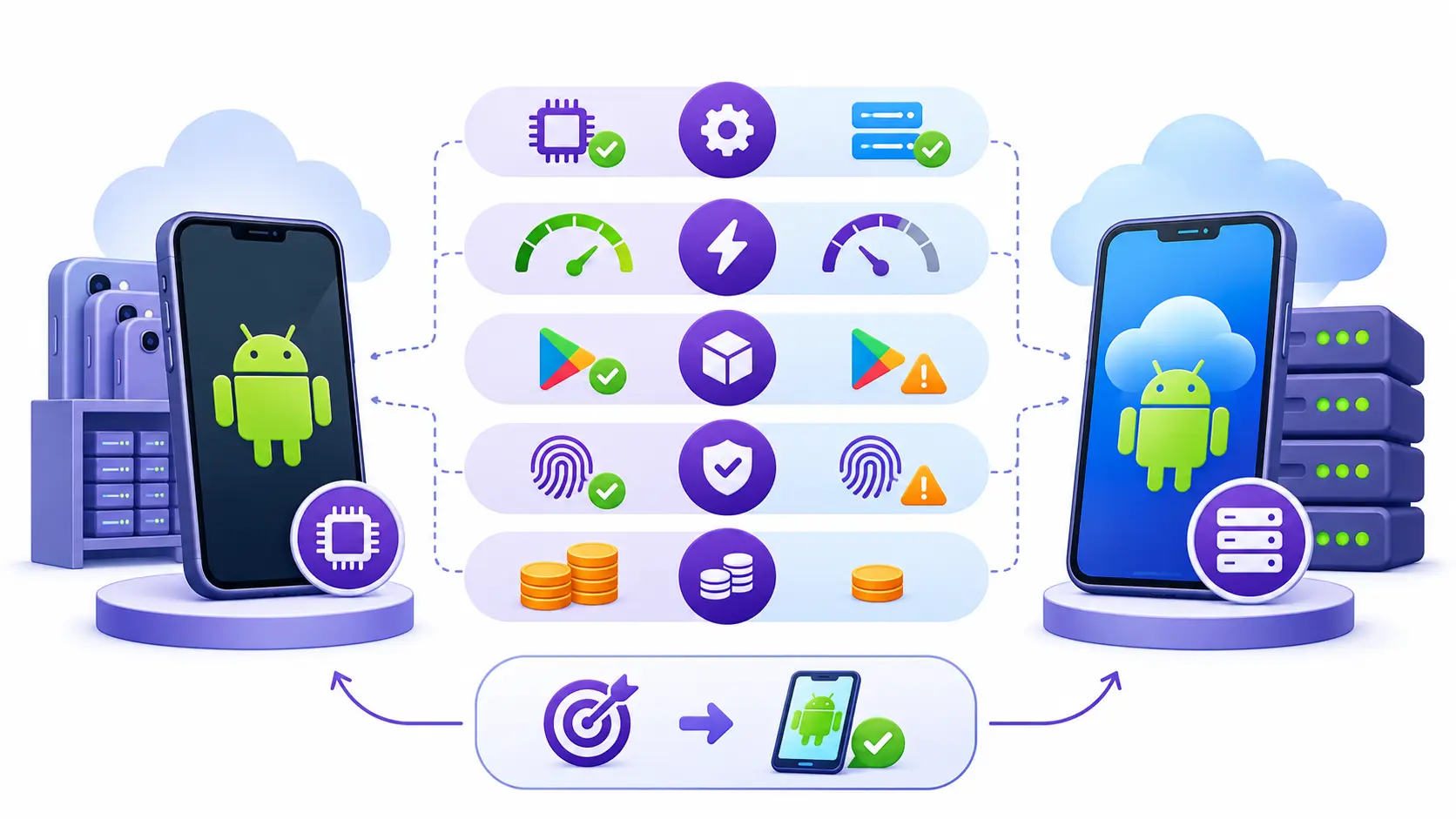
Physical vs Virtual Android Cloud Phones: What Is the Difference?
Hardware and Device Architecture
Physical cloud phones run on actual phone hardware. Virtual ones run on server processors that imitate a phone environment.
Performance and Resource Allocation
Virtual instances share server resources, so performance depends on how the provider allocates them. Physical devices have fixed hardware, which is predictable but limited.
App Compatibility
Physical devices usually offer the closest match to a real phone. Virtual environments can have gaps, especially with apps that rely on specific hardware features.
Device Identity and Virtualization
Some apps check whether they are running in a virtualized environment. Results vary by app and change over time. No provider can guarantee otherwise.
Cost and Scalability
Virtual devices are usually cheaper and scale faster. Physical devices cost more per unit but may suit apps that need native behavior.
Which Type Should You Choose?
Start with your most important app. Test it on a short plan. If it works reliably, then scale up with the same type.
How to Choose the Best Android Cloud Phone
Android Version and App Compatibility
Make sure the offered Android version supports your apps. Newer apps may require a recent version.
CPU, RAM, and Storage
Match resources to your workload. A single social app needs far less than a heavy game.
Device Performance and Streaming Quality
Streaming quality depends on your connection and the provider’s servers. Test latency before committing.
Multi-Device Management
If you will run more than a few devices, look for grouping, bulk actions, and shared team access.
Automation and API Support
Check whether the plan includes automation tools or an API, and whether they cost extra.
Network Configuration and Server Locations
Server location can affect speed and regional app behavior. Check available regions and proxy support.
Security and Privacy Controls
Look for two-factor authentication, role-based access, and clear data policies.
Pricing and Billing Transparency
Prefer providers that clearly list what is included and what costs extra.
Customer Support and Reliability
Check support channels and response times. Read independent user feedback on forums such as Reddit before buying.
Pre-purchase checklist:
- Is the device physical or virtual?
- Does my key app run on a short trial?
- What Android version is offered?
- What does the plan include, and what costs extra?
- Can I export or back up my data?
- Is there a refund or cancellation policy?
- Does the provider offer team permissions?
How Much Does an Android Cloud Phone Cost in [this_year]?
Prices vary widely by provider, device type, and resources. I am not listing exact rates because they change often. Use the models below to compare.
Monthly Subscription Pricing
Most consumer-focused tools charge a fixed fee per device per month. Longer plans often reduce the monthly rate.
Pay-As-You-Go Pricing
Developer-oriented tools often bill by runtime or usage. This suits occasional testing but can surprise you with always-on use.
Dedicated Device Pricing
Physical devices usually cost more, since each one occupies real hardware.
Additional Costs to Consider
- Proxy subscriptions if you need specific network locations
- Device runtime on usage-based plans
- Extra storage
- RAM and CPU upgrades
- Additional team members
- API usage
- Data transfer
Example Monthly Cost for Different Device Requirements
These are illustrative formulas, not quotes. Replace each variable with the provider’s current rate.
| Setup | Devices | How to calculate |
| Individual user | 1 | Base plan + extras |
| Small team | 5 | (Device price × 5) + team seats |
| Growing agency | 10 | (Device price × 10) + proxies + upgrades |
| Large operation | 20 | (Bulk device price × 20) + proxies + infrastructure |
Worked example (hypothetical numbers only): if a device costs $10 per month and a proxy costs $3 per month, ten devices would cost (10 × $10) + (10 × $3) = $130 per month. Real prices will differ.
Are Android Cloud Phones Safe?
They can be, but safety depends on the provider and on how you use the device. No cloud phone is risk-free.
Common Security Risks
The main risks are weak passwords, shared logins, unclear data handling, and providers with poor security practices. Remember that your data sits on someone else’s server.
Can Apps Detect Cloud Phones?
Sometimes, yes. Apps can look for signs of virtualization or unusual device traits. Detection methods vary and evolve, so no provider can honestly promise that you will never be flagged.
Do Cloud Phones Protect Multiple Accounts?
Cloud phones help keep accounts organized and separate. They do not guarantee protection from platform bans. Always follow each platform’s terms of service.
How Cloud Phone Providers Handle Data
Read the privacy policy. Look for details on data retention, encryption, and what happens when you cancel.
Best Practices for Securing Your Cloud Phone
- Use strong, unique passwords and turn on two-factor authentication.
- Limit team access to what each person needs.
- Avoid storing sensitive data you do not need.
- Keep recovery options up to date for every account.
- Review the provider’s data retention policy.
Best Android Cloud Phones for Different Use Cases
These picks are based on each provider’s stated positioning. Test before you commit.
Best Android Cloud Phone for Social Media Management
GeeLark, because of its social media and automation focus.
Best Android Cloud Phone for Gaming
Redfinger or VMOS Cloud, for always-on and flexible Android access.
Best Android Cloud Phone for App Testing
Genymotion, since it is built for developers.
Best Android Cloud Phone for AI Agents
MobileRun, for its API-first positioning.
Best Android Cloud Phone for Multiple Accounts
BitCloudPhone or DuoPlus, depending on how many devices you need.
Best Budget Android Cloud Phone
Compare entry plans from VMOS Cloud and Redfinger. Prices change, so check the current cheapest option that runs your apps.
Best Android Cloud Phone for Businesses and Agencies
DuoPlus, MoreLogin, or Multilogin, depending on whether you also manage browser profiles.
How to Set Up and Use an Android Cloud Phone
Step 1: Choose a Cloud Phone Provider
Pick based on your use case, device type, and budget.
Step 2: Create Your Cloud Android Device
Sign up and launch a new device from the dashboard. Choose the Android version and resources.
Step 3: Configure Android Settings
Set language, time zone, and display options so the device matches your needs.
Step 4: Install Applications
Install apps through the available store or upload an APK if the provider allows it.
Step 5: Configure Network and Security Settings
Set up proxy options if needed and enable two-factor authentication on the provider account.
Step 6: Test Performance and Connectivity
Open your main apps, check latency, and leave the device running for a day to confirm stability.
Step 7: Manage and Monitor Your Device
Check usage, restart when needed, and review billing regularly.
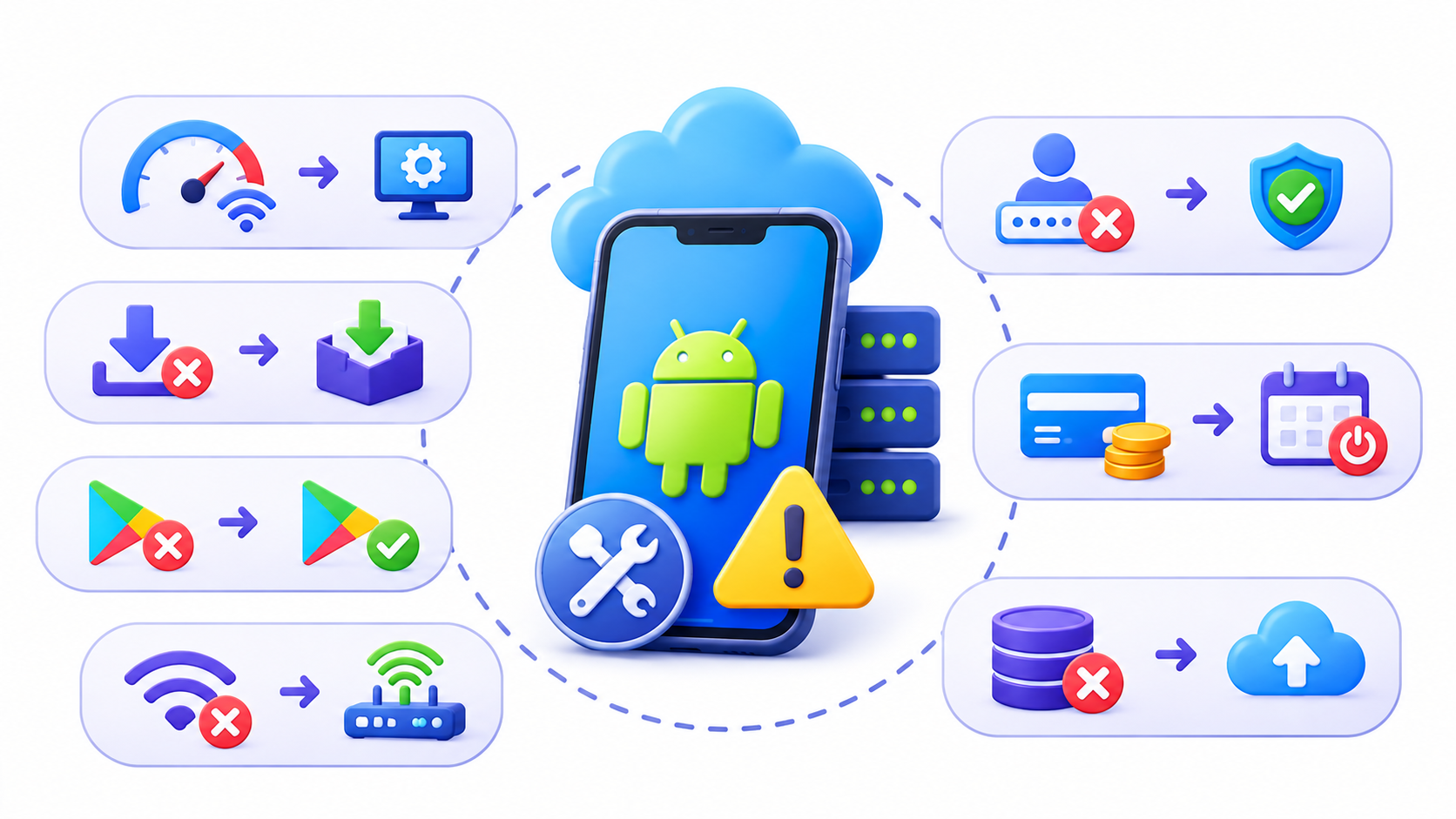
Common Android Cloud Phone Problems and How to Fix Them
Slow Performance and High Latency
Try a closer server region, lower the streaming quality, or upgrade resources.
Android App Installation Errors
Check Android version compatibility and storage space. Reinstall from a clean download.
Google Play Compatibility Problems
Some devices do not include Google Play by default. Check whether it is supported before buying.
Device Disconnections
Restart the device, check your own internet connection, and contact support if it repeats.
Login and Authentication Issues
Confirm your recovery methods work. Repeated logins from new environments can trigger extra verification on some apps.
Unexpected Usage Charges
Review your billing model. Usage-based plans keep charging while a device is running, so shut devices down when finished.
Data Loss and Session Reset Problems
Back up what matters. Ask your provider what happens to data after a reset or plan expiry.
Frequently Asked Questions About Android Cloud Phones
1. What is the best Android cloud phone in [this_year]?
There is no single best option. GeeLark suits social media teams, DuoPlus suits large fleets, Genymotion suits developers, and Redfinger suits simple always-on use. Match the tool to your goal.
2. Are there free Android cloud phones?
Some providers offer free trials or limited free tiers. Free options usually have restrictions on time, performance, or features.
3. Can I use an Android cloud phone on my PC?
Yes. Most providers offer a web dashboard or desktop app that streams the device to your computer.
4. Can I run multiple Android cloud phones simultaneously?
Yes, on most platforms. The limit depends on your plan and the provider’s device caps.
5. Do cloud phones work 24/7?
Many are designed to keep running continuously, but uptime depends on the provider and your plan. Check the service terms.
6. Can I install Google Play on a cloud phone?
Often yes, but it varies. Confirm Google Play support before buying.
7. Are cloud phones better than Android emulators?
Not always. Cloud phones are better for remote, always-on use. Emulators are better for local development and testing.
8. Can Android cloud phones be detected?
It is possible. Apps may identify virtualized environments. No provider can guarantee otherwise.
9. Do cloud phones require proxies?
Not always. Proxies are optional unless you need a specific network location or IP setup.
10. What happens to my data when I cancel a cloud phone subscription?
It depends on the provider. Many delete device data after cancellation or expiry, so back up anything important first.
Conclusion
The best Android cloud phone depends on what you need to do. Social media teams should look at GeeLark. Large fleets should compare DuoPlus. Developers should use Genymotion. Always-on users should try Redfinger or VMOS Cloud. Teams that also manage browser profiles should compare Multilogin, GoLogin, and MoreLogin. AI builders should explore MobileRun.
Before you pay, test your most important app on a short plan. Confirm whether the device is physical or virtual. Then check pricing and data policies on the official site.
That approach will save you more money than picking from any top-ten list, including this one.