

Most growing businesses hit the same wall. They need senior marketing thinking, but a full-time leader and a full team cost more than they can justify yet. Hiring one generalist often leaves big gaps.
Fractional marketing offers a middle path. You bring in experienced marketers for a set number of hours or a defined scope, instead of building a permanent department. You get the strategy and skill you need, and you pay only for the time and output you use.
This guide explains what fractional marketing is, what services it covers, how teams are structured, what it costs, and where it falls short. You will also learn how to hire the right provider and how to measure results.
What Is Fractional Marketing?
Fractional marketing is a model where a business hires experienced marketing professionals on a part-time or project basis to lead or run parts of its marketing. The professional works with the company for a fraction of a full-time week. They own real responsibilities and results, not just advice.
Think of it as renting senior expertise. You do not take on a full salary, benefits, or long hiring cycles. You do get someone who has solved your type of problem before.
How Fractional Marketing Works
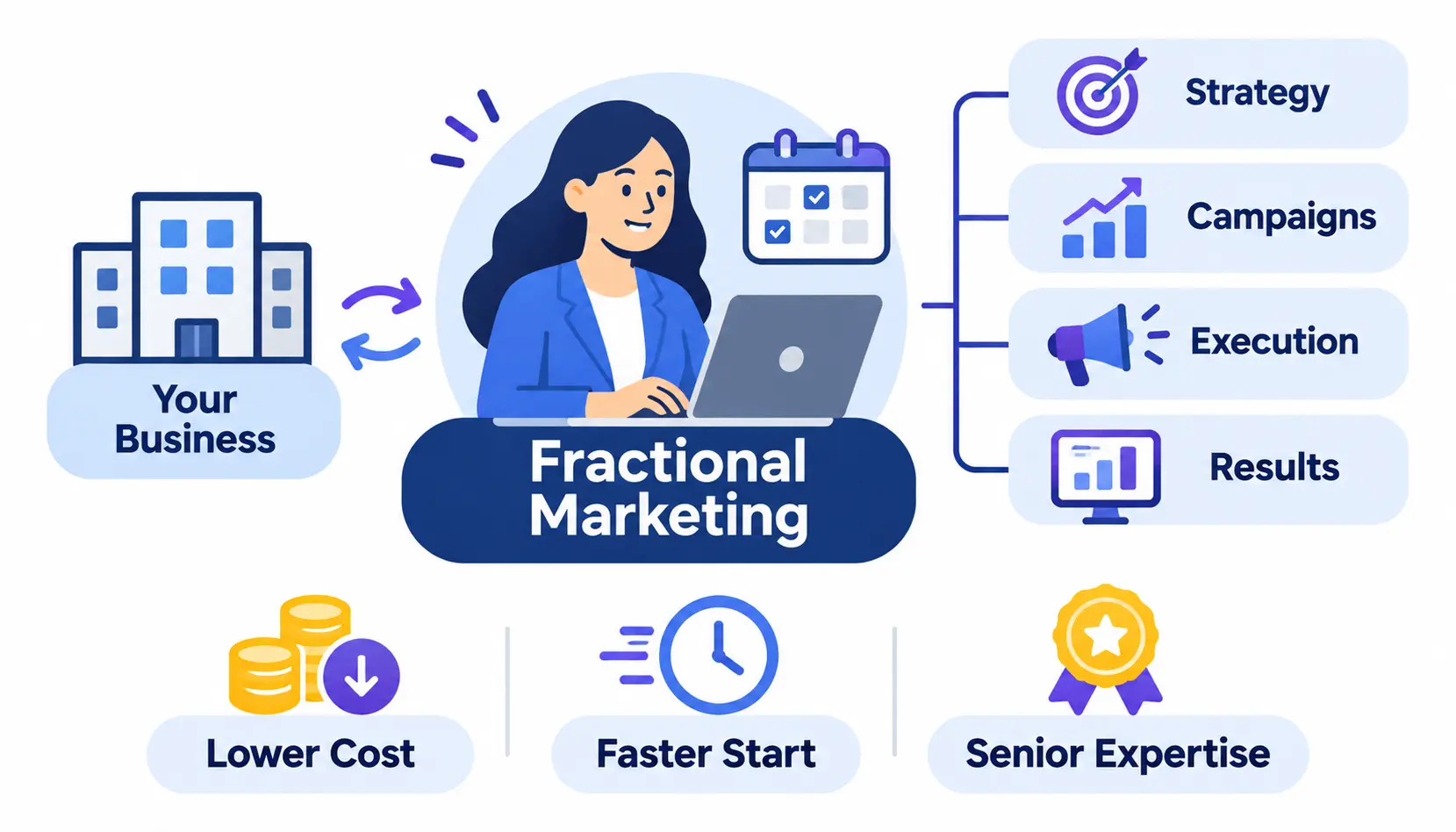
A fractional marketer joins your business for an agreed number of hours each week or month. They set strategy, manage priorities, and either run campaigns themselves or direct other specialists.
Most engagements start with a short audit. Then the marketer builds a roadmap, runs it, and reports on results. The relationship usually continues on a monthly basis until the business is ready for something bigger.
What Makes Fractional Marketing Different From Traditional Marketing?
Traditional marketing usually means a full-time employee or a retained agency. Fractional marketing sits between them. You get the seniority of an executive hire with the flexibility of outsourced help.
The key difference is ownership. A fractional leader acts like a member of your leadership team. They join planning meetings, set goals, and answer for results, even though they are not on your payroll.
Who Is Involved in a Fractional Marketing Engagement?
Three groups usually take part. The first is the fractional lead, such as a fractional CMO or head of marketing. The second is any specialists they bring in, such as an SEO expert or paid ads manager.
The third group is your internal team. This includes the founder or executive sponsor, the sales team, and any in-house marketers. Good results depend on how well these groups work together.
Why Businesses Are Adopting the Fractional Marketing Model
Three reasons come up again and again. Budgets are tighter, so fixed salaries feel risky. Marketing has also become more specialized, so no single hire covers SEO, paid media, analytics, and strategy well.
Finally, remote work has made it normal to work with experts who are not in your office. Businesses now care more about the skills they can access than about where those people sit.
What Services Does Fractional Marketing Include?
Fractional marketing can cover any marketing function, from high-level strategy to daily execution. The exact mix depends on your goals and gaps. Here are the most common services.
Marketing Strategy and Planning
This is the foundation. It covers who you sell to, how you position your offer, which channels to use, and what to measure. A good plan fits your budget and sales process instead of copying a generic template.
SEO and Content Marketing
SEO helps people find you through search engines. Content marketing gives them useful pages, guides, and posts once they arrive. A fractional expert chooses topics, sets the editorial plan, and checks that content supports sales.
Businesses that need support with these activities can explore professional SEO and digital marketing services to improve search visibility, attract relevant audiences, and strengthen their online presence.
Paid Advertising and Performance Marketing
This covers paid search, paid social, and similar channels. The goal is measurable return. A fractional specialist sets up tracking, tests messages, and shifts spend toward what works.
Social Media and Brand Management
Social media builds awareness and trust. Brand management keeps your message, tone, and visuals consistent. Together they help buyers recognize you before they ever talk to sales.
Lead Generation and Demand Generation
Lead generation captures people who are ready to engage now. Demand generation builds interest among people who may buy later. Most B2B companies need both, and a fractional lead balances them.
Email Marketing and Marketing Automation
Email nurtures leads and keeps customers engaged. Automation sends the right message at the right time based on behavior. Setup takes careful planning, which is why many teams lean on outside experience here.
Marketing Analytics and Reporting
Analytics shows what is working. A fractional marketer builds dashboards tied to business goals, not vanity numbers. They also explain the results in plain language so leaders can act.
Marketing Operations and CRM Management
Marketing operations covers the tools and processes behind the work. That includes your CRM, lead routing, and data hygiene. Clean systems let marketing and sales see the same picture.
Product Marketing and Go-to-Market Strategy
Product marketing connects what you build to what buyers need. It includes messaging, launch plans, and sales enablement. Fractional help is especially useful before a new product or market launch.
What Is a Fractional Marketing Team?
A fractional marketing team is a group of part-time specialists who together cover strategy, execution, and measurement for one business. Each person works only the hours their role requires. You get a full set of skills without a full set of salaries.
Fractional Chief Marketing Officer (CMO)
A fractional CMO sets marketing strategy at the executive level. They define goals, manage budgets, and report to the CEO or board. Most spend a few hours a week with the company.
Fractional Chief Growth Officer (CGO)
A fractional CGO looks at growth across marketing, sales, and customer success. This role suits companies where revenue growth depends on aligning several teams, not just marketing.
Fractional Head of Marketing
A head of marketing is more hands-on than a CMO. They manage day-to-day priorities, run campaigns, and coach junior staff. Smaller companies often start here.
Fractional SEO Specialist
This person owns search visibility. They handle keyword research, technical fixes, and content briefs. Many businesses only need this skill for part of the week.
Fractional Content Marketing Manager
They plan, commission, and edit content. They also keep quality and brand voice consistent across writers and formats.
Fractional Demand Generation Manager
This specialist builds programs that create pipeline. They combine channels such as paid media, events, and email, and track which ones produce qualified leads.
Fractional Marketing Operations Specialist
They manage your marketing technology and data. Their work keeps reports accurate and handoffs to sales smooth.
How These Specialists Work Together
The team works best when each person has a clear job. Someone leads, someone executes, and someone checks the numbers. Regular check-ins keep everyone on the same plan.
Strategy and Leadership
The fractional CMO or head of marketing sets direction. They choose priorities, assign work, and decide what to stop doing. Strong leadership prevents scattered effort.
Campaign Planning and Execution
Specialists turn the strategy into campaigns. The SEO lead, content manager, and demand generation manager coordinate calendars so channels support each other.
Performance Tracking and Optimization
Operations and analytics roles track results against goals. The team reviews them on a regular schedule and adjusts spend, messaging, and timing.
How Does Fractional Marketing Work?
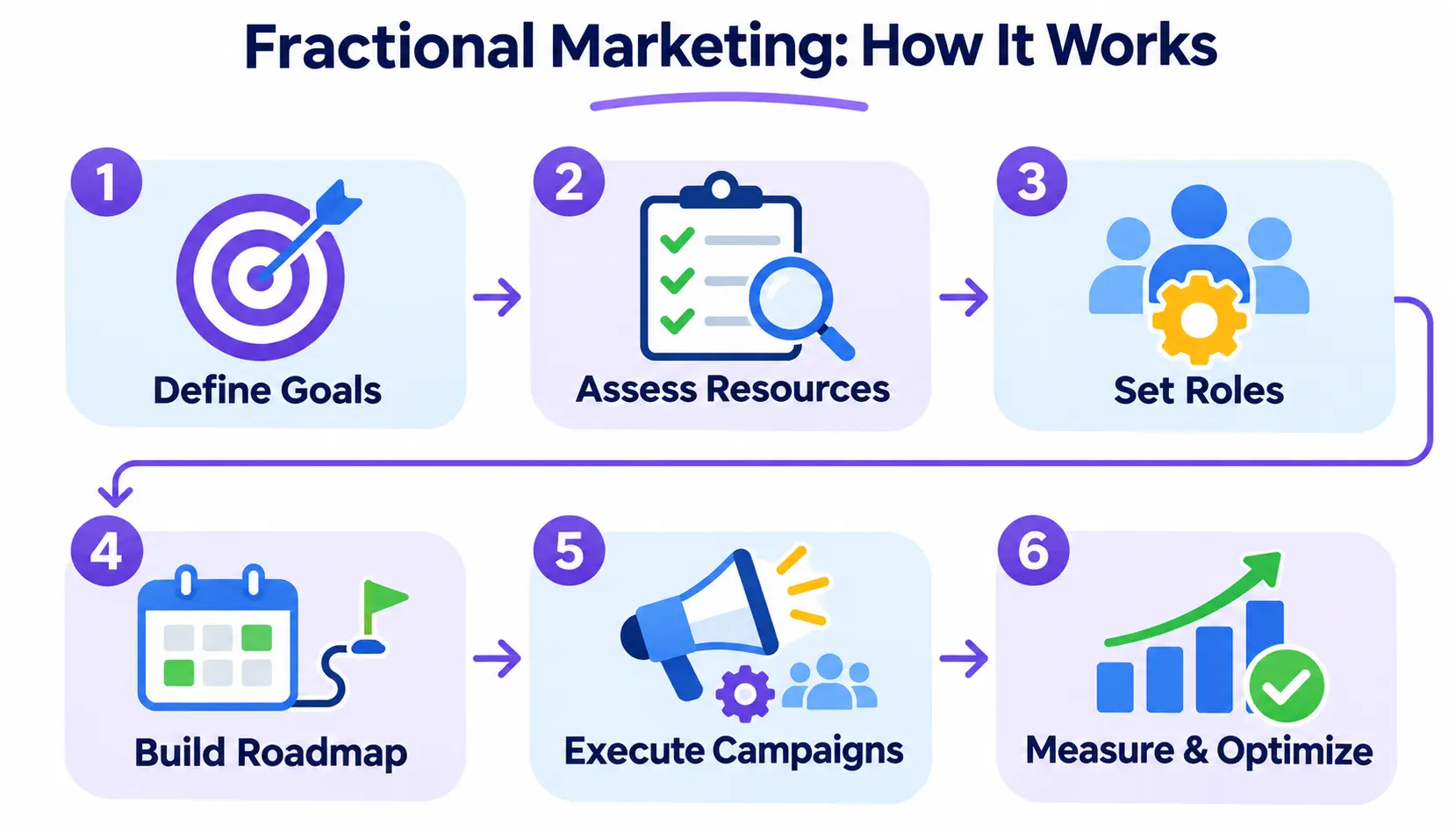
A typical fractional marketing engagement follows six steps: define goals, assess resources, set roles, build a roadmap, execute, and measure. The details vary, but this order keeps the work focused on business results.
Step 1: Identify Business Goals and Marketing Challenges
Start with the business, not the channels. Are you trying to win new customers, enter a market, or improve retention? Clear goals decide everything that follows.
Step 2: Assess Existing Marketing Resources
Review what you already have. That includes people, tools, content, data, and past campaign results. This step prevents paying for work you already own.
Step 3: Define the Required Roles and Responsibilities
Match gaps to roles. You may need a strategic lead, a single specialist, or a small team. Write down who owns what so nothing falls between people.
Step 4: Develop a Marketing Strategy and Roadmap
Turn goals into a plan with priorities, timelines, and budgets. A good roadmap is specific enough to act on and flexible enough to change when data demands it.
Step 5: Execute Campaigns and Coordinate Specialists
Now the work begins. The lead coordinates specialists, approves content, and keeps projects on schedule. Weekly or biweekly meetings keep your team informed.
Step 6: Measure Performance and Optimize Activities
Track results against the goals from Step 1. Review what worked, drop what did not, and put more effort into winners. Then the cycle repeats.
Benefits of Fractional Marketing for Businesses
The main benefits are senior expertise, lower fixed costs, flexibility, and speed. Not every business will feel each one equally, but these are the advantages we see most often.
Access to Experienced Marketing Professionals
Senior marketers are expensive to hire full time. With a fractional model, a smaller business can work with someone who has led similar programs before.
Lower Fixed Staffing Costs
You avoid full-time salary, benefits, and recruiting costs. Spending becomes more variable, which helps when revenue is uncertain.
Flexible Access to Specialized Skills
Need paid media this quarter and content next quarter? You can change the mix. You are not stuck paying for skills you no longer need.
Faster Marketing Strategy Development
Experienced marketers have seen what works and what fails. They often build a workable plan in weeks, not months, because they do not start from zero.
Better Marketing and Sales Alignment
A senior fractional lead usually talks with sales early. Shared definitions of a good lead and a clear handoff process reduce friction between the two teams.
Scalable Marketing Support
You can add hours or specialists as you grow and scale back during slow periods. That makes planning easier than hiring and later laying off staff.
Improved Focus on Business Growth
Founders often spend too much time on marketing tasks. A fractional lead takes that load off, so leaders can focus on product, sales, and customers.
What Are the Limitations of Fractional Marketing?
Fractional marketing is not perfect. The main limits are availability, coordination, scope clarity, dependence on outsiders, less control, and potential conflicts of interest. Knowing these up front helps you plan around them.
Limited Availability and Working Hours
A fractional marketer serves several clients. They may not answer instantly or join every meeting. Agree on response times and meeting schedules early.
Communication and Coordination Challenges
Part-time team members can miss context. Shared documents, a single point of contact, and regular updates help prevent confusion.
Unclear Scope and Responsibilities
Vague agreements cause arguments. If nobody knows who writes the emails or owns the CRM, work stalls. Put deliverables in writing.
Dependence on External Specialists
If all knowledge sits with outsiders, it leaves when they do. Ask for documentation and playbooks so your business keeps what it learns.
Limited Control Over Day-to-Day Execution
You direct the goals, but you do not manage every hour. Some leaders find this uncomfortable. Clear reporting and approval steps restore a sense of control.
Potential Conflicts of Interest
A marketer might work with a competitor or favor tools that pay them referral fees. Ask about other clients and how they choose vendors.
Fractional Marketing vs. Other Marketing Models
Fractional marketing differs from other models in cost structure, depth of involvement, and who is responsible for execution. The table below gives a quick view, and the sections after it explain each comparison.
| Factor | Fractional Marketing | In-House Team | Agency | Freelancer | Consultant |
| Cost structure | Retainer or hourly, scaled to need | Salaries and benefits | Monthly retainer or project fees | Hourly or per project | Hourly or project fees |
| Expertise | Senior, often multi-skill | Depends on hires | Broad, varies by account team | Narrow and specialized | Strategic, advisory |
| Availability | Part-time, scheduled | Full-time | Shared across clients | Flexible, limited capacity | Scheduled sessions |
| Control | Moderate to high | Highest | Moderate | Moderate | Advisory only |
| Scalability | High | Slow, requires hiring | High | Limited by one person | Limited |
| Execution | Leads and often executes | Owns execution | Executes | Executes one task area | Usually does not execute |
Fractional Marketing vs. In-House Marketing Team
An in-house team gives you full-time focus and deep company knowledge. It also brings fixed costs and hiring risk. Fractional marketing costs less at the start and adds senior skill faster, but offers less daily availability.
Fractional Marketing vs. Marketing Agency
An agency usually delivers a packaged set of services with a team behind it. A fractional leader acts as part of your leadership. Agencies often fit execution-heavy needs, while fractional models fit businesses missing strategic direction.
Fractional Marketing vs. Freelance Marketers
Freelancers are usually hired for a specific task, such as writing or design. They rarely own strategy. A fractional marketer takes responsibility for outcomes across channels.
Fractional Marketing vs. Marketing Consultants
Consultants typically advise, and your team does the work. Fractional marketers advise and take part in running the plan. If you lack people to execute, a consultant alone may not be enough.
Fractional CMO vs. Full-Time CMO
A full-time CMO commits all their time to one company and manages a larger organization. A fractional CMO provides the same strategic skill for fewer hours and a lower cost. For many small and mid-sized firms, that is the right amount of leadership.
How Much Does Fractional Marketing Cost?
Fractional marketing costs vary widely. The price depends on seniority, hours, scope, and the number of specialists involved. Rather than quote averages, this section explains how pricing works so you can judge any proposal.
Common Fractional Marketing Pricing Models
Providers use a few standard structures. Each suits a different type of need.
Monthly Retainer
You pay a fixed monthly fee for an agreed scope or number of hours. This is the most common model for ongoing work and makes budgeting easy.
Hourly Engagement
You pay for time actually used. This works for short-term needs or advice, but costs can rise if scope is not controlled.
Project-Based Pricing
You pay a set fee for a defined deliverable, such as a go-to-market plan or a website audit. It suits one-time needs with clear boundaries.
Dedicated Part-Time Engagement
You reserve a fixed number of days each week with one professional. They work almost like a part-time employee and attend your regular meetings.
Factors That Affect Fractional Marketing Costs
Several things move the price:
- Seniority: Executive-level leaders cost more than hands-on specialists.
- Hours and scope: More hours and more channels raise the cost.
- Team size: Adding specialists increases the monthly total.
- Industry complexity: Regulated or highly technical fields often need deeper expertise.
- Tools and ad spend: Software and media budgets are usually separate from fees.
Fractional Marketing vs. Full-Time Hiring Costs
A full-time hire includes salary, benefits, taxes, equipment, recruiting, and training. You also carry the cost during slow periods. A fractional arrangement turns most of that into a single service fee tied to actual need.
Full-time can still be cheaper once your workload fills the whole week. Compare costs based on how many hours of real work you have.
Example Fractional Marketing Budgets
The scenarios below are hypothetical and meant only to show how budgets might be structured. They are not market averages, and real prices will differ.
- Early-stage startup: A single part-time marketing lead on a monthly retainer, plus a modest ad budget. Focus: positioning, website messaging, and first campaigns.
- Growing B2B company: A fractional head of marketing plus a part-time SEO specialist and content manager. Focus: pipeline growth and sales alignment.
- Mid-market firm with a leadership gap: A fractional CMO with a small team of specialists. Focus: strategy, reporting, and managing existing staff and vendors.
Ask every provider for a written scope so you can compare proposals fairly.
Who Should Hire a Fractional Marketing Team?
Fractional marketing suits businesses that need senior skill but cannot yet justify, or do not want, a full-time team. The situations below are the most common fits.
Startups Building Their First Marketing Strategy
Founders often guess at marketing. A fractional lead helps define the customer, message, and first channels before money is wasted.
Small Businesses With Limited Marketing Budgets
Small firms rarely need a full department. A few focused hours from an expert can lift results more than scattered activity. Small businesses can also explore these effective marketing strategies to identify suitable channels, prioritize activities, and make better use of limited marketing resources.
Growing B2B Companies
B2B sales cycles are long and involve many people. A fractional team can build lead programs that support sales over months, not days.
SaaS Companies Scaling Customer Acquisition
SaaS companies need to track acquisition cost, trial conversion, and retention closely. A fractional marketer with SaaS experience can set up the right measurement and test channels quickly.
Mid-Market Companies With Marketing Leadership Gaps
Sometimes a CMO leaves and the search takes months. A fractional leader can keep programs moving and stabilize the team while you hire.
Businesses Expanding Into New Markets
New markets need research, localized messaging, and fresh channels. A fractional expert who has done this before reduces trial and error.
When Is Fractional Marketing Not the Right Choice?
Fractional marketing is a poor fit when you need constant on-site presence, lack clear goals, need huge execution capacity immediately, or cannot support collaboration internally. In those cases, another model will serve you better.
Businesses That Need Full-Time On-Site Support
If your work depends on someone physically present every day, such as retail events or in-person sales support, a part-time remote lead will struggle.
Companies Without Clear Marketing Goals
A fractional marketer can help set goals, but they cannot fix a business with no direction. If you cannot say what success looks like, pause and define it first.
Businesses That Need Immediate Large-Scale Execution
A big product launch with dozens of assets in a few weeks may exceed a small fractional team’s capacity. An agency or larger in-house team might fit better.
Companies That Cannot Provide Internal Collaboration
Fractional marketers need access to sales data, decision makers, and quick feedback. If leaders are unavailable, progress slows and results suffer.
How to Choose the Right Fractional Marketing Agency or Professional
Choose a fractional marketing provider by checking relevant experience, proof of results, scope clarity, communication habits, team access, and contract terms. Take your time here, since a poor match wastes both money and months.
Evaluate Industry Experience and Expertise
Look for experience with your business model and stage. A marketer who scaled a software company may not suit a local services business.
Review Case Studies and Previous Results
Ask for examples with clear goals and outcomes. Be cautious about vague claims. Ask what the provider personally did, not what the team did.
Understand the Service Scope
Get a written list of deliverables, hours, and meeting cadence. Know what is included and what costs extra.
Check Communication and Reporting Processes
Ask how often you will get updates and what the reports include. Good reports tie activity to business goals, not just clicks.
Ask About Team Structure and Specialist Availability
Find out who actually does the work. Some firms sell a senior name and assign junior staff. Ask who you will talk to and how specialists are scheduled.
Understand Pricing and Contract Terms
Review the minimum term, notice period, and what happens if you want to scale up or down. Short initial terms reduce risk.
Identify Potential Red Flags
Watch for guaranteed rankings or results, refusal to share past work, unclear pricing, pressure to sign quickly, and no questions about your business. Strong providers ask many questions before proposing anything.
Questions to ask before signing:
- Which businesses like mine have you worked with?
- Who will do the day-to-day work?
- How many hours per week or month are included?
- How will you report results, and how often?
- Which goals will you be accountable for?
- Do you work with competitors?
- Who owns the accounts, data, and content created?
- What is the notice period if we want to end or change the engagement?
- How will you hand over documentation if we bring work in-house?
How to Measure the ROI of Fractional Marketing
Measure fractional marketing ROI by comparing agreed business results, such as pipeline and customer acquisition cost, against what you spend. Traffic and lead counts alone can mislead, because high volume does not always mean revenue.
Customer Acquisition Cost (CAC)
Customer acquisition cost is the total sales and marketing spend needed to win one new customer. If it falls while quality holds, your marketing is getting more efficient.
Marketing Qualified Leads (MQLs)
MQLs are leads that marketing judges likely to become customers based on agreed criteria. Track quality, not only quantity. Your sales team should help define what qualifies. To evaluate lead quality more effectively, businesses can use SEO intent signals to understand which website visitors are researching, comparing solutions, or showing stronger purchase intent.
Sales Qualified Leads (SQLs)
SQLs are leads that sales has reviewed and accepted as real opportunities. The share of MQLs that become SQLs shows how well marketing and sales agree.
Marketing-Sourced Pipeline
This is the sales opportunity value that started with a marketing activity. It links marketing effort to revenue potential and is often the most persuasive number for leadership.
Conversion Rates
Track conversion at each stage, from visitor to lead, lead to opportunity, and opportunity to customer. Small gains at each stage add up.
Return on Marketing Investment
Compare the revenue or profit linked to marketing against the total you spent, including fees. Be honest about timing, since some channels take months to pay off.
Customer Retention and Lifetime Value
Good marketing attracts customers who stay. Retention and lifetime value show whether you are winning the right buyers, not just more of them.
Always set targets with your provider at the start. Agree on which metrics matter and how often you will review them.
How to Get Started With Fractional Marketing
To get started, define goals, identify gaps, set a budget, choose a partner, agree on deliverables, build a 90-day roadmap, and review results. Follow these steps in order to avoid common mistakes.
Define Your Business and Marketing Objectives
Write down what you want to achieve in the next six to twelve months. Use specific targets, such as new customers or pipeline value.
Identify Your Marketing Skill Gaps
List what your team can do and what it cannot. Be honest. The gaps tell you which roles to bring in.
Set a Realistic Budget
Decide what you can invest, including fees, tools, and ad spend. A realistic budget protects you from underfunded plans.
Select Your Fractional Marketing Partner
Interview more than one candidate. Use the checklist above and look for someone who asks sharp questions and speaks plainly.
Establish Deliverables and Responsibilities
Put roles, outputs, and meeting rhythms in writing. Name one internal owner who will answer questions and approve work.
Create a 90-Day Marketing Roadmap
A 90-day plan keeps the engagement focused. Here is a sample you can adapt:
- Days 1-30 (Learn and set up): Audit current marketing, review data, interview sales, confirm goals, fix tracking, and agree on the plan.
- Days 31-60 (Launch): Start priority campaigns, publish first content, set up key automations, and begin weekly reporting.
- Days 61-90 (Optimize): Review results, double down on what works, cut what does not, and plan the next quarter.
Review Results and Adjust the Engagement
At day 90, hold a formal review. Compare results with goals, then decide whether to extend, change scope, add specialists, or bring work in-house.
Real-World Fractional Marketing Examples
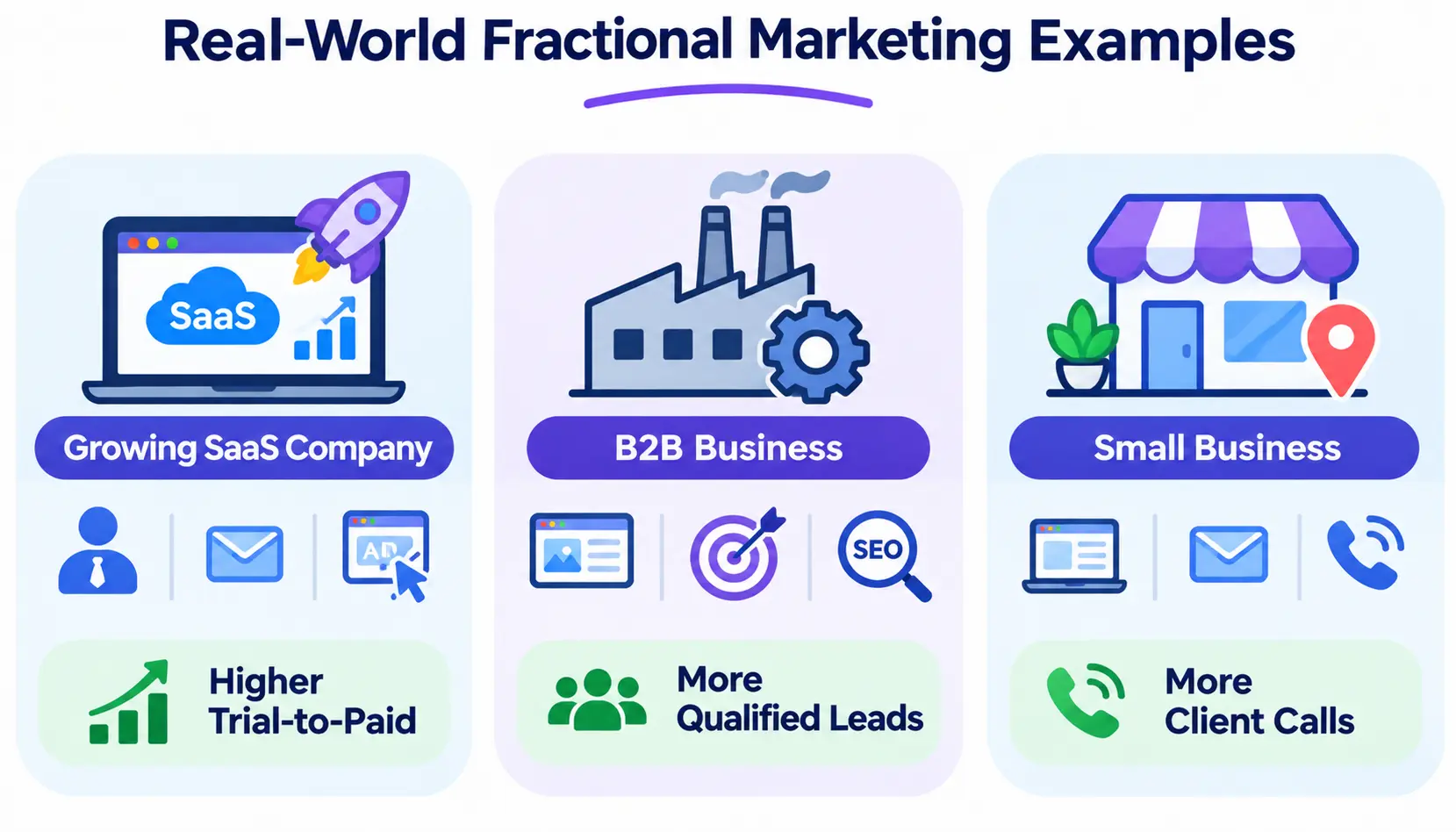
The examples below are hypothetical scenarios created to show how fractional marketing can work. They are not verified client case studies.
Example 1: Fractional Marketing for a Growing SaaS Company
A software company has product-market fit but struggles to turn free trials into paid accounts. It brings in a fractional head of marketing and a part-time analytics specialist. They fix tracking, rewrite onboarding emails, and test new ad messages. Within a few months, the team can see which channels bring users who stay.
Example 2: Fractional Marketing for a B2B Business
A manufacturing services firm relies on referrals and wants steady leads. A fractional CMO audits the website, sets up a content plan, and aligns messaging with the sales team. A part-time SEO specialist supports the work. The company gains a repeatable way to attract qualified inquiries.
Example 3: Fractional Marketing for a Small Business
A local professional services firm has a basic website and no marketing plan. A fractional marketer works a few hours each week to clarify the offer, improve the site, and build simple email follow-up. The owner stops guessing and starts tracking which efforts bring calls.
Frequently Asked Questions About Fractional Marketing
1. What Is Fractional Marketing in Simple Terms?
Fractional marketing means hiring experienced marketers part-time instead of building a full-time team. You get senior skill for a fraction of the time and cost.
2. Is Fractional Marketing Worth It?
It is often worth it for businesses that need expert direction but cannot fill a full-time role. It is less suitable if you need constant on-site help or have no clear goals.
3. How Much Does Fractional Marketing Cost?
Costs depend on seniority, hours, scope, and team size. Common pricing models are monthly retainers, hourly rates, project fees, and dedicated part-time arrangements. Always request a written scope before comparing quotes.
4. What Does a Fractional Marketer Do?
A fractional marketer plans strategy, sets priorities, manages campaigns, tracks results, and coordinates specialists. Some also run channels directly, such as SEO or paid ads.
5. What Is the Difference Between Fractional Marketing and an Agency?
An agency delivers services through its own team. A fractional marketer works as an embedded part of your leadership and focuses on strategy and accountability. Some fractional providers also bring a team, so the line can blur.
6. Can Startups Benefit From Fractional Marketing?
Yes. Startups often need clear positioning and a small set of tested channels. A fractional lead can provide both without the expense of a full-time executive.
7. How Many Hours Does a Fractional Marketer Work?
It varies by agreement. Some work a few hours a week, others a day or two weekly. Match hours to the workload and adjust as needs change.
8. How Long Should a Fractional Marketing Engagement Last?
Many engagements run for at least a few months, since marketing results take time. A 90-day review point is a practical way to decide whether to continue.
9. How Do You Measure Fractional Marketing Success?
Use business metrics agreed at the start, such as CAC, pipeline, conversion rates, and customer retention. Review them on a regular schedule.
10. Can a Fractional Marketing Team Work With an Existing Marketing Department?
Yes. They often fill gaps, provide leadership, or train junior staff. Clear roles and open communication make the partnership work.
Conclusion
Fractional marketing gives growing businesses access to senior expertise without the weight of a full department. It works best when goals are clear, scope is written down, and your internal team collaborates.
It will not fit every company. If you need daily on-site presence or massive immediate output, other models may serve you better.
Start by defining your goals and gaps, then talk to a few providers using the checklist in this guide. A clear 90-day plan will show you quickly whether fractional marketing is the right move for your business.