



Are you creating content but still not getting traffic from search engines? If that sounds familiar, the problem might not be your content, it might be your keyword research. In the world of SEO, success doesn’t come from writing more; it comes from creating content that matches what people are actually searching for. That’s why keyword research is considered the foundation of every successful SEO strategy.
As the saying goes, “Don’t create content to be found, create content based on what people are already searching for.” This simple idea highlights the true power of keyword research. It helps you understand your audience, uncover real search intent, and build a strategy that drives targeted traffic, improves rankings, and increases conversions.
Many beginners jump straight into content creation without proper keyword research. As a result, they struggle to gain traffic, visibility, and conversions. That’s where a structured keyword research checklist becomes essential; it keeps you organized, focused, and aligned with your SEO goals.
In this guide, you’ll discover a step-by-step keyword research checklist that simplifies the entire process. From identifying seed keywords to analyzing competition and search intent, everything is covered in a practical and easy-to-follow format.
What is Keyword Research and Why It Matters

Keyword research is the process of discovering and analyzing the exact words and phrases that people type into search engines when they are looking for information, products, or services. These keywords act as a bridge between what users are searching for and the content you create, making it easier to connect your website with the right audience.
In simple terms, keyword research helps you understand the language of your audience so you can create content based on real search behavior instead of guesswork. By identifying high-demand topics and relevant search queries, you can improve your chances of ranking higher on search engines and attracting meaningful traffic.
For example, instead of writing a broad article about “SEO,” keyword research may show that users are searching for more specific terms like “SEO for beginners step by step.” Targeting such keywords allows you to create focused and valuable content that meets user intent.
Keyword research is not just about finding popular terms it also includes understanding search intent, competition level, and traffic potential. This makes it a crucial step in building a strong SEO strategy that drives targeted traffic, improves engagement, and increases conversions.
Why Keyword Research is Important
1.Helps You Understand Your Audience’s Needs
Keyword research gives you direct insight into what your audience is searching for online. It reveals their questions, problems, and interests. By analyzing these search queries, you can create content that solves real problems instead of making assumptions.
For example, if many users search for “how to improve website speed,” it indicates a common concern. You can then create content addressing that issue, making your website more valuable to users.
2. Improves Search Engine Rankings
Search engines like Google use keywords to understand the content of your pages. When your content includes relevant keywords that match user queries, it becomes easier for search engines to rank your website.
Proper keyword targeting increases your chances of appearing on the first page of search results, which is where most clicks happen.
3. Drives Targeted Traffic to Your Website
Not all traffic is valuable. Keyword research helps you attract users who are genuinely interested in your content, product, or service.
For example:
- A keyword like “SEO” may bring general traffic
- A keyword like “best SEO tools for small business” brings highly targeted users
Targeted traffic increases engagement and reduces bounce rates.
4. Increases Conversion Rates
When you target the right keywords, especially those with transactional or commercial intent you attract users who are more likely to take action, such as making a purchase, signing up, or contacting you.
For instance, someone searching “buy keyword research tool” is much closer to making a decision than someone searching “what is keyword research.” This makes keyword research essential for improving conversions.
5. Guides Your Content Strategy
Keyword research acts as a roadmap for your content creation. It helps you decide:
- What topics to cover
- What type of content to create
- How to structure your website
Instead of randomly publishing content, you can build a structured strategy based on keyword clusters and user intent. This improves both SEO performance and user experience.
6. Helps You Stay Competitive
By analyzing keywords your competitors are ranking for, you can identify gaps and opportunities. This allows you to create better content and outperform competitors in search results.
Here’s a detailed explanation of each keyword type to help you understand how they work in SEO:
Types of Keywords You Should Know
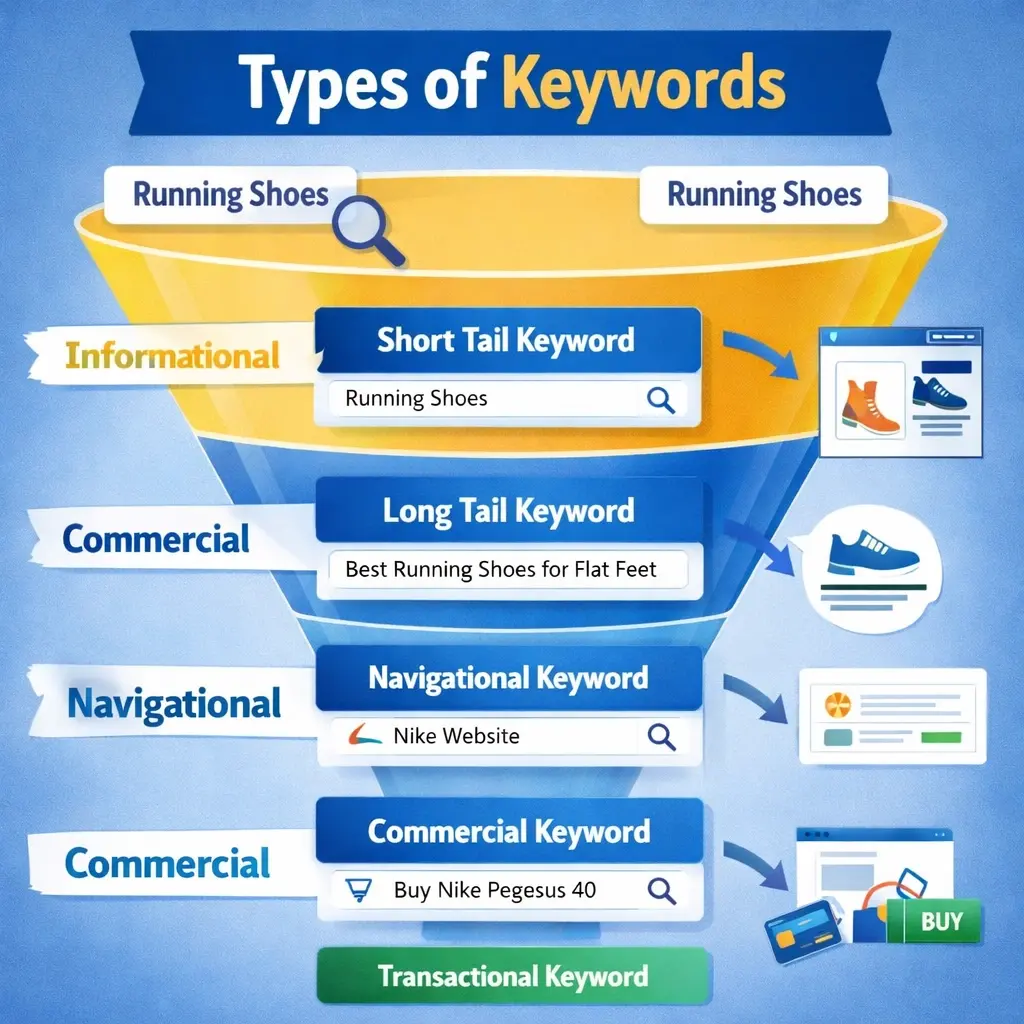
Before starting keyword research, it’s important to understand the different types of keywords. Each type serves a unique purpose and targets users at different stages of their search journey.
1. Short-Tail Keywords
Short-tail keywords (also called head keywords) are broad and general search terms, usually consisting of one or two words.
These keywords typically have very high search volume, meaning a large number of people search for them every month. However, they are also extremely competitive, making it difficult for new or small websites to rank for them.
For example, a keyword like “SEO tools” is very broad. A user searching this term could be looking for anything: reviews, free tools, paid tools, or general information. Because the intent is unclear, conversion rates are usually lower.
Key Points:
- High traffic potential
- High competition
- Low specificity
- Better for brand awareness than conversions
2. Long-Tail Keywords
Long-tail keywords are more specific phrases, usually containing three or more words. They target a narrower audience but are much easier to rank for.
For example, instead of “SEO tools,” a long-tail keyword would be “best free SEO tools for beginners.” This clearly defines what the user is looking for.
These keywords have lower search volume, but they often bring highly targeted traffic. Since the user intent is clear, long-tail keywords usually have a higher conversion rate.
Key Points:
- Lower competition
- More specific audience
- Higher conversion potential
- Ideal for beginners and niche websites
3. Informational Keywords
Informational keywords are used when users are looking for knowledge, answers, or guidance. These searches are typically at the awareness stage of the buyer journey.
For example, a user searching “how to do keyword research” is looking to learn, not buy.
Content targeting informational keywords usually includes:
- Blog posts
- Guides
- Tutorials
- FAQs
These keywords are important for building trust, authority, and organic traffic over time.
Key Points:
- Focus on educating users
- High traffic potential
- Lower immediate conversion
- Great for content marketing
4. Transactional Keywords
Transactional keywords indicate that the user is ready to take action, such as making a purchase, signing up, or downloading something.
For example, “buy SEO tools online” shows strong buying intent.
These keywords are usually used in:
- Product pages
- Landing pages
- Sales pages
Although they may have lower search volume compared to informational keywords, they bring high-value traffic with a strong chance of conversion.
Key Points:
- High conversion intent
- Lower volume but high value
- Important for revenue-focused pages
5. Navigational Keywords
Navigational keywords are used when users want to find a specific website, brand, or page.
For example, “Ahrefs login” shows that the user already knows the platform and is trying to access it.
These keywords are important for brand visibility and ensuring users can easily find your website or services.
Key Points:
- Brand-focused searches
- High intent but limited scope
- Important for established brands
The Ultimate Keyword Research Checklist
Keyword research is not just about finding popular words, it’s about building a strategy that connects your content with what people are actively searching for. A well-structured keyword research checklist ensures that every step, from planning to execution, is aligned with your SEO goals. By following a systematic approach, you can improve rankings, attract targeted traffic, and increase conversions.
Now, let’s break down the complete checklist step by step.
1. Define Your SEO Goals

Before starting keyword research, you need a clear direction. Defining your SEO goals helps you focus on the right keywords and measure success effectively.
Your goals should align with your business objectives. For example, if you want more traffic, you’ll target informational keywords. If you want sales, you’ll focus on transactional keywords.
Ask yourself:
- Do you want more traffic?
- Are you targeting conversions or sales?
- Is your focus on brand awareness?
Example Goals:
- Increase blog traffic by 50%
- Rank on the first page for targeted keywords
- Generate leads through organic search
Having clear goals ensures your keyword research is purposeful and results-driven.
2. Identify Your Target Audience
Understanding your audience is essential because keyword research is based on user behavior. You need to know who your audience is and what they are searching for.
When you understand your audience, you can create content that solves their problems and matches their intent.
Consider:
- Age group
- Location
- Interests
- Problems they are trying to solve
Example:
If your audience is beginners in SEO, use simple and educational keywords like:
- “SEO basics for beginners”
- “how to start SEO”
This helps you attract the right audience and improve engagement.
3. Create a List of Seed Keywords
Seed keywords are the foundation of your keyword research. These are basic terms related to your niche that help generate more keyword ideas.
Start by brainstorming topics and analyzing your content and competitors.
How to Find Seed Keywords:
- Brainstorm ideas related to your niche
- Analyze your website topics
- Look at competitors
- Use forums and social media
Example Seed Keywords:
- SEO
- keyword research
- digital marketing
- SEO tools
These keywords will help you expand into more specific and valuable keyword opportunities.
4. Use Keyword Research Tools
Keyword research tools are essential for building an effective SEO strategy because they provide accurate, data-driven insights into what users are actively searching for online. Instead of relying on guesswork, these tools help you discover relevant keyword opportunities, analyze competition, and evaluate performance using key metrics like search volume, keyword difficulty, cost-per-click (CPC), and trends
. By using tools such as Google Keyword Planner, Ahrefs, SEMrush, and Ubersuggest, you can identify high-potential keywords that align with your content goals and audience intent, allowing you to prioritize effectively, create targeted content, and ultimately improve your search rankings, traffic quality, and overall SEO performance.
What to Look For in Keyword Research Tools
- Search Volume – Understand how many people are searching for a keyword each month to estimate traffic potential and identify high-demand topics.
- Keyword Difficulty – Analyze how competitive a keyword is so you can choose terms that match your website’s authority and ranking capability.
- Cost-Per-Click (CPC) – Evaluate the commercial value of a keyword by checking how much advertisers are willing to pay for it, which often indicates strong buying intent.
- Keyword Trends – Track whether a keyword is growing, stable, or declining over time to ensure long-term relevance and avoid outdated topics.
- Keyword Suggestions – Explore related keywords and variations provided by tools to expand your list and discover new content ideas.
- Search Intent Insights – Identify whether a keyword is informational, transactional, or commercial so you can match your content accordingly.
- Competitor Keyword Data – Analyze which keywords your competitors are ranking for to find gaps and opportunities in your strategy.
- SERP Analysis – Review the top-ranking pages for a keyword to understand what type of content performs best and how strong the competition is.
- Filtering Options – Use filters to narrow down keywords based on difficulty, volume, or intent, making your research more efficient.
5. Analyze Search Intent
Keyword intent analysis is a critical part of keyword research because it helps you understand the purpose behind a user’s search. Instead of focusing only on keywords, you need to identify why someone is searching whether they want information, to visit a specific site, or to make a purchase.
If your content does not match this intent, it is unlikely to rank well, even if you target the right keywords. Search engines prioritize content that best satisfies user intent, making it essential for both rankings and user experience.
Types of Search Intent
- Informational Intent – Users are looking for knowledge, answers, or guidance (e.g., “how to do keyword research”).
- Navigational Intent – Users want to find a specific website or page (e.g., “Ahrefs login”).
- Transactional Intent – Users are ready to take action, such as buying or signing up (e.g., “buy SEO tools online”).
- Commercial Intent – Users are comparing options before making a decision (e.g., “best SEO tools”).
Example
- Keyword: “best SEO tools”
- Intent: Commercial (user is comparing different tools before purchasing)
Matching your content with the correct search intent ensures better rankings, higher engagement, and improved chances of conversions.
6. Check Keyword Difficulty
Keyword difficulty is an important factor in keyword research because it determines how challenging it will be to rank for a specific keyword in search engines. It is usually calculated based on the strength of competing websites, including their authority, backlinks, and content quality. High-difficulty keywords are often dominated by established websites, making them harder for new or smaller sites to rank. That’s why understanding keyword difficulty helps you choose realistic opportunities and build your SEO strategy step by step.
Tips for Choosing the Right Keyword Difficulty
- Target Low to Medium Difficulty Keywords – Focus on keywords that are easier to rank for, especially if your website is new or has low authority.
- Avoid Highly Competitive Keywords Initially – High-difficulty keywords require strong backlinks and authority, which can take time to build.
Strategy to Follow
- Start with Long-Tail Keywords – These are more specific and have lower competition, making them easier to rank for.
- Gradually Move to Competitive Keywords – As your website gains authority and traffic, you can start targeting more competitive keywords.
This approach helps you achieve faster and sustainable results.
7. Analyze Search Volume
Search volume is a key metric in keyword research that indicates how many times a specific keyword is searched within a given period, usually per month. It helps you estimate the potential traffic a keyword can bring to your website and gives insight into how popular a topic is among users.
However, relying solely on high search volume can be misleading, because popular keywords are often highly competitive and difficult to rank for, especially for newer or smaller websites.
Important Points to Understand About Search Volume
- High Search Volume = High Competition – Keywords with large search volumes are usually targeted by many websites, making them harder to rank for without strong authority and backlinks.
- Low Search Volume = More Targeted Traffic – These keywords may bring fewer visitors, but the audience is often more specific and likely to engage or convert.
- Search Volume Can Be Seasonal – Some keywords perform better during certain times of the year, so trends should always be considered.
- Not All Traffic is Valuable – A keyword may have high volume but low relevance to your content, resulting in poor engagement.
Best Practices for Using Search Volume Effectively
- Balance Volume with Competition – Choose keywords that have a reasonable search volume but are not too competitive.
- Focus on Relevance – Always prioritize keywords that closely match your content and audience intent over just high numbers.
- Combine Short-Tail and Long-Tail Keywords – Use high-volume keywords for visibility and long-tail keywords for better targeting and conversions.
- Use Data from Tools – Analyze search volume using tools like Google Keyword Planner, Ahrefs, SEMrush, and Ubersuggest to make informed decisions.
This ensures you target keywords that are both achievable and valuable.
8. Find Long-Tail Keywords
Long-tail keywords are highly specific search phrases that usually contain three or more words, making them more targeted and easier to rank for compared to broad keywords. These keywords attract users who have a clear intent, whether they are looking for detailed information or ready to take action.
Because of their specificity, long-tail keywords often have lower competition and higher conversion rates, making them especially valuable for beginners, niche websites, and businesses aiming to reach a focused audience.
How to Find Long-Tail Keywords
- Use Google Autocomplete – Start typing a keyword into Google, and it will suggest longer, related search queries based on real user searches.
- Check “People Also Ask” Section – This section shows common questions users search for, which can be turned into long-tail keyword ideas.
- Use Keyword Research Tools – Tools like Google Keyword Planner, Ahrefs, SEMrush, and Ubersuggest help you discover long-tail variations along with useful metrics.
- Analyze Competitor Content – Look at what keywords competitors are ranking for and identify longer, more specific variations you can target.
Example
- Broad Keyword: “SEO tools”
- Long-Tail Keyword: “best free SEO tools for small businesses”
Focusing on long-tail keywords allows you to attract more qualified traffic, improve your chances of ranking faster, and create content that directly matches what your audience is searching for.
9. Analyze Competitors
Competitor analysis is a powerful part of keyword research because it helps you understand what is already working in your niche and how other websites are attracting traffic. Instead of starting from scratch, you can study successful competitors to identify the keywords they rank for, the type of content they create, and the strategies they use to perform well in search results. This insight allows you to make smarter, data-driven decisions and uncover opportunities that you might otherwise miss.
Steps to Analyze Competitors
- Identify Top Competitors – Find websites that rank for your target keywords or operate in the same niche as your business.
- Analyze Their Keywords – Use tools like Ahrefs, SEMrush, and Ubersuggest to see which keywords are driving traffic to their site.
- Check Their Top-Ranking Pages – Identify which pages bring the most traffic and understand what makes them successful (content quality, structure, keyword usage).
Benefits of Competitor Analysis
- Discover Keyword Gaps – Find keywords your competitors are ranking for that you are not targeting yet.
- Find Content Ideas – Get inspiration for new topics and formats that resonate with your audience.
- Improve Your Strategy – Learn from competitors’ strengths and weaknesses to refine your own SEO approach.
By analyzing competitors effectively, you gain a clear roadmap of what works in your industry, helping you build a stronger keyword strategy and achieve a competitive advantage in search engine rankings.
10. Focus on Keyword Relevance
Keyword relevance is one of the most important factors in a successful SEO strategy because it ensures that your content directly matches what your audience is searching for. Choosing keywords that align with your topic, audience intent, and overall content purpose helps search engines understand your page better and deliver it to the right users.
While high-traffic keywords may seem attractive, they are not effective if they do not relate to your content, as this can lead to poor engagement, higher bounce rates, and lower rankings over time.
What to Avoid
- Irrelevant Keywords – Targeting keywords that do not match your content may bring traffic, but users will leave quickly if their expectations are not met.
- Keyword Stuffing – Overusing keywords unnaturally can harm readability and may lead to search engine penalties.
Best Practices for Keyword Relevance
- Match Keywords with Content – Ensure your keywords accurately reflect what your content is about.
- Focus on User Intent – Choose keywords based on what users actually want to find or achieve.
- Use Natural Language – Incorporate keywords in a way that feels organic and easy to read.
- Prioritize Quality Over Quantity – A smaller number of highly relevant keywords is more effective than many unrelated ones.
Relevant keywords improve engagement and SEO performance.
11. Group Keywords into Clusters
Keyword clustering is an advanced SEO technique that involves grouping related keywords together based on their meaning, intent, or topic. Instead of creating separate pages for every single keyword, you organize similar keywords into clusters and target them within a single piece of content.
This approach helps search engines better understand your content, improves topical relevance, and allows you to rank for multiple related search queries at once. It also creates a more structured content strategy, making your website easier to navigate for both users and search engines.
Why Keyword Clustering Matters
- Improves SEO Structure – Organizing keywords into clusters creates a clear and logical content hierarchy.
- Boosts Topic Authority – Covering multiple related keywords in one page signals expertise on the subject.
- Reduces Keyword Cannibalization – Prevents multiple pages from competing for the same keyword.
How to Create Keyword Clusters
- Group by Topic – Combine keywords that share a common theme or subject.
- Match Search Intent – Ensure all keywords in a cluster serve the same user intent.
- Use Primary + Secondary Keywords – Choose one main keyword and support it with related variations.
Example
- Main Topic: Keyword Research
- Cluster Keywords:
- keyword research tools
- keyword research tips
- how to do keyword research
This improves internal linking and topic authority.
12. Optimize for SERP Features
Optimizing for SERP (Search Engine Results Page) features is an essential SEO strategy that helps your content stand out beyond traditional blue links. Modern search results often include elements like featured snippets, “People also ask” boxes, image packs, and FAQs, which can significantly increase your visibility and click-through rate.
By structuring your content in a way that directly answers user queries and is easy for search engines to extract, you improve your chances of appearing in these high-visibility positions even if you’re not ranking #1 organically.
Common SERP Features to Target
- Featured Snippets – Short answers displayed at the top of search results.
- People Also Ask (PAA) – A list of related questions users commonly search for.
- FAQ Sections – Structured question-and-answer formats shown in results.
- Image Packs – Visual results that appear for certain queries.
Optimize for SERP Features
- Use Clear Headings – Structure your content with H1, H2, and H3 tags so search engines can easily understand it.
- Answer Questions Directly – Provide concise and clear answers, especially in the first few lines of a section.
- Add Bullet Points & Lists – Organized content is easier to scan and more likely to be featured.
- Use Structured Data (Schema Markup) – Helps search engines display your content as rich results like FAQs.
This helps your content stand out in search results.
13. Track Keyword Trends
Tracking keyword trends is an important part of keyword research because it helps you understand how search behavior changes over time. Instead of focusing only on static data, trend analysis shows whether a keyword is gaining popularity, declining, or experiencing seasonal spikes.
By using tools like Google Trends, you can identify emerging topics and adjust your content strategy accordingly, ensuring that your website stays relevant and aligned with what users are actively searching for.
Why Tracking Keyword Trends Matters
- Identify Seasonal Keywords – Some keywords perform better during specific times of the year, allowing you to plan content in advance.
- Stay Updated with Trends – Helps you catch rising topics early and gain a competitive edge before they become highly competitive.
- Plan Future Content – Trend data allows you to create timely and relevant content that matches current user interests.
- Avoid Declining Keywords – Prevents you from investing time in keywords that are losing popularity.
Tracking trends keeps your content relevant and competitive.
14. Analyze Click-Through Rate (CTR)
Click-Through Rate (CTR) is a crucial SEO metric that measures the percentage of users who click on your website link after seeing it in search engine results. It reflects how attractive and relevant your title and meta description are to users.
Even if your page ranks well, a low CTR means you’re missing out on potential traffic. Search engines like Google also consider CTR as a behavioral signal, so a higher CTR can positively influence your rankings over time by indicating that your content matches user expectations.
How to Improve CTR
- Write Compelling Titles – Use clear, engaging, and keyword-rich titles that grab attention and spark curiosity.
- Use Strong Meta Descriptions – Summarize your content in a persuasive way that encourages users to click.
- Add Numbers & Power Words – Phrases like “Top 10,” “Best,” “Ultimate,” or “Proven” can increase click appeal.
- Match Search Intent – Ensure your title and description clearly reflect what the user is looking for.
- Use Brackets or Dates – Adding elements like “[2026 Guide]” can make your result stand out.
Better CTR improves both traffic and rankings.
15. Create a Keyword Strategy
Creating a keyword strategy is the step where all your research comes together into a clear, actionable plan. Instead of randomly targeting keywords, a well-defined strategy helps you prioritize the right opportunities based on your goals, audience, and competition.
It ensures that every piece of content you create serves a purpose whether it’s driving traffic, generating leads, or improving rankings. A strong keyword strategy also keeps your SEO efforts consistent, focused, and aligned with long-term growth.
What to Include in a Keyword Strategy
- Target Keywords – Select primary and secondary keywords based on relevance, search volume, and difficulty.
- Content Plan – Decide what type of content (blogs, landing pages, guides) you will create for each keyword.
- SEO Goals – Define clear objectives such as increasing traffic, improving rankings, or boosting conversions.
- Keyword Prioritization – Focus on high-impact keywords first, especially those with lower competition and strong intent.
Example Strategy
- 10 Blog Posts – Targeting long-tail keywords to attract specific and low-competition traffic.
- 5 Core Pages – Targeting commercial or high-intent keywords to drive conversions.
This helps you execute your SEO plan effectively.
16. Map Keywords to Content
Keyword mapping is the process of assigning specific keywords to individual pages on your website to ensure a clear and organized SEO structure. Instead of targeting the same keyword across multiple pages, keyword mapping helps you define which page should rank for which term.
This prevents confusion for search engines and ensures that each page has a distinct purpose. By aligning keywords with the most relevant content, you improve your chances of ranking higher and delivering a better user experience.
Benefits of Keyword Mapping
- Better Organization – Creates a structured approach where each page focuses on a specific topic or keyword.
- Clear SEO Focus – Helps search engines understand what each page is about, improving relevance.
- Prevents Keyword Cannibalization – Avoids multiple pages competing for the same keyword, which can hurt rankings.
- Improved Rankings – Clear keyword targeting increases the chances of ranking for the right search queries.
Each page should target a unique keyword.
17. Optimize On-Page SEO
On-page SEO is the process of optimizing individual web pages so that search engines can easily understand your content and rank it for relevant keywords. It involves strategically placing keywords and improving key elements of your page to enhance both visibility and user experience.
Proper on-page optimization not only helps search engines index your content more effectively but also ensures that users find your page useful, relevant, and easy to navigate.
Where to Include Keywords
- Title Tag – Add your primary keyword in the title to clearly indicate what the page is about.
- Meta Description – Use keywords naturally while writing a compelling summary to improve click-through rate.
- Headings (H1, H2, H3) – Include keywords in headings to structure your content and improve readability.
- URL – Keep URLs short, clean, and include the main keyword for better SEO clarity.
- Content – Use keywords naturally throughout the content without overstuffing, focusing on quality and relevance.
Proper optimization increases your chances of ranking higher.
18. Monitor Performance
Monitoring performance is a crucial step in your SEO process because it allows you to evaluate how well your keyword strategy is working and identify areas for improvement. Without tracking results, you won’t know whether your efforts are driving traffic, improving rankings, or generating conversions.
By consistently analyzing performance data, you can make informed decisions, refine your strategy, and focus on what delivers the best results over time.
Key Metrics to Track
- Keyword Rankings – Monitor where your keywords are ranking in search engine results to measure visibility and progress.
- Organic Traffic – Track the number of visitors coming from search engines to understand how well your content is performing.
- Conversions – Measure actions like sign-ups, purchases, or leads to evaluate the effectiveness of your SEO efforts.
Regular monitoring helps you identify what works and what doesn’t.
19. Update Keywords Regularly
Updating keywords regularly is an essential part of maintaining a strong and competitive SEO strategy. Search behavior, trends, and competition constantly evolve, which means the keywords that worked well in the past may lose effectiveness over time.
By consistently reviewing and updating your keywords, you ensure that your content stays relevant, continues to rank well, and aligns with current user intent. This ongoing process helps you adapt to changes in search engine algorithms and audience preferences.
What to Update
- Old Content – Refresh existing pages with updated keywords, improved information, and better optimization.
- Outdated Keywords – Replace keywords that no longer perform well or have declining search interest.
- New Opportunities – Identify and target emerging keywords or trending topics to stay ahead of competitors.
Regular updates keep your content fresh and competitive.
20. Avoid Common Keyword Research Mistakes
Avoiding common keyword research mistakes is just as important as following the correct strategies, because even small errors can negatively impact your SEO performance. Many beginners focus only on finding keywords without considering how they align with user intent, competition, or content quality.
This often leads to poor rankings, low engagement, and missed opportunities. By understanding and avoiding these common mistakes, you can build a more effective and sustainable SEO strategy.
Mistakes to Avoid
- Ignoring Search Intent – Targeting keywords without understanding why users are searching can result in content that doesn’t meet their needs.
- Targeting Only High-Volume Keywords – Focusing only on popular keywords often leads to high competition and lower chances of ranking.
- Not Analyzing Competitors – Skipping competitor research means missing valuable insights and keyword opportunities.
- Keyword Stuffing – Overusing keywords unnaturally can harm readability and lead to search engine penalties.
- Skipping Long-Tail Keywords – Ignoring specific, low-competition keywords can cause you to miss highly targeted traffic.
Avoiding these mistakes helps improve your SEO performance, enhances user experience, and increases your chances of achieving better rankings and long-term results.
Conclusion
Keyword research is an ongoing process that serves as the foundation of a successful SEO strategy, helping you understand your audience, identify the right keywords, and analyze competition, intent, and performance to improve search visibility; by following a structured approach, you can replace guesswork with data-driven decisions that attract consistent, targeted traffic, and by focusing on relevance, user intent, and long-term growth rather than just high search volume you can continuously refine your strategy, optimize content, and track results to build a strong SEO presence that boosts rankings, enhances user experience, and drives meaningful conversions.
Frequently Asked Questions (FAQs)
1. What is keyword research in SEO?
Keyword research is the process of finding and analyzing the search terms people use in search engines to create content that matches their needs and improves rankings.
2. Why is keyword research important for SEO?
It helps you understand user intent, improve rankings, attract targeted traffic, and increase conversions by creating relevant content.
3. What are long-tail keywords?
Long-tail keywords are specific phrases with lower competition and higher conversion potential, such as “best SEO tools for beginners.”
4. How do I find the best keywords?
You can use tools like Google Keyword Planner, Ahrefs, and SEMrush, along with Google autocomplete and competitor analysis.
5. What is keyword difficulty?
Keyword difficulty measures how hard it is to rank for a keyword based on competition and authority of existing pages.
6. What is search intent in keyword research?
Search intent refers to the reason behind a user’s query, such as learning (informational) or buying (transactional).
7. How many keywords should I target per page?
You should focus on one primary keyword and a few related secondary keywords for each page.
8. What is keyword clustering?
Keyword clustering is grouping similar keywords together to target them in a single piece of content.
9. How often should I update keywords?
You should review and update keywords regularly, especially when trends change or performance drops.
10. What tools are best for keyword research?
Popular tools include Google Keyword Planner, Ahrefs, SEMrush, and Ubersuggest.
11. Can I rank without keyword research?
It is possible, but very unlikely to achieve consistent results without proper keyword research.
12. What is the difference between short-tail and long-tail keywords?
Short-tail keywords are broad and competitive, while long-tail keywords are specific, less competitive, and more targeted.
13. How does keyword research improve conversions?
By targeting keywords with clear intent, especially transactional keywords, you attract users who are more likely to take action.
14. What is keyword cannibalization?
It happens when multiple pages on your website target the same keyword, causing them to compete against each other in search results.